Shelf-Stable Raspberry Ganache for Bonbons: A 1 kg Formula
A cream-free 1 kg raspberry ganache for bonbons calculated at about 30 days at 20 °C and a water activity of 0.759: the formula, the method, and how freeze-dried raspberry adds flavor without water.
Ingredient weights and method below; a free account lets you save and adapt the recipe.
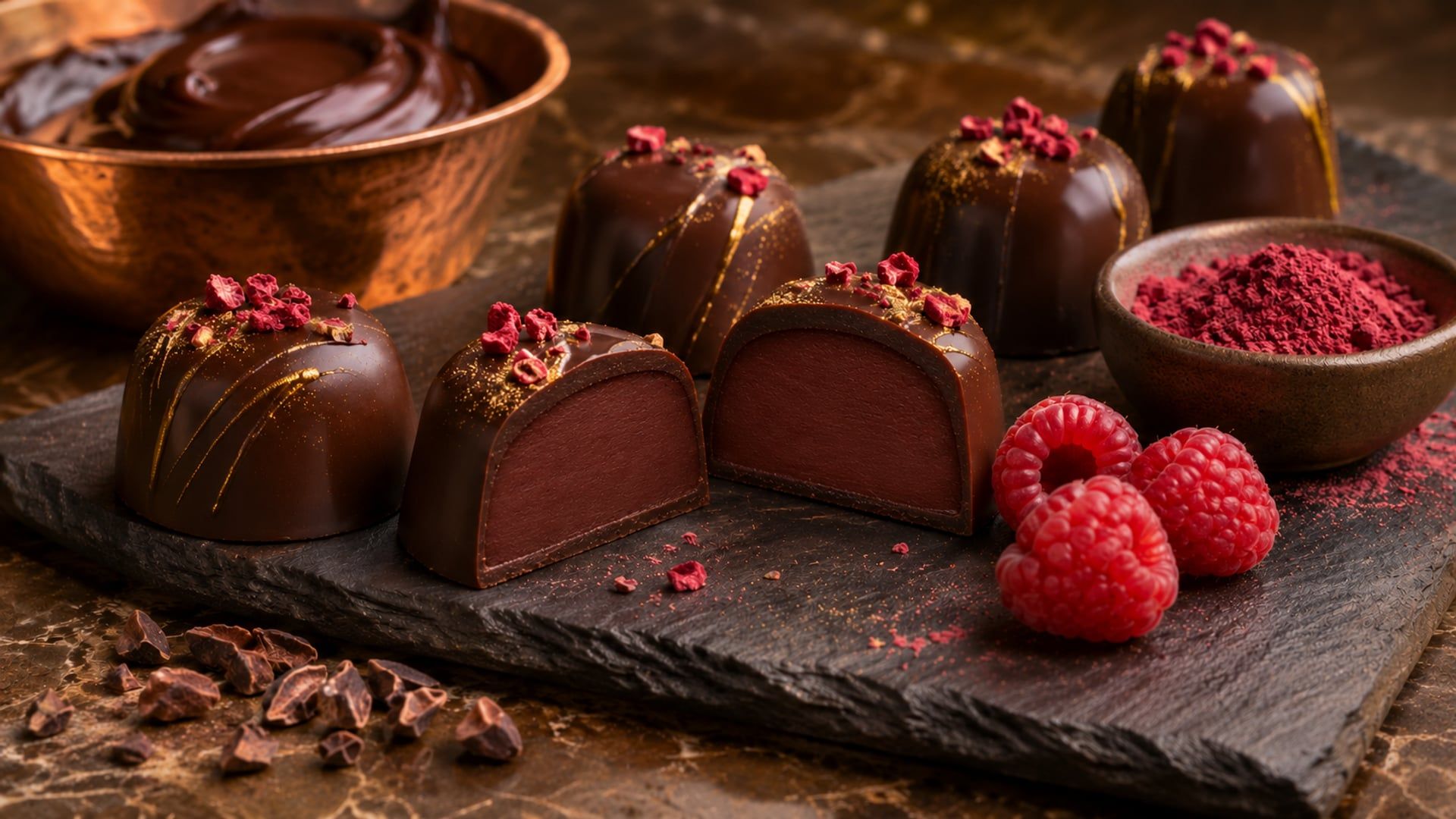
Raspberry purée is about 90 % water, so every extra spoonful of flavor costs shelf life. This cream-free 1 kg bonbon ganache keeps the purée to 160 g and adds 15 g of freeze-dried raspberry powder for flavor without the water. It calculates at about 30 days at 20 °C and about 115 days at 4 °C, at a water activity (aw) of 0.759.
Those days are calculator estimates, not a date for your label: measure the aw of the finished batch and run a storage test first. The formula also misses four of the calculator’s targets, and the section on them says how far. Whether a ganache can stay out of the fridge in general is covered in our shelf-stable guide.
Raspberry Ganache Formula
The formula totals 1,000 g and uses no cream: the purée and syrups bring nearly all of its water.
| Ingredient | Weight (g) | Share | What it does |
|---|---|---|---|
| Dark chocolate (Valrhona Caraïbe 66 %) | 495 | 49.5 % | Structure and bitterness against the fruit |
| Raspberry purée | 160 | 16 % | Fruit flavor and acidity; most of the water |
| Invert sugar (Trimoline) | 120 | 12 % | Lowers aw, keeps the filling soft |
| Sorbitol, crystalline | 70 | 7 % | Lowers aw with less sweetness than sugar |
| Glucose syrup DE40 | 60 | 6 % | Slows crystallization |
| Cocoa butter | 40 | 4 % | Sets the ganache |
| Butter, unsalted | 40 | 4 % | Softer melt |
| Freeze-dried raspberry powder | 15 | 1.5 % | Raspberry flavor with almost no water |
| Total | 1000 | 100 % |
Makes 1 kg of bonbon filling.
Open the live raspberry ganache
See the calculation behind aw 0.759 and about 30 days at 20 °C, then save a copy and try your own purée in it.
What Purée Costs a Raspberry Ganache
The amount of purée does not set the raspberry flavor on its own, but it does set the water. Here are three ganaches on the same 66 % chocolate:
| Formula | Water activity | Days at 20 °C | Where it stands |
|---|---|---|---|
| 600 g chocolate + 400 g purée† | 0.93 | ~3 | Fridge only; texture very soft |
| 230 g purée, no powder† | 0.84 | ~10 | Too close to call: fridge until tested |
| This formula: 160 g purée + 15 g powder | 0.759 | ~30 | Likely passes 0.85: confirm by test |
† Calculator simulations, not saved recipes. The 230 g version also uses 480 g chocolate, 30 g cocoa butter, 90 g invert sugar, 40 g glucose syrup, 60 g sorbitol and 70 g butter. Days are from the Conservative model; they are spoilage estimates, not safe holding times.
The first row is what you get by swapping cream for purée in a plain ganache. It belongs in the fridge. The second looks close to the line, and a calculation cannot settle a value that close, so it stays in the fridge until a test of the finished ganache shows 0.85 or lower. Only the third sits under 0.80, the level where a ganache is likely to pass that line.
Four choices take the formula from the first row to the third:
- Purée sets the water. 160 g brings about 144 g of water, most of the 18.75 % in the finished ganache. Every gram you cut lowers the aw.
- Freeze-dried powder puts the flavor back. 15 g adds raspberry and carries almost no water, so you recover flavor that a smaller purée dose gives up.
- Cream stays out. With no cream in the formula, the fruit’s acid has nothing to curdle and no milk water lands on top of the purée’s. Fruit Purée in Ganache explains how much purée a ganache can carry.
- Sugars and sorbitol bind what is left. 120 g of invert sugar, 60 g of glucose syrup and 70 g of sorbitol dissolve into that water. Crystallization risk stays at 11, against a target of 30 or less.
You can also reduce the purée to concentrate it. The calculation does not subtract the steam, so measure the aw of that batch instead of relying on these figures.
Where This Raspberry Ganache Misses the Targets
The calculator grades this formula A. A grade is not a storage test, and four figures sit outside the calculator’s targets:
-
Fat is 27.3 %, low for the water it carries. The calculator warns of a softer set and a weaker emulsion, and this is what holds the grade at A. Blend fully and check the set on a test batch.
-
Water is 18.75 %, 0.75 points over the 12–18 % target. That is the price of real purée. Water migration risk is still low at 17, and the aw is what the calculator grades shelf life on.
-
Sugars are 30.17 %, under the 35–50 % target. Sorbitol does part of the work sugar would do, which keeps the filling less sweet against the fruit.
-
The fat melting ratio is 0.14, under its 0.4–0.8 bonbon target. Cocoa butter makes up most of the fat, at 23.9 % against 3.3 % milk fat. The calculator still reads the texture as medium, so judge the bite on a test batch.
Sorbitol at 7 % of the ganache has two practical effects. It is less sweet than sugar, so taste a small batch first, and it has to appear on your label. Polyol load is 7, within the calculator’s target.
Two more cautions apply. The butter, the chocolate’s starch and the powder’s starch and density are estimates from class profiles, not supplier data. And the lab comparison behind the calculator has no ganache with purée, sorbitol or glucose syrup, so a meter reading matters more here than for a plain ganache.
Raspberry Ganache Method
Melt the chocolate
Melt the chocolate with the cocoa butter gently in a dry bowl, stirring until combined.
Heat the purée and sugars
Combine the raspberry purée, invert sugar, glucose syrup and sorbitol in a saucepan. Heat to 85 °C, stirring until the sorbitol dissolves.
Add the powder off the heat
Take the pan off the heat and whisk in the freeze-dried raspberry powder until no dry lumps remain.
Emulsify
Pour a third of the hot purée over the chocolate. Wait 30 seconds, then stir from the center in small circles. Add the rest in two more additions, emulsifying each time.
Add the butter and blend
When the ganache reaches 35–40 °C, add the softened butter. Use an immersion blender for 30 seconds with its head under the surface, so you add no air.
Fill or hold
At 28–29 °C, pipe the ganache into shells, then leave it 12–24 hours at 16–18 °C before you cap. The calculator rates this texture as marginal for cutting, so do not frame it without a test batch. To hold it instead, pour it into a shallow container, cool at 20 °C for 2 hours, then cover and refrigerate.
If the ganache splits, bring it to 32–34 °C and blend again; the split ganache guide walks through each cause.
Storing Raspberry Ganache Bonbons
Treat about 30 days at 20 °C and about 115 days at 4 °C as Conservative-model estimates for this purée only, and print neither. A different purée moves both. At this aw the calculator expects molds and yeasts, not bacteria, to set the limit. The dark chocolate recipe page quotes the default Balanced model, which reads longer, so compare formulas on one model only.
Measure the aw of a finished batch with a calibrated meter, then follow retained samples in your final packaging for flavor, emulsion stability and microbial quality. Purées differ in water and sugar from one supplier to the next, so repeat the measurement when you change yours. The shelf-life testing guide turns the estimate into checkpoints and a sample plan, and how long ganache keeps covers fridge and freezer handling.
Raspberry Ganache Questions
How long does raspberry ganache last?
Why is there no cream in this raspberry ganache?
Can I leave out the freeze-dried raspberry powder?
Can I use fresh or frozen raspberries?
Will sorbitol change the taste of the ganache?
Can I make this with white or milk chocolate?
Related Topics
Related Articles
Shelf-Stable Milk Chocolate Ganache: A 1 kg Bonbon Formula
A 1 kg milk chocolate bonbon filling calculated at about 45 days at 20 °C and a water activity of 0.730: the formula, the method, and why milk chocolate needs extra cocoa butter and invert sugar.
Shelf-Stable Caramel Ganache for Bonbons: A 1 kg Formula
A 1 kg salted caramel ganache for bonbons calculated at about 34 days at 20 °C and a water activity of 0.75: the formula, how to cook the caramel, and what a calculation cannot see in cooked sugar.
Shelf-Stable Dark Chocolate Ganache
A 1 kg dark ganache with a calculated aw around 0.75. Use the complete formulation and its model-based storage predictions to develop a filling for your product.