How to Fix Split Ganache (Broken, Oily or Grainy)
Oily, grainy or seized ganache can almost always be saved. Read the symptom, bring the batch to 32–34°C, blend, and add liquid only if the split comes from too much fat or the ganache has seized.
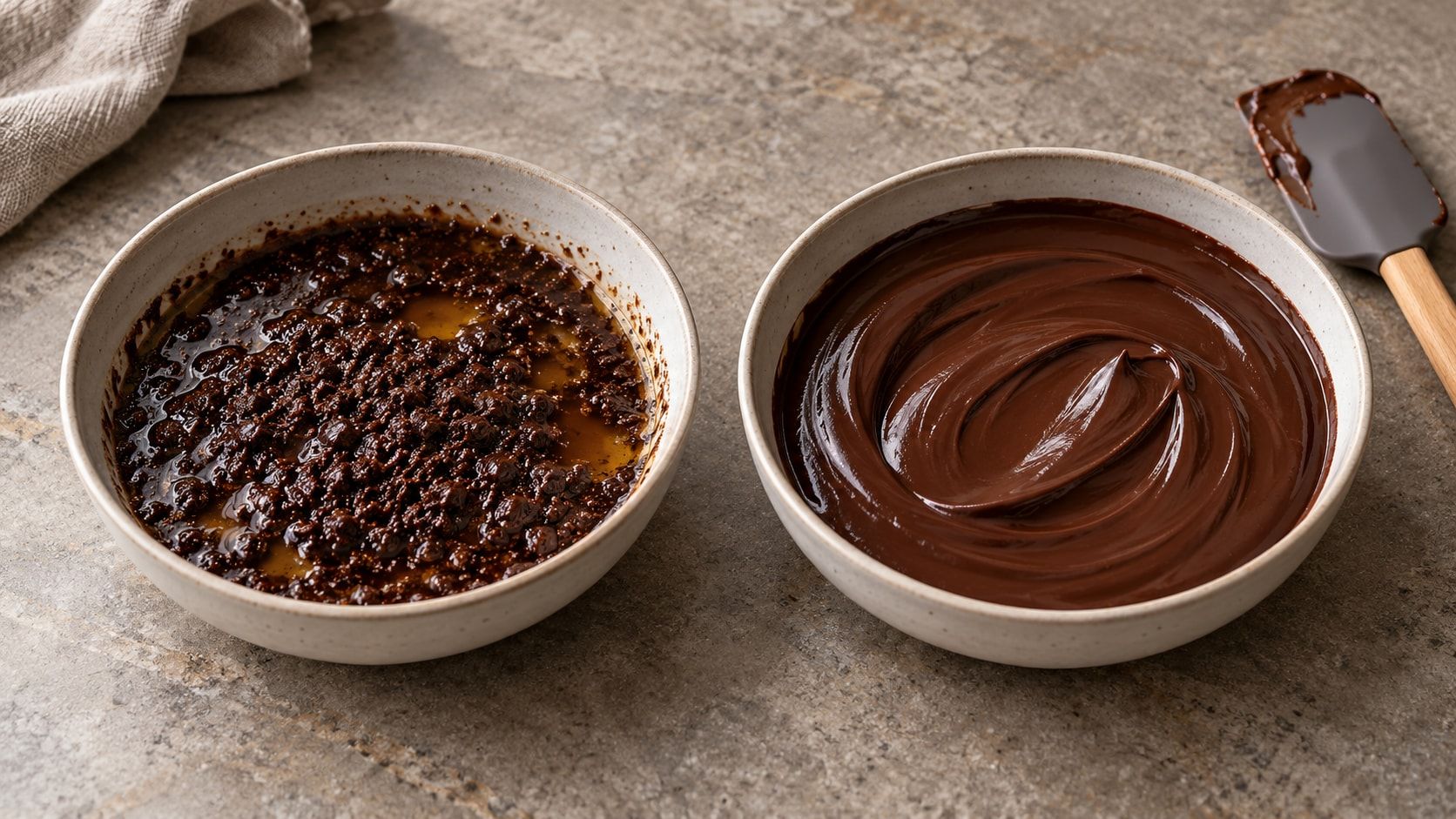
Stop stirring and take its temperature
A split ganache is rarely ruined. Before adding anything, probe the centre: the temperature tells you whether you are fixing heat, cold or too much fat.
Ganache is an emulsion: droplets of cocoa butter and milk fat dispersed in a syrup made from the cream’s water and the chocolate’s sugar, with cocoa particles suspended in it. It splits when those droplets merge into free fat, or when the solids clump instead of staying dispersed. Each failure looks different, and each has its own first move.
What Split Ganache Looks Like, and What Caused It
Match what you see to a row below. The working range for re-emulsifying is 32–34°C: warm enough to melt most fat crystals, cool enough to keep the cocoa-butter seed crystals that help the ganache set faster and finer.
Stirring at the wrong temperature is the most common cause of all. When a ganache that has cooled below this range is stirred hard, the fat starts to set in clumps and the emulsion separates.
| What you see | Most likely cause | How to confirm | First move |
|---|---|---|---|
| Oily sheen, fat pooling on top or at the edges, thin | Too hot: boiling cream or an overheated melt | Probe reads well above 34°C | Cool to 32–34°C while stirring, then blend; the seed crystals are lost, so it sets more slowly unless re-seeded |
| Still oily at 32–34°C after blending | Too much fat for the liquid: high-cocoa chocolate, extra butter, too little cream | Not smooth after about 2 minutes of blending | Add warm liquid a teaspoon at a time (Steps 4–5) |
| Grainy, curdled, matte; greasy on the tongue | Stirred too cold, or cold cream, butter or spirit added | Probe reads below 32°C | Warm to 32–34°C, then blend |
| Stiff, dull, gritty paste as soon as liquid hits the chocolate | Seized: too little liquid, or a splash of water or steam | Stays a paste even when warm | Add hot liquid a teaspoon at a time until it flows |
| Split right after adding butter | Cold or melted butter, or butter added well below 32°C or above 40°C | Split began at that addition | Bring to 32–34°C and blend |
| Smooth when made, oily or grainy after the fridge | Cooling and crystallisation, not mixing | Broke only while chilling | See the after-cooling guide below |
Split ganache: symptoms, causes, first move
White and Milk Chocolate Ganache Splits
White chocolate has no cocoa mass (non-fat cocoa solids): it is cocoa butter, milk solids and sugar. The milk solids scorch quickly, so overheating is the usual culprit. Melt white couverture gently, to about 40–45°C, and never in long microwave bursts. An oily white ganache rescues like any other. A thick, lumpy batch that smells cooked has burnt, and burnt chocolate cannot be recovered.
White and milk ganaches also set softer and more slowly than dark ones at the same ratio, so a batch that is merely slow to thicken has not split.
How to Fix Broken Ganache, Step by Step
Stop as soon as the ganache turns glossy, thick and elastic. Most batches recover by step 3.
Stop and measure
Stop whisking, probe the centre and match the symptom in the table.
Bring it to 32–34°C
Hot: stir gently off the heat until it cools into range. Cold: warm it over a water bath or in short microwave bursts, stirring in between. Do not overshoot 34°C, or you melt the seed crystals that help it set faster and finer.
Blend without adding air
Use a stick blender, head fully submerged, bowl tilted, for about 2 minutes. If the fat is not excessive, this alone re-emulsifies it.
Still oily? Add warm liquid a teaspoon at a time
The ganache has too much fat for its water. Add invert or glucose syrup, a spirit, or milk or water boiled, then cooled to about 35°C, a teaspoon at a time, blending after each. Avoid cream: it is about 35% fat. A standard batch (about 1 kg) rarely needs more than 1–2 tablespoons. Enter what you added into the recipe and re-check aw before trusting the shelf-life estimate: 100 g of cream moved the example below by 0.045.
Stubborn split: rebuild from a starter
In a clean bowl, whisk about 1 tablespoon of hot syrup, or milk boiled and cooled to about 35°C, with 1 tablespoon of broken ganache until shiny. Add the rest a spoonful at a time, then faster once the base holds.
Seized paste? Add more liquid, not less
Seized ganache has just enough water to make its sugar sticky, gluing sugar and cocoa particles into clumps. More liquid dissolves them: stir in hot liquid a teaspoon at a time until it flows.
Fix the formula before the next batch
Needing step 4 or 5 means the formula is too rich in fat. Rebalance it as shown below.
The rescue liquid changes shelf life
Water and milk raise water activity (aw). Syrups and spirits re-emulsify with less effect on aw, so prefer them for fillings that must keep.
Why Ganache Splits: Too Much Fat for Its Water
Fat droplets need enough water phase around them to stay apart. Push the fat up with high-cocoa chocolate, extra butter or less cream, and the droplets crowd, touch and merge until oil leaks out. A dark ganache beyond about 3:1 chocolate to cream, with cream as the only liquid, runs a real risk of breaking. The example below sits at 3.4:1, plus butter.
The Formul.io ganache calculator flags this as the fat-to-liquid balance: the fat share divided by the water phase. Its target band is 1–2. The calculator flags the balance, not the split itself, so use it to catch a risky formula before you cook.
In the bowl, add as little liquid as possible: every spoonful softens the set ganache. In the formula, add enough water phase to bring the balance back into the band, and choose which liquid carries it.
Over-fat dark chocolate ganache (splits)
Open the formula and see why the calculator flags its balance.
At 44.1% fat the over-fat example sits under the 45% ceiling often used for ganache. What puts it at risk is how little water surrounds that fat.
More cream restores the water phase and costs shelf life. Adding 100 g of cream alone lifts water activity from 0.818 to 0.863 and cuts the estimate to about 10 days at 20°C. At +150 g the balance only reaches 2.17, still above the band, while aw climbs to 0.881: the calculator moves the ganache into its bacteria-risk class, switches storage to refrigerated and estimates about 6 days at 20°C.
Splitting the added liquid between cream and invert sugar restores the balance to 1.97 while aw moves only from 0.818 to 0.832. Invert sugar adds liquid to the water phase together with a lot of dissolved sugar, so the syrup stays concentrated.
Rescued dark chocolate ganache
The same ganache rebalanced with cream and invert sugar.
Prevent the Next Split
- Check the fat-to-liquid balance before you cook, and count butter, about 80% fat, in it.
- Pour the hot cream in two or three additions and stir from the centre until a shiny, elastic core forms.
- Add soft butter once the ganache has cooled to 35–40°C.
- Finish with a submerged stick blender, then let framed ganache crystallise at 16–18°C before it goes anywhere colder.
Why ganache splits after cooling
Smooth at first, broken after chilling? Diagnose the cooling side.
Split Ganache FAQ
What does split ganache look like?
Why does ganache split?
Can I fix split ganache by adding more cream?
Why does white chocolate ganache split?
Why won't my ganache set?
Related Topics
Related Articles
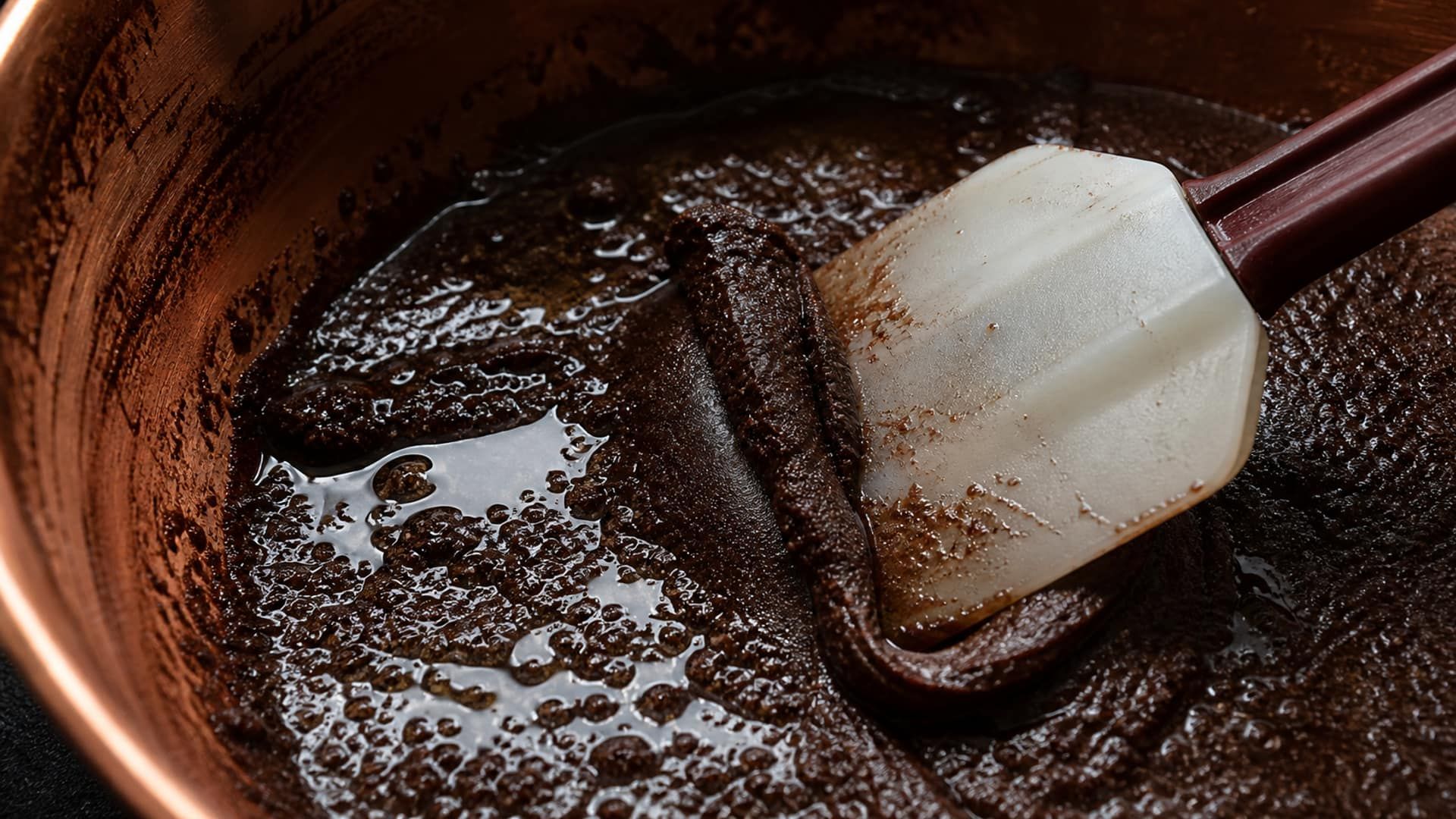
Why Ganache Splits After Cooling
Your ganache looked perfect, but after refrigeration it's oily and broken. Here's why it happens and how to prevent it.
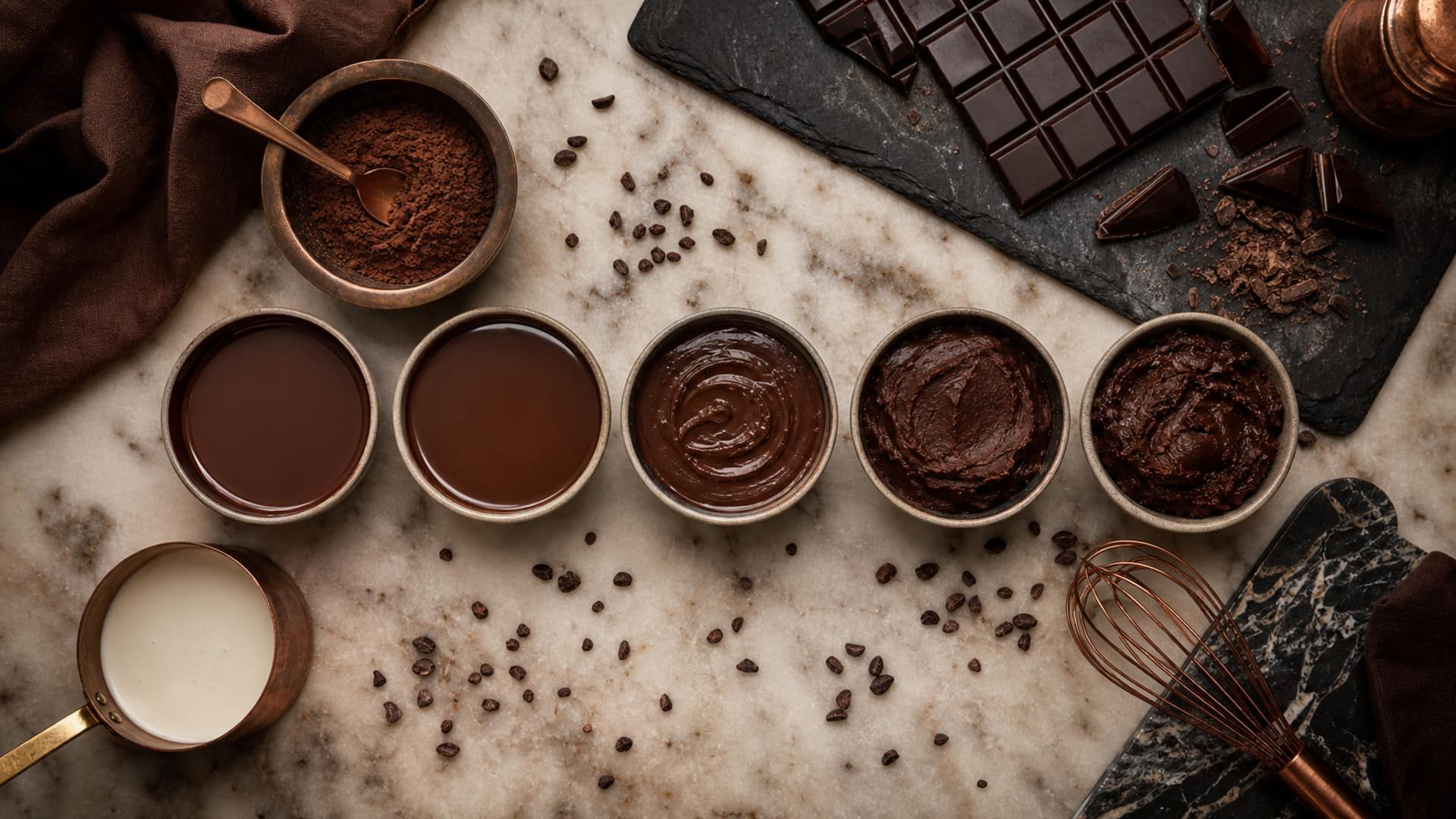
Ganache Ratio Guide: Matching Chocolate-to-Cream Ratios to Every Use Case
The chocolate-to-cream ratio determines everything: texture, setting time, shelf stability, and workability. This guide maps each ratio to its application — from pourable glazes to firm praline centres.
Shelf-Stable Dark Chocolate Ganache
A 1 kg dark ganache with a calculated aw around 0.75. Use the complete formulation and its model-based storage predictions to develop a filling for your product.