White Chocolate Bonbon Ganache: A 1 kg Trial Formula
A 1 kg white chocolate bonbon filling engineered for low predicted aw, a plastic set, and controlled piping—ready for measurement and shelf-life validation.
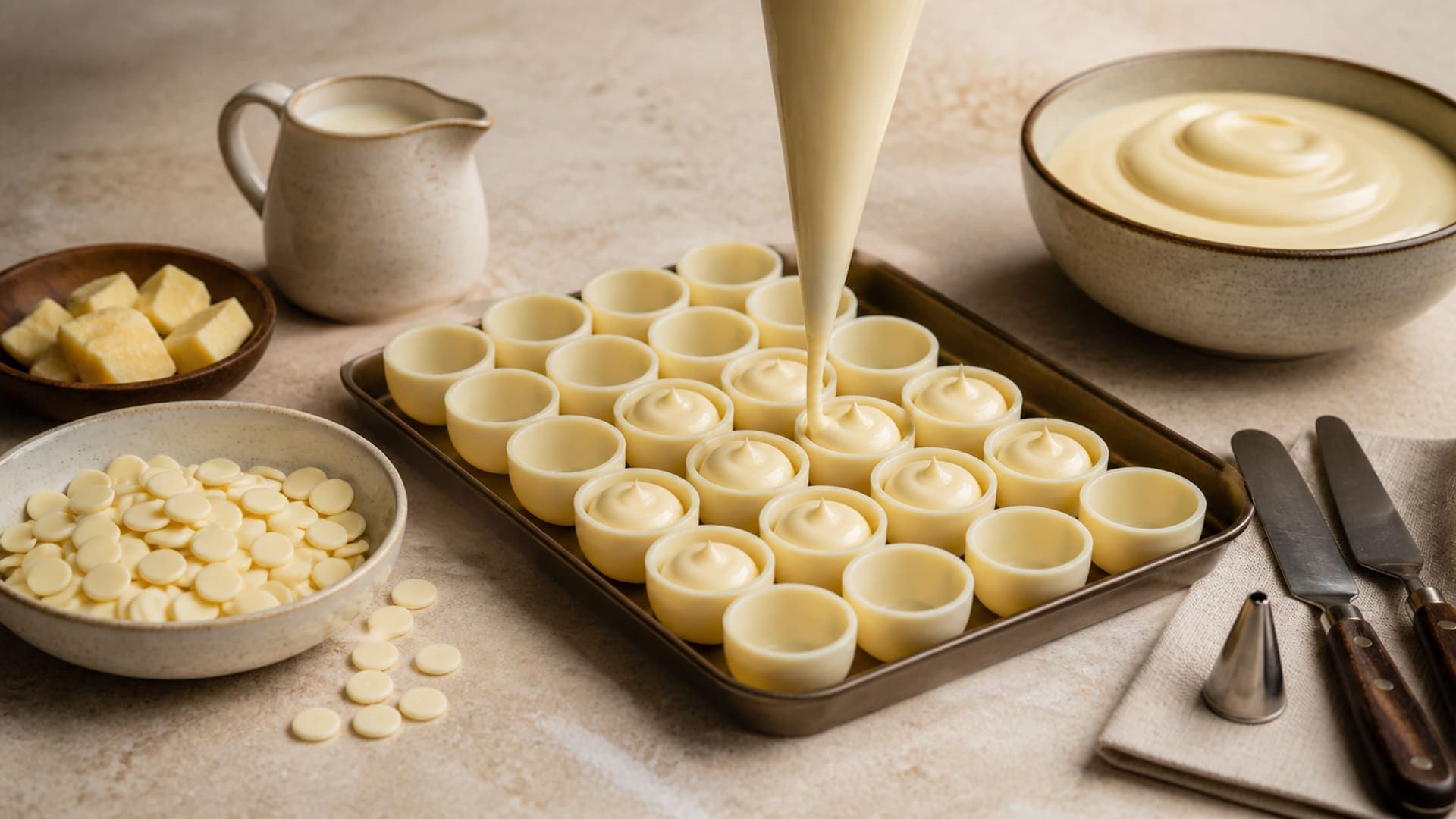
White chocolate ganache needs more than a chocolate-to-cream ratio. White couverture brings cocoa butter, milk fat, sugar, and milk solids but no cocoa mass; those proportions determine whether the centre pipes cleanly, sets at service temperature, and stays uniform during storage.
No validated storage date
This is a recipe-development example. The composition and aw below were recalculated in Formul.io; no measured shelf-life result is claimed. Decide storage and release from the finished bonbon and its production controls.
White Chocolate Ganache Formula and Targets
The formula below totals exactly 1,000 g. It uses a specified white couverture because switching chocolate can change cocoa butter, milk fat, sugar, and moisture enough to move both texture and calculated aw.
| Ingredient | Weight | Batch % | Function |
|---|---|---|---|
| W2NV-595 white chocolate | 500 g | 50% | Cocoa butter, milk solids, sugar, flavour |
| Cocoa butter | 60 g | 6% | Firmness and fat structure without added water |
| Unsalted butter | 40 g | 4% | Plasticity, melt, and mouthfeel |
| Cream 35% | 220 g | 22% | Aqueous phase, milk fat, and protein |
| Invert syrup, 82% solids | 90 g | 9% | Humectancy, softness, crystallisation control |
| Glucose syrup DE40, 80% solids | 50 g | 5% | Body and crystallisation control |
| Sorbitol powder, 99.8% solids | 40 g | 4% | Humectancy and texture control |
Worked 1,000 g formula for a white chocolate bonbon filling.
These composition-model outputs were recalculated on 1 October 2026 using the W2NV-595 supplier specification: 35.8% fat, including 29.5% cocoa butter and a derived 6.3% milk fat. The calculation uses the supplier’s 1% maximum moisture as an input assumption; sugar-species fractions and some dairy fields remain model estimates. W2 contains milk and soy; these inputs describe the calculation, not a measured production batch.
Open the 1 kg white chocolate ganache formula
Review the supplier-based ingredient data and process, then copy the recipe to adapt your bonbon filling.
Check the mass: 500 + 60 + 40 + 220 + 90 + 50 + 40 = 1,000 g. The sorbitol entry means powder. Using 40 g of a 70% solution instead would bring roughly 12 g water and substantially less sorbitol. Record that as a different formula.
The pilot should establish whether the filling works in its intended shell. Record deposit pressure, surface shape, set and bite; a predicted texture label cannot replace those observations.
Neither the low estimate nor the high fat fraction protects a poorly handled batch. Fat determines much of the set and melt, while dissolved solids influence aw; sanitation, phase temperatures, deposit control, shell integrity, and packaging remain separate controls that the formula cannot replace.
Controlled Method for a Smooth Emulsion
Prepare and document
Sanitise and dry all food-contact equipment. Weigh each ingredient and record the couverture lot, cream specification, syrup solids, and sorbitol form.
Melt the fat phase to 42°C
Combine the white chocolate, cocoa butter, and unsalted butter. Melt gently to 42°C and stir until completely uniform; do not continue heating once the fats have melted.
Heat the cream phase to 80°C
Combine cream, invert sugar syrup, glucose syrup DE40, and sorbitol. Heat to 80°C while stirring so the ingredients are evenly dispersed.
Build the emulsion in additions
Add the hot cream phase to the melted fat phase in three additions. Mix from the centre after each addition until the ganache becomes glossy and elastic.
Homogenise
Blend with a fully submerged immersion blender until smooth. Keep the head below the surface to avoid air bubbles and do not overwork the mass.
Cool to 29°C and pipe
Cool with gentle stirring to 29°C, then pipe into prepared shells without touching the rim. Use the same deposit temperature in validation and routine production.
The phase temperatures above describe a starting emulsification method, not a pasteurization hold. Use the heat treatment and hygiene controls established for the ingredients and production process.
Leave the filling to crystallize before capping. Record room and product temperatures and the actual time used; the criterion is a surface suitable for clean closure, not a waiting time copied from another recipe.
Fill a few shells before committing the main pilot. If flow is unsuitable, make a documented formula adjustment instead of repeatedly warming the batch and assuming its original data still apply.
Read the Result Before Adjusting It
Judge the ganache at its intended working and service temperatures. A centre that looks firm straight from refrigeration may become too soft in a 20°C room; a filling that seems fluid at 29°C may set correctly after cocoa-butter crystallisation.
| Observation | Check first | Controlled response |
|---|---|---|
| Too soft after full set | Actual room temperature, couverture composition, weighing, crystallisation time | Adjust chocolate or cocoa butter in the calculator; repeat aw and texture validation. |
| Too firm or short | Deposit temperature and whether the fat phase overheated | Reduce structural fat or revise the liquid balance as a new formula; do not add cream to a finished production batch and keep the old shelf-life claim. |
| Oily or split | Phase temperatures, addition sequence, and immersion-blender position | Gently re-emulsify a development batch at a controlled temperature, then investigate the process before release. |
| Too sweet | Sweetness from the couverture, syrups, and sorbitol | Choose a different couverture or rebalance solids by function; simply removing humectants raises aw and changes texture. |
| Shell cracks or filling pulls away | Moisture migration, geometry, storage cycle, and filling temperature | Test the assembled bonbon and package; an acceptable filling sample alone does not prove compatibility with the shell. |
Every adjustment changes a connected formulation system.
Replacing W2NV-595 with another white chocolate is a reformulation, even at the same gram weight. Update cocoa butter, total fat, sugar, milk solids, and moisture from the technical sheet, then check the new piping window and set at the actual service temperature.
Establish Storage Conditions for the Finished Bonbon
No number of ambient days is assigned to this formula. Start with the intended distribution temperature, final package and proposed date, then design the finished-product study for those conditions.
Record couverture and syrup specifications, actual yield, phase temperatures, deposit temperature, setting and closure. If water evaporates, 1 kg ingredient input is not 1 kg finished yield; check the mass before interpreting composition per 100 g.
Measure aw after the defined equilibration period using the instrument’s procedure. Pair the result with the appropriate microbiological assessment and observations of shell integrity, texture, bloom, leakage and flavour over storage.
The sample-plan guide explains how to allocate unopened units and record decisions. Review its assumptions after changing chocolate, sorbitol form or packaging instead of retaining a date by default.
White Ganache Questions
Is room-temperature shelf life established for this recipe?
Can I use any white chocolate in the same amount?
Can I omit sorbitol from the ganache?
Must every batch be piped at exactly 29°C?
Should I refrigerate the filled bonbons?
How can I make the ganache less sweet?
References: Callebaut Chocolate Academy, White chocolate ganache for moulded pralines, recipe 1493, for professional preparation context. It is a different formula; its storage life is not transferred here. Hartel, von Elbe and Hofberger, Confectionery Science and Technology (2018), for confectionery structure. The quoted composition is calculated from the specified Formul.io ingredient records.
Related Topics
Related Articles
Shelf-Stable Dark Chocolate Ganache
A 1 kg dark ganache with a calculated aw around 0.75. Use the complete formulation and its model-based storage predictions to develop a filling for your product.
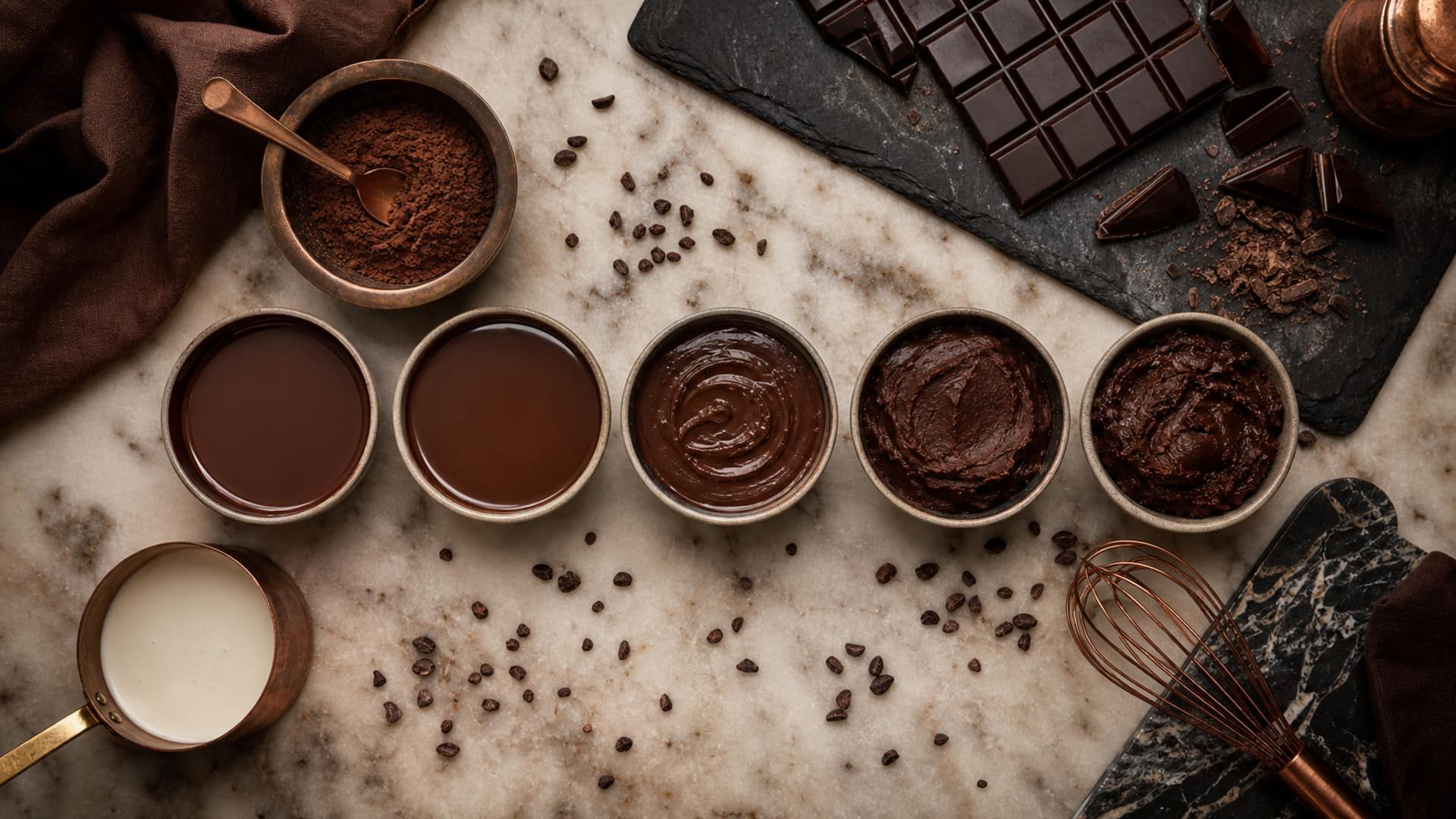
Ganache Ratio Guide: Matching Chocolate-to-Cream Ratios to Every Use Case
The chocolate-to-cream ratio determines everything: texture, setting time, shelf stability, and workability. This guide maps each ratio to its application — from pourable glazes to firm praline centres.
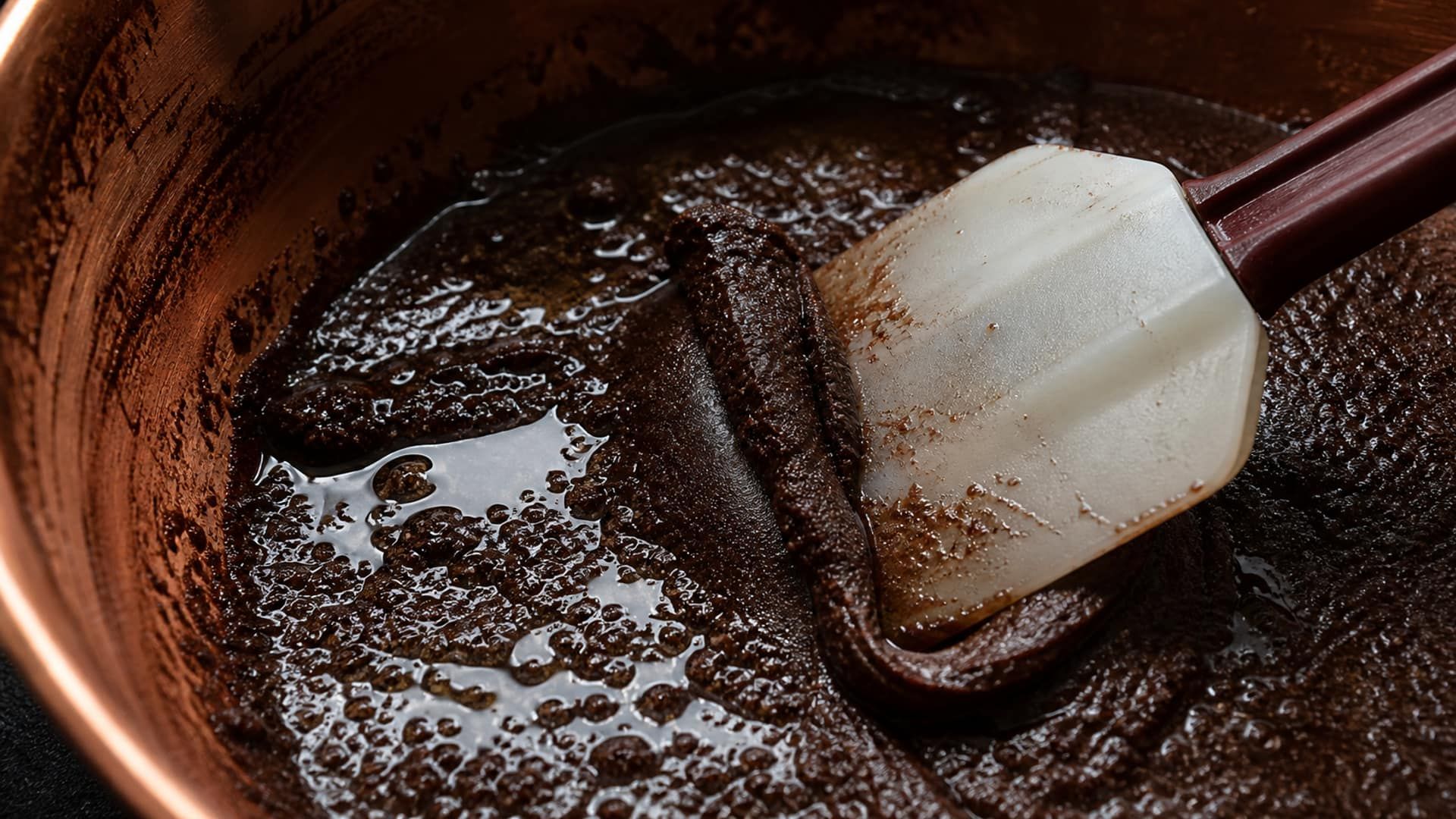
Why Ganache Splits After Cooling
Your ganache looked perfect, but after refrigeration it's oily and broken. Here's why it happens and how to prevent it.