Why Ganache Splits After Cooling
Your ganache looked perfect, but after refrigeration it's oily and broken. Here's why it happens and how to prevent it.
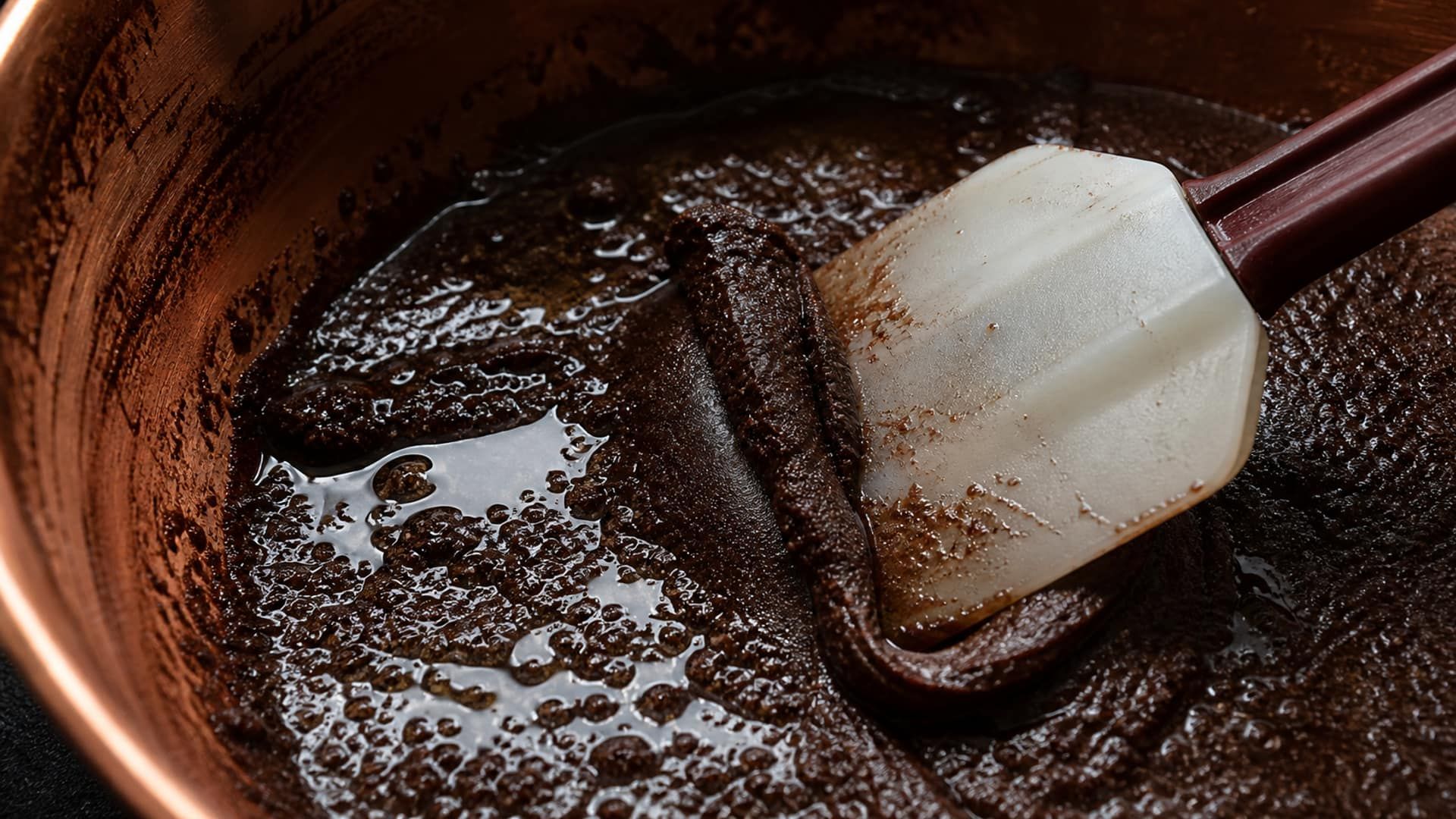
You’ve made what seemed like a perfect ganache. Smooth, glossy, and beautifully emulsified. Then you put it in the fridge. Hours later, you find an oily, grainy mess. The fat has separated, and your ganache is broken.
This is one of the most common problems in confectionery production, and it’s entirely preventable once you understand the science behind it.
Why Does Ganache Split?
The Science
Ganache is an emulsion — a stable mixture of fat (cocoa butter) and water (from cream). When the emulsion breaks, these phases separate.
More precisely, a well-made ganache is an oil-in-water (o/w) emulsion where fat globules are coated and stabilised by emulsifiers — lecithin from the chocolate (~0.3–0.5%) and casein proteins from cream. These emulsifiers create an interfacial film around each fat droplet, generating a repulsive force that keeps droplets from merging (coalescence). Three conditions undermine this film: an imbalanced fat-to-water ratio that overloads the emulsifier capacity; temperature-induced crystal phase changes in cocoa butter; and mechanical stress from rapid, uneven cooling. When any one condition exceeds the tolerance of the emulsifier system, the fat and water phases separate — and a broken ganache results.
The primary causes of ganache splitting after cooling are:
- Improper fat-to-water ratio (too much fat for the available water)
- Temperature shock during cooling
- Insufficient emulsification during mixing
- Butter added outside the 35–40°C window: too cold (or the ganache stirred hard once it has cooled below 32°C) and the fat sets in clumps before it disperses; above about 40°C the butter melts and oils out
- Using chocolate with incompatible cocoa butter crystals
The Fat-to-Water Ratio Problem
Every ganache has a critical balance between fat and water. When there’s too much fat relative to water, the emulsion becomes unstable. During cooling, cocoa butter crystallises, and without enough water-based phase to hold it in suspension, the fat separates.
Cocoa butter crystallises into six polymorphic forms (Forms I–VI), of which Form V (β₂) is the target in finished chocolate. When a ganache cools rapidly and unevenly, Form IV or unstable mixtures of polymorphs can appear, producing a grainy, waxy texture in the set ganache — distinct from true phase separation but often misdiagnosed as splitting. Properly tempered couverture contributes stable Form V seed crystals to the ganache; working with untempered or over-heated chocolate removes those seeds and increases the risk of polymorphic instability during cooling.
Not sure which side of that 45% fat ceiling your recipe falls on? Enter its chocolate and cream weights in the estimate below: it shows the fat share of the mix next to the likely texture. The ganache ratio guide explains which ratio suits each use.
Temperature Shock
Rapid temperature changes cause cocoa butter crystals to form unevenly. When you put a warm ganache directly into a cold refrigerator, the outer layer cools faster than the center, creating stress in the emulsion.
The physics of thermal stress in emulsions is straightforward: different regions cool and contract at different rates, generating shear forces at the interfacial films surrounding fat droplets. Once those films rupture, fat droplets coalesce irreversibly. The critical window is between 40°C and 20°C — the range where cocoa butter transitions from liquid to solid and where thermal stress is highest. Spending at least 30–45 minutes in this window at stable room temperature before refrigeration allows crystal networks to form slowly and uniformly, maintaining emulsion integrity.
Pro Tip
Always let ganache cool to room temperature (20–22°C) before refrigerating. Then refrigerate gradually — 15°C for 2 hours, then full refrigeration.
How to Fix Split Ganache
Bring it to 32–34°C
Warm the broken ganache gently over a water bath or in short microwave bursts, stirring in between. Do not overshoot 34°C: above it the stable cocoa butter seed crystals melt and the ganache sets more slowly.
Re-emulsify with an immersion blender
Keep the blender head fully submerged and blend from the center outwards for about 2 minutes. Often this alone brings the emulsion back.
Still oily? Add liquid a teaspoon at a time
Add warm syrup, a spirit, or milk or water boiled and then cooled to about 35°C, blending after each addition. Avoid cream: it adds more fat. A standard batch of about 1 kg rarely needs more than 1–2 tablespoons in total.
Cool properly this time
Let it set at room temperature before refrigerating.
For a symptom-by-symptom diagnosis, seized ganache and stubborn splits, follow the full guide: How to Fix Split Ganache.
Prevention with Formul.io
The easiest way to prevent ganache splitting is to calculate your formulation before you make it. Formul.io’s Ganache Calculator checks the levers that actually govern splitting — total fat content, fat-to-liquid balance, and an emulsion-stability index — before you touch any ingredients. Understanding which variables matter most — fat ratio, ingredient temperature, and cooling rate — lets you lock those variables down in your process. Once your total fat content sits below 45% and the emulsion index is comfortably in range, you’ve handled the two formulation-side causes before they reach the production kitchen; the remaining factor, cooling rate, is solved by the staged protocol described above. (Water activity is a separate lever — it governs shelf life and food safety, not whether the emulsion holds. Target a low Aw of ~0.70–0.75 for shelf life, as in the shelf-stable ganache recipe linked below.)
| Factor | Manual Approach | With Formul.io |
|---|---|---|
| Fat ratio check | After the fact | Before mixing |
| Emulsion stability | Unknown | Scored before mixing |
| Shelf life estimate | Guesswork | Days/weeks forecast |
| Adjustment suggestions | Trial and error | Automatic alternatives |
Comparison: Manual vs. Calculated Approach
Try the Ganache Calculator
Calculate water activity, fat ratios, and shelf life for your ganache recipes.
Related Problems
Can I save ganache that has completely separated?
Does the type of chocolate affect splitting?
Why does my ganache split only sometimes?
What is the ideal temperature for adding cream or butter to melted chocolate?
Related Topics
Related Articles
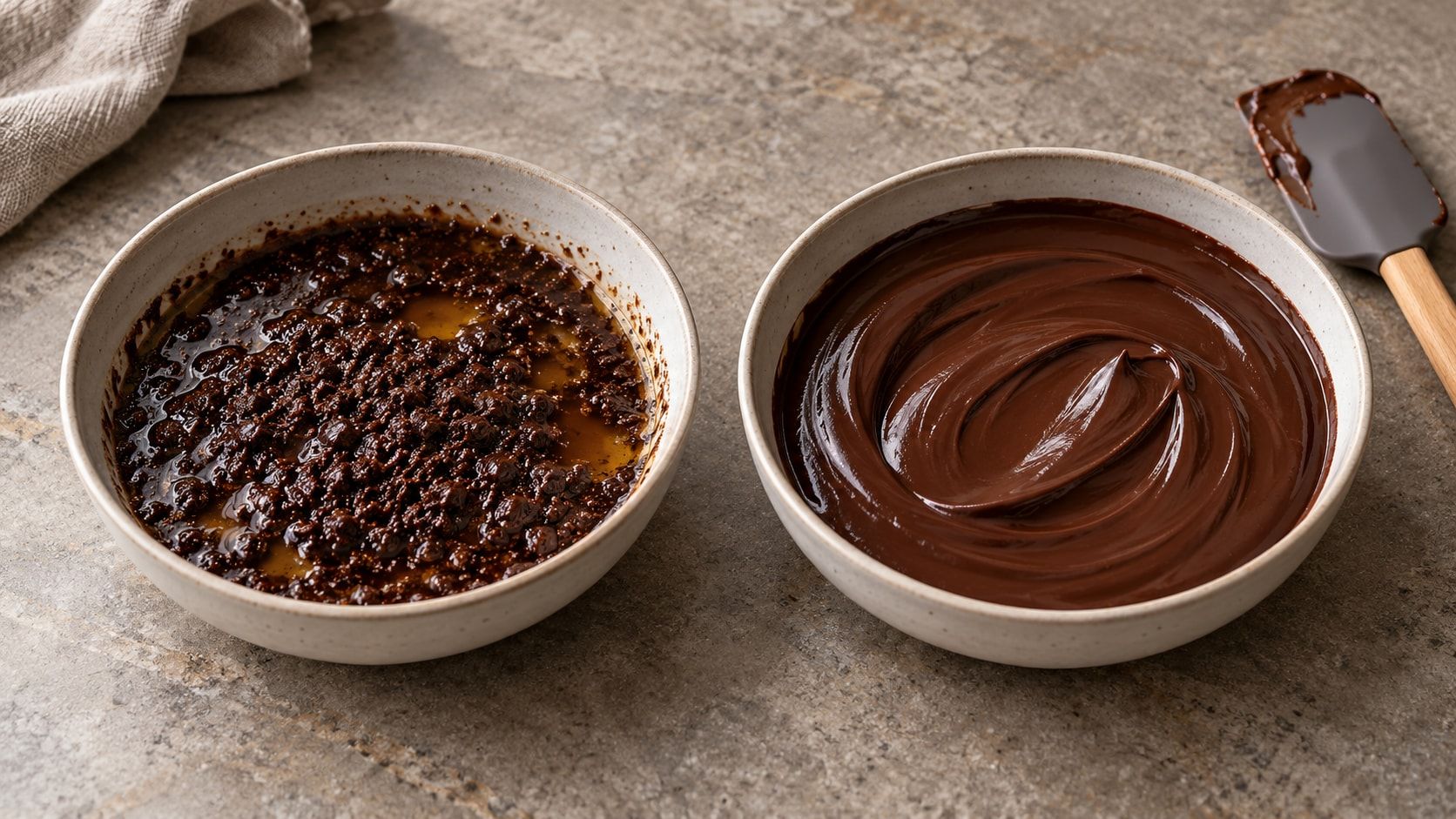
How to Fix Split Ganache (Broken, Oily or Grainy)
Oily, grainy or seized ganache can almost always be saved. Read the symptom, bring the batch to 32–34°C, blend, and add liquid only if the split comes from too much fat or the ganache has seized.
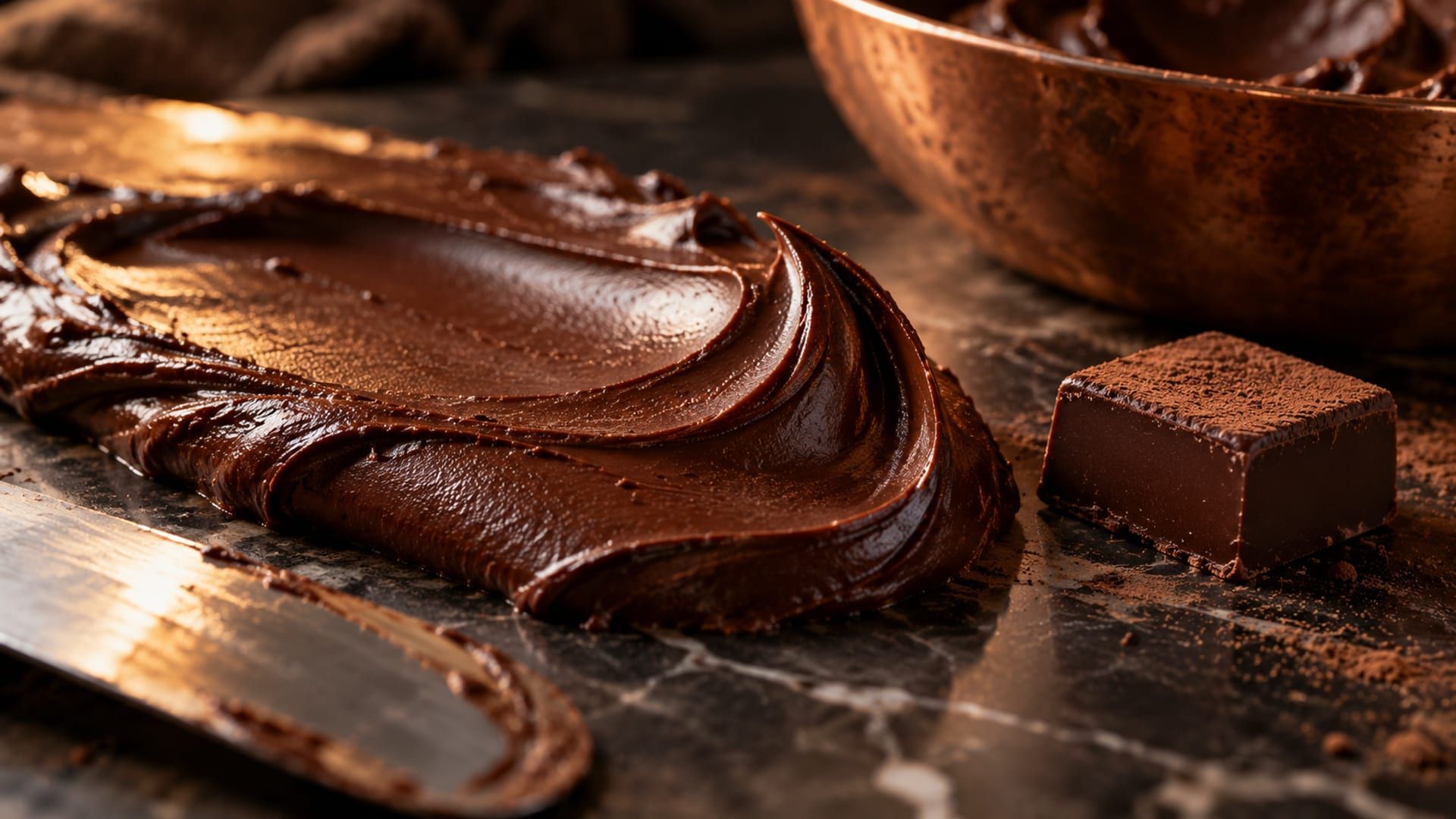
Ganache Not Setting: How to Fix a Filling That Stays Too Soft
A smooth ganache can still be too soft for its job. Separate temperature and crystallization problems from a formula that needs changing before you add more chocolate.
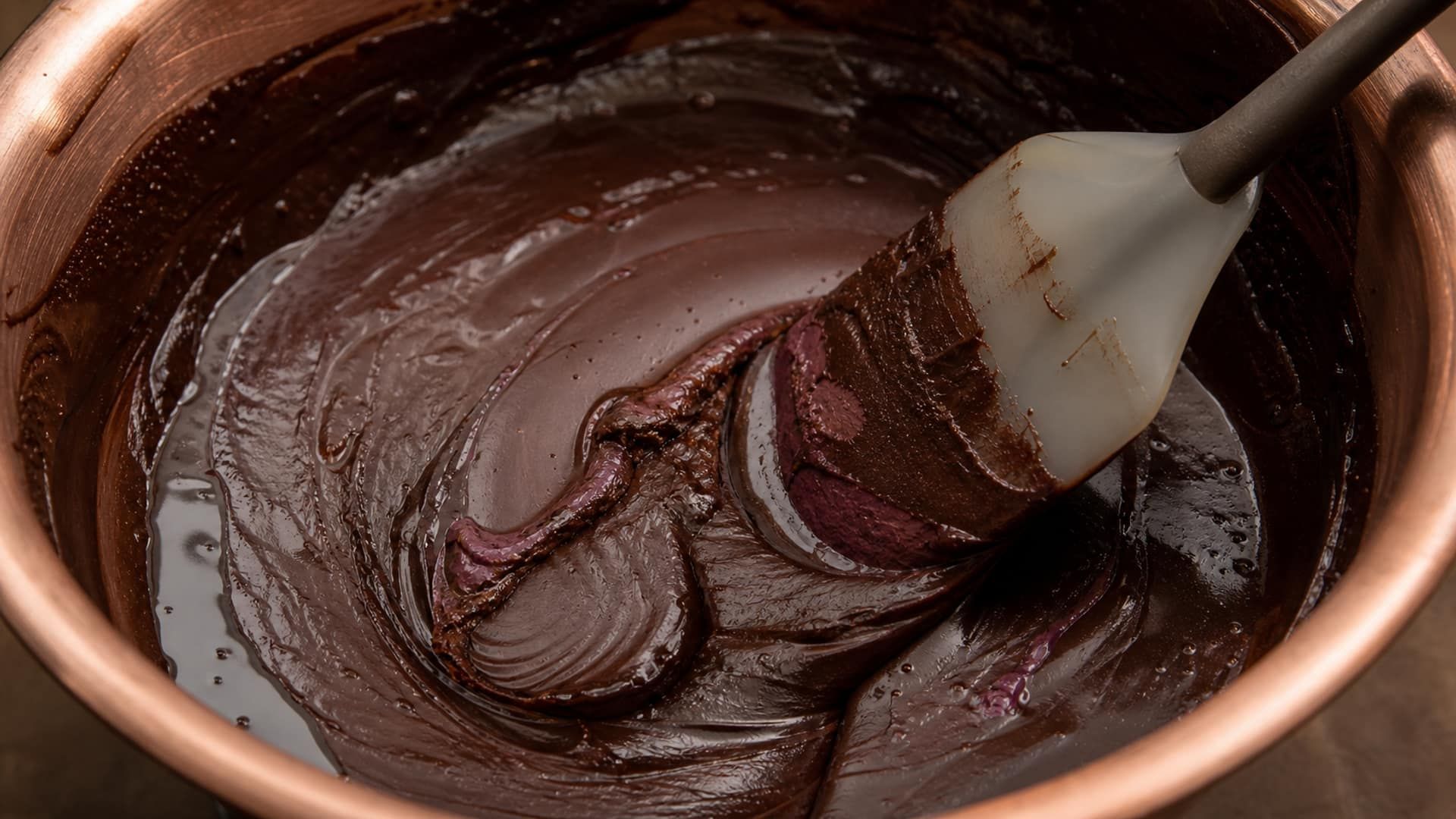
Fruit Purée in Ganache: Substitution, Not Addition
Adding fruit purée to ganache without reformulating around it splits the emulsion and cuts shelf life. Here's the science and the fix.