Fruit Purée in Ganache: Substitution, Not Addition
Adding fruit purée to ganache without reformulating around it splits the emulsion and cuts shelf life. Here's the science and the fix.
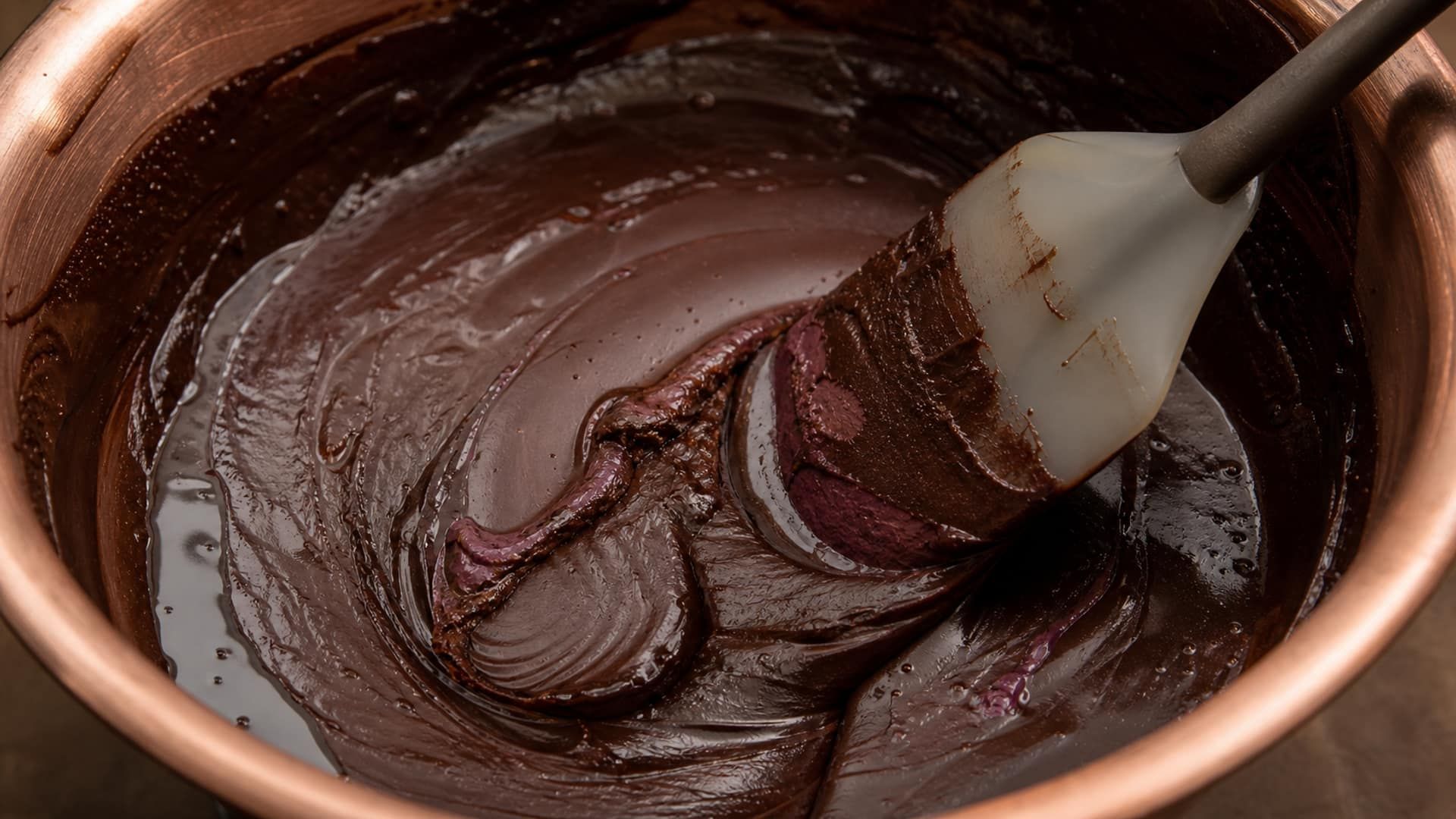
Your recipe calls for 100 g cream. You swap it for 100 g raspberry purée. The result splits, blooms within days, or tastes sharp enough to overwhelm the chocolate. The swap failed because purée is not a cream substitute — it’s a complete reformulation trigger.
Why Purée Destabilises Ganache
To bring measured purée to a target Brix, use the fruit purée Brix calculator. It helps calculate sugar or water additions and evaporation. After adjusting the purée, return to the balance of the whole filling: a Brix reading alone does not determine ganache stability.
Ganache is a complex emulsion: in cream-heavy ratios, fat droplets disperse in an aqueous phase stabilised by casein proteins from cream and lecithin from chocolate (~0.3–0.5%); when chocolate dominates the formula, fat becomes the continuous phase, shifting toward water-in-oil character. Lecithin’s low HLB (~4) means it favours water-in-oil stability — the structure typical of high-chocolate-ratio ganaches. Two properties of fruit purée attack this system simultaneously.
Water load. Heavy cream is ~60% water; most fruit purées are 80–90% water. A 1:1 swap floods the aqueous phase, pushing the fat-to-water ratio past the emulsifier capacity. The interface film ruptures and the ganache breaks. The deeper issue is that the missing cream fat — approximately 35% of cream’s weight — is not replaced, leaving the emulsion structurally deficient even if it initially holds.
Organic acids. Passion fruit, raspberry, and most citrus purées are pH 2.8–3.6; lemon and lime can drop to pH 2.0–2.5. At this acidity, casein micelles destabilise through charge disruption as pH approaches or crosses their isoelectric point (pI ~4.6). Casein is an intrinsically disordered, heat-stable protein — it does not classically denature, but the shift in charge balance reduces its capacity to coat and separate fat droplets. This is why acid-sensitive ganaches can look intact directly after blending but fail as the product cools: cocoa butter crystallisation exerts mechanical stress on the already-weakened emulsion interface.
Fat must be replaced, not removed
Cream contributes ~35% fat to a standard ganache. Fruit purée contributes almost none. Every formulation substituting purée for cream must add back 25–40 g anhydrous butter or 15–25 g cocoa butter per 200 g chocolate to maintain emulsion stability and target texture.
Two Methods for Incorporating Purée
Direct Substitution
Replace the entire liquid phase — cream, milk, and any added water — with purée. Do not add purée on top of an existing cream component. Calculate the recipe from scratch using these starting-point ratios:
- Start with 55–60 g purée per 100 g dark chocolate (55–70% cocoa solids).
- Reduce to 40–50 g per 100 g for milk or white chocolate (higher milk-fat and sugar content narrow the tolerance).
- Add fat replacement: 25–40 g anhydrous butter or 15–25 g cocoa butter per 200 g chocolate.
- Add lecithin at 0.3–0.5% of total weight to supplement the chocolate’s native emulsifier.
- Verify Aw with the Ganache Calculator before the first production run.
Reduction Before Use
Simmer purée at 85–90°C until weight drops 50%. This concentrates dissolved solids — a strawberry purée beginning at 6–8° Brix reaches 12–16° Brix, behaving closer to a sugar syrup than water in its Aw contribution. Measure Brix with a refractometer after reduction; weigh after reduction for accuracy. For already-sharp fruits (passion fruit, lime), stir in 0.5–1% glucose syrup post-reduction — its humectant action also lowers Aw, so account for it in your calculation — or a pinch of sodium citrate, which buffers acidity without meaningfully shifting Aw. Reduction is also the preferred method when flavour intensity is a priority — aromatic volatile esters progressively volatilise during any reduction, but losses are substantially lower at 85–90°C than at a rolling boil.
Handling Acid-Induced Curdling
When a cream component remains in the recipe alongside purée — for example, in a ganache tart filling — acidic fruits can destabilise casein through isoelectric aggregation and cause visible curdling. A cream-free formula (purée, chocolate, and butter only) sidesteps this entirely. When cream is required:
Heat separately
Bring cream and purée to temperature in separate pans — never combine cold cream with hot acidic purée.
Pour purée first
Pour the hot purée over chopped chocolate to begin emulsification before the cream is added.
Add cream off the heat
Incorporate cream once the chocolate-purée mix has dropped below 50°C, or remove cream entirely and rely on butter for fat.
Buffer if needed
Add 0.1–0.2% sodium citrate of total weight to raise pH and stabilise casein when cream is essential.
Formulation Targets and Shelf Life
Fruit ganaches land at Aw 0.78–0.86 before humectant adjustment. The formulas below target Aw 0.80–0.85 — the published range for refrigerated filled chocolates (2–4 weeks). A moderate humectant load at this target preserves fruit character and texture far better than chasing the ≤ 0.75 ambient threshold. The Aw model is water-phase Norrish and gives an upper bound: bound water in cocoa solids, protein, and pectin is not counted, so real Aw typically lands 0.02–0.04 lower than the model output. Verify your specific formula in the Ganache Calculator before committing to a shelf-life claim.
| Component | R1: Raspberry + Dark 64% | R2: Passion Fruit + Milk 40% |
|---|---|---|
| Chocolate | 200 g | 250 g |
| Fruit purée | 120 g reduced to 72 g (1.65:1) | 100 g reduced to 85 g (1.18:1) |
| Glucose DE40 | 22 g | 30 g |
| Invert sugar (70% syrup) | 24 g | 10 g |
| Sorbitol (anhydrous) | 20 g | 12 g |
| Anhydrous butter | 28 g | — |
| Cocoa butter | — | 20 g |
| Lecithin | 2 g | 2 g |
| Total | 368 g | 409 g |
| Water | 19.3% | 20.1% |
| Fat | ~29% | ~28% |
| Aw model (upper bound) | 0.853 | 0.846 |
| Est. Aw (real) | ~0.81–0.84 | ~0.81–0.84 |
Refrigerate, Aw ~0.81–0.84, 2–4 weeks. Aw model is water-phase Norrish (upper bound); real Aw runs 0.02–0.04 lower as bound water in cocoa solids and protein is not counted. Verify your final formula in the Ganache Calculator.
Prepare and reduce purée
Heat purée separately to 40°C. For R1 simmer raspberry purée from 120 g down to 72 g at 85–90°C (1.65:1); for R2 simmer passion fruit from 100 g down to 85 g (1.18:1).
Dissolve humectants in warm purée
Stir glucose DE40, invert syrup, and sorbitol into the warm purée before it contacts the chocolate.
Emulsify
Pour hot purée over chopped chocolate. Rest 2 minutes, then emulsify outward from the centre with a spatula.
Add fat below 35°C
Blend in soft anhydrous butter (R1) or cocoa butter (R2) using a stick blender once the mix drops below 35°C.
Finish with lecithin
Add lecithin last and blend briefly to incorporate.
Crystallise and store
Cast or pipe and crystallise 24 hours at 16–18°C before cutting. Refrigerate.
Notes on these formulas
Values are computed on generic chocolates: dark 64% (sucrose 34%) and milk 40% (sucrose 48%). For your supplier’s specific %, recompute in the Ganache Calculator — sucrose content in milk chocolate moves Aw most. Fat at ~28–29% is functional for cut or piped ganache; add 5–10 g anhydrous butter per batch for a richer mouthfeel with negligible Aw shift. Sorbitol per bonbon: R1 ~0.54 g, R2 ~0.3 g per 10 g filling — well below any laxative threshold.
Humectant dose reference
5 g anhydrous sorbitol per 100 g total ganache lowers Aw by ~0.02–0.03. Equal mass of invert sugar syrup (typically 70% solids) lowers it by ~0.01–0.015 — the gap reflects the ~30% water the syrup carries; on a dry-solids basis the two depress Aw similarly. Combining 3% sorbitol + 4% invert sugar is a common professional target that balances Aw reduction against sweetness and firmness.
Frequently Asked Questions
Can I use frozen fruit purée instead of fresh?
Why does white chocolate split more easily with fruit purée?
How much does reduction actually help with Aw?
Do I need to recalculate sugar ratios when I change the purée?
Related Topics
Related Articles
Why Ganache Splits After Cooling
Your ganache looked perfect, but after refrigeration it's oily and broken. Here's why it happens and how to prevent it.
Water Activity Calculator for Ganache and Filled Chocolates
Calculate water activity from your formulation, compare ingredient changes, and use recipe-level predictions to plan shelf-life testing for filled chocolates.
Water Activity in Ganache: The Science Behind Shelf Life Prediction
How the Formul.io Ganache Calculator estimates water activity from a formulation's sugar, polyol, and alcohol composition to predict microbial shelf life — and how to use those numbers responsibly.