Why is my Pâte de Fruit Grainy?
A sandy or grainy texture in Pâte de Fruit is a common failure. Learn how to prevent sugar crystallization and ensure a smooth, melting texture.
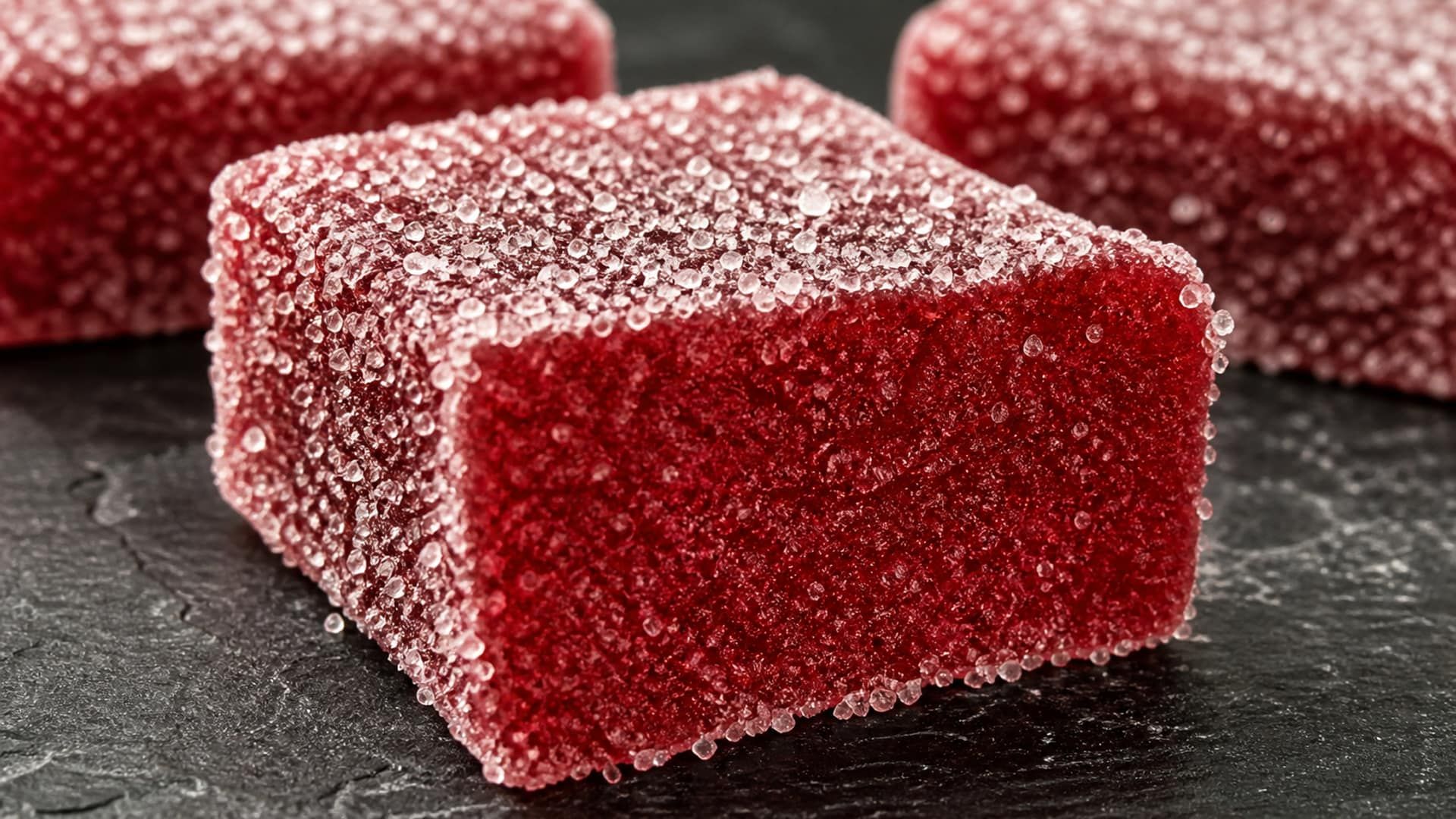
The Problem: Sandy Texture
A perfect Pâte de Fruit should be smooth, translucent, and tender. If your fruit jelly feels sandy, crunchy, or grainy on the tongue, it means sugar crystallization has occurred. Instead of remaining dissolved in a stable glass-like structure, the sucrose molecules have bonded together to form solid crystals. The process matters as much as the recipe: even a well-balanced formula will crystallize if sugar is added too quickly, if the pot sides are not kept clean, or if the mixture is disturbed during setting. Graininess is always a process failure, not an ingredient failure — which means it is preventable with the right technique every time.
Crystallization begins with supersaturation: during cooking, you dissolve far more sugar than water can hold at room temperature, creating a metastable supersaturated solution. When this solution cools, it seeks equilibrium by depositing excess sucrose as crystals — a process triggered by nucleation sites such as undissolved sugar grains, scratches in the pan, or even airborne dust. Once a single nucleus forms, growth is rapid; individual crystals link into a crystalline network that collapses the glassy amorphous structure and produces the characteristic sandy mouthfeel. The window between ‘safe’ supersaturation and ‘crystallization onset’ is narrow, typically within a 5° Brix of your target final concentration — which is why precise temperature control and the use of anti-crystallization agents is non-negotiable in professional production.
Common Causes
- Insufficient Doctoring Agents: Not enough glucose or invert sugar to interfere with sucrose crystallization.
- Incomplete Dissolution: Sugar granules were not fully dissolved before the mixture reached boiling point.
- Agitation after Cooking: Stirring the mixture too vigorously as it cools can trigger crystallization.
- Seeding: A single undissolved sugar crystal on the side of the pot can trigger a chain reaction.
The Solution: Glucose Balance
Sucrose (table sugar) wants to crystallize. To prevent this, we use doctoring agents like Glucose Syrup or Invert Sugar. These ingredients coat the sucrose molecules and physically prevent them from joining together.
Glucose syrup (DE 40) and invert sugar both interfere with sucrose crystallization, but through different mechanisms and with different secondary effects. Glucose syrup consists primarily of long-chain dextrins and maltose, which act as physical barriers between sucrose molecules; its relatively low sweetness and neutral flavour make it the preferred choice in most pâte de fruit recipes. Invert sugar (a 50:50 mix of fructose and glucose) is more strongly hygroscopic — it absorbs moisture from the environment — which means exceeding 15% can make the finished jellies sticky on the surface during storage. In practice, a combination of 12–18% glucose syrup and 3–5% invert sugar delivers robust anti-crystallization protection while keeping hygroscopicity under control.
Golden Ratio
For Pâte de Fruit, aim for a total sugar composition of:
- Sucrose: 80-85%
- Glucose Syrup (DE 40): 15-20%
If you use too much glucose (>25%), the jelly may become sticky (hygroscopic). If you use too little (<10%), it risks crystallization.
The Acid Factor
Acid is necessary to set the pectin, but it also causes sugar inversion (breaking sucrose into glucose and fructose). While some inversion is good, adding acid too early can cause pre-gelling, which results in a lumpy, fractured texture that can be mistaken for graininess.
For pâte de fruit, always use high-methoxyl (HM) pectin — also sold as yellow pectin or slow-set pectin. HM pectin gels when the sugar concentration exceeds approximately 55% soluble solids (°Brix) AND the pH falls below ~3.5. At the end of cooking, when the mixture reaches 106–107°C and 65–75° Brix, adding the acid solution drops the pH into the 2.8–3.3 range that triggers gelation. Adding acid too early shifts the pH before sufficient sugar concentration is reached, causing premature and uneven gelation. The resulting lumpy, fractured texture is a distinct failure mode — different from crystallization graininess — but is sometimes confused with it because both produce an uneven mouthfeel.
How to Fix It (Next Batch)
Mix Pectin Correctly
Always mix pectin with 5x its weight in sugar before adding to the fruit puree to prevent lumps.
Dissolve Sugar Fully
Add the remaining sugar in stages. Ensure it is completely dissolved before the mixture boils.
Add Glucose at the Boil
Add your glucose syrup once the mixture is boiling. This ensures it distributes evenly.
Wash the Pot Sides
Use a wet brush to wash down any sugar crystals stuck to the side of the pot.
Add Acid Last
Add your acid solution (citric/tartaric) only at the very end of cooking, just before pouring.
Can grainy pâte de fruit be fixed after setting?
What type of pectin should I use for pâte de fruit?
Can I substitute glucose syrup with corn syrup or invert sugar?
How do I know the exact moment to add the acid solution?
Get the Ratios Right Before You Cook
The most reliable way to avoid graining is to lock your sugar composition before production. The Formul.io Pâte de Fruit Calculator models your sucrose-to-glucose balance and target concentration, so you can spot a crystallization-prone formula on screen rather than in a set batch.
Related Reading
Related Topics
Related Articles
Ice Cream Too Hard or Icy? Find the Cause and Fix It
Rock-hard straight from the freezer and icy after a week are two different faults. Diagnose which one you have, then fix it with sugar swaps, stabilizer and storage.
My Caramel Crystallized During Storage
Grainy, sandy, or white caramel that crystallized after production? Learn the five root causes of sucrose graining and how to prevent each one.
Why Gummies Turn Sticky, Hard or Wet During Storage
Use the timing and location of a gummy defect to distinguish moisture uptake, drying, condensation, syneresis and crystallization, then choose the next trial.