Ice Cream Too Hard or Icy? Find the Cause and Fix It
Rock-hard straight from the freezer and icy after a week are two different faults. Diagnose which one you have, then fix it with sugar swaps, stabilizer and storage.
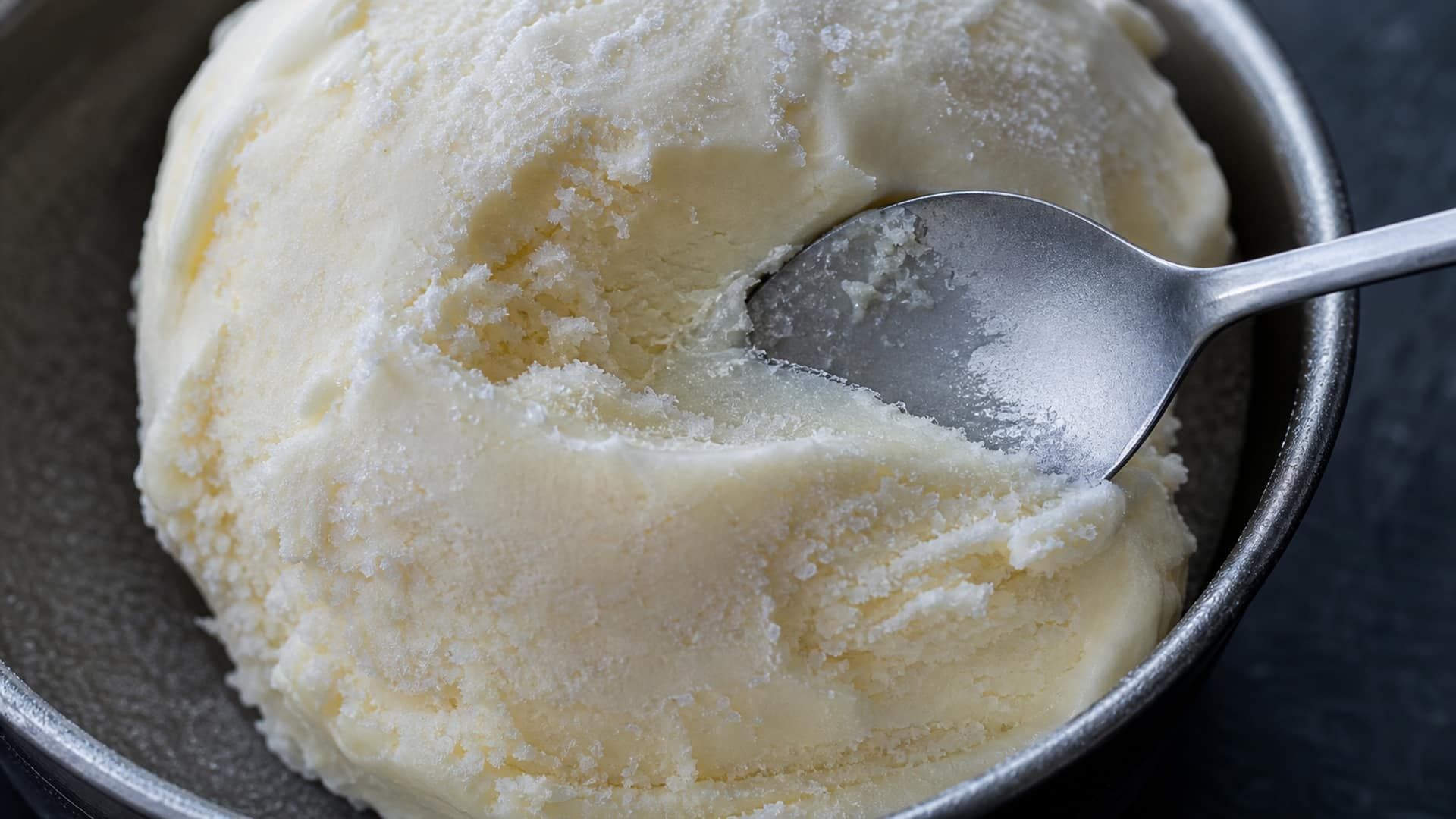
You pull your ice cream from the freezer and it is either a brick that bends the scoop, or a gritty, crystalline mass that used to be smooth. Both are common in homemade and small-batch ice cream, and they have different causes. Diagnose first, then apply the fix that matches.
Step 1: Diagnose your texture problem
The two faults can look alike in the container. When the problem appears tells you which one you have.
| Symptom | When it appears | Root cause | Fix category |
|---|---|---|---|
| Rock-solid at -18°C, impossible to scoop straight from the freezer | From the first serving | PAC too low: too much water frozen | Rebalance the sugars |
| Starts smooth, turns grainy or icy in storage | After days or weeks | Ice recrystallization: no or too little stabilizer, or temperature swings | Add stabilizer and fix storage |
| Frost layer on the surface | After the container has been opened or the freezer has warmed | Moisture moving to the lid and refreezing | Seal the surface, keep the temperature steady |
| Sandy mouthfeel throughout | From the first serving or after storage | Lactose crystals from too many milk solids | Reduce milk powder or other milk solids |
| Hard in the centre, softer at the edges | After long storage | Temperature gradients in the freezer | Store away from the door, improve packaging |
Texture problem diagnosis
Most common scenario
If the ice cream is hard immediately from the freezer, the cause is almost always low PAC. If it was fine when fresh and got worse over weeks, look at recrystallization: stabilizer and storage temperature.
Problem A: ice cream is too hard
PAC is the anti-freezing power of your sugars, counted with sucrose = 100. The higher the PAC per kilogram of mix, the more water stays unfrozen at -18°C and the softer the scoop. Each sugar has its own coefficient: dextrose and invert sugar sit near 190, lactose and maltose at 100.
POD and PAC Values for Ice Cream Sugars, with Calculator
Full coefficient tables for sugars, polyols and alcohol, plus a calculator that totals your blend.
The Formul.io ice cream calculator marks these PAC bands as optimal for each style:
| Style | PAC per kg of mix | POD per kg of mix |
|---|---|---|
| Ice cream | 260–300 | 150–190 |
| Gelato | 250–320 | 150–220 |
| Sorbet | 280–350 | 250–320 |
Optimal bands used by the Formul.io ice cream calculator.
More cream will not soften it
Cream adds fat and water but almost no sugar, so it dilutes the PAC per kilogram rather than raising it. Glucose syrup does not soften either: a DE 42 syrup is about PAC 80 on its solids (by molar mass, as the calculator counts it) and about 80% solids, so swapping it gram for gram for sucrose lowers PAC. Replace part of the sucrose with dextrose or invert sugar instead.
Problem B: ice cream turns icy in storage
If the ice cream is smooth when fresh but turns coarse after days or weeks, the cause is recrystallization. Below about 40 µm ice crystals feel smooth; above about 50 µm the tongue reads them as icy. During each warm spell small crystals melt, and on refreezing the water joins larger ones, so the crystal size climbs with every cycle.
Two things drive it: temperature swings in storage, and too little stabilizer to slow water movement in the unfrozen phase. Raising PAC does not protect against it; a softer mix melts more ice with each degree of warming.
Why swings matter more than the average
A freezer that averages -18°C but cycles up and down coarsens crystals faster than one that holds steady at the same average. Stabilizers slow recrystallization by thickening the unfrozen phase; they do not stop it, and they do not lower the freezing point.
| Factor | Low risk | High risk |
|---|---|---|
| Storage temperature | Steady at -18°C or colder | Repeated warm-ups toward -12°C |
| Stabilizer | 0.2–0.5% blend | None |
| Total solids (ice cream) | 36–42% | Low solids, more free water |
Recrystallization risk factors
Step-by-step fixes
Fixes 1–3 raise PAC for ice cream that is hard from the start. Fix 4 slows recrystallization. Fix 5 helps both. The numbers use the coefficients the Formul.io calculator applies.
Fix 1: Replace part of the sucrose with dextrose
Dextrose has PAC 190 and POD 75 against 100 for sucrose. Swapping 40 g of sucrose per kg of mix for 40 g of anhydrous dextrose adds about 36 PAC and removes about 10 POD: softer and slightly less sweet. Dextrose monohydrate is about 9% water, so it adds a little less.
Fix 2: Replace part of the sucrose with invert sugar
Invert sugar solids have PAC 190 and POD 125. Each 100 g of sucrose replaced by 100 g of invert solids adds 90 PAC and 25 POD. Invert usually comes as a syrup, so count only its solids: swapping 30 g of sucrose for 30 g of an 80%-solids invert syrup adds about 16 PAC with no change in sweetness.
Fix 3: Add a little sorbitol
Sorbitol has PAC about 188 and POD 60. Adding 20 g per kg of mix raises PAC by about 38 and POD by 12. In the EU, a food with more than 10% added polyols must carry the label warning that excessive consumption may produce laxative effects, so keep sorbitol a minor part of the sugars.
Fix 4: Add a stabilizer blend
Stabilizers do not change PAC, but they slow ice crystal growth during storage. A heated dairy mix usually takes locust bean gum with guar and a little carrageenan, at 0.2–0.5% of the mix in total. Locust bean gum needs heating to about 80°C to hydrate. Doses for each gum are in the stabilizer guide.
Fix 5: Get more air in and harden fast
Air softens the scoop by diluting the ice. Continuous freezers reach 50–100% overrun; a home batch machine makes a denser product, so chill both the bowl and the mix thoroughly before churning. Then move the ice cream straight to the coldest part of the freezer in a shallow, pre-chilled container so it hardens quickly with small crystals.
Ice Cream Stabilizers: Types, Rates and Selection Guide
Usage rates and blends for locust bean gum, guar, carrageenan and the other common stabilizers.
Keep sweetness in balance while you fix PAC
Every sugar swap that changes PAC also changes sweetness (POD). Dextrose lowers sweetness, invert sugar raises it slightly, and sorbitol adds less sweetness than PAC.
| Change per kg of mix | PAC change | POD change | Result |
|---|---|---|---|
| 40 g sucrose → 40 g anhydrous dextrose | +36 | -10 | Softer, slightly less sweet |
| 30 g sucrose → 30 g invert syrup, 80% solids | +16 | 0 | Softer, same sweetness |
| Add 20 g sorbitol | +38 | +12 | Softer, slightly sweeter |
| 36 g sucrose → 36 g glucose syrup DE 42, 80% solids | -13 | -27 | Firmer and less sweet; adds body, not softness |
Effect of common sugar swaps, using the Formul.io calculator coefficients
POD/PAC guideline: 0.55–0.70
The Formul.io calculator marks a POD/PAC ratio of 0.55–0.70 as optimal for ice cream. Use it as a guideline after the totals: first bring PAC to 260–300 and POD to 150–190, then check the ratio. Above 0.70, sweetness runs ahead of softness.
Check the fix in the calculator first
The cheapest batch to fix is the one you have not made yet. Enter the recipe in the Formul.io ice cream calculator before you churn.
Enter every ingredient with its weight
Include milk, cream, milk powder, sugars, stabilizers, fruit and any spirits. The calculator reads each ingredient's sugars, lactose and alcohol from its composition.
Read PAC and POD against the band
The calculator shows PAC and POD per kilogram of mix against the optimal band for the style. PAC below 260 for ice cream is a hardness risk.
Apply Fix 1, 2 or 3
Swap part of the sucrose for dextrose or invert sugar, or add a little sorbitol, and watch PAC and POD update.
Check the POD/PAC ratio
With both totals in their bands, confirm the ratio sits near 0.55–0.70. If sweetness dropped too far, move some dextrose back to invert sugar.
Storage practices that prevent iciness
A well-formulated ice cream still turns icy if it is stored badly. Temperature cycling is the main enemy: each warm-up melts some small crystals, and they refreeze onto large ones.
- Keep it at -18°C or colder. Small swings add up over weeks of storage.
- Avoid temperature cycling. Do not store it in the door. In a domestic freezer the back is coldest and steadiest.
- Seal the surface. Press a sheet of plastic wrap onto the ice cream before closing the lid, so moisture cannot move to the lid and come back as frost.
- Do not refreeze melted ice cream. Once it has softened toward melting, the crystal structure is coarse and refreezing locks it in.
- Harden it fast after churning. Use shallow, pre-chilled containers in the coldest spot; slow hardening grows large crystals.
Why homemade ice cream is often harder and icier
Homemade ice cream has three disadvantages against commercial ice cream:
- No stabilizer. Without locust bean gum, guar or carrageenan, crystals grow freely in storage.
- Less air. A home machine incorporates less air than a continuous freezer, so the ice cream is denser and feels harder.
- Slow hardening. A domestic freezer takes hours to harden a batch, and large crystals form meanwhile.
A small stabilizer dose, a sugar blend with enough PAC and fast hardening in the coldest part of the freezer close most of the gap.
Frequently asked questions
Why is my ice cream fine at -12°C but rock-solid at -18°C?
Can I add more cream to make ice cream softer?
How much does locust bean gum help with iciness?
Why does my ice cream get icy after I open the container?
My recipe uses only sucrose. What is the smallest change that softens it?
Does alcohol in ice cream affect hardness?
Related Topics
Related Articles
POD and PAC Values for Ice Cream Sugars, with Calculator
POD and PAC values for sucrose, dextrose, fructose, invert sugar, lactose, glucose syrup and polyols, a free sugar-balance calculator, and how to read the totals.
Ice Cream Stabilizers: Types, Rates and Selection Guide
Stabilizers control ice crystal size, overrun, and melt resistance in ice cream. This guide covers eight common stabilizers — usage rates, texture effects, and selection by product type — so you can formulate confidently.
Fior di Latte Gelato: 1 kg PAC Sugar-Balancing Example
Work through a 1 kg fior di latte base to balance PAC, sweetness, solids, serving temperature, and production validation.