Ice Cream Stabilizers: Types, Rates and Selection Guide
Stabilizers control ice crystal size, overrun, and melt resistance in ice cream. This guide covers eight common stabilizers — usage rates, texture effects, and selection by product type — so you can formulate confidently.
Start with heated dairy, a cold-process base or fruit sorbet; then compare rates and texture.
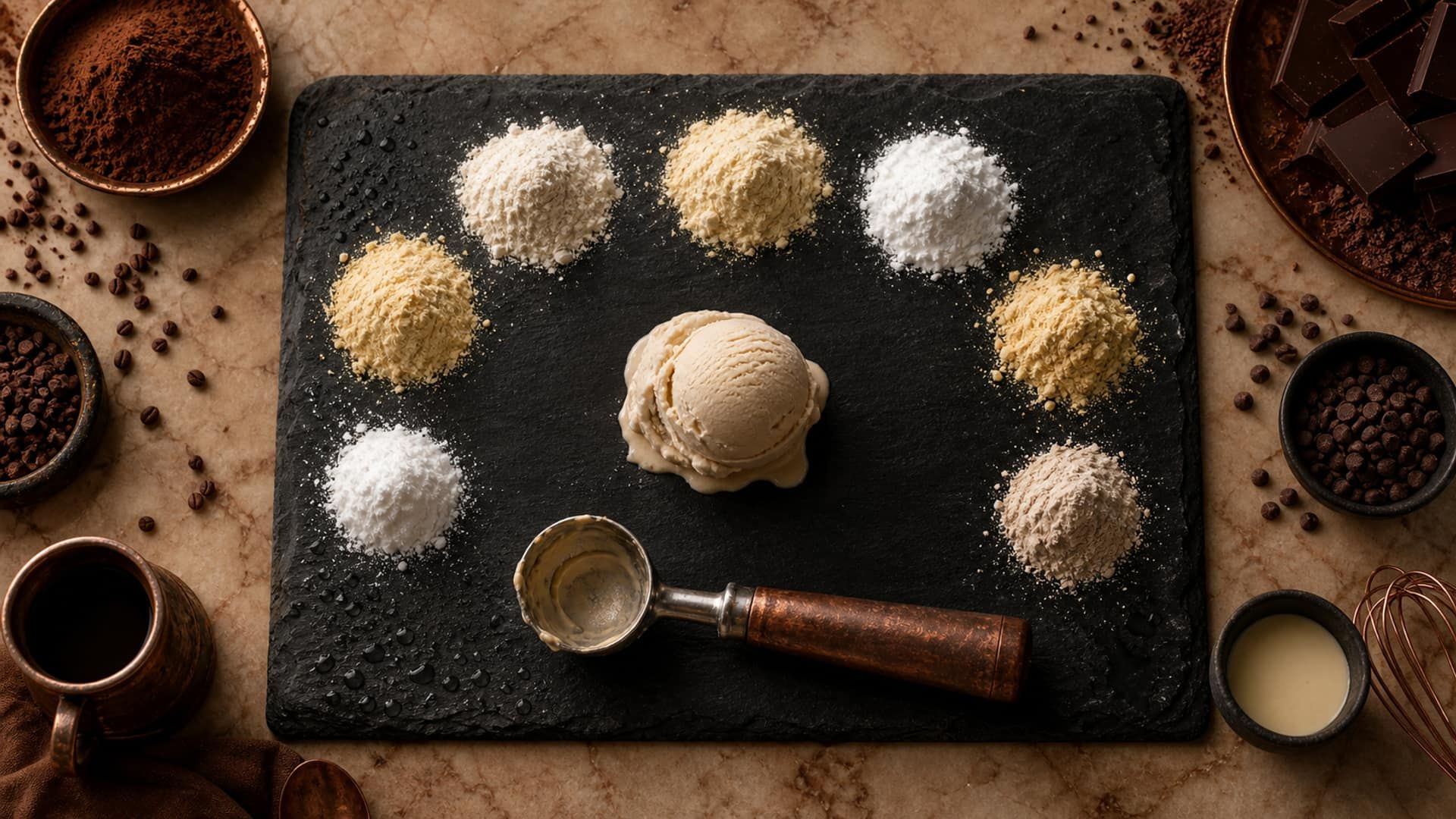
Which Stabilizer Gives Ice Cream a Smooth Texture?
For a heated dairy mix, an LBG–guar blend is a useful starting point: it adds body and helps limit ice recrystallisation during storage. A small secondary addition of carrageenan can address serum separation in dairy mixes. For a cold-process base, start with a blend specified to hydrate cold; guar is more soluble at low temperatures than conventional LBG.
The best choice follows your process and the defect you need to solve. A stabilizer helps maintain a smooth texture; the sugar balance, freezing and hardening process still determine how much ice forms and how easily the product scoops.
| Your process | Starting point | Check before increasing the dose |
|---|---|---|
| Heated dairy ice cream or gelato | LBG with guar; carrageenan as a secondary dairy stabilizer | Hydration conditions, serum separation and gumminess |
| Cold-process base | A supplier-specified cold-soluble blend, often using guar or CMC | That every component hydrates in your actual process |
| Fruit sorbet | A blend designed for fruit acidity and solids | Fruit composition, pH and the blend's hydration instructions |
| Already smooth but too hard to scoop | Review sugar balance and serving temperature | Use the POD/PAC guide before adding more gum |
Choose by process first, then refine the dose in your complete formulation.
For the last case, open the POD/PAC sugar-balancing tool. If the texture becomes icy during storage, compare your process with the hard or icy ice cream guide.
Why Stabilizers Matter
A stabilizer’s primary job is to control ice crystal size. During freezing, water organises into crystals; during storage and distribution, those crystals grow primarily through melt–refreeze recrystallisation — during temperature fluctuations, small crystals melt and water redeposits on surviving larger crystals during refreezing — with Ostwald ripening (curvature-driven diffusion) acting as a secondary mechanism during steady-state storage. A well-chosen stabilizer binds free water in the unfrozen phase, physically impeding crystal migration and keeping crystals below the ~40-micron threshold where texture feels smooth rather than icy.
Secondary functions include improving overrun stability (keeping air bubbles from coalescing during churning), slowing melt-down (the rate at which the product loses shape at room temperature), and providing body — the chew and resistance that distinguish premium ice cream from a thin, watery product.
Stabilizers also contribute to heat-shock resistance. During a warm excursion some ice melts; on cooling, water can join surviving crystals and make the texture coarser. A stabilizer blend can slow recrystallisation, while the degree of protection depends on the formulation, temperature cycle and storage time.
Total stabilizer dose: 0.2–0.5% of mix weight
Hydrocolloid gum stabilizers are rarely used individually above 0.3% by weight; gum blends are typically 0.3–0.5% total. Exceeding 0.5% total gum introduces off-textures: gumminess, sliminess, or excessive melt resistance. Modified starches (5–20 g/kg) and gelatine (5–10 g/kg) are different categories — they operate by different mechanisms and do not cause gumminess at their usage rates.
The Eight Core Stabilizers
| Stabilizer | Usage rate (g/kg mix) | Key texture effect | Overrun impact | Notes |
|---|---|---|---|---|
| Locust bean gum (LBG) | 1.0–2.0 | Strong crystal growth inhibition; smooth body | Neutral to slight reduction | Needs 80°C hydration; synergistic with guar and carrageenan |
| Guar gum | 1.0–2.0 | Viscosity builder; amplifies LBG effect on body | Moderate increase when used with LBG | Cold-soluble; works in unheated mixes |
| Carrageenan (κ or λ) | 0.1–0.2 | Prevents wheying-off via interaction with κ-casein; reduces instrumental hardness and controls melt-down | No significant effect | κ-type gels on cooling; λ-type stays fluid — use λ for soft serve |
| CMC (carboxymethylcellulose) | 1.0–2.0 | Viscosity-only thickener; weak standalone crystal control; effective in blends with carrageenan or LBG | Slight increase in blends | Cold-soluble; budget-friendly; suitable for unheated mixes |
| Xanthan gum | 0.5–1.0 | High viscosity at rest; thins under shear | Can reduce if used alone above 1 g/kg | Cold-soluble; creates ropey, slimy mouthfeel above ~1 g/kg due to pseudoplastic rheology — generally compatible with milk proteins; blend with CMC or guar to moderate rheology |
| Pectin (LM type) | 1.0–2.0 | Slows melt-down; mild crystal control | Neutral to slight reduction | Best for fruit-based sorbets and sherbets; less effective in full-dairy mixes |
| Gelatine (200 bloom) | 5.0–10.0 | Excellent crystal inhibition; clean-melt texture | Supports overrun by stabilising foam | Bloom 30+ min cold; dissolve at 60°C; full mix aging 4–24 h required; 7–10 g/kg gives elastic texture — 3–5 g/kg more typical for hard-pack; animal-derived |
| Modified starch (acetylated or cross-linked) | 5.0–20.0 | Body and freeze-thaw stability; foam support | Moderate support in high-dose systems | Higher dose vs gums; adds bulk solids; good in low-cost mixes. OSA-modified starch is a surface-active emulsifier (egg-yolk replacer) — not a primary crystal-growth stabilizer |
Usage rates and primary effects of the eight core ice cream stabilizers. Sources: icecreamscience.com; dreamscoops.com
Stabilizer Blends vs. Single Hydrocolloids
No single stabilizer performs all required functions. The professional approach is to combine 2–3 stabilizers in a synergistic blend where the total hydrocolloid gum dose remains below 0.5% while delivering effects no single ingredient achieves alone.
The classic blend is LBG + guar gum + κ-carrageenan: LBG controls crystal growth, guar amplifies body and viscosity, and κ-carrageenan prevents the phase separation (wheying-off) that LBG alone can cause in dairy mixes — the underlying mechanism is thermodynamic incompatibility (depletion flocculation) between galactomannans and casein micelles, which accelerates during pasteurisation.
An alternative blend used in cost-sensitive products replaces LBG with CMC, pairing CMC 1.5 g/kg + guar 0.5 g/kg + κ-carrageenan 0.15 g/kg. CMC is significantly less expensive than LBG and is cold-soluble, which simplifies processing. Its crystal-inhibition effect is weaker, however, making this blend better suited to products with a short shelf life (four to eight weeks) rather than long retail runs requiring six months of storage stability.
Gelatine, when used as the primary stabilizer at 7–10 g/kg, can replace the entire gum system in artisan hard ice cream. It hydrates fully at 60°C and develops a three-dimensional protein gel network during the aging step that impedes both crystal growth and air bubble coalescence simultaneously. The trade-off is longer processing time and the requirement to source and handle a perishable animal-derived ingredient.
LBG and milk protein incompatibility
LBG alone does not prevent the wheying-off that occurs in heated dairy mixes. The mechanism is thermodynamic incompatibility (depletion flocculation) between galactomannans and casein micelles — heat accelerates this phase separation but is not its sole trigger; wheying-off can also develop in unheated mixes over time. Kappa-carrageenan at 0.1–0.15 g/kg prevents this via its sulfate groups interacting specifically with kappa-casein on micelle surfaces, maintaining colloidal stability through pasteurisation and aging.
Selecting a Stabilizer by Product Type
The right stabilizer depends on whether you are making hard-pack ice cream, gelato, or soft serve — because each product has a different thermal history, overrun target, and service temperature.
Hard-pack ice cream (overrun 60–90%, stored at -18°C)
Use LBG 1.5 g/kg + guar 1.0 g/kg + κ-carrageenan 0.15 g/kg. This blend delivers maximum crystal-growth inhibition during months of frozen storage and heat-shock resistance for retail distribution. LBG requires heating to 80°C for full hydration — incorporate it in the pasteurisation step. Guar is cold-soluble and hydrates during mix-out; it does not need a heat step. Age the mix 4–24 h at 4°C before freezing to allow full viscosity development.
Gelato (overrun 20–40%, served at -9°C to -11°C)
Use a lighter blend: LBG 0.8–1.0 g/kg + guar 0.5 g/kg, optionally with κ-carrageenan 0.1 g/kg. Gelato's lower overrun and warmer serving temperature demand less aggressive crystal inhibition, and heavy stabilisation creates a gummy mouthfeel at the soft serving temperature. Traditional Italian gelato often uses only 0.3–0.5% of a commercial stabiliser blend — do not over-stabilise.
Soft serve (overrun 40–60%, served immediately, no hardening)
Use cold-soluble gums only: λ-carrageenan 0.1–0.15 g/kg + CMC 1.0–1.5 g/kg ± guar 0.5 g/kg. Soft serve mixes are not always pasteurised by the operator, and the product is consumed immediately without a storage phase. Heat-requiring gels (LBG, κ-carrageenan, gelatine) are less critical here. λ-carrageenan (unlike κ) does not gel on cooling and is suitable for liquid soft-serve mixes.
Sorbet and fruit sherbet
Use LM pectin 1.0–2.0 g/kg alone or combined with xanthan 0.5 g/kg. Pectin is extracted from citrus peel and apple pomace and performs well in high-acid, fruit-based systems where dairy proteins are absent. Xanthan adds shear-thinning viscosity that aids mouth-coating. Gelatine can be used for sorbets where a vegan claim is not required.
Overrun: How Stabilizers Affect Air Incorporation
Overrun — the volume increase from air incorporation during churning — is not controlled by stabilizers directly, but stabilizers influence how well the mix holds air once incorporated.
Fat content and total solids independently influence overrun capacity: a mix with 10–14% fat and 36–42% total solids aerates more consistently than a low-fat mix. Stabilizers work best when the base formula is already well-balanced — they amplify a good mix; they cannot fully compensate for a poorly formulated one.
Guar gum increases mix viscosity before freezing, which slows the rate of air bubble coalescence and gives a more uniform bubble size distribution — translating to a lighter, smoother texture at the same overrun percentage. LBG’s primary function is crystal-growth inhibition; its secondary overrun contribution is foam stabilisation during hardening — increased viscosity in the unfrozen phase helps maintain the dispersed structure as the mix freezes.
Excessive xanthan (above 1.0 g/kg used alone) raises viscosity so high that air incorporation by the dasher is impeded, reducing overrun — a common error when formulators reach for xanthan without blending.
Practical Formulation Steps
Choose your blend based on product type
Hard ice cream: LBG + guar + κ-carrageenan. Gelato: LBG + guar (light dose). Soft serve: CMC + λ-carrageenan. Sorbet: pectin ± xanthan. Write down the target dose for each component — keep the total hydrocolloid gum dose below 0.5% of mix weight.
Incorporate heat-requiring stabilizers during pasteurisation
LBG requires 80°C for 20–30 min to fully hydrate and develop viscosity. Gelatine needs to bloom in cold water for 30+ minutes, then dissolve at 60°C; the full mix aging hold is 4–24 hours — blooming gelatin and aging the mix are separate steps. Pre-mix powdered stabilizers with 5× their weight in sucrose to prevent clumping before adding to the warm mix.
Age the mix before freezing
After pasteurisation and homogenisation, chill the mix to 4°C and age for a minimum of 4 hours — ideally 12–24 hours. Aging allows LBG to reach full viscosity, fat to partially crystallise (improving overrun), and emulsifiers to adsorb onto fat globule surfaces. Skipping aging is the most common cause of low overrun and poor body.
Validate texture and melt-down after the first trial
Compare equal samples under the same conditions: for example, record drip mass after 30 minutes on a mesh at 20°C. Keep sample shape, starting temperature and overrun consistent. Use the results alongside mouthfeel to choose the better formulation rather than applying one universal retention percentage.
Why does my ice cream feel slimy after adding xanthan gum?
Can I use gelatine in gelato and still call it artisan?
How do I know if I am using too much stabilizer?
What is the difference between κ-carrageenan and λ-carrageenan for ice cream?
Should I use a commercial stabilizer blend or formulate my own?
Does the stabilizer change how I should adjust PAC (anti-freezing power)?
Related Topics
Related Articles
POD and PAC Values for Ice Cream Sugars, with Calculator
POD and PAC values for sucrose, dextrose, fructose, invert sugar, lactose, glucose syrup and polyols, a free sugar-balance calculator, and how to read the totals.
Ice Cream Too Hard or Icy? Find the Cause and Fix It
Rock-hard straight from the freezer and icy after a week are two different faults. Diagnose which one you have, then fix it with sugar swaps, stabilizer and storage.
Glucose Syrups and Dextrose Equivalent Explained
Comprehensive analysis of glucose syrups, Dextrose Equivalent (DE) impact on confectionery formulations, and the functional differences between syrup and powder forms.