Gelato vs. Ice Cream: Formulation Science Explained
Fat content, overrun, PAC/POD targets, and stabilizer strategy diverge sharply between gelato and ice cream. Understanding why each lever differs is the foundation of formulating either product correctly.
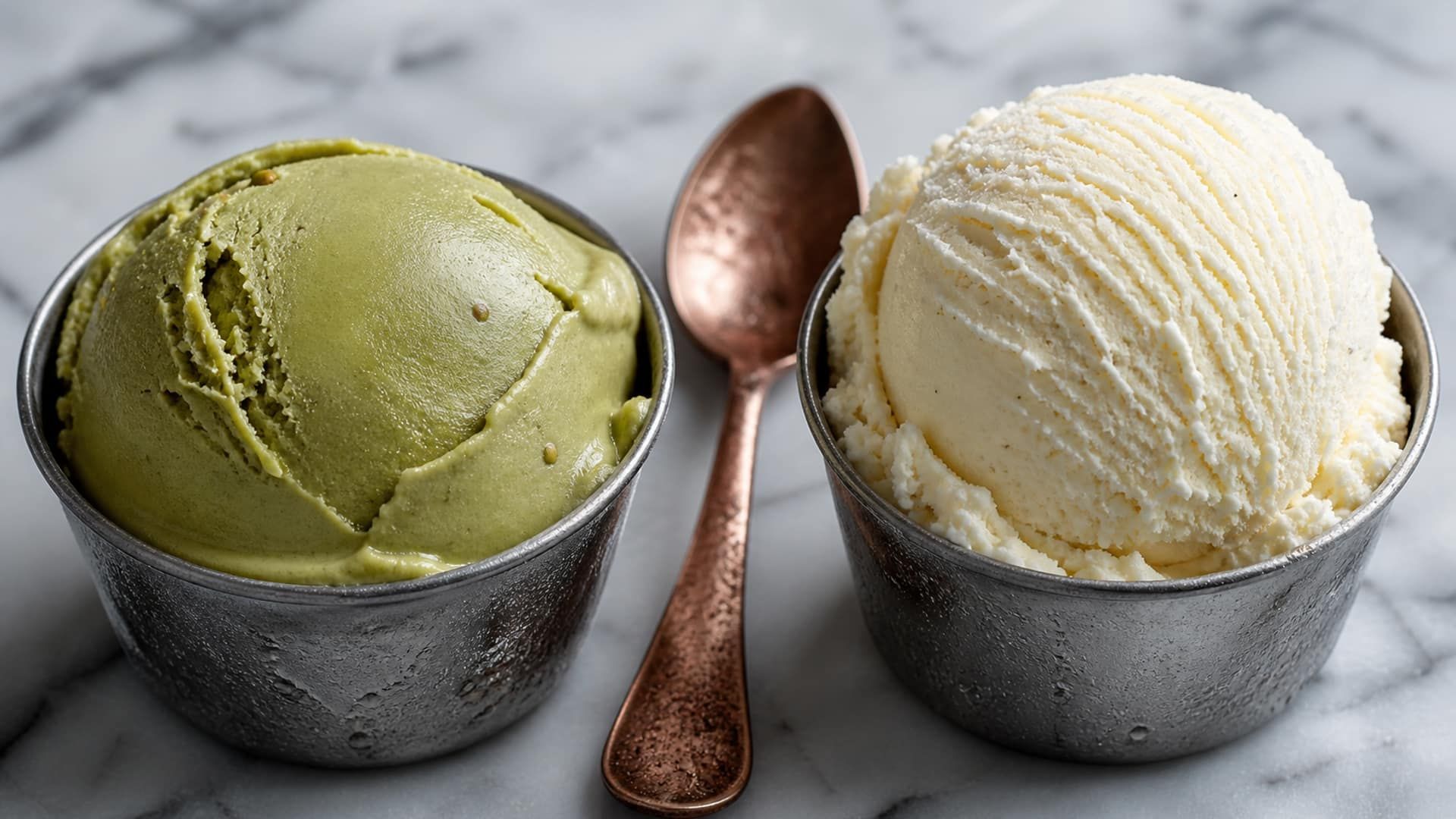
Two Products, One Shared Framework
Gelato and ice cream are both frozen emulsions of fat, water, sugar, and air — but each variable in that description sits at a different setpoint. Understanding the why behind each difference is the prerequisite for formulating either product reliably, and for diagnosing texture failures when they occur.
The four primary levers are: fat content, overrun (air incorporation), PAC/POD balance, and stabilizer system. Each interacts with the others. Pull one lever without accounting for the rest and texture suffers.
Fat Content and Overrun: The Structural Pair
Fat and air are structurally coupled because fat globules stabilise air bubbles during churning. Gelato commonly contains 4–8% fat and about 20–35% overrun (some artisan products are near 15%). By contrast, standard/economy hard-pack ice cream commonly reaches roughly 90–120% overrun, while premium products are often around 50–90%.
| Parameter | Gelato | Standard Ice Cream | Premium Ice Cream |
|---|---|---|---|
| Fat content | 4–8% | 10–14% | 12–16% |
| Overrun | ~20–35% (artisan can be ~15%) | ~90–120% | ~50–90% |
| Dairy base | Whole milk dominant | High cream content | High cream + egg yolks |
| Serving temperature | -11°C to -13°C | -14°C to -16°C | -14°C to -16°C |
| Texture result | Dense, silky, concentrated | Light, fluffy, rich | Creamy, moderately airy |
Primary formulation parameters for gelato versus ice cream product types
The low overrun in gelato is deliberate, not a processing limitation. Artisan gelato churns slowly to limit air uptake. The result is a product that weighs significantly more per volume and delivers a denser, more concentrated flavour in each spoonful. Standard ice cream can double in volume during churning — a litre of mix yields two litres of finished product.
Low fat in gelato has two formulation consequences that require active compensation:
- Less structural fat means air bubbles collapse faster — the stabilizer system must work harder to maintain overrun and body.
- Less fat means colder temperature sensitivity — fat does not freeze, so higher fat ice cream remains pliable at lower temperatures even before PAC is fully optimised.
The warmer serving temperature of gelato (-11°C to -13°C in the display cabinet) partially compensates for the lower fat: a product that would be icy and brittle at -18°C can be soft and silky at -11°C. Artisan gelato is held and served from a display cabinet in that warmer range — not at the -18°C of a hard-pack freezer — and that warmer hold-and-serve window is what lets a leaner, softer mix stay scoopable.
PAC, POD, and Serving Temperature
PAC (Potere Anti Congelante — anti-freezing power) quantifies how much a formula depresses the freezing point relative to sucrose. The higher the PAC, the softer the product at any given temperature.
PAC and serving temperature are linked, but cause and effect run opposite to the intuitive reading. The fraction of water frozen at a given temperature follows the mix’s freezing curve: the colder you go, the more of the water turns to ice and the firmer the product. A higher-PAC mix sits lower on that curve — less ice at any temperature, softer everywhere. So reaching the same ~65–70% frozen fraction at a warmer temperature takes less freezing-point depression, not more.
That is exactly why a high-PAC gelato is served warm: its sugar load keeps so much water unfrozen that at -18°C it would be too soft to scoop. The warm cabinet is a consequence of the high sugar, not its cause. Gelato carries that higher sugar for two reasons unrelated to serving temperature — to compensate for its low fat (which otherwise leaves the body thin and the texture coarse) and to lift flavour. Serving it warm is what lets the higher sugar load stay scoopable instead of turning soupy.
Practical PAC implications for gelato:
- Sucrose alone may not provide the desired balance. Replacing a portion with dextrose increases freezing-point depression without proportionally increasing sweetness. Typical balancing tables put anhydrous dextrose and fructose near PAC 190 when sucrose is 100; dextrose monohydrate is lower because the crystal water adds mass.
- Higher sugar total. Gelato sugar content is typically 16–22% of the mix versus 14–18% in ice cream — carried to compensate for the low fat and to lift flavour, not to chase a freezing point. Dextrose lets that larger sugar load raise PAC without over-sweetening.
POD (Potere Dolcificante — sweetness power, normalised to sucrose = 100) follows a different logic. Lower fat in gelato means fat does not coat the palate and suppress flavour. Warmer serving temperature means taste buds are more sensitive. Together, these factors allow gelato to achieve equivalent perceived sweetness at lower POD than ice cream. Ice cream’s higher fat level mutes sweetness, requiring a higher POD to compensate. When reformulating from ice cream to gelato, adjust both PAC (increase) and POD (can decrease or maintain) together — not independently.
The dextrose lever in gelato
Substituting part of the sucrose with dextrose raises PAC substantially while dextrose contributes only about 70–75% of sucrose’s sweetness. A 30–40% substitution is a useful trial range, not a universal target: use the coefficient for the actual anhydrous or monohydrate product and recalculate total POD, PAC, solids, and frozen-water fraction.
Stabilizer Systems: Neutro vs. Gum Blends
The stabilizer approach for gelato diverges from ice cream in both composition and philosophy.
Ice cream uses hydrocolloid gum blends — typically LBG + guar + kappa-carrageenan — at a total dose of 0.2–0.5% of mix weight. When egg yolks are present (custard-style), they supply natural lecithin emulsification, and the gum blend handles water and ice crystal control. The fat content (10%+) contributes substantially to structural stability, reducing the stabiliser workload.
Gelato uses a Neutro — a combined stabilizer-and-emulsifier blend. Because most gelato is egg-free (or nearly so), emulsification must be provided by the Neutro separately from gum-based crystal control.
Ice Cream Stabilizer Approach
Pros
- • LBG + guar + kappa-carrageenan blend at 0.2–0.5% mix weight
- • Egg yolks (in custard bases) supply natural lecithin emulsification
- • High fat content provides baseline structural stability
- • Individual gums can be tuned per product type (hard-pack vs. soft serve)
Cons
- • Gum blends need heat for full hydration (LBG requires 80°C+)
- • Carrageenan interactions with casein must be managed
- • Over-stabilisation creates gummy, stringy texture
Gelato Neutro Approach
Pros
- • Combined stabilizer + emulsifier in one blend (typically 40% stabilizer, 60% emulsifier)
- • Compensates for absent egg yolk emulsification in most gelato
- • Dosed at 3–5 g/kg mix, proportional to lower fat content
- • Cold-soluble versions available for no-heat gelato processes
Cons
- • Proprietary Neutro blends obscure individual component ratios
- • Cannot fine-tune individual stabilizer dose without building from scratch
- • Low fat means less structural redundancy if stabilizer is under-dosed
Gelato’s lower fat means each gram of stabilizer must do more work. A gum dose adequate for 12% fat ice cream may be insufficient for 6% fat gelato — the fat is no longer there as a structural buffer. Low-fat mixes also have lower viscosity before freezing, which accelerates ice crystal growth during churning. A well-dosed Neutro counteracts this by increasing mix viscosity and providing water-binding from the stabilizer component alongside the emulsifier’s role in fat-globule control. The practical guidance: total solids for gelato should be 36–42%, with the MSNF (milk solids non-fat) component at 8–12% providing body and viscosity that compensates partly for the fat reduction.
| Product | Total Stabilizer Dose | Stabilizer Type | Emulsifier | Total Solids Target |
|---|---|---|---|---|
| Gelato | 3–5 g/kg mix | LBG + guar or CMC (light blend) | Mono/diglycerides via Neutro | 36–42% |
| Hard-pack ice cream | 2–4 g/kg mix (gums) | LBG + guar + kappa-carrageenan | Egg yolk or polysorbate 80 | 36–42% |
| Soft serve | 2–3 g/kg mix | CMC + lambda-carrageenan | Mono/diglycerides or polysorbate | 32–38% |
| Sorbet | 2–4 g/kg mix | LM pectin + xanthan | None (no fat) | 28–36% |
Stabilizer and total solids targets across frozen dessert types
Formulation Implications: Moving Between Products
The differences above have practical consequences when you are adapting an existing ice cream formula into gelato, or scaling a gelato to a packaged product.
Reduce fat: replace cream with whole milk
Drop fat from 12–14% to 6–8% by substituting cream with whole milk. This increases water content in the mix, which lowers total solids and raises the free-water fraction available for ice crystal formation. Compensate by increasing MSNF (milk powder) to 10–12% to rebuild solids.
Reduce overrun target: slow the churn
Target roughly 20–35% overrun instead of the ~50–120% range used across premium through standard hard-pack ice cream. Slow churning speed reduces air uptake. At low overrun, the machine residence time may need to be shorter — pull the gelato when it reaches -6°C to -8°C at the barrel exit, before it over-whips.
Recalculate PAC: replace 30–40% sucrose with dextrose
Increase PAC from the ice cream range (230–260) to the gelato range (260–300). The most controlled way: swap 30–40% of sucrose mass with dextrose. For a 1 kg gelato base with 180 g sucrose, replace 60–70 g sucrose with dextrose. Recalculate POD to confirm sweetness remains adequate — dextrose POD is 70 vs. sucrose 100.
Switch stabilizer system: build or buy a Neutro
If the ice cream formula uses egg yolks, the gelato version needs a Neutro to supply emulsification. A starting Neutro for gelato (per kg mix): LBG 1.0 g, guar 0.5 g, lambda-carrageenan 0.15 g, mono/diglycerides 3.0 g. Dose at 4–5 g/kg total. Adjust if the melt-down test shows instability.
Validate at gelato cabinet temperature, not freezer temperature
Set your validation display cabinet to -11°C and test scoopability, melt-down (retain 70–80% weight after 30 min at 20°C), and texture. A gelato checked only at -18°C will read as far too firm — the relevant serving condition is the warmer cabinet temperature.
Gelato to packaged retail: the PAC trap
Artisan gelato served at -11°C from a display cabinet does not survive retail distribution at -18°C without reformulation. At -18°C, the high PAC that keeps gelato scoopable in the cabinet produces a product that is too soft for packaging, transport, and hard-pack retail. For retail gelato at -18°C, lower PAC toward the ice cream range (240–260) and accept a firmer texture — or specify that the product must be tempered at -12°C before serving.
Does gelato need a higher PAC because it is served warmer?
Can I make gelato by simply reducing cream in an ice cream recipe?
What is a Neutro and when do I need one?
Why is gelato flavour more intense than ice cream at the same sugar level?
How does stabilizer dose change when I reduce fat from 12% to 6%?
How do I calculate PAC for a gelato mix without specialist software?
References
- Goff, H. D. & Hartel, R. W. (2013). Ice Cream, 7th ed. Springer.
- Goff, H. D. Ice Cream Technology: formulation considerations. University of Guelph.
- Clarke, C. (2018). Controlling the hardness of ice cream, gelato and similar frozen desserts. Food Science and Technology.
- CyberColloids. Ice cream classifications and typical overrun ranges.
Related Articles
POD and PAC Values for Ice Cream Sugars, with Calculator
POD and PAC values for sucrose, dextrose, fructose, invert sugar, lactose, glucose syrup and polyols, a free sugar-balance calculator, and how to read the totals.
Ice Cream Stabilizers: Types, Rates and Selection Guide
Stabilizers control ice crystal size, overrun, and melt resistance in ice cream. This guide covers eight common stabilizers — usage rates, texture effects, and selection by product type — so you can formulate confidently.
Ice Cream Too Hard or Icy? Find the Cause and Fix It
Rock-hard straight from the freezer and icy after a week are two different faults. Diagnose which one you have, then fix it with sugar swaps, stabilizer and storage.