Stabilizing Ice Cream and Sorbet: A Complete Guide
Stabilizing a frozen dessert means controlling water, ice crystals, air, and the unfrozen phase across the whole cold chain. This guide walks the system end to end — building blocks, process, stabilizer choice, and target ranges for both dairy ice cream and dairy-free sorbet.
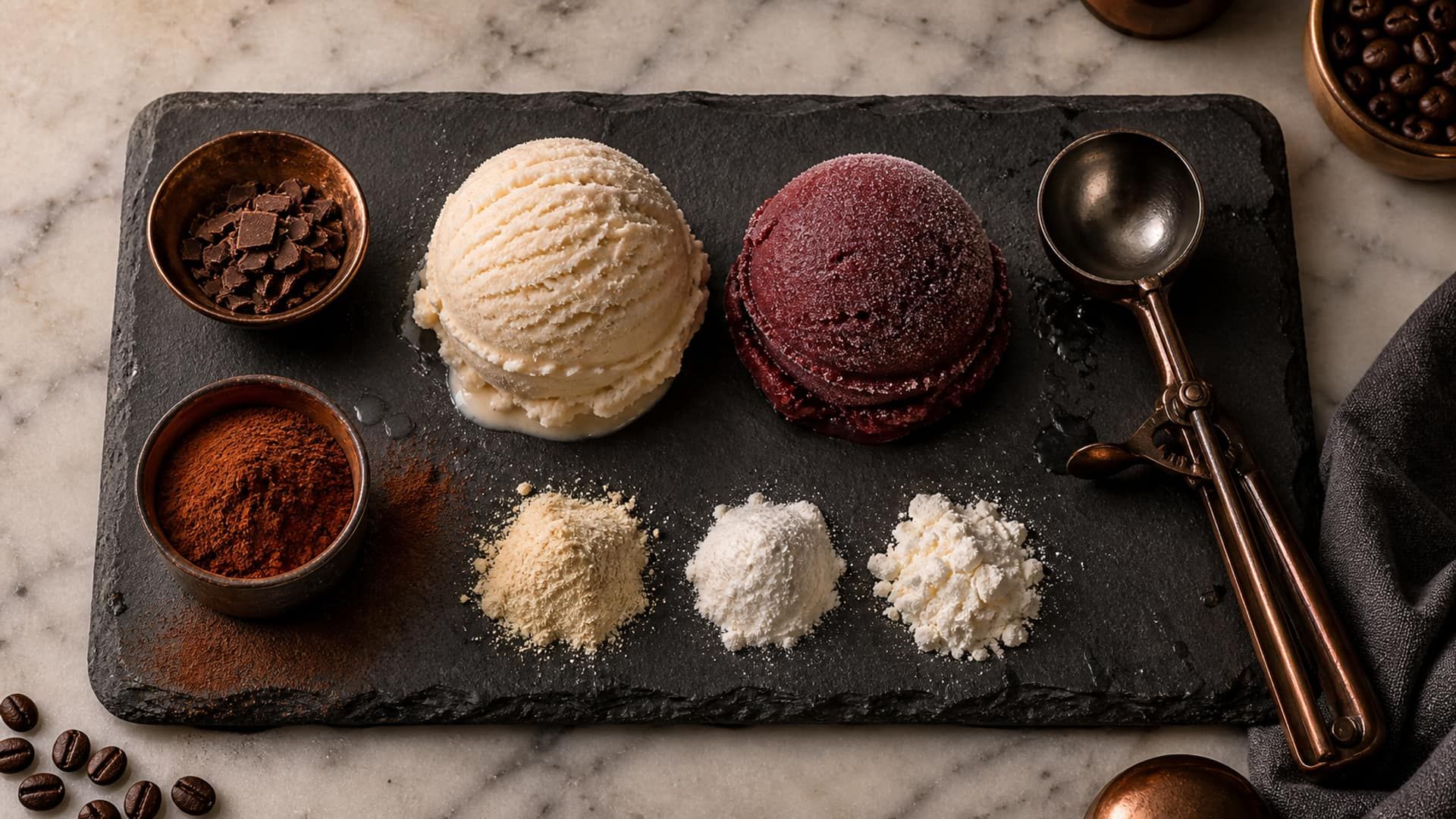
What “Stabilizing” Really Means
A frozen dessert is a partly frozen foam: ice crystals, air bubbles, fat globules, and unfrozen syrup all coexisting below 0°C. Stabilizing is not one additive — it is the practice of keeping that four-phase system smooth and scoopable from the freezer door to the spoon.
Four things move during storage and distribution, and each degrades texture. Water migrates and refreezes onto existing crystals, coarsening them. Air bubbles coalesce and the product deflates. The unfrozen syrup phase shifts with temperature, hardening or softening the scoop. Fat globules destabilise or stay too dispersed to give body.
Control all four and you have a stable dessert. The lever for crystal size is a hydrocolloid stabilizer plus enough dissolved solids. The lever for the scoop — how hard the product is at serving temperature — is the sugar blend and its freezing-point-depression power. They are designed together, never independently.
Stabilizing is a system, not a single ingredient
Adding a gum at the mixer does not “stabilize” a poorly balanced mix. A stable dessert needs the right total solids, the right sugar blend for the target serving temperature, AND a hydrocolloid to bind free water. Skip any one and the others cannot compensate. Sorbet proves the point — it carries zero fat yet stays smooth when sugar and fruit solids are balanced correctly.
The Building Blocks of a Frozen Dessert
Five components set the behaviour of the finished mix. Get their proportions right and the dessert is forgiving; get them wrong and no stabilizer will rescue it.
Air and Overrun
Overrun is the volume increase from air whipped in during churning. More air means a lighter, softer scoop; less air means a denser, colder-eating product. Air is structural, not filler — the bubbles must be small and stable or the product feels coarse and collapses.
Water and Ice
Water is the phase you are fighting. Roughly 55–65% of an ice cream mix is water, and how that water freezes decides everything. Smooth texture means keeping crystals below the ~40-micron threshold; above ~50 microns the product reads as icy. Bound water — held by dissolved solids and the stabilizer network — cannot migrate to grow large crystals.
Sugars and Antifreeze Power
Sugars do two jobs at once: they sweeten and they depress the freezing point, keeping part of the water liquid at serving temperature so the scoop yields to a spoon. Different sugars pull these two levers by different amounts. The KB tracks this with two coefficients — POD (relative sweetness, sucrose = 100) and PAC (anti-freezing power, sucrose = 100).
| Sugar | Approx. solids | POD (sweetness, sucrose=100) | PAC (anti-freeze, sucrose=100) | Formulation role |
|---|---|---|---|---|
| Sucrose | 100% | 100 | 100 | Reference; backbone of most blends |
| Dextrose (glucose) | 92% | 70 | 190 | Softens the scoop; raises PAC without over-sweetening |
| Invert sugar | 75% | 130 | 190 | High PAC and high sweetness; use sparingly |
| Glucose syrup (DE 42) | 80% | 50 | 60 | Adds solids and body; mild PAC; resists crystallisation |
| Fructose | 100% | 173 | 190 | Very high sweetness and PAC; small doses only |
Indicative sweetness (POD) and anti-freezing (PAC) coefficients relative to sucrose. Exact values vary by source and purity — design the blend to a target, not a single sugar.
A mix built on sucrose alone freezes too hard to scoop straight from a −18°C freezer. Replacing part of the sucrose with dextrose or a low-DE glucose syrup raises total PAC, softening the scoop while a low-DE syrup simultaneously adds solids and chew. This sugar-balancing logic is the heart of the POD and PAC framework.
Fats and Solids
Fat — 10–14% in standard ice cream, up to ~16% in super-premium — coats the palate, carries flavour, and stabilises the foam through partial coalescence of fat globules around air cells. Total solids (fat + sugars + milk-solids-non-fat + stabilizer) should land at 36–42% for ice cream. Solids are what is left to taste and chew once the water is removed; too few and the product is thin and icy, too many and it is heavy and sandy.
The Production Process, Step by Step
How you process the mix matters as much as what is in it. Each stage builds the structure the stabilizer relies on.
Mix and pasteurise
Combine liquids, then dry ingredients pre-blended with sucrose to prevent clumping. Pasteurise to a hold that hydrates heat-set stabilizers (locust bean gum needs ~80°C) and disperses fat. Pasteurisation also delivers food safety, but its formulation job is full hydration of the stabilizer system.
Homogenise
Drive the warm mix through a homogeniser to break fat into sub-micron globules. A fine, uniform fat dispersion is what later allows controlled partial coalescence around air cells — the source of a dry, stable, slow-melting body.
Age (mature) the mix
Chill to 4°C and hold 4–24 hours. Aging lets the stabilizer reach full viscosity, fat partially crystallise, and emulsifiers adsorb onto fat surfaces. Skipping aging is the most common cause of low overrun and weak body — it is not optional for a stabilized mix.
Churn and freeze
Freeze with agitation so air is whipped in to the target overrun while the dasher scrapes ice off the barrel wall. Fast freezing with vigorous agitation makes many tiny crystals; slow or static freezing makes few large ones. This is where crystal size is set.
Harden
Drop the core to −18°C or below as fast as possible. Rapid hardening locks crystals at the small size the churn created; slow hardening lets them grow. After hardening, hold the cold chain steady — every melt-refreeze cycle coarsens the texture.
Choosing a Stabilizer System
No single hydrocolloid does every job, so professionals build a blend of two or three. A typical system pairs a crystal-control gum with a viscosity builder and, in dairy, a protein-protecting gel.
A classic dairy blend is locust bean gum + guar + a small dose of carrageenan: the locust bean gum inhibits crystal growth, guar builds viscosity and body, and carrageenan stops the phase separation (wheying-off) that galactomannans alone can cause in milk. Total hydrocolloid gum dose stays in the 0.2–0.5% band — push past 0.5% and the product turns gummy or slimy. Other categories sit outside that band by different mechanisms: gelatine works at 5–10 g/kg (never above 15 g/kg, where texture turns rubbery), and modified starches at 5–20 g/kg.
Incorporation depends on the stabilizer. Hot-process gums (locust bean gum, κ-carrageenan, gelatine) must be hydrated in the heated mix during pasteurisation. Cold-process gums (guar, CMC, λ-carrageenan, xanthan) hydrate in unheated mixes — useful for soft-serve bases that are never pasteurised by the operator. Note that CMC thickens by viscosity only; it does not form a true gel network on its own.
Blend, don't overdose
If one gum is not delivering, the answer is rarely more of it. Above 0.5% total gum you trade one defect (icy) for another (gummy or stringy). Add a complementary gum at a low dose instead — and for the type-by-type rates, mechanisms, and product-specific blends, see the dedicated stabilizer guide below.
For the eight core stabilizers with exact usage rates and selection by product type, see the ice cream stabilizer guide.
Sorbet: Stabilizing Without Dairy
Sorbet is the hard case. With zero fat and no milk solids, there is no butterfat or lactose to temper crystals — only sugar and fruit fibre stand between you and an ice block. Everything that gives ice cream its margin for error is absent.
The fix is solids and sugar — and sugar is the bulk of a sorbet’s solids, with fruit fibre and a little stabilizer making up the rest. A balanced sorbet runs 20–28% sugar inside a 28–34% total solids window, so total solids always sit above the sugar level, never below it. On a refractometer that lands around 28–30 Brix. Below ~26 Brix the sorbet freezes rock-hard and tastes watery; push much above ~32 and it may never freeze firm. Because fruit is mostly water — often 80%+ — you balance each fruit individually: a low-Brix fruit needs more added sugar and sometimes added solids (dextrose, a low-DE glucose syrup, or fibre) to reach the target.
Stabilizers in sorbet lean on the fruit side of the catalogue. Low-methoxyl pectin and locust bean gum bind free water and slow melt-down; a touch of guar or xanthan adds mouth-coating viscosity. Keep the total gum dose in the same 0.2–0.5% band — sorbet is no more tolerant of overdosing than dairy ice cream.
Putting It Together: Target Ranges
Balance is a set of overlapping windows. Hit them all and the dessert is smooth, scoopable, and stable; miss one and a defect surfaces.
| Parameter | Ice cream | Sorbet | Why it matters |
|---|---|---|---|
| Water | 55–65% | 66–72% | The phase you freeze; less water = fewer/smaller crystals |
| Sugar | 14–18% | 20–28% | Sweetness plus freezing-point depression (PAC) |
| Fat | 10–14% | 0% | Body, flavour carrier, foam stability |
| Total solids | 36–42% | 28–34% | What is left to taste and chew; fights iciness; always exceeds sugar |
| Total gum stabilizer | 0.2–0.5% | 0.2–0.5% | Binds free water; controls crystal growth |
Working balance windows for a smooth, scoopable frozen dessert. Treat them as overlapping targets, not independent dials.
Validate empirically. Run a 30-minute melt-down test at 20°C: a well-stabilized product retains 70–80% of its weight; over 90% means too much stabilizer (gummy), and a fast collapse means too little (or thin solids). Check scoopability straight from −18°C — if it is rock-hard, raise PAC with dextrose or invert sugar; if it is slushy, the sugar blend carries too much PAC. For a full diagnostic of a too-hard or icy scoop, see why ice cream turns too hard or icy, and for how the same dials shift between dairy styles, see gelato vs. ice cream formulation.
Do I need a stabilizer for sorbet?
Should I use a hot-process or cold-process stabilizer blend?
Why does my sorbet turn icy?
How much sugar does an ice cream mix need?
Why age the mix before churning?
What overrun should I target?
Related Articles
Ice Cream Stabilizers: Types, Rates and Selection Guide
Stabilizers control ice crystal size, overrun, and melt resistance in ice cream. This guide covers eight common stabilizers — usage rates, texture effects, and selection by product type — so you can formulate confidently.
POD and PAC Values for Ice Cream Sugars, with Calculator
POD and PAC values for sucrose, dextrose, fructose, invert sugar, lactose, glucose syrup and polyols, a free sugar-balance calculator, and how to read the totals.
Gelato vs. Ice Cream: Formulation Science Explained
Fat content, overrun, PAC/POD targets, and stabilizer strategy diverge sharply between gelato and ice cream. Understanding why each lever differs is the foundation of formulating either product correctly.