Gelling Agents for Jelly Textures: Selection, Dosage, and Set Temperatures
Pick the gelling agent that delivers the texture you want — melt-in-mouth, firm and sliceable, brittle clean-cut, or warm-serve heat-stable — with dosages, set temperatures, and vegan options for agar, gelatin, pectin, carrageenan, and gellan.
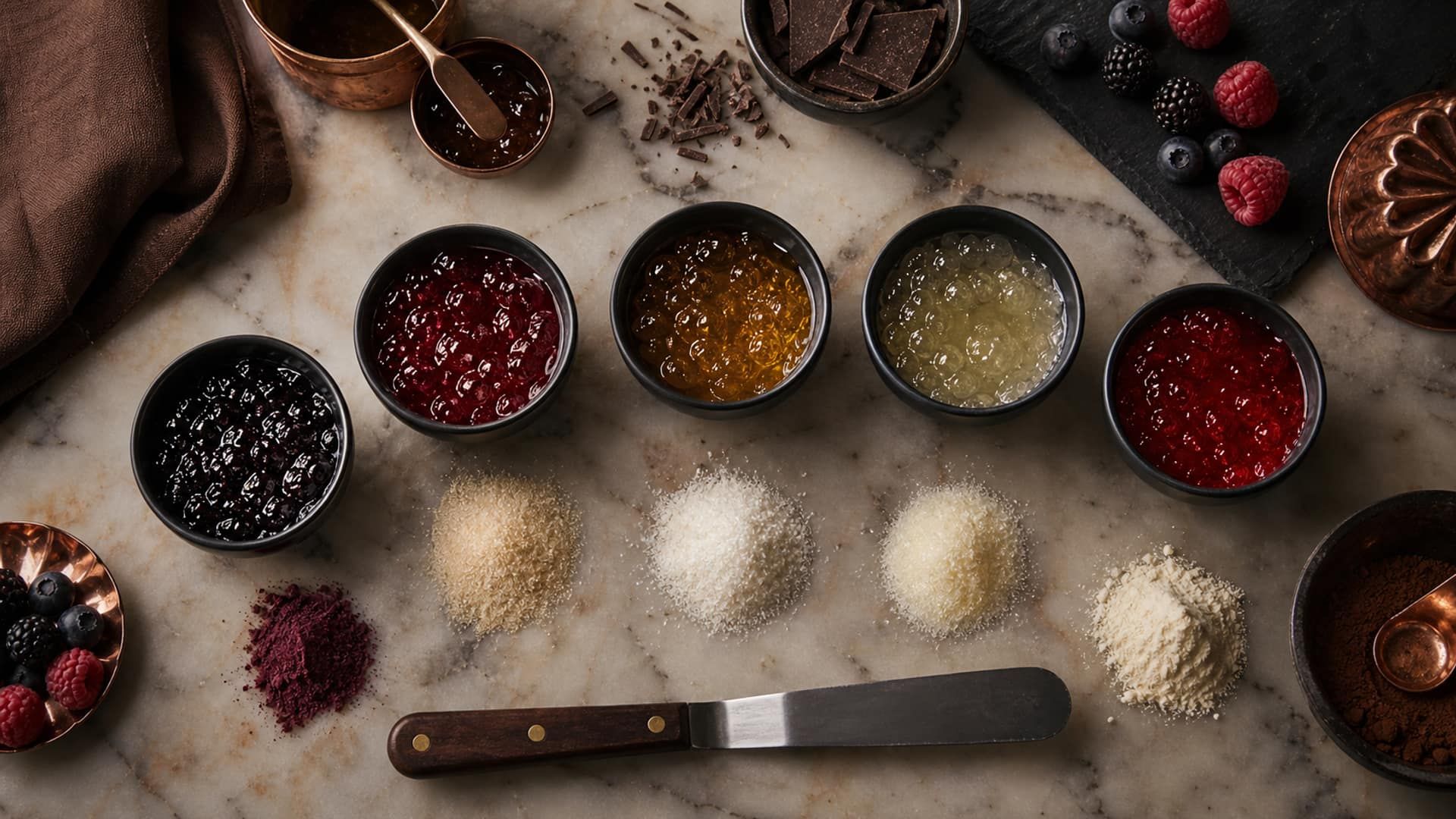
What a Gelling Agent Does
A gelling agent turns a liquid into a solid that still holds water by building a continuous three-dimensional network through the liquid. The molecules cross-link at junction zones, trapping water in the mesh so it no longer flows. The mouthfeel you get — soft and melting, firm and sliceable, brittle and clean-cutting, or elastic and bouncy — is decided by how dense, how strong, and how rigid that network is.
Five levers control the result. Dose sets network density: more agent means more junction zones and a firmer gel. Set and melt temperature decide whether the gel forms on cooling, holds at room temperature, or collapses on the warm tongue. Thermoreversibility says whether the gel re-melts and re-sets when reheated (agar, gelatin, carrageenan, gellan) or sets once and never melts again (high-methoxyl pectin). And each agent has a dependency — an ion, an acid, or a high sugar level — that must be present for it to gel at all.
Clarity is the final lever. Gelatin and high-acyl gellan give glass-clear gels; agar and κ-carrageenan are slightly turbid and brittle. Match the agent to the texture first, then tune the dose to the firmness.
A gelling agent is not a thickener
Thickeners such as xanthan gum, guar gum, and CMC raise viscosity but never set into a self-supporting solid — they make a liquid pour slowly, not stand up. Only a true gelling agent builds a continuous network that holds a cut edge. If your “jelly” slumps into a puddle, you used a thickener where you needed a gelling agent, or you dosed below the setting threshold.
Match the Texture to the Agent
Start from the bite you want, not the ingredient you have. Each target texture points to a small set of agents that deliver it, and most failures come from asking an agent to produce a texture it physically cannot.
| Target texture | Best agents | Why |
|---|---|---|
| Melt-in-mouth, soft, wobbly | Gelatin | Body-temperature melt point releases flavour instantly; tender, cohesive |
| Firm, sliceable confection | HM pectin, agar, gellan (low-acyl) | High network strength holds a clean slice at ambient temperature |
| Brittle, clean-cut, short | Agar, κ-carrageenan, low-acyl gellan | Rigid, low-elasticity network fractures cleanly under the knife |
| Soft, spreadable, no set sugar | LM pectin | Calcium-set network gels at low sugar; tender, spoonable |
| Elastic, springy, bouncy | ι-carrageenan, high-acyl gellan, gelatin | Flexible network deforms and recovers without fracturing |
| Fluid gel (pourable, gel-like) | Sheared agar, sheared low-acyl gellan | A set gel broken under shear flows yet keeps a gelled mouthfeel |
Map the texture you want to the agent that delivers it. Several agents overlap — narrow by dietary, heat-stability, and clarity constraints.
The two ends of the scale are gelatin and agar. Gelatin melts at body temperature, so it dissolves on the tongue and floods flavour out; agar holds firm well above body heat and reads as cuttable and brittle, never melting in the mouth. Everything else sits between, tuned by the agent and its dose.
The Gelling Agents, Compared
| Agent | Origin | Typical dose | Set temp | Melt / serve temp | Thermoreversible? | Gel character | Key dependency |
|---|---|---|---|---|---|---|---|
| Gelatin | Animal (collagen) | 0.5–2.5% | 10–15°C | Melts 30–35°C | Yes | Soft, elastic, melt-in-mouth, clear | None (just cooling) |
| Agar | Red seaweed | 0.5–2.0% | 32–43°C | Melts 85–90°C | Yes | Firm, brittle, short | Disperse cold, then boil |
| HM pectin | Fruit (citrus / apple) | 0.5–2.0% | On cooling below ~80°C | Does not re-melt | No | Firm, sliceable, glossy | Sugar ≥65°Brix + pH 2.8–3.5 |
| LM pectin | Fruit (de-esterified) | 0.5–2.0% | On cooling with calcium | Re-melts; melting point rises with calcium | Yes | Soft, spreadable, tender | Calcium ions, pH 2.8–7.0 |
| κ-carrageenan | Red seaweed | 0.5–1.5% | On cooling (with potassium) | Melts ~60–70°C | Yes | Firm, brittle | Potassium ions |
| ι-carrageenan | Red seaweed | 0.5–1.5% | On cooling (with calcium) | Melts ~50–60°C | Yes | Soft, elastic, freeze-thaw stable | Calcium ions |
| Gellan (low-acyl) | Bacterial fermentation | 0.1–1.0% | On cooling (with ions) | Heat-stable to ~70–120°C | Limited | Firm, brittle, clean-cut | Calcium / sodium ions |
| Gellan (high-acyl) | Bacterial fermentation | 0.1–1.0% | On cooling (with ions) | Melts ~70–80°C | Yes | Soft, elastic, flexible | Calcium / sodium ions |
Indicative working values. Exact temperatures and doses vary with concentration, ions, sugar, acid, and purity — design to a target texture and confirm with a test set.
Gelatin
Gelatin is hydrolysed collagen and the only common gelling agent that melts at body temperature, which is exactly why it gives that clean melt-in-mouth release. Firmness scales with bloom — the standard gel-strength rating, roughly Bronze ~125–155, Silver ~150–180, Gold ~190–220, Platinum ~235–265 across a 60–300 scale. Bloom powdered gelatin in 5× its weight of cold water, then dissolve at 50–60°C and never above 70°C, where heat starts to degrade it and weaken the gel. It sets around 10–15°C and re-melts near 30–35°C, so it is fully thermoreversible but cannot survive a warm room.
Agar
Agar comes from red seaweed and sets a firm, brittle, short gel — the opposite of gelatin’s tender wobble. It must be dispersed cold then boiled to dissolve, after which it sets fast on cooling at around 32–43°C. Its defining trick is a large hysteresis gap: once set, it does not melt again until about 85–90°C. That high melt point makes agar the workhorse for jellies that must hold their shape at room temperature or even on a warm plate. Doses of 0.5–2.0% span soft to very firm.
HM and LM pectin
Pectin splits into two families by degree of esterification. High-methoxyl (HM) pectin (DE 60–75%) needs both high sugar — 55–75% solids, roughly ≥65°Brix — and acid at pH 2.8–3.5 (about 3.2 optimal) to gel, which is why it is the engine of pâte de fruit. Its set is irreversible: once formed it does not re-melt. Low-methoxyl (LM) pectin (DE 28–45%) gels by calcium bridging instead — the “egg-box” model — so it sets at pH 2.8–7.0 with no added sugar, giving softer, spreadable low-sugar gels. Those gels are thermoreversible: they re-melt on heating, and the more calcium they hold, the higher they melt.
κ- and ι-carrageenan
Carrageenans are seaweed extracts whose texture depends on type and ion. κ-carrageenan gels firm and brittle in the presence of potassium; ι-carrageenan gels soft, elastic, and freeze–thaw stable with calcium. λ-carrageenan does not gel at all — it only thickens — so do not reach for it when you need a set. Both gelling types are thermoreversible, re-melting roughly between 50°C and 70°C.
Gellan, high- and low-acyl
Gellan gum is produced by bacterial fermentation and is the most efficient agent here, gelling at just 0.1–1.0%. Low-acyl gellan sets firm, brittle, and crystal-clear; high-acyl gellan sets soft and elastic. Both set on cooling in the presence of calcium or sodium ions, and both are remarkably heat-stable — low-acyl gels can hold well above body temperature, which makes gellan a leading choice for warm-served jellies and fluid gels.
Synergists thicken — they do not set alone
Locust bean gum (LBG, dosed ~1.0–2.0 g/kg, hydrated near 80°C) and xanthan gum (~0.5–1.0 g/kg) are thickeners, not standalone gelling agents. LBG forms no gel by itself but turns a brittle κ-carrageenan gel elastic and cohesive when blended with it; xanthan only raises viscosity. Use them to modify a gel’s character, never as the sole setter.
Process: Hydrate, Activate, Set
Every gelling agent follows the same four-stage arc — disperse, activate, pour, set — but the temperatures differ, and getting the activation step wrong is the most common reason a gel never forms.
Disperse or bloom the agent
Hydrate first so the agent does not clump. Powders (agar, carrageenan, gellan, pectin) are dispersed into cold or room-temperature liquid, ideally pre-blended with sugar to separate the particles. Gelatin is bloomed in 5× its weight of cold water (or soaked as sheets) for several minutes until swollen.
Activate at the right temperature
Heat to the agent's activation point. Agar must be boiled to dissolve fully; carrageenan and gellan need roughly 80–90°C; HM pectin is brought to a boil with the sugar and acid. Gelatin is the exception — dissolve it gently at 50–60°C and never above 70°C, or it loses strength.
Add the dependency, then pour
Supply whatever the agent needs to set: sugar and acid for HM pectin, calcium for LM pectin and ι-carrageenan, potassium for κ-carrageenan, calcium or sodium for gellan. Pour while still hot — agar and low-acyl gellan begin setting the moment they cool past their set point, so work quickly.
Cool to set
Let the gel cool through its set temperature undisturbed. Gelatin needs the fridge (sets 10–15°C); agar, pectin, carrageenan, and gellan set as they cool to room temperature or below. Hot-set agents (agar, gellan) firm up fast; gelatin sets slowly and benefits from chilling time.
Demould and finish
Release once fully set. Brittle gels (agar, low-acyl gellan, κ-carrageenan) unmould cleanly and slice with a sharp knife; elastic gels (gelatin, ι-carrageenan, high-acyl gellan) flex out of the mould. Remember which gels re-melt: gelatin and agar reset if reheated, while HM pectin does not.
The deepest divide is hot-set versus cold-set. Agar, pectin, carrageenan, and gellan are hot-set — they form their network as a hot solution cools, so they must be poured hot. Gelatin is effectively cold-set: it dissolves warm but only builds its network in the fridge. Layer the two and you can build a single dessert with a heat-stable base and a melt-in-mouth top.
Building Custom Textures
The most interesting textures come from blends, because the right pair delivers a mouthfeel no single agent reaches. Synergy between agents is the workhorse technique.
The classic example is LBG + κ-carrageenan: κ-carrageenan alone is brittle and prone to syneresis (weeping), but adding locust bean gum converts it to a strong, elastic, cohesive gel with far less weeping. Agar + gelatin blends marry agar’s heat-stable structure with gelatin’s tender melt, giving a sliceable jelly that still softens pleasantly in the mouth. ι-carrageenan on its own already reads soft and elastic, useful where κ would be too short and snappy.
Fluid gels are a second technique: set a weak gel (agar or low-acyl gellan work best), then shear it — blend or sieve it — into a smooth, pourable purée that behaves like a thick sauce but holds suspended particles and coats the palate like a gel. Because gellan and agar are heat-stable, their fluid gels stay stable warm.
Layering exploits reversibility. Pour a hot-set agar or gellan layer, let it firm, then pour a cooler gelatin or pectin layer on top without melting the base. Reversible and irreversible agents stacked together give multi-textured terrines that hold clean horizontal lines.
Choosing by Constraint
Once two or three agents could deliver your texture, the deciding factor is usually a practical constraint — diet, serving temperature, the acid or calcium already in the recipe, or whether the gel must be crystal-clear.
Set your texture and constraints below to shortlist the agents that fit, then dial in the dose in the full calculator.
Vegan is the most common fork. Gelatin is animal-derived; agar, pectin, carrageenan, and gellan are all plant- or microbially-sourced and vegan-friendly. For a vegan melt-in-mouth effect, no single agent fully mimics gelatin’s body-temperature melt, but a soft agar or high-acyl gellan blend comes closest.
Warm-serve heat stability rules out gelatin, which melts at 30–35°C and turns to liquid on a warm plate or a hot day. Agar (melts 85–90°C), low-acyl gellan (heat-stable well above body temperature), and LM pectin all hold their set when served warm.
Acid and calcium tolerance matter when the recipe is fixed. HM pectin only works in high-acid, high-sugar systems; LM pectin and ι-carrageenan need calcium; gellan needs calcium or sodium. A low-acid, low-sugar, calcium-free base points toward agar or gelatin, which set on cooling alone.
Clarity is the last filter: choose gelatin or high-acyl gellan for glass-clear gels, and accept some turbidity with agar and κ-carrageenan.
Vegan and thermoreversible at a glance
Need a vegan jelly that survives a warm room? Reach for agar or low-acyl gellan — both are plant- or ferment-derived and hold their set far above body temperature. Need a vegan gel you can re-melt and reset like gelatin? Agar and carrageenan are thermoreversible; HM pectin sets once and never re-melts. Gelatin remains the only thermoreversible agent that melts at body temperature — which is both its signature and its heat-stability weakness.
Which gelling agents are vegan?
What is the difference between agar and gelatin?
Why won't my gelatin set?
Can I serve a jelly warm?
How do I make a soft melting jelly versus a firm clean-cut one?
Do I need calcium for pectin?
What is a fluid gel and which agents make one?
Related Articles
Pectin Gelation: pH, Brix and Dose for a Firm Set
Why an HM pectin gel sets, sets weak or fails: the pH and soluble-solids window, the dose, rapid vs slow set, and how to fix a weak or weeping pâte de fruit.
Fruit Jelly Recipe Formulation: Brix, Acid Balance, and Yield
How to formulate any fruit jelly from first principles — choosing the right Brix target, balancing acid for pectin gelation, controlling sugar ratios, and predicting yield before you cook.
Mousse Science: Foam Stability, Cream, and Gelatin
Build stable mousse by controlling bubble size, cream-fat crystallization, overrun, and gelatin concentration—with practical Bloom conversion and realistic heating guidance.