Mousse Science: Foam Stability, Cream, and Gelatin
Build stable mousse by controlling bubble size, cream-fat crystallization, overrun, and gelatin concentration—with practical Bloom conversion and realistic heating guidance.
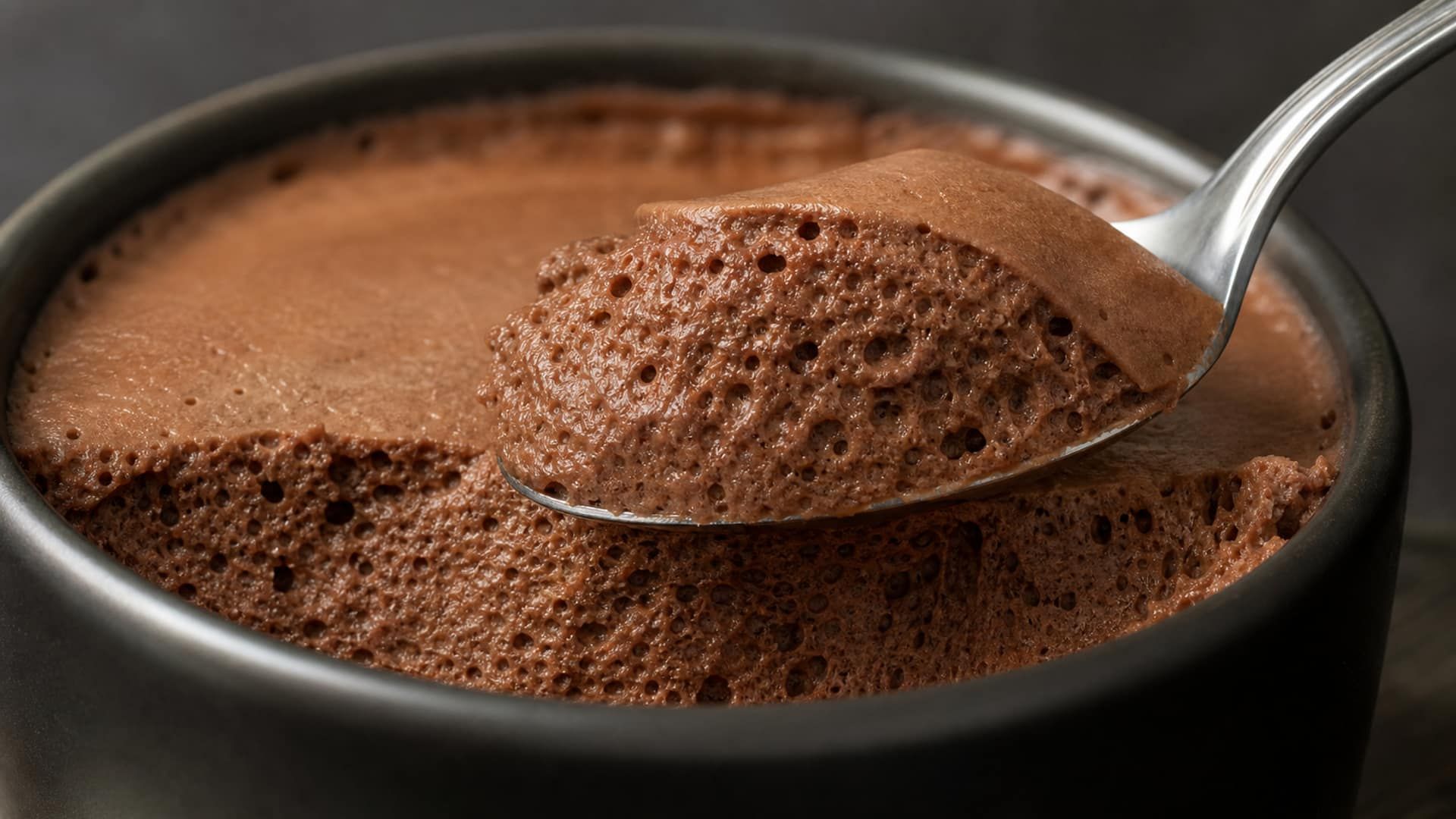
Mousse is a foam, emulsion, and gel at the same time
A mousse is not held by one ingredient. It is a gas dispersed in a continuous phase, usually with emulsified fat, dissolved sugars, proteins, and sometimes a gelatin network. Its final texture emerges from four linked operations:
- creating air bubbles during whipping;
- covering those bubbles with proteins and fat globules quickly enough to stop coalescence;
- limiting drainage from the thin liquid films between bubbles;
- setting the continuous phase before gravity and coarsening destroy the structure.
The formulation and process cannot be separated. More gelatin can reduce drainage, but it cannot repair buttered cream or a chocolate base that seized before folding. Higher overrun makes a lighter mousse, but it also creates more interface to stabilize. A cold, stable cream foam can still collapse if it is folded into a base that is too warm.
Measure the process as well as the recipe
Record cream temperature, base temperature, component densities, final density, mixing time, and set temperature. Ingredient percentages alone cannot explain batch-to-batch foam differences.
Bubble formation and interfacial pressure
Whipping stretches air into bubbles. Surface-active milk proteins adsorb at the air–water interface and lower interfacial tension. In dairy cream, partially crystalline fat globules then attach and partially coalesce around bubbles, reinforcing the protein-covered interface. The foam remains an oil-in-water emulsion; excessive coalescence inverts the structure toward butter.
The Young–Laplace relationship explains why small bubbles have higher internal pressure:
ΔP is pressure inside the bubble above the surrounding phase, γ is interfacial tension, and r is bubble radius. Smaller bubbles have larger pressure at the same γ.
That pressure difference drives gas from small bubbles toward larger ones when gas can diffuse through the continuous phase, a process called disproportionation or Ostwald ripening. Coalescence is different: the liquid film between adjacent bubbles ruptures and two bubbles merge. Drainage thins those films and makes rupture more likely.
Small, evenly distributed bubbles give a fine texture, but they are not automatically stable. Stability requires an interface that resists rupture and a continuous phase viscous or gelled enough to slow drainage and gas transfer. Gentle folding preserves bubbles already formed; aggressive mixing creates broad bubble sizes and can break the fat network.
Cream temperature and partial coalescence
Dairy cream whips because some milk fat is crystalline and some remains liquid. The crystals help fat globules bridge around air bubbles; the liquid fraction lets globules deform and adhere. Warm cream contains too little crystalline fat and produces weak foam. Adequately chilled cream, bowl, and whisk slow warming during whipping.
Tetra Pak’s dairy-processing guidance recommends ripening whipping cream at low temperature and reports the best whipping results below about 6°C. A practical production target is commonly 4–6°C at the start of whipping, with the exact optimum depending on fat percentage, seasonal milk-fat composition, homogenization, and equipment.
The claim that “below 2°C fat becomes too rigid, globules shatter, and incorporation is poor” is not a general rule. Colder cream usually supports whipping as long as it remains unfrozen and the equipment can process it. Graininess more commonly signals overwhipping, excessive partial coalescence, warm-up during a long whip, or local freezing and thawing. Do not intentionally freeze dairy cream to improve foam: ice damages the emulsion and creates a different failure mode.
| Observed condition | Likely behavior | Process response |
|---|---|---|
| Cream starts near 4–6°C | Good fat crystallization and controllable partial coalescence | Use chilled tools and stop at the required peak |
| Cream warms during a long whip | Lower foam stability; risk of greasy or buttered texture | Use an appropriate batch size and restore cooling |
| Cream is near freezing or contains ice | Emulsion damage and inconsistent whipping | Thaw under control and evaluate; do not treat sub-2°C as a universal target |
| Cream is overwhipped | Excessive coalescence, graininess, serum release | Stop earlier; temperature alone will not reverse butter formation |
Diagnostic guidance; exact temperatures depend on cream composition and equipment.
Cream fat content also matters. Conventional dairy whipping cream is commonly around 35–40% fat; lower-fat systems require formulation support and do not follow the same process window. Plant-based whipping systems use different fats, emulsifiers, and proteins and need their own temperature validation.
Overrun and density
Overrun expresses the volume increase caused by air. When mass is held constant:
V_base and V_foam must refer to the same mass before and after aeration.
Density is often easier to measure reproducibly with a fixed-volume cup:
Use net densities measured at controlled temperature with the same calibrated cup and no large voids.
For example, a base density of 1.10 g/mL and final mousse density of 0.70 g/mL gives (1.10/0.70 − 1) × 100 ≈ 57% overrun. This calculation is reproducible; a target range still depends on style. A plated mousse can be lighter than an insert that must cut cleanly and support layers.
Measure the density of the complete mousse, not only whipped cream. Folding, chocolate, puree, and gelatin solution change both mass and volume. Sample several locations because poor folding creates density gradients.
Gelatin networks and Bloom strength
Gelatin slows drainage and gives the continuous phase elastic strength as it cools. Bloom strength is a standardized test property, not a percentage or a direct measure of setting speed. In the standard method, a 6.67% gelatin gel is matured at 10°C for 17 hours, and Bloom grams are the force expressed as mass needed for a standard plunger to depress the gel by 4 mm. Commercial food gelatins cover a broad range, commonly about 50–300 Bloom.
Bloom value, concentration, gelatin type, pH, sugars, salts, alcohol, temperature history, and set time all affect the real mousse. Two gelatins with the same Bloom can differ in viscosity and molecular-weight distribution. Conversion equations are therefore starting points that require a bench test.
For an equal set, the gelatin dose scales inversely with Bloom. The GMIA Gelatin Handbook gives about 1.3% of a 275-Bloom gelatin for the same dessert set as 2.0% of a 175-Bloom gelatin; the linear rule predicts 1.27%.
This is a practical substitution rule, not part of the official Bloom test. Verify texture in the complete formulation.
If a mousse uses 1.00% of 200-Bloom gelatin and the available gelatin is 160 Bloom:
1.00% × (200/160) = 1.00% × 1.25 = 1.25%
This conversion is only a starting point because gelatin type and the complete formula also affect bite and melt. Keep the total added water consistent when changing powdered-gelatin mass or gelatin-mass ratios.
Hydration and heating
Hydrate sheet gelatin in ample cold water and squeeze consistently, or bloom powdered gelatin in a weighed amount of cold liquid. Dissolve the hydrated gelatin completely in a warm part of the formula before combining it with the rest. A 50–60°C liquid is convenient, but 70°C is not a sharp destruction threshold.
Gelatin degradation is a function of time, temperature, and pH. Research on gelatin solutions at 60, 70, and 80°C found progressive hydrolysis whose rate increased with temperature and was catalyzed away from the least-reactive pH region. Brief contact with a hot liquid does not instantly eliminate gel strength; prolonged holding or boiling, especially in strongly acidic or alkaline systems, causes increasing loss. Use the lowest temperature and shortest hold that reliably dissolves the gelatin.
Drainage, setting, and process order
Immediately after folding, the mousse is most vulnerable. Liquid drains through channels between bubbles while the gelatin network is still weak. Cooling increases viscosity and allows gelatin helices to form junction zones. Chocolate and cocoa butter can add structure as their fat crystallizes, but that structure is formulation-dependent and should not be confused with gelatin gel strength.
The base must be fluid enough to fold without crushing bubbles and cool enough not to melt the cream-fat network. There is no single universal incorporation temperature. For chocolate mousse, the appropriate window depends on chocolate percentage, fat composition, gelatin, sugar, and batch size. Determine it by measuring final density and set quality at several controlled base temperatures.
A reproducible sequence is:
- Prepare and hydrate gelatin with weighed water.
- Build the flavored base and dissolve gelatin without an extended hot hold.
- Cool the base to the validated folding window while preventing premature lumps.
- Whip cold cream to the specified peak and record its density.
- Lighten the base with a small portion of cream, then fold in the remainder.
- Measure final density, deposit immediately, and chill under controlled conditions.
Gelatin percentage should be reported on total finished mousse weight together with Bloom value. Statements such as “1.0% gives a classic set” are formulation starting points, not universal thresholds. Acidity, alcohol, fruit enzymes, chocolate solids, and freezing all change performance. Fresh pineapple, papaya, kiwi, and fig can contain proteases that weaken gelatin unless the enzyme is adequately inactivated.
Validation and storage
Run a small matrix rather than changing several variables at once. Compare two gelatin levels and two final densities while holding process temperature constant. Evaluate set after the same maturation time at the same temperature, then measure cut, spoon texture, syneresis, and sensory melt.
Refrigerated life cannot be inferred from gelatin percentage. Dairy, egg, fruit puree, handling, pH, aw, and cold-chain control determine microbiological risk. A three-to-five-day window may suit one recipe and process, but it cannot be transferred to another mousse without evidence. Establish a validated food-safety plan and product-specific durability study. Freezing can be suitable for a mousse designed and tested for freeze–thaw use; it is not universally damaging or universally safe for texture.
Use density plus texture as release checks
A batch can reach the target gelatin percentage and still be wrong because its overrun changed. Record final density alongside set strength and syneresis so the cause of a dense, weak, or rubbery batch remains visible.
References
- Gelatine Manufacturers of Europe. Standardised Methods for the Testing of Edible Gelatine, version 15 (2020).
- Gelatin Manufacturers Institute of America. Gelatin Handbook (2012).
- Tetra Pak. Dairy Processing Handbook: Pasteurized and ESL Dairy Products—Whipping Cream.
- Nguyen, V., Duong, C. T. M., and Vu, V. “Effect of Thermal Treatment on Physical Properties and Stability of Whipping and Whipped Cream.” Journal of Food Engineering 163, 32–36 (2015).
- Croome, R. J. “Acid and Alkaline Hydrolysis of Gelatin.” Journal of Applied Chemistry 3(6), 280–286 (1953).
- Osorio, F. A., Bilbao, E., Bustos, R., and Alvarez, F. “Effects of Concentration, Bloom Degree, and pH on Gelatin Melting and Gelling Temperatures Using Small Amplitude Oscillatory Rheology.” International Journal of Food Properties 10(4), 841–851 (2007).
Frequently Asked Questions
How do I convert 200-Bloom gelatin to 160 Bloom?
Does gelatin lose its strength immediately above 70°C?
Why should whipping cream start cold?
What should I measure when a mousse is inconsistent?
Related Topics
Related Articles
POD and PAC Values for Ice Cream Sugars, with Calculator
POD and PAC values for sucrose, dextrose, fructose, invert sugar, lactose, glucose syrup and polyols, a free sugar-balance calculator, and how to read the totals.
Moisture Migration: Water Activity, Fick's Law, and Packaging
Predict moisture movement by separating its water-activity driving force from diffusion rate, and compare packaging only with WVTR units and test conditions attached.
Gelling Agents for Jelly Textures: Selection, Dosage, and Set Temperatures
Pick the gelling agent that delivers the texture you want — melt-in-mouth, firm and sliceable, brittle clean-cut, or warm-serve heat-stable — with dosages, set temperatures, and vegan options for agar, gelatin, pectin, carrageenan, and gellan.