Fruit Jelly Recipe Formulation: Brix, Acid Balance, and Yield
How to formulate any fruit jelly from first principles — choosing the right Brix target, balancing acid for pectin gelation, controlling sugar ratios, and predicting yield before you cook.
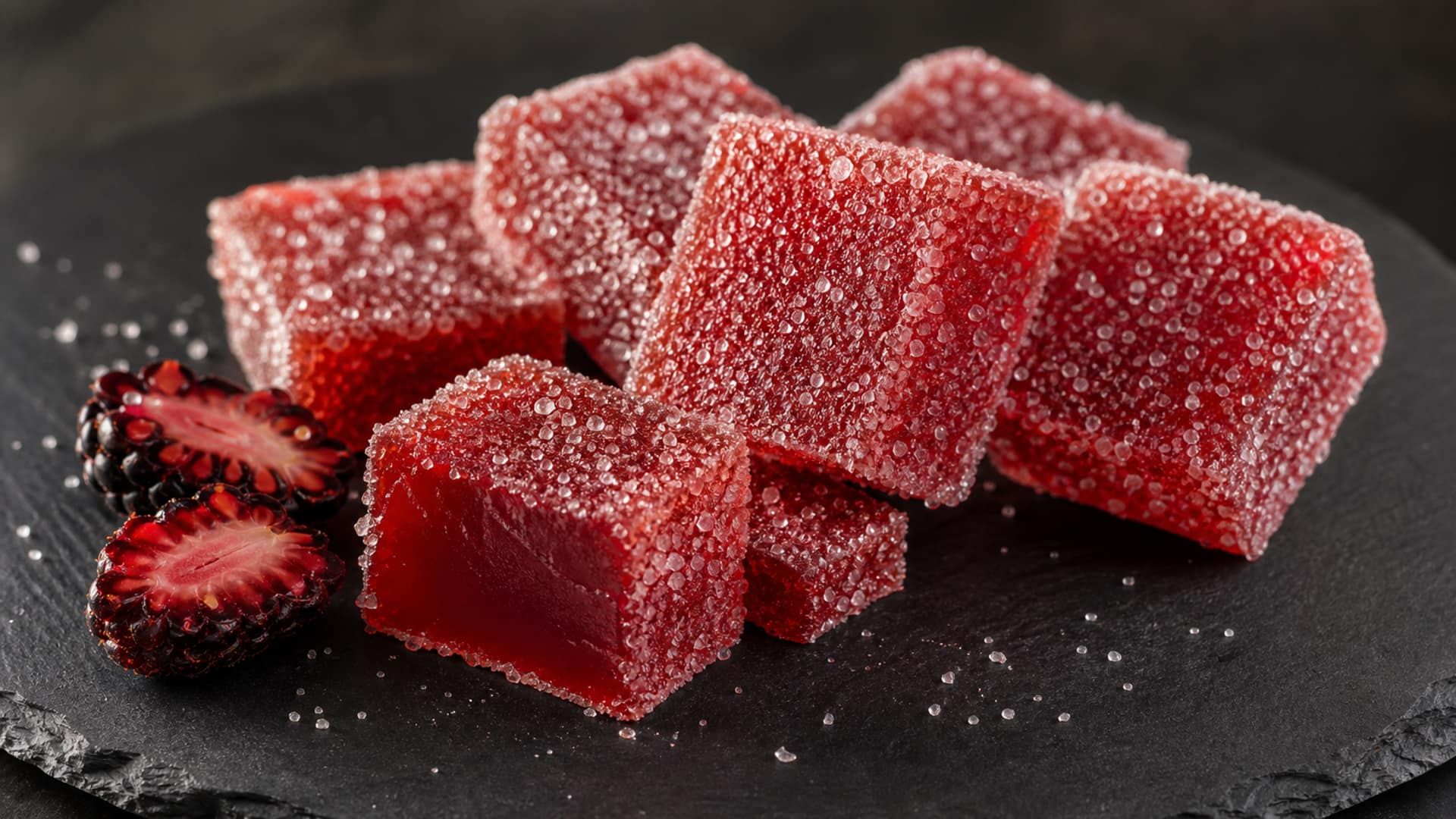
Formulation Parameters That Govern Every Fruit Jelly
A fruit jelly built on high-methoxyl (HM) pectin has three interdependent control variables: Brix, pH, and pectin concentration. Change any one and the other two must be re-evaluated. Before picking up a saucepan, define your target for all three.
Why 75–78°Brix? Below 75°Brix, the gel may fail to set firm enough for clean slicing, and reduced soluble solids shorten ambient shelf life. Above 80°Brix, over-concentration increases crystallisation risk and may make the product harder to cut cleanly.
Across 75–78°Brix a fruit jelly reads a water activity of about 0.73–0.78, lower with more fruit sugars (glucose, fructose) or invert sugar in the mix. A DE 38–42 glucose syrup raises it slightly at the same Brix. Moulds and osmophilic yeasts can still grow slowly in that band, so plan on one to two months at room temperature, sealed and dry. The calculator’s reference shelf life at 20°C, based on water activity alone, is longer; confirm any longer date with a storage trial.
Why pH 3.2–3.4? HM pectin requires protonation of its carboxyl groups to allow hydrogen bonds to form between chains. At 75–78% soluble solids the calculator’s firm-set window runs from pH 2.8 to 3.6. Above it the gel weakens, and from about pH 3.8 it does not set. Below about pH 3.0 an unbuffered pectin can start to set in the pan before you cast, and from about pH 2.6 down any HM pectin does, so buffer or dilute the purée.
Everything here assumes HM pectin. If your pack does not name the family, the free pectin selector tells you which family a firm fruit jelly needs and what to confirm on the data sheet.
Choosing Your Fruit Puree and Setting Initial Brix
Every fruit puree enters the formula with its own natural sugar content (Brix), water content, and pH. Measure both with a refractometer and a pH meter on every new batch — these values shift between suppliers and seasons.
| Fruit Puree | Typical Brix | Typical pH | Acid Adjustment |
|---|---|---|---|
| Strawberry | 8–11 | 3.2–3.5 | Add 0.5–0.7% citric acid solution |
| Raspberry | 8–12 | 3.2–3.9 | Add 0.3–0.5% (already acidic) |
| Passion fruit | 14–18 | 2.4–3.1 | Minimal or none; monitor pH |
| Mango | 14–18 | 3.4–4.8 | Add 0.7–1.0% citric acid solution |
| Blackcurrant | 10–14 | 2.8–3.2 | Check pH first; may need buffer |
| Apricot | 12–16 | 3.4–3.8 | Add 0.8–1.2% citric acid solution |
Typical puree parameters — measure your actual batch before formulating
Use sodium citrate as a pH buffer during cooking
Add 0.2–0.3% sodium citrate (of batch weight) to the puree before adding pectin. It holds the pH above 3.5 during the heating phase, preventing premature gelation in the pot. The final citric acid addition at the end of cooking drops the pH into the gelling range precisely when you need it.
Setting initial Brix: the initial Brix of your mixed batch (puree + sugars, before cooking) determines how much water must evaporate to reach the final Brix target. A typical starting Brix of 50–58°Brix requires approximately 24–35% of batch weight to evaporate as water during cooking. Enter these values into the Pâte de Fruit Calculator to get an accurate evaporation estimate and yield prediction before you start.
Sugar Ratio: Sucrose, Glucose, and Anti-Crystallisation
Sucrose is the primary humectant and gel driver. Left alone, however, sucrose at 75°Brix+ concentration will crystallise during storage — producing the grainy, sandy texture described in detail in the troubleshooting article. Glucose syrup (or trimoline/invert sugar) prevents this by interfering with sucrose crystal lattice formation.
Glucose-to-sucrose ratio for pâte de fruit: 20–35% glucose of total sugar dry weight
Below 20% glucose: crystallisation risk during storage. Above 35% glucose: the product becomes hygroscopic — it draws moisture from the air, dissolves its own sugar coating, and becomes sticky within days. The sweet spot for most fruit jellies is 25–30% glucose of total sugar dry weight.
In practice, for a 1000g pre-cook batch with 480g sucrose and 120g glucose syrup (80% dry matter = 96g dry weight), the glucose fraction is approximately 96 / (480 + 96) = 17% — on the low end. Add about 30 g more glucose syrup, 150 g in total or 120 g dry, to reach the 20% minimum: 120 / (480 + 120) = 20%. The Pâte de Fruit Calculator recalculates crystallisation risk in real time as you adjust the ratio.
Invert sugar (trimoline) as a partial substitute: invert sugar increases hygroscopicity more than glucose syrup of equivalent DE, so it is better kept at 10–15% of total sugar dry weight when combined with glucose. Do not replace glucose entirely with invert sugar for ambient-stored products.
Yield Calculation and Batch Planning
Yield shrinks during cooking because water evaporates. The evaporation amount is predictable: it depends on starting Brix, target Brix, and total batch weight.
Yield estimation formula
Water to evaporate (g) = Total batch weight × (1 − Starting Brix% / Target Brix%)
Example: 1000g batch at 52°Brix initial, target 77°Brix: Water to evaporate = 1000 × (1 − 52/77) = 1000 × 0.325 = 325g Expected yield = 1000 − 325 = 675g (before cutting losses of 3–5%)
Weigh and measure all ingredients
Measure fruit puree Brix and pH with calibrated instruments. Weigh pectin and pre-mix it with 5× its weight in sucrose. This sugar-coating prevents pectin from clumping ('fish-eyes') when added to warm liquid.
Dissolve buffer and heat puree to 40°C
Add sodium citrate to the puree and warm to 40°C. Keep the temperature below 50°C — above this, pectin hydrates too fast and lumps form. The sodium citrate holds pH above 3.5 during the early heating phase.
Stream in pectin-sugar premix
While stirring continuously, add the pectin-sugar mix to the warm puree in a thin stream. Bring to a full boil while stirring. The pectin must be fully dissolved before the remaining sugars are added.
Add remaining sucrose and glucose syrup
Add sucrose and glucose in one addition once the pectin mass is boiling. Stir until dissolved. Continue cooking over medium-high heat, stirring frequently to prevent scorching.
Cook to target Brix (75–78°Brix)
Check Brix every 2–3 minutes with a refractometer once the mass exceeds 104°C. Do not rely on temperature alone — altitude and sugar composition shift the boiling point. The refractometer is the authoritative endpoint check.
Add citric acid solution off heat
Remove from heat at target Brix. Wait 10–15 seconds, then stir in the citric acid solution rapidly for 20–30 seconds. pH drops from the buffered ~3.6 into the gelation range, about 3.2–3.4. At this Brix the pectin sets far hotter than its jam-test rating, so cast without delay.
Cast and set (12–24 hours)
Pour into frames or moulds at once, while the mass is still about 95°C, the calculator's casting temperature for HM pectin. Leave undisturbed at 18–22°C for at least 12 hours before cutting. Slow-set HM pectin reaches full gel strength over 12–24 hours. Cutting early produces a gel that tears rather than slices cleanly.
Frequently Asked Questions
What happens if my fruit jelly Brix is below 74?
Can I use LM pectin instead of HM pectin for pâte de fruit?
How do I adjust the formulation for a more acidic fruit like passion fruit?
Why does my fruit jelly weep liquid after cutting?
Related Topics
Related Articles
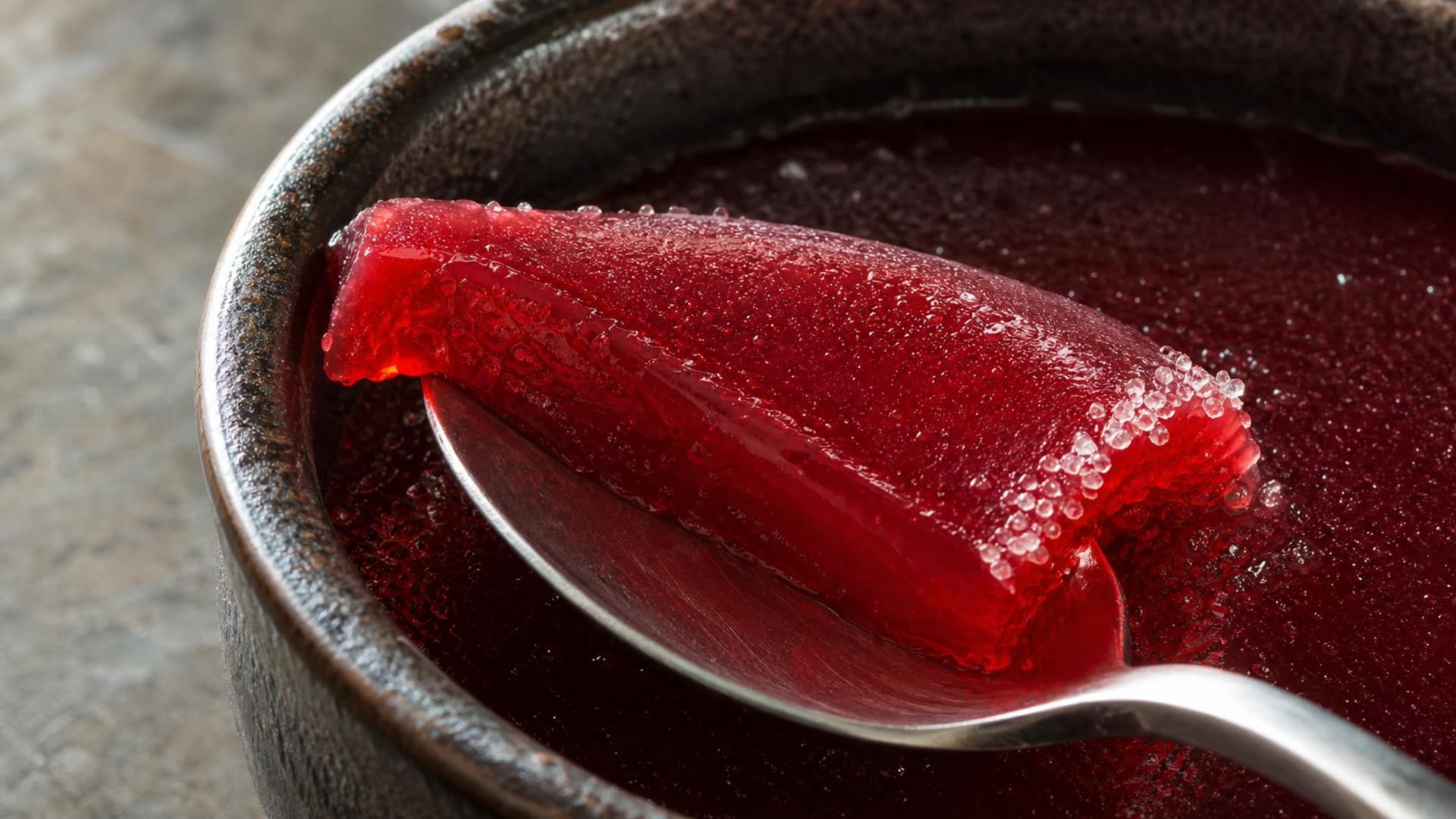
Pectin Gelation: pH, Brix and Dose for a Firm Set
Why an HM pectin gel sets, sets weak or fails: the pH and soluble-solids window, the dose, rapid vs slow set, and how to fix a weak or weeping pâte de fruit.
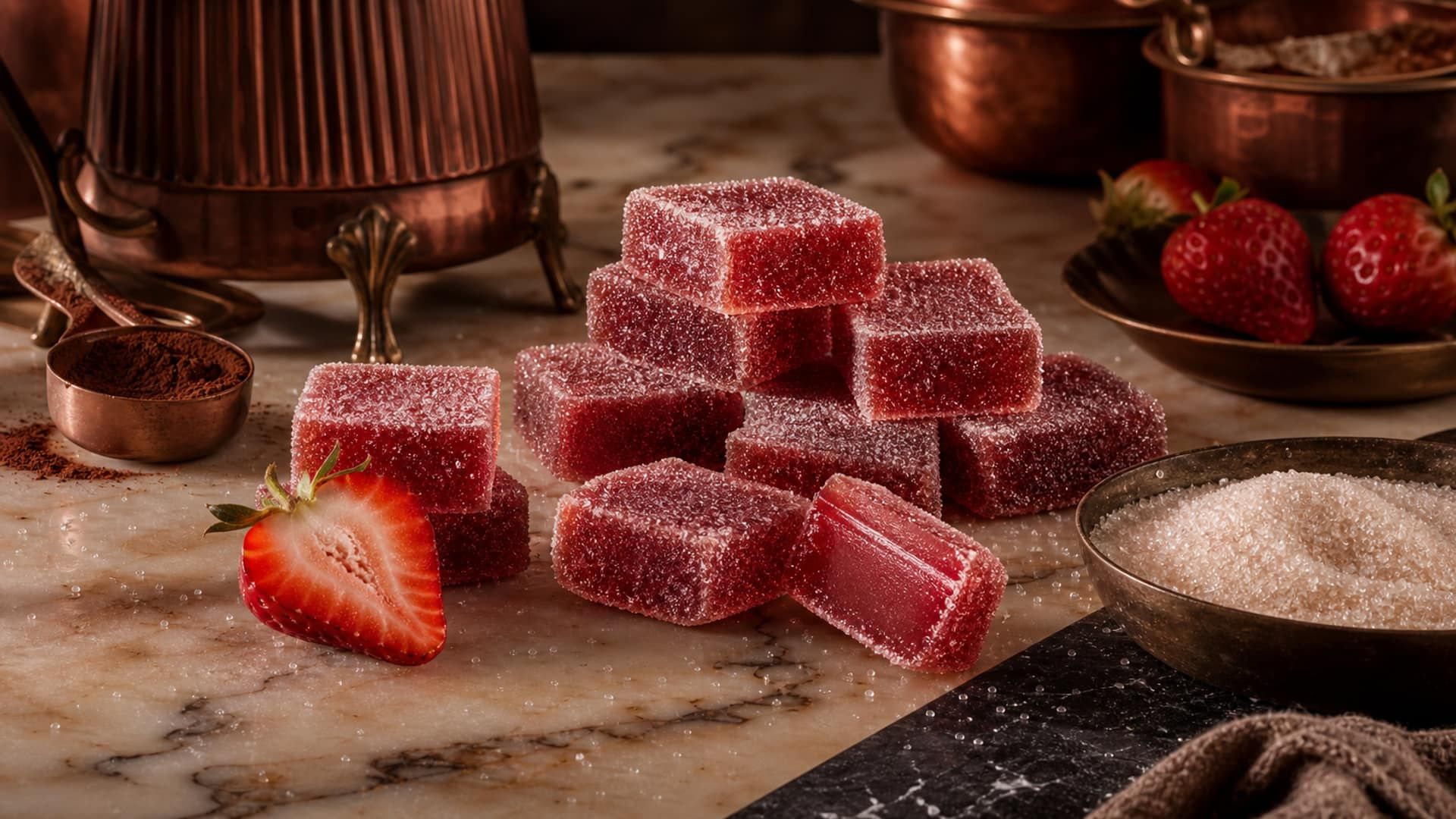
Strawberry Pâte de Fruit: A 1 kg Batch Cooked to 77°Brix
A 1 kg strawberry pâte de fruit with slow-set HM pectin, cooked to 77°Brix at pH 3.2: the formula, the calculator readings, the cook, cutting, coating and storage.
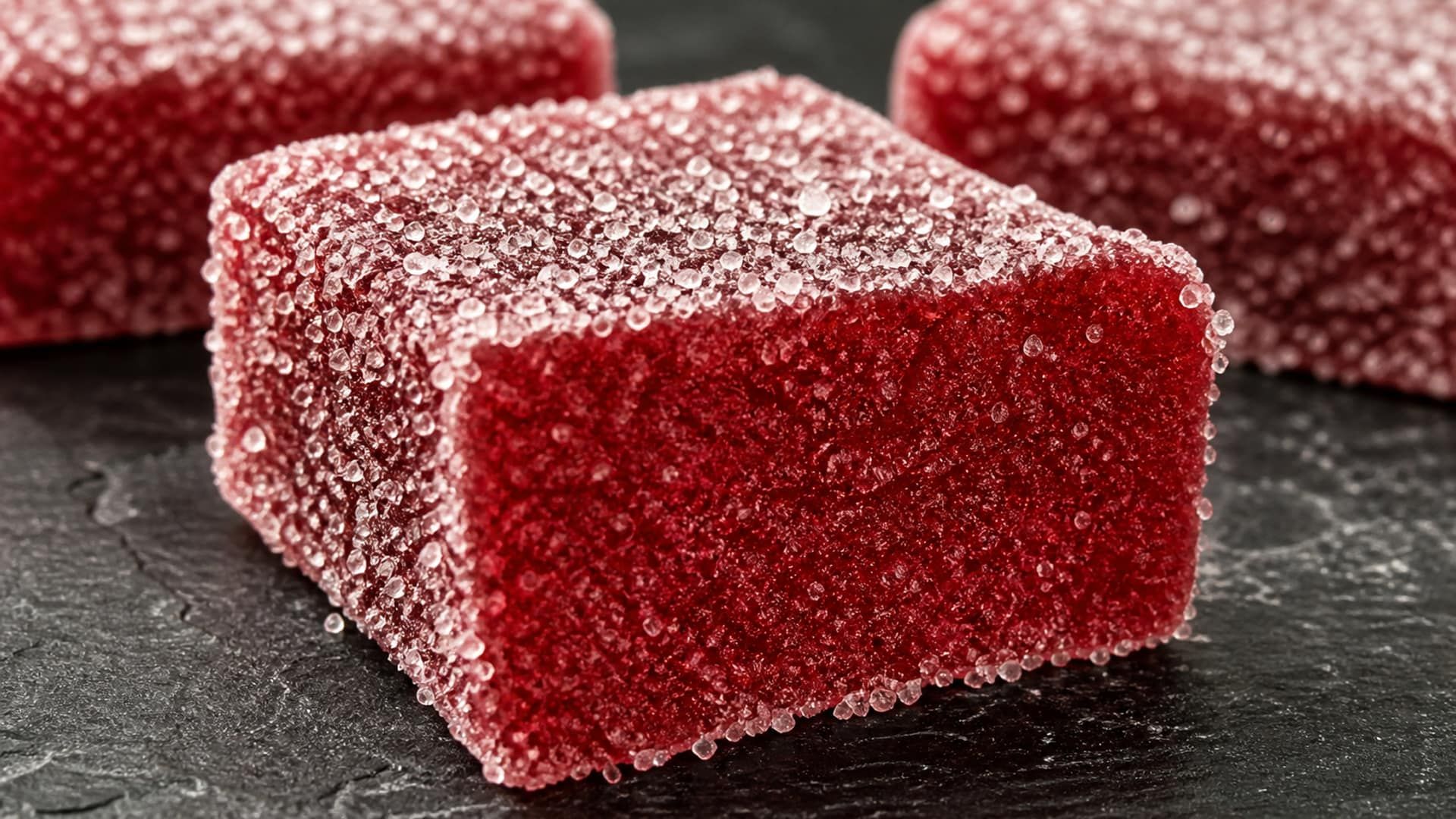
Why is my Pâte de Fruit Grainy?
A sandy or grainy texture in Pâte de Fruit is a common failure. Learn how to prevent sugar crystallization and ensure a smooth, melting texture.