Pectin Gelation: pH, Brix and Dose for a Firm Set
Why an HM pectin gel sets, sets weak or fails: the pH and soluble-solids window, the dose, rapid vs slow set, and how to fix a weak or weeping pâte de fruit.
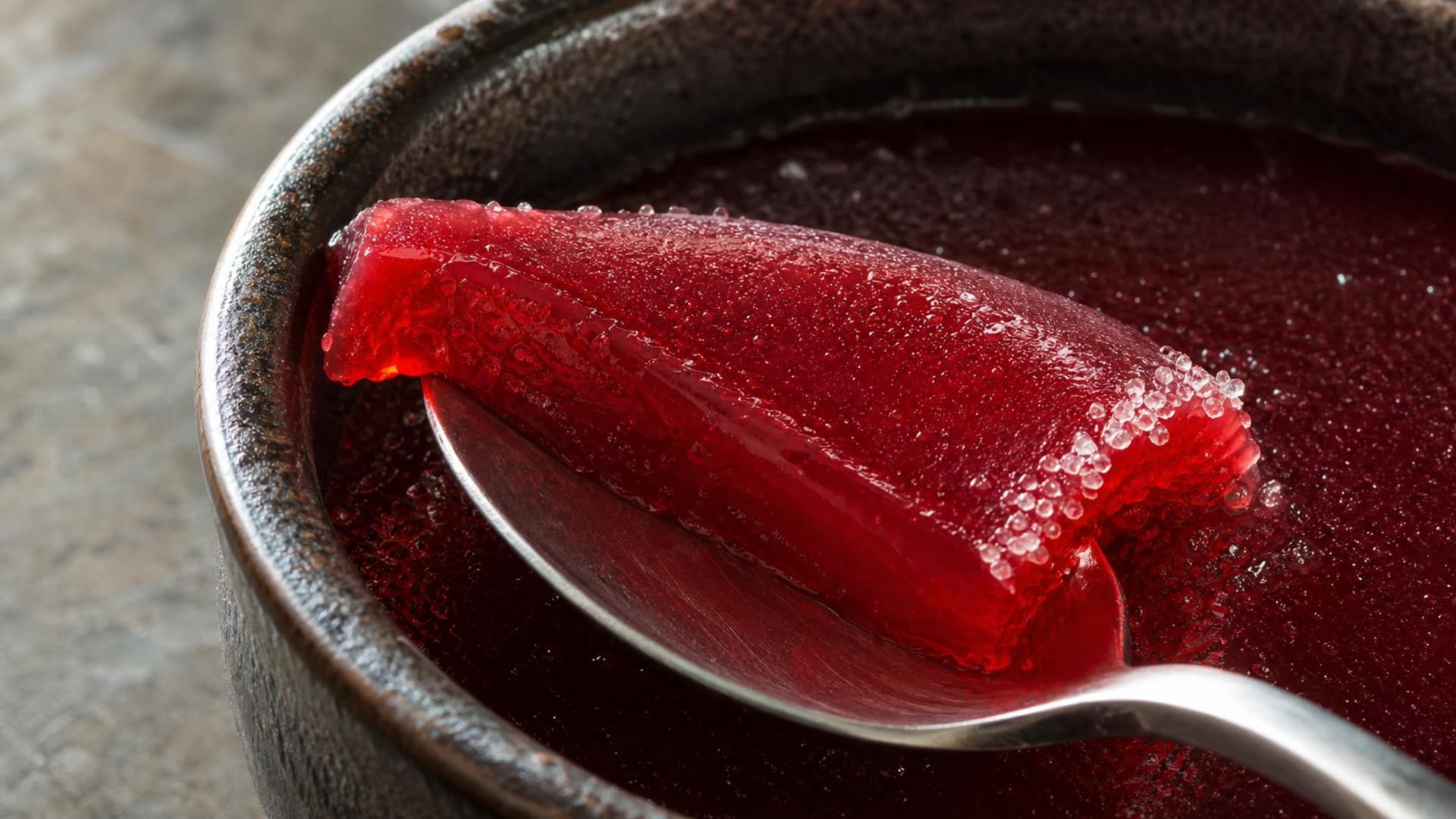
The Three Levers of an HM Pectin Gel
An HM pectin gel depends on three interdependent levers: the pectin dose, the pH and the soluble solids (Brix). None of them can rescue the others. A pH outside the window is not fixed by more pectin, and too little sugar undermines both.
When you cook fruit purée with pectin and sugar, you build a three-dimensional polymer network. Pectin chains carry negative charges that push them apart, so they have to be brought close enough to form junction zones. Acid protonates the carboxyl groups and removes most of that charge. Sugar competes with the pectin for water and strips its hydration shell. Enough pectin chains have to be present for the junctions to join into a continuous network.
The response is non-linear. A shift of about 0.2 pH units can move a batch from a firm set to a runny one, and rapid-set, slow-set and low-methoxyl pectins follow different rules. The sections below walk through each lever, then show how the Pâte de Fruit Calculator combines them into a verdict.
HM vs LM Pectin: Which Mechanism You Are Using
Pectin is split by its degree of esterification (DE). High-methoxyl (HM) pectin, DE above 50%, gels through sugar and acid. Low-methoxyl (LM) pectin, DE below 50%, gels through calcium bridges.
| Property | HM Pectin | LM Pectin |
|---|---|---|
| Degree of esterification | Above 50% (typically 60–75%) | Below 50% (typically 28–45%) |
| What makes it gel | Soluble solids above about 55% plus acid | Calcium bridges between chains |
| Working pH | Firm set at about 2.8–3.6, rising with soluble solids | Wide, about 2.8–7.0 |
| Calcium | Not needed; some lower-DE grades react to it | Always gels through it; more sugar lowers the need |
| Typical use | Jams, jellies, pâte de fruit | Low-sugar preserves, dairy |
Pâte de fruit is finished at about 75–78°Brix and a pH near 3.2–3.4, so it is an HM product. If the pack does not name the family, the pectin selector below tells you what to check on the data sheet. The rest of this article covers HM gels.
Pectin Selector: Which Pectin Fits Your Product
Match the pectin family to the product and read what to confirm on the supplier data sheet.
The pH-Gel Strength Relationship: Critical Control Point
HM pectin gels only once enough carboxyl groups are protonated to neutralise the charge on the chains. That makes pH the most sensitive lever in the system.
Inside the HM window, a lower pH gives a stronger gel, and about 0.2 units separate a firm set from a runny failure. Below about pH 2.8 the gain flattens and the product turns sharply tart. The practical target for pâte de fruit is a finished pH of about 3.2–3.4, tuned to the pectin grade. The table shows the trend; it is directional, not a formula.
| Finished pH | Gel behaviour | Flavour / risk |
|---|---|---|
| ~2.8 | Very firm, fast set | Noticeably tart; risk of setting in the pan |
| ~3.0 | Firm | Slightly tart, robust set |
| ~3.2 | Firm, balanced | Good all-round target |
| ~3.4 | Softer set | Approaching the weak end |
| ~3.6 | Weak | Likely under-set |
| ~3.8 | Non-setting | Above the HM gelling window |
That sensitivity is why professional kitchens measure pH with a meter instead of judging acidity by taste.
Measure the pH of every purée batch before you formulate. The same fruit can differ by 0.3–0.5 pH units with ripeness, variety and growing conditions. Correct it with citric or tartaric acid, or raise it with sodium citrate, before the pectin goes in.
Sugar (Brix) Effect on Gel Strength
Sugar does not take part in the junction zones, but it decides whether they form. Dissolved sugar binds water that would otherwise hydrate the pectin, which pushes the chains together.
HM pectin stops gelling below about 55% soluble solids. Jam scales show the climb above that floor: around 60% the mass is a viscous liquid, around 62% a weak gel, and about 68% a good jelly texture. Pâte de fruit is cooked further, to about 75–78°Brix, for a firm, sliceable set.
| Final Brix | Gel Character | Typical Application |
|---|---|---|
| ~60° | Very weak or none for HM | Low-sugar preserve (LM pectin) |
| ~65° | Soft gel | Spreadable jam |
| ~70° | Firm gel | Sliceable jam |
| ~75° | Strong gel | Soft pâte de fruit |
| ~78° | Very firm | Firm pâte de fruit |
| ~82° | Rigid | Hard confection, structural |
Brix also sets the water activity. At 75–78°Brix a pâte de fruit reads an aw of about 0.73–0.78: the higher the Brix, and the more fruit sugars (glucose, fructose) or invert sugar in the mix, the lower the value. A DE 38–42 glucose syrup raises it slightly at the same Brix. That band still allows moulds and osmophilic yeasts to grow slowly, which is why storage, not the gel, limits shelf life. The fruit jelly formulation guide covers storage and yield.
Pectin Concentration: The Foundation Variable
Once pH and Brix sit inside the window, the dose sets the firmness. Doses are easy to misread, because suppliers quote the pectin product, which is standardised with sugar. A commercial pectin carries about 65% pure pectin, so 1.0% of product is about 0.65% of pectin.
The calculator classes texture by pure pectin in the finished gel, the fruit’s own pectin included:
| Pure pectin in finished gel | About this much pectin product | Texture class |
|---|---|---|
| Below about 0.2% | Below about 0.3% | Will not set |
| About 0.2–0.55% | About 0.3–0.85% | Soft |
| About 0.55–1.0% | About 0.85–1.5% | Tender: a classic pâte de fruit |
| About 1.0–1.7% | About 1.5–2.6% | Firm |
| Above about 1.7% | Above about 2.6% | Very firm: pastilles, gums |
Texture classes used by the Pâte de Fruit Calculator. Product equivalents assume 65% pectin in the product.
Published pâte de fruit formulas sit at the low end of that range. They use about 0.8–1.3% of pectin product, measured against the batch or the finished paste depending on the source. Going much higher gives a firmer, more rubbery bite, not a safer set.
Pectin Type Modifiers: Rapid vs Slow-Set
HM pectin comes in rapid-set (higher DE) and slow-set (lower DE) grades. Under the same test conditions, a rapid-set pectin gels hotter and sooner than a slow-set one. A higher DE also needs slightly less acid to gel, so the grades differ at the top of the pH range too: in fruit jellies a slow-set pectin stops setting above about pH 3.4, a rapid-set one above about pH 3.6. Confectionery formulations run both near a finished pH of 3.2–3.4.
| Pectin Type | DE Range | Setting temperature (jam test) | Set Characteristics |
|---|---|---|---|
| Rapid-set HM | 68–75% | About 70–85°C | Fast, keeps fruit pieces suspended |
| Slow-set HM | 60–65% | About 55–65°C | Slower, longer working time |
| LM (non-amidated) | 28–40% | Rises with calcium | Calcium-dependent |
| LM Amidated | 28–40% | Rises with calcium | Gels with less calcium |
Approximate HM setting temperatures in a standard jam at about 65% soluble solids and pH near 3. They vary with supplier, grade and pH.
Those temperatures belong to the jam test. At 75–80°Brix and a finished pH near 3.2, the same pectin sets hotter and faster than its rating. A rapid-set pectin can start to set in the pan before the mass is cast. That is why confectionery jellies use slow-set or buffered (yellow) pectin, which holds the set back until the acid goes in. Even so, the mass is cast hot: the calculator’s casting temperature for any HM pectin is 95°C, matching published practice of keeping the batch above 95°C until it is all deposited.
A slow-set pectin gives a longer working window, but it usually needs a somewhat higher dose to reach the same firmness.
For complex shapes or multi-colour layers, choose a slow-set pectin, or a buffered (yellow) one for the longest window, because it does not set until the acid is stirred in. The calculator picks its rules from the pectin type you select or the one it reads from the ingredient name. It does not convert a supplier’s numeric jelly grade into a dose.
How the Calculator Judges the Set
The calculator weighs the levers together, pectin system and dose, pH, and soluble solids, and reports three things:
- Whether the gel sets: sets, sets weak or will not set, judged against the window of the recipe’s own pectin. For an HM pectin that window rises with soluble solids, from a firm set at about pH 2.8–3.2 in a 67% preserve to about 2.8–3.6 from 68% up, the range pectin makers apply their HM grades in. A weak or failed set comes with its reason: the pH, the soluble solids, a buffered pectin with no acid, or too little calcium for an LM pectin.
- The texture class: soft, tender, firm or very firm, from the pectin dose in the table above.
- Process risks: setting in the pan before casting (a rapid-set pectin at confectionery solids, or an unbuffered pectin acidified below about pH 3.0), and weeping (too much acid in a preserve-strength gel, or in a conventional LM gel). Far below the window, at about pH 2.4–2.6, any pectin sets in the pan: the calculator calls the gel weak and suggests raising the purée to pH 3–3.5 with sodium citrate before the cook, or diluting it.
When the recipe gives no usable pH, the calculator says the set is not assessed instead of guessing. Use the verdict to compare formulations, then confirm the set on a test batch by SAG grade, penetrometer or a clean cut before you commit.
Example Calculations with Real Formulas
Raspberry Pâte de Fruit (well-balanced)
40% raspberry purée (pH ~3.2), 55% sugar, 1.2% rapid-set pectin, 3% glucose syrup, finished near 76°Brix. Acidic fruit, high solids and a moderate dose all push the same way: the gel sets. At 76°Brix, though, a rapid-set pectin can start to set in the pan, so the calculator flags that risk. Cast quickly and hot, or switch to a slow-set or buffered pectin.
Passion Fruit Pâte de Fruit (too acidic)
45% passion-fruit purée (pH ~2.8), 50% sugar, 1.0% rapid-set pectin, finished near 76°Brix with no added acid. With no other acid in the batch, the calculator's estimated finished pH stays near 2.8, at the bottom of the firm window for those solids and under pH 3.0. At confectionery solids that does not mean a weak set; it means a set that starts in the pan. The calculator flags pre-gelation for the rapid-set pectin, and a slow-set pectin alone would still be flagged for an unbuffered pH under 3.0. A gel that forms before casting comes out uneven and weaker. Raise the finished pH toward ~3.2 with sodium citrate, or use a buffered pectin, instead of adding pectin.
Apricot Pâte de Fruit (too soft)
50% apricot purée (pH ~3.5), 45% sugar, 1.1% slow-set pectin, finished near 73°Brix. The high pH sits near the weak end of the window and gives a soft, borderline set. Citric acid that brings the finished pH toward ~3.2 firms it without changing anything else.
Passion fruit’s low pH sets the mass in the pan, while apricot’s high pH under-sets it. Reading the direction before you cook lets you correct pH or dose instead of losing a batch.
Cooking Process and Temperature Control
The cook has one job: reach the target Brix without damaging the pectin. Pectin breaks down with time and heat, and faster at low pH, so a long hold near the boil weakens the gel. Cook fast and stop at target.
The calculator solves the endpoint from your target Brix. It reports the water to evaporate, the yield and the End-Point Temperature: the temperature at which the batch boils at that Brix, under the Atmospheric Pressure you enter. Water boils cooler at altitude, and so does the batch. A strawberry pâte de fruit cooked to 77°Brix reads about 107.5°C at sea level, but about 102°C at 84 kPa, roughly 1,500–1,600 m up. A refractometer remains the final check.
The cooking-time output is a planning estimate: the water to evaporate divided by a fixed 10 g per minute per kilogram of batch, with a 5-minute minimum. There is no heat-source input, and the model does not add pectin to compensate for a slow kettle or a long hold. Validate the timing on your own equipment.
The mass balance behind the yield, with a worked example, lives in the fruit jelly guide.
Fruit Jelly Formulation: Yield and Batch Planning
Water to evaporate, expected yield and the cooking sequence for an HM pectin fruit jelly.
Calcium and Mineral Content Effects
HM pectin does not need calcium to gel. Some HM grades with a lower degree of esterification still react to it, and calcium changes how fast an HM gel builds. In laboratory HM gels at 60% sucrose and pH 3.0, calcium sped up gelation of both a blockwise and a randomly esterified pectin, but after three hours the blockwise gel was weaker and the random one stronger. At pH 3.5 calcium reinforced both. The effect depends on how the ester groups are distributed along the chain, not only on the DE.
In practice, very hard water or calcium-rich fruit can cause early or patchy setting with a calcium-sensitive grade. Water hardness is not a calculator input. If your water source changes, keep it consistent, use a sodium citrate buffer if the supplier recommends one, and confirm the set on a test batch.
Color and Flavor Impact of pH
pH also controls the colour of red fruit. Strawberry, raspberry and blackcurrant owe their colour to anthocyanins, which are most intensely red below about pH 3. Between pH 3 and 4 a growing share converts to colourless forms, so the red weakens and fades faster with heat and storage. Blue and violet forms appear only near neutral pH, far above any pectin gel.
That puts colour and set on the same side: a finished pH near 3.2 keeps a firm gel and a bright red. Red fruit at the mild end of its range, such as a strawberry or raspberry purée reading pH 3.6 or more, needs the acid for both reasons. Treat any compromise pH as a variable to test; the calculator estimates the recipe you enter, not a colour correction.
Practical Application: Case Study
A confectioner wants a mango-lime pâte de fruit for a warm climate: firm enough to survive 30–35°C ambient, bright in colour, with a date code backed by a storage trial.
Initial Formula Assessment
Starting formula: 50% mango purée (pH ~4.2), 45% sugar, 1.2% rapid-set pectin, 5% lime juice. Lime juice is far more acid than its 5% share suggests: the calculator puts the mixed pH near 3.4, inside the HM window, so the pH is not the problem. The moderate Brix is: it leaves the aw high for warm storage.
pH Optimization
Keep the finished pH near 3.2–3.4. If you cut the lime for flavour, replace its acid with citric acid: the mango alone sits near pH 4.2, past the point where an HM pectin sets.
Water-Activity Management
Raise the finished Brix toward ~78° by adding sugar and trimming the purée. That brings aw down to about 0.73–0.74. At 78°Brix a rapid-set pectin can set in the pan, so switch to a buffered (yellow) pectin, or the calculator flags the risk.
Confirm Before Production
Make a test batch and check the cut, the colour and a measured aw. Then run a storage trial at the target climate before setting a date code.
Without an estimate, a warm-climate mango pâte de fruit can take many trial batches. Reading the direction first narrows it to a couple of informed iterations, each still confirmed on a test batch.
Frequently Asked Questions
How reliable is the calculator's verdict on the set?
Can I use apple pectin instead of citrus pectin?
Why does my pâte de fruit weep or form surface moisture?
How do I convert between different pectin grades (150, 200, 300)?
Can I make pâte de fruit with less sugar?
Why do some fruits set perfectly while others always fail?
How do altitude and humidity affect pâte de fruit production?
Related Topics
Related Articles
Pectin Selector and Compatibility Checker
Choose the broad HM or LM gelation mechanism, then check whether an exact supplier product supports your fruit gel, glaze, or dairy process.
Fruit Jelly Recipe Formulation: Brix, Acid Balance, and Yield
How to formulate any fruit jelly from first principles — choosing the right Brix target, balancing acid for pectin gelation, controlling sugar ratios, and predicting yield before you cook.
Strawberry Pâte de Fruit: A 1 kg Batch Cooked to 77°Brix
A 1 kg strawberry pâte de fruit with slow-set HM pectin, cooked to 77°Brix at pH 3.2: the formula, the calculator readings, the cook, cutting, coating and storage.