Cocoa Butter Polymorphism: Temper Chocolate Reliably
Understand cocoa butter’s six traditional crystal forms, target Form V through controlled pre-crystallization, and reduce bloom through measured process and storage controls.
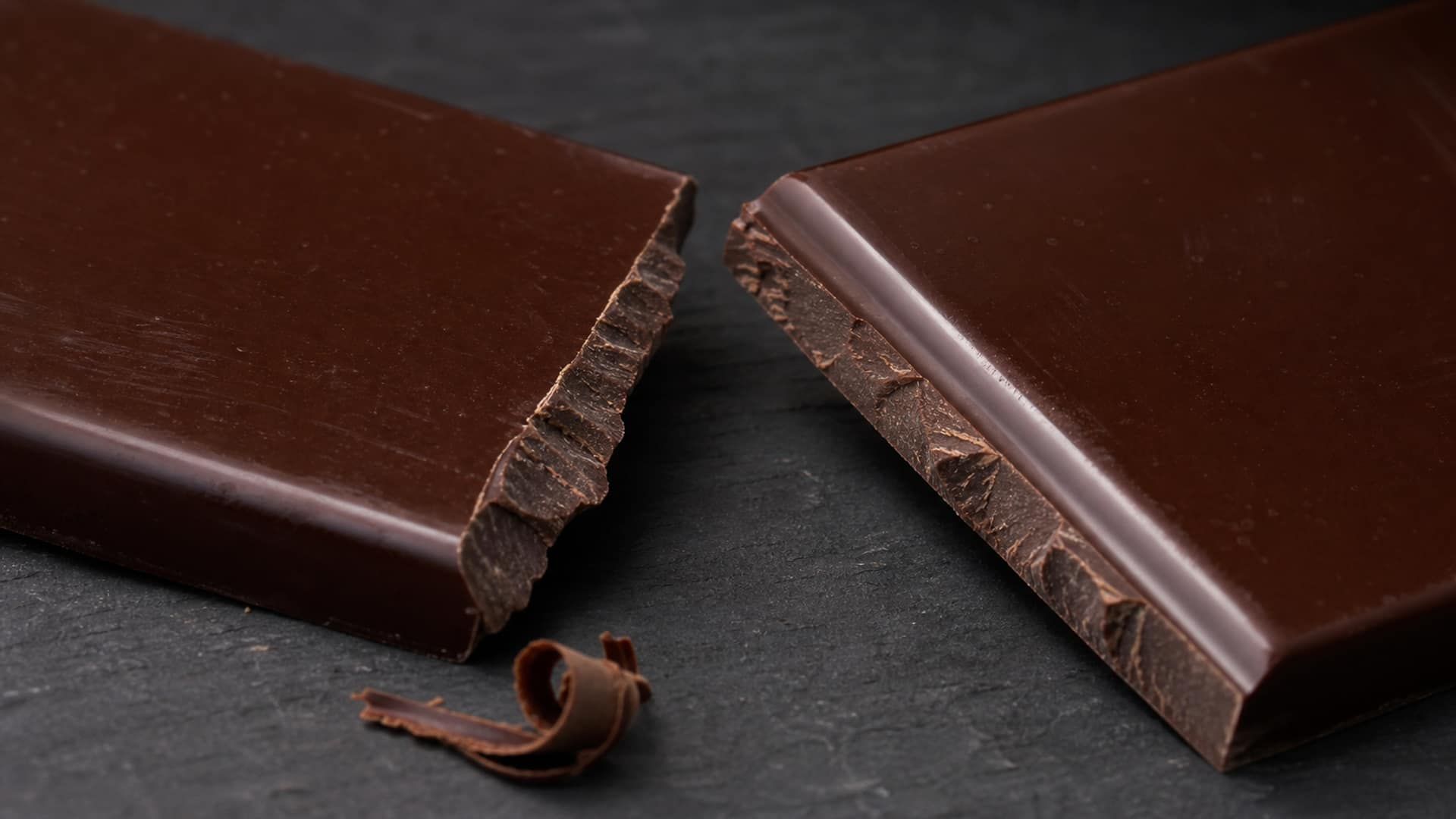
Cocoa butter is a mixture of triacylglycerols that can pack into several crystal arrangements. That polymorphism explains why the same chocolate can set glossy and crisp after one thermal history, yet turn soft, streaked, or bloomed after another. Tempering is the controlled pre-crystallization process used to favor the structure needed for the finished product.
Tempering does not freeze one permanent form
Tempering creates a useful population of crystal nuclei—principally Form V—which guides the remaining liquid fat as the product cools. The deposited chocolate still needs controlled cooling, adequate time, and stable storage to develop and retain the intended network.
What polymorphism means in cocoa butter
A polymorph has the same chemical molecules arranged in a different crystal lattice. Packing changes melting behavior, density, contraction, mechanical properties, and stability. Cocoa butter is especially sensitive because its major triacylglycerols—commonly POP, POS, and SOS—are similar enough to co-crystallize but not identical.
The traditional confectionery nomenclature follows Wille and Lutton’s Forms I through VI. Modern diffraction work has refined the structural interpretation, and Greek labels vary between authors. For production communication, state both the Roman form and the measurement method rather than assuming that every α, β′, or β label maps identically across sources.
| Traditional form | Approximate melting range | Relative stability | Production meaning |
|---|---|---|---|
| I | ~17°C | Lowest | Forms under very rapid, deep cooling; melts easily |
| II | ~23°C | Low | Soft and unstable at ordinary room conditions |
| III | ~25–26°C | Low | Can appear during uncontrolled cooling |
| IV | ~27–29°C | Intermediate | Common in under-tempered chocolate; can transform and bloom |
| V | ~33–34°C | High | Desired commercial form for gloss, snap, contraction, and melt |
| VI | ~35–36°C | Highest | Develops slowly; commonly associated with aging bloom |
Ranges depend on cocoa-butter composition and analytical method; the sequence of increasing stability is the key point.
Form I is sometimes called γ and sometimes grouped with “sub-α” language in older or alternate conventions. This is a nomenclature issue, not evidence for a seventh practical form. Cite the convention whenever a Greek subscript matters.
Why Form V is the production target
Form V provides a useful compromise. It is stable enough for normal handling, melts just below body temperature, and forms a dense network that gives gloss and snap. Form VI is more thermodynamically stable, but its slow development and larger reorganized crystals are associated with surface haze and a higher melting sensation.
Well-tempered Form V chocolate contracts as it crystallizes, helping it release from a mould. An overall contraction around 2–3% is a useful rough range, but the result depends on formulation, geometry, cooling rate, and measurement method. Treat it as formulation-dependent, not a universal design allowance.
During pre-crystallization, only a small fraction of the fat needs to be crystalline seed. Those nuclei direct the bulk liquid during subsequent cooling. The useful amount and crystal-size distribution depend on method, so assess temper with a defined temper index, cooling curve, DSC, or standardized set test.
| Property | Form V contribution | Other variables still matter |
|---|---|---|
| Gloss | Fine, organized surface crystal network | Mould condition, cooling, condensation, polishing |
| Snap | Dense high-melting fat skeleton | Fat content, particle loading, temperature, shell thickness |
| Mould release | Crystallization contraction | Mould geometry, cooling uniformity, release time |
| Melt | Melting range near mouth temperature | Milk fat, nut oil, cocoa-butter origin, particle size |
Form V is necessary for classic couverture performance but is not the only quality variable.
Tempering is a three-stage control process
The conventional curve has three purposes:
- Complete melt. Heat enough to erase existing crystal memory without scorching flavor components.
- Controlled cooling and shear. Enter a range where crystals nucleate while mixing distributes nuclei and evens temperature.
- Reheat to working temperature. Melt lower-melting unstable forms and excess crystals while retaining useful Form V seed.
| Chocolate | Complete melt | Cooling / seed region | Typical working region |
|---|---|---|---|
| Dark couverture | ~45–55°C | ~27–28°C | ~31–32°C |
| Milk couverture | ~45–50°C | ~26–27°C | ~29–30°C |
| White couverture | ~40–45°C | ~25–27°C | ~28–30°C |
| Ruby or specialty couverture | Supplier-specific | Supplier-specific | Often ~28–30°C |
Typical ranges only. Published brand curves differ: Callebaut and Cacao Barry melt dark to 45–50°C, Valrhona to 55–58°C; white melts at 40–45°C (Callebaut 45°C). Cocoa-butter origin, milk fat, added fat, viscosity, and equipment shift the curve; follow the supplier's curve for your product.
A practical operating tolerance is often around ±1°C, but even that is not a universal specification. A large continuous tempering unit controls shear, residence time, and cooling differently from tabling or seed tempering. Temperature without time and agitation does not define temper.
Erase prior crystals
Melt the complete mass uniformly and verify the coldest point. Avoid local overheating and water contact.
Create or add nuclei
Cool with agitation, table the chocolate, or add a documented Form V seed material according to its supplier method.
Return to working viscosity
Reheat gradually to the product-specific working range so unwanted lower-melting crystals and excess seed melt without erasing the desired nuclei.
Verify and maintain
Check temper state before depositing and periodically during production. Account for heat from pumps, rooms, centres, and panning friction.
How to verify temper
A smear test should set within a few minutes under controlled room conditions, with even gloss and no streaks. Its timing depends on chocolate thickness and room temperature, so it is a go/no-go craft check rather than a quantitative polymorph analysis.
A temper meter records a cooling curve and reports a temper index tied to the instrument and method. DSC measures melting events and estimates the crystal population. X-ray diffraction identifies lattice structures more directly. Use the method that matches the risk: a small artisan batch may use a standardized smear plus storage retain; a factory investigating repeated bloom needs instrumental data.
Record the conditions of the test
“Passed the temper test” is incomplete. Record chocolate type and lot, test thickness, room and surface temperature, set time, gloss, and the operator’s acceptance criterion.
Fat bloom is not one V-to-VI equation
The slow V→VI transition is one major bloom mechanism, but migration and recrystallization of filling oil, IV→V transformation in under-tempered chocolate, and behavior of non-cocoa-butter compound fats also matter. Rousseau and Smith observed that diffusion and capillarity can both contribute, with temperature and filling fat affecting which route dominates.
Bloom development reflects several coupled processes rather than one multiplicative rate equation. Temperature changes the liquid-fat fraction and diffusion at the same time, while crystallization adds nucleation and growth behavior often described with Avrami-type models. Quantitative prediction therefore requires measurements on the actual shell, filling, and temperature history.
Keep bloom scores within their test method
A bloom-risk score can rank variants only when the formulation, temperature cycle, observation method, and acceptance limit are defined. Do not convert that ranking directly into guaranteed shelf life; correlate it with real-time storage for the same product.
Temperature comparisons must use absolute temperature in Arrhenius calculations. Raising storage from 15°C to 25°C is a 10°C increase, not a doubling of temperature; in kelvin it is about 288 K to 298 K. A Q10-style statement can summarize measured product data, but no universal bloom multiplier applies. Determine it from the chosen bloom endpoint and the actual formula.
Dragée coatings add mechanical and thermal constraints
Panning repeatedly deposits a thin chocolate layer while air removes heat and the centres tumble. Each pass changes mass, surface temperature, roughness, and heat generation. The correct process keeps previously deposited layers below the point where useful nuclei are erased while allowing the new layer to flow and join the shell.
Values such as millimetres per pass, pan revolutions per minute, air temperature, or resting time are equipment- and centre-specific. Record them together with pan size, load, centre geometry, air flow, and chocolate so the operating window can be reproduced and transferred deliberately.
| Variable | Too low | Too high |
|---|---|---|
| Chocolate temperature | Poor spreading and rough buildup | Seed loss, slow set, agglomeration |
| Centre temperature | Premature set before leveling | Softening, long set, fat migration |
| Cooling air | Slow crystallization | Thermal shock, condensation risk, unstable forms |
| Dose per pass | Long process and dry roughness | Clumping, uneven shell, trapped liquid fat |
| Mechanical shear | Poor distribution | Heat generation and shell damage |
Optimize the coupled process in the actual pan rather than copying one numerical recipe.
A final gum or wax polish can improve appearance and reduce abrasion, but it does not correct an untempered underlying shell or stop all fat migration. Validate bloom before polishing so the coating does not hide early evidence.
Storage determines how long good temper remains good
Cool, stable storage slows migration and crystal reorganization. A common quality range is about 14–18°C with relative humidity below roughly 50–60%, protected from light and odors. The exact optimum depends on the filling and food-safety plan.
Warm excursions increase the liquid-fat fraction and molecular mobility. Repeated cycling can be more damaging than a stable condition because it repeatedly dissolves and rebuilds parts of the network. There is no universal table mapping one temperature to “12–18 months bloom-free.” Shell composition, filling oil, temper, packaging, and endpoint definition dominate the result.
Build a storage study with:
- real-time conditions that match distribution;
- one or more defined stress conditions used only for ranking;
- instrumental or standardized visual color measurement;
- retained samples from independent batches;
- a record of temperature, humidity, and orientation;
- separate scoring of fat bloom, sugar bloom, texture, and flavor.
Frequently asked questions
Why is Form V preferred if Form VI is more stable?
How should chocolate temper be assessed?
Can storage at 25°C be described as double the temperature of 15°C?
Is fat bloom always the Form V to Form VI transition?
What temperature should white chocolate be worked at?
Can a polish coat prevent bloom on dragées?
References
- Wille, R. L., & Lutton, E. S. (1966). Polymorphism of cocoa butter. Journal of the American Oil Chemists’ Society, 43(8), 491–496.
- Lonchampt, P., & Hartel, R. W. (2004). Fat bloom in chocolate and compound coatings. European Journal of Lipid Science and Technology, 106(4), 241–274.
- Rousseau, D., & Smith, P. (2008). Microstructure of fat bloom development in plain and filled chocolate confections. Soft Matter, 4(8), 1706–1712.
- Altimiras, P., Pyle, L., & Bouchon, P. (2007). Structure–fat migration relationships during storage of cocoa butter model bars. Journal of Food Engineering, 80(2), 600–610.
- Purdue University Extension. (2023). Cocoa Processing: Tempering. FS-153-W.
Related Topics
Related Articles
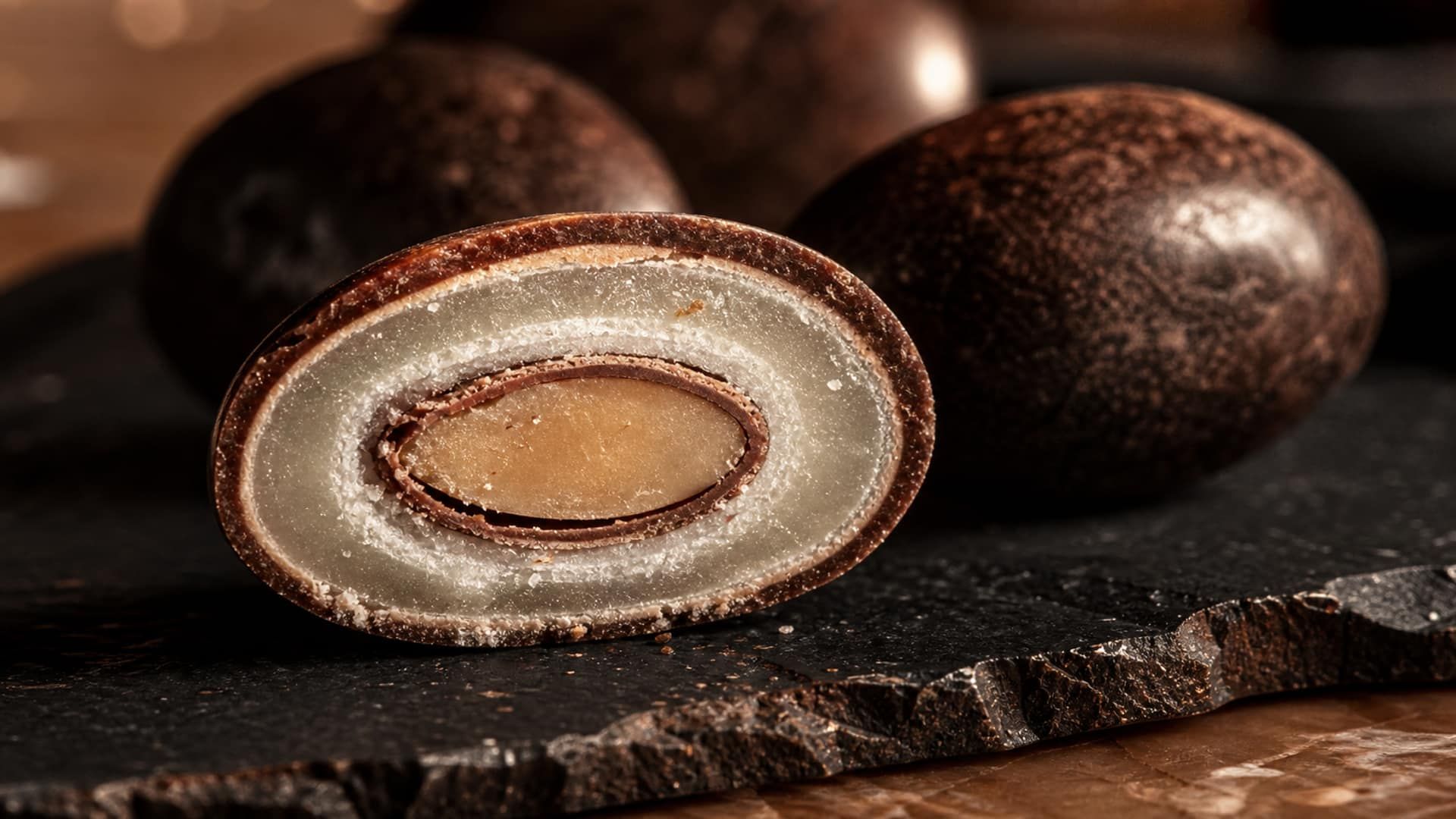
Dragée Coating Weight: How Much Coating Each Layer Needs
A coating layer weighs its shell volume times its density, and shell volume grows with the cube of the radius. How to calculate layer and batch coating weight for a dragée, with a worked sphere example.
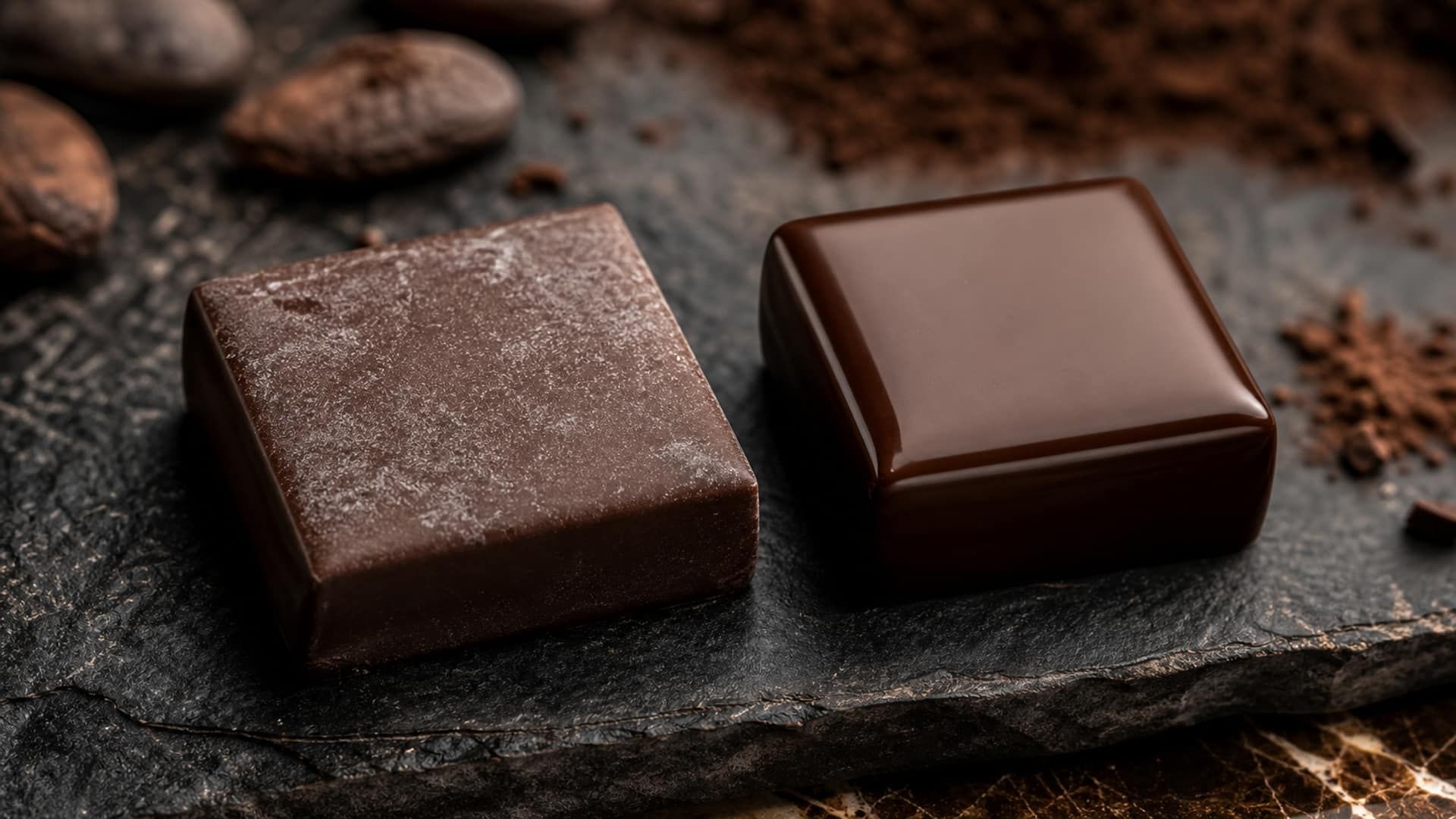
Fat Bloom and Sugar Bloom in Chocolate: Diagnose and Prevent
Distinguish fat migration and polymorphic change from condensation-driven sugar bloom, then control temper, storage, and dew point.
POD and PAC Values for Ice Cream Sugars, with Calculator
POD and PAC values for sucrose, dextrose, fructose, invert sugar, lactose, glucose syrup and polyols, a free sugar-balance calculator, and how to read the totals.