Dragée Coating Weight: How Much Coating Each Layer Needs
A coating layer weighs its shell volume times its density, and shell volume grows with the cube of the radius. How to calculate layer and batch coating weight for a dragée, with a worked sphere example.
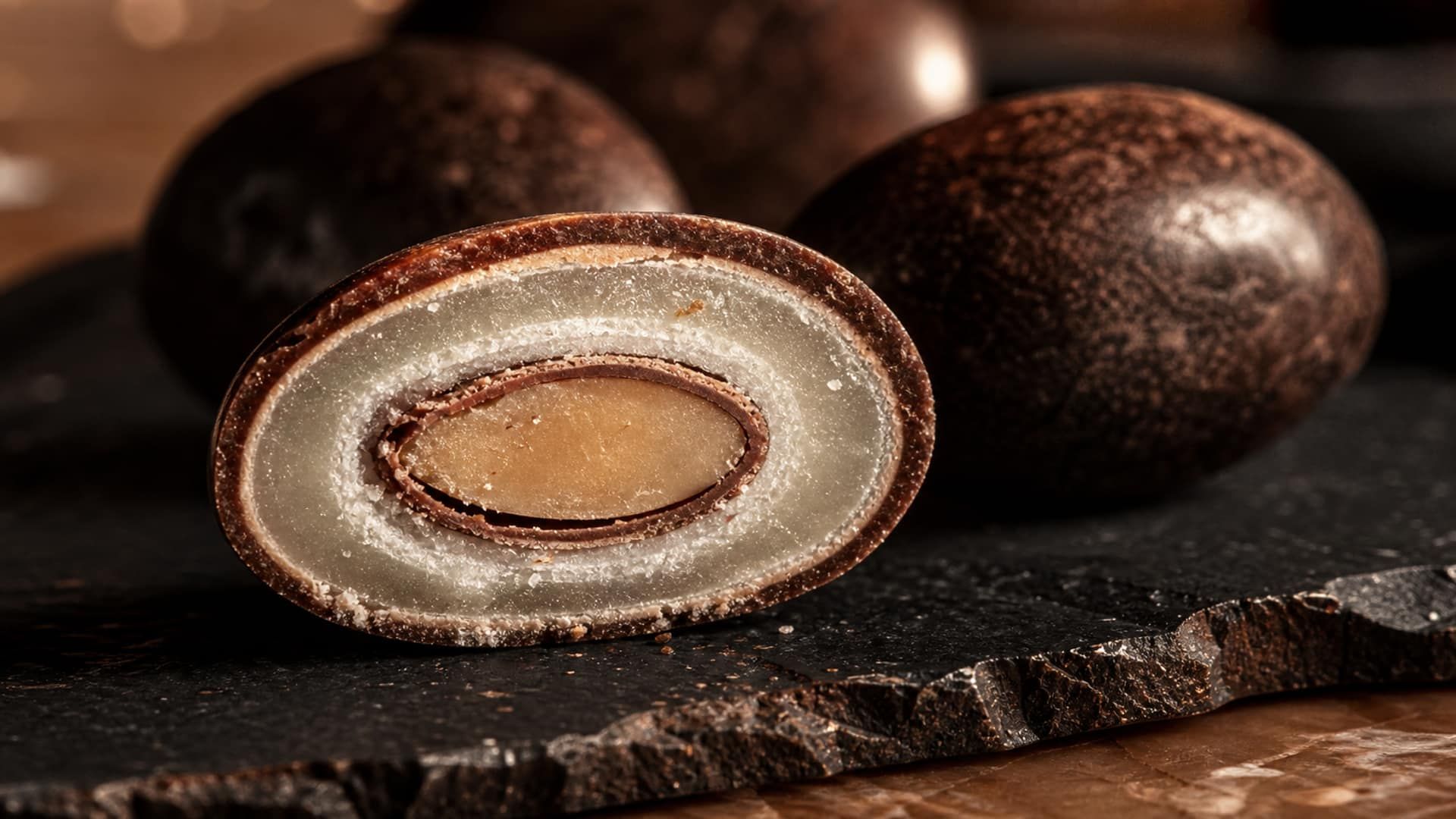
Coating Weight Is a Geometry Problem
Every dragée layer is a hollow shell. Its mass is the shell’s volume multiplied by the density of the material left behind once it has dried or set. Get the core size, the layer thickness and the density right, and the coating weight follows by arithmetic, not by eye.
Panners usually judge a batch by look and feel, then weigh it at the end. That works for a product you have made a hundred times. It fails when you change the core size, switch from sugar to chocolate, or quote a new customer a piece weight before the first trial.
The weight of a coating is not linear in its thickness. A shell sits on an ever larger surface as it builds, so the same tenth of a millimetre weighs more at the end of the run than at the start. This article works through the three numbers that decide coating weight (core geometry, shell volume and density) and then turns them into batch totals you can buy sugar and book pan time against.
Core Geometry: Sphere, Cube or Irregular
The Formul.io dragée calculator offers three core shapes. Each one sets how the core volume, and therefore the piece count in a batch, is calculated.
| Core shape setting | Core volume | How each layer is calculated | Typical cores |
|---|---|---|---|
| Sphere | V = (4/3) × π × r³ | Spherical shell between the old and new radius | Hazelnuts, macadamias, chocolate balls, malt centres |
| Cube | V = a³, where a is the entered diameter | Cubic shell: (a + 2t)³ − a³ | Caramel or fudge cubes, cut cereal pieces |
| Irregular | Same as sphere | Spherical shell, then +20% coating mass for crevices | Cashews, pistachios, walnut halves, raisins |
Core shapes in the dragée calculator
There is no ellipsoid setting. An almond, a peanut or a coffee bean is entered as a sphere of the same volume. For an almond of 18 × 10 × 7 mm the ellipsoid volume is 0.66 cm³, which is the volume of a 10.8 mm sphere, so you enter 10.8 mm as the core diameter.
Equal volume does not mean equal surface. Using Knud Thomsen’s approximation, that almond has about 4.09 cm² of surface while the 10.8 mm sphere has 3.66 cm², so the real nut carries roughly 12% more coating per thin layer than the sphere estimate. Smooth ellipsoid cores land 8–15% above their equal-volume sphere. The irregular setting adds a flat 20%, which overstates a smooth almond, so sphere is the closer of the two buckets; keep the 8–15% gap in mind when you compare the plan with the scale.
The core diameter and density also set the piece count. At a fixed batch weight, the calculator divides the batch by the mass of one core and rounds down. The minimum and maximum diameter fields turn that single count into a range, which is where a mixed calibre shows up before the pan does.
Shell Volume Calculation: Layer by Layer
Each layer is the volume between its inner surface (the previous layer) and its outer surface. For a sphere:
Shell volume of a spherical layer
V_shell = (4/3) × π × (R_outer³ − R_inner³), where R_outer = R_inner + layer thickness. Because the radius is cubed, every successive layer adds more volume than the last, even at constant thickness.
Take a 10 mm core and add four 1 mm layers:
| Layer | Outer Diameter | Shell Volume | Cumulative Volume | % Increase |
|---|---|---|---|---|
| Core | 10mm | - | 0.524 cm³ | - |
| Layer 1 | 12mm (10+2) | 0.381 cm³ | 0.905 cm³ | +73% |
| Layer 2 | 14mm (12+2) | 0.532 cm³ | 1.437 cm³ | +59% |
| Layer 3 | 16mm (14+2) | 0.708 cm³ | 2.145 cm³ | +49% |
| Layer 4 | 18mm (16+2) | 0.909 cm³ | 3.054 cm³ | +42% |
Layer 4 adds 0.909 cm³, about 2.4 times the volume of layer 1 (0.381 cm³), at the same 1 mm thickness. The four layers together hold 2.530 cm³, 6.6 times the first. A schedule that adds the same thickness each time therefore uses more coating material at the end of the run than at the start, and a cost estimate based on the first layer will undershoot.
A layer in the calculator is a band, not one charge
Real hard panning builds the shell from many very thin charges. Each charge of sugar syrup deposits roughly 0.01–0.02 mm, and hard-panning schedules commonly run 30–60 coats. A 1 mm sugar shell is therefore 50 to 100 charges, not one.
The calculator is built for bands. It treats any layer thinner than 0.1 mm as an error and suggests at least 0.5 mm for every layer after the first. Enter each stage as one band with its total thickness (for example, engrossing as a single 0.5 mm sucrose band) and divide its mass by the number of charges you plan. For a thin band the shell is close to surface area × thickness, which is why the per-charge dose has to grow as the pieces grow.
Density-Based Mass Calculation
Volume tells you how much space a layer occupies. Weight, which is what you buy, cost and label, also needs density:
Layer weight
Layer weight (g) = Shell volume (cm³) × Density of the deposited material (g/cm³). Use the density of what stays on the piece: crystalline sucrose for a sugar shell, set chocolate for a chocolate layer. Do not use the density of the syrup you ladle.
The calculator reads density from each layer’s ingredient record. When a classified ingredient has no density, it fills a class value and marks the result as an estimate:
| Deposited material | Density used (g/cm³) | 1 mm layer on a 10 mm core | Where the value comes from |
|---|---|---|---|
| Sugar (crystalline sucrose) | 1.6 | 0.61 g | Class value for sugar; sucrose crystal is 1.59 |
| Dark or milk chocolate | 1.32 | 0.50 g | Class value for chocolate |
| White chocolate | 1.25 | 0.48 g | Class value for white chocolate |
| Gum or stabilizer layer | 1.1 | 0.42 g | Class value for hydrocolloids |
| Nut paste or praline | 1.02 | 0.39 g | Class value for nuts |
| Cocoa butter | 0.90 | 0.34 g | Calculator fallback for cocoa butter |
| Cocoa, matcha or colour dusting | 0.60 | 0.23 g | Bulk density of a dusting powder |
Densities the dragée calculator falls back to when an ingredient record has none
A density fallback is a planning number, not a measurement. If an ingredient has no density and no class to borrow one from, the calculator uses 1.20 g/cm³ and warns that the weight is estimated. Enter the measured density of your coating material in the ingredient record, then check the result against a weighed trial batch.
Syrup in the ladle, solids on the piece
The calculator returns deposited solids. Your ladle measures syrup. Brix is the mass fraction of dissolved solids, so a 72 Brix syrup leaves 72% of its weight on the piece once the water has gone. Divide the solids by the Brix fraction to get syrup: 77 g of sugar per charge needs about 77 ÷ 0.72 = 107 g of 72 Brix syrup.
Per charge, hard-panning practice works with roughly 1–3% of the batch weight in syrup, 10–30 g per kg. Start near the low end and increase the dose as the pieces grow, because each charge has more surface to cover. Too small a charge leaves rough, bare patches; too large a charge glues pieces into doubles. The worked example below lands at about 21 g/kg, and the almond dragée schedule runs at 20–30 g/kg.
Batch Calculations and Production Scaling
A worked example shows the whole chain, from one core to the sugar order. The figures are what the calculator’s geometry produces for these inputs; treat them as the starting estimate for a trial, not as the finished specification.
Describe the core
Hazelnuts, entered as a sphere of 14 mm with density 0.95 g/cm³ and a 5,000 g batch. One core is 1.437 cm³ and 1.365 g, so the batch holds 3,663 pieces. Narrow the minimum and maximum diameter to your measured calibre (13–15 mm gives 2,978–4,575 pieces); the default ±4 mm spread produces a range wide enough to trigger the size-variance warning.
Stack the bands
Band 1: sucrose engrossing, 0.5 mm, about 25 charges at 0.02 mm each. Band 2: sucrose smoothing and colour, 0.5 mm. At density 1.6 the bands weigh 0.529 g and 0.604 g per piece, 1.133 g in total. The finished piece is 16 mm across and weighs about 2.50 g, with the coating at 45% of the piece and 83% of the core weight. Two bands on a hard-panning recipe also draw a reminder that hard panning usually takes three to five layers; it is advice, not an error.
Total the batch
Coating on the product: 3,663 × 1.133 g ≈ 4.15 kg. The default 5% machine loss adds about 0.21 kg of coating that never reaches the pieces. Finished product is about 9.15 kg, roughly 400 pieces per kg. Set the pan capacity, which is a mass in grams, to your real pan: at the 5 kg default the 9.4 kg total triggers the overfill warning, while a 12 kg pan sits at 78% fill.
Convert to syrup and charges
Band 1 deposits 1.94 kg of sugar across the batch. Over 25 charges that is 77 g of sugar per charge, or about 107 g of 72 Brix syrup on a 5 kg starting charge (about 21 g per kg). The whole shell, losses included, needs about 4.36 kg of sugar, roughly 6.05 kg of syrup at 72 Brix.
Weigh a 20-piece sample every five charges and compare the gain with the plan. If the pan consistently delivers less, your real charges are thinner than the bands you entered: change the band thickness in the model so the next batch starts from what the pan actually does.
What the Calculator Checks Besides Weight
The weights come with warnings that catch the mistakes geometry makes visible. A layered calculation needs a core ingredient with a known composition, because the core is treated as its own moisture zone.
- Thickness. Below 0.1 mm a layer is an error. The first layer gets a minimum of 0.2 mm on small spheres, 0.3 mm above 15 mm and 0.5–0.8 mm on irregular cores; later layers under 0.5 mm get a note. Layers over 5 mm are flagged as likely to crack or to take too long, and a coating that more than doubles the core diameter draws a reminder to check that the pan can handle the size.
- Core strength. A coating heavier than the core can carry is flagged: above 3.0 times the core weight for nuts, 2.5 for chocolate, 4.0 for hard candy, 1.5 for dried fruit and 2.0 for other cores.
- Moisture. The calculator estimates the water activity (aw) of the core and of every layer. A step between neighbouring layers, core included, above 0.08 is a medium migration risk and above 0.15 a high one. A layer above aw 0.75, or a layer with more than 10% water next to one under 2%, is flagged too.
- Compatibility and pan. A fat-based layer under a water-based one is flagged for adhesion. A batch heavier than 85% of the pan capacity (a mass setting) draws a warning; one that exceeds it draws a stronger one.
The moisture flags are a screen, not a shelf-life test. How fast water actually moves depends on barrier layers, packaging and storage, which is covered in the moisture-migration article below.
Moisture Migration: Water Activity, Fick's Law, and Packaging
Why an aw step between core and shell sets the direction of water movement, and what decides its speed.
Frequently Asked Questions
How accurate is the weight prediction compared to actual production?
How do I enter an almond or another oval core?
Why does the calculator flag a 0.02 mm sugar layer when that is what one charge deposits?
How much syrup should one charge be?
Does the calculator cost the batch or estimate panning time?
When should I choose the irregular shape setting?
Related Topics
Related Articles
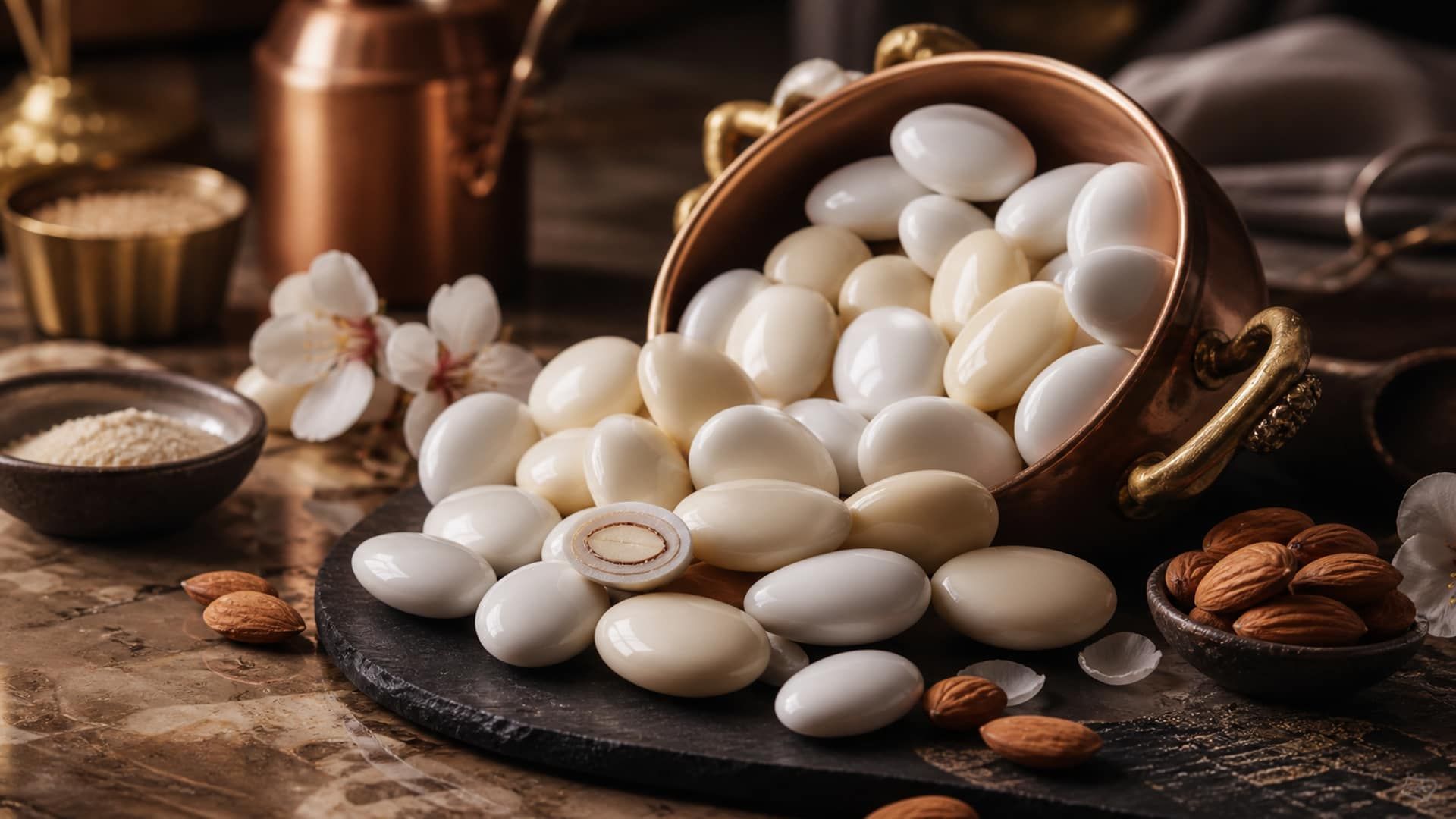
Almond Dragée: Building a Multi-Layer Coating from Core to Finish
A complete production guide to multi-layer sugar panning for almond dragée: gum arabic sealing, 20–30 engrossing layers, smoothing, coloring, and final polish — with calculator walkthrough.
Dragée Coating Is Uneven: Diagnosing Coverage Problems
Flat spots, doubles, rough shells or colour streaks in dragée panning? Diagnose each defect by root cause (charge size, pan speed, core shape, temperature and drying) and fix it.
Moisture Migration: Water Activity, Fick's Law, and Packaging
Predict moisture movement by separating its water-activity driving force from diffusion rate, and compare packaging only with WVTR units and test conditions attached.