Fat Bloom and Sugar Bloom in Chocolate: Diagnose and Prevent
Distinguish fat migration and polymorphic change from condensation-driven sugar bloom, then control temper, storage, and dew point.
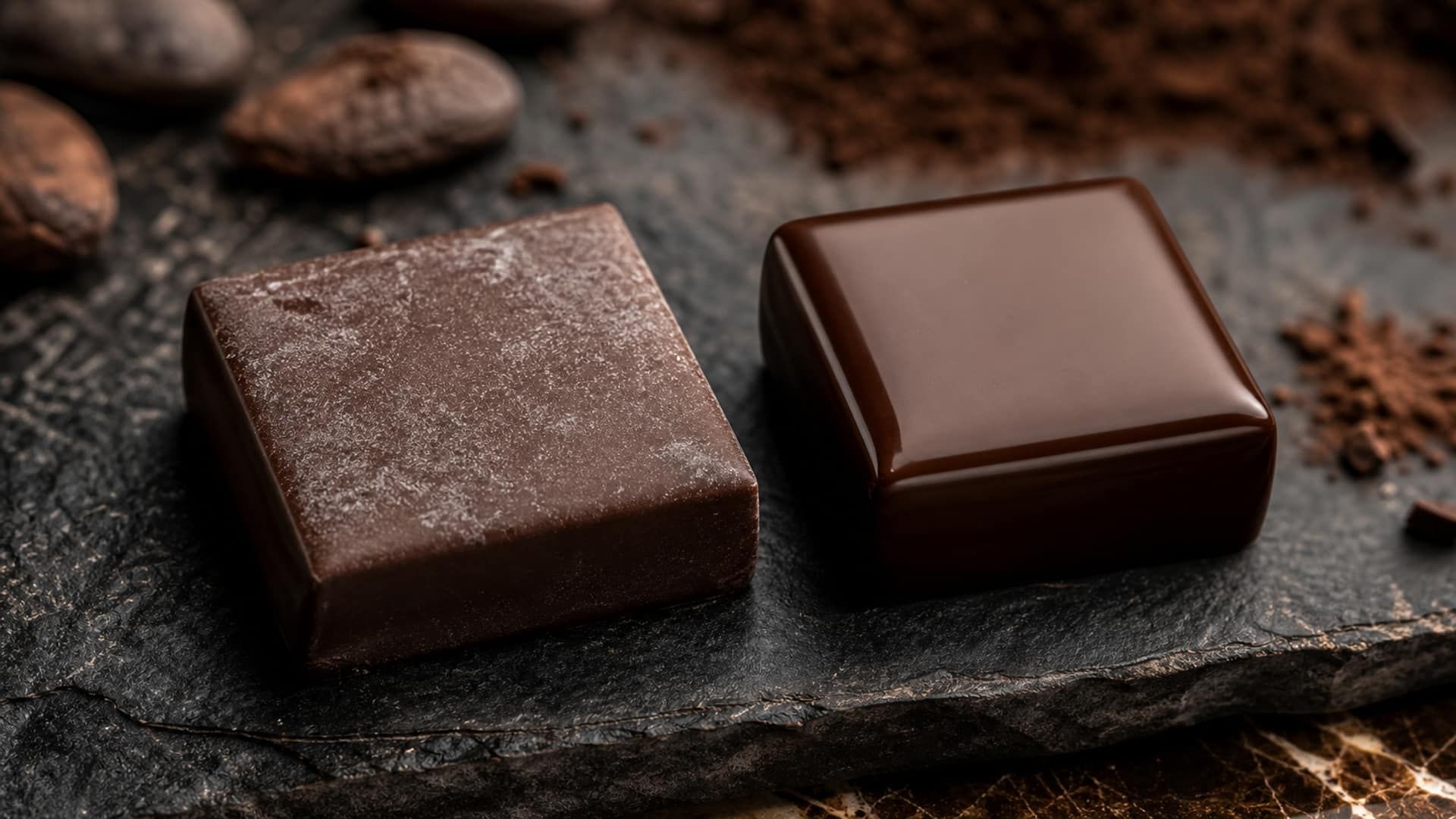
Chocolate bloom is a visible quality defect, not one mechanism. Fat bloom arises from changes and movement in the fat phase. Sugar bloom arises when water dissolves surface sugar and later leaves larger crystals behind. The two defects can look similar, but the controls that prevent them are different.
Use the standard names
Fat bloom concerns cocoa-butter crystallization and fat migration. Sugar bloom concerns moisture, dissolution, and recrystallization of sugar. “Water bloom” describes the condensation event but is not the standard name of the finished defect.
Fat bloom has several mechanisms
Cocoa butter is polymorphic: its triacylglycerols can pack into crystal forms with different melting ranges and stability. Tempering creates a small population of suitable Form V seed crystals, which directs most of the remaining cocoa butter to solidify predominantly as Form V during cooling. Form V gives well-made chocolate gloss, contraction, snap, and a clean melt near body temperature.
Fat bloom is often associated with the slow transition from Form V to the more thermodynamically stable, higher-melting Form VI. Larger or differently organized surface crystals scatter light and appear gray-white. That is not the only route. Under-tempered chocolate can transform from Form IV to Form V and bloom. Soft fat from a filling can also migrate through the shell, dissolve part of the cocoa-butter network, and recrystallize at the surface.
The direction and cause of the change therefore depend on the route: the common V→VI transition moves toward a more stable form, while under-tempering and filling-fat migration follow different paths.
| Route | What changes | Typical trigger |
|---|---|---|
| Form V → Form VI | Cocoa butter moves toward the more stable polymorph | Time, warm storage, and temperature cycling |
| Form IV → Form V | Unstable crystals reorganize after inadequate tempering | Insufficient or poorly controlled pre-crystallization |
| Filling-fat migration | Liquid oil moves into the shell and recrystallizes near the surface | Nut pastes, soft fats, warm storage, thin or permeable shells |
| Compound-coating bloom | A non-cocoa-butter fat network reorganizes | Incompatible fat blends or unsuitable cooling/storage |
The visible result can be similar even when the underlying route differs.
Temper is a process state, not a percentage target
Professional tempering does not require proving a universal Form V percentage immediately after tempering. The process creates enough appropriate nuclei to guide crystallization after depositing or moulding. Industry assesses the state with a temper meter or temper index, cooling curves, differential scanning calorimetry, and practical set tests.
What a temper test can and cannot show
A quick smear or knife test can reveal slow set, streaking, or poor gloss. It does not quantify polymorph percentage or guarantee long-term bloom resistance. Use it as an in-process check, then validate the real product through storage.
Formulation changes alter the useful temperature curve. Dark, milk, white, and ruby chocolates have different fat phases; supplier recommendations are the primary operating window. Typical working ranges are roughly 31–32°C for dark, 29–30°C for milk, and around 28–30°C for many white or ruby couvertures, but a practical tolerance is often about ±1°C rather than a universal ±0.5°C.
Filled chocolates add a migration problem
Nut oils, milk fat, coconut oil, and other soft fats can lower the solid-fat content of the shell locally. Migration depends on the concentration gradient, liquid-fat fraction, crystal network, particle structure, temperature, and time. A qualitative “compatibility index” may be useful inside one product-development program, but “excellent,” “poor,” or “very high risk” is not a transferable measured constant without a stated method.
| Factor | Why risk changes | Control |
|---|---|---|
| Poor pre-crystallization | Too few suitable seeds or mixed unstable forms | Follow the couverture curve; verify temper before depositing |
| High liquid-fat filling | Oil can diffuse into and soften the shell network | Reformulate, cool appropriately, or add a tested barrier |
| Warm or cycling storage | Raises liquid-fat fraction and accelerates migration/reorganization | Keep temperature cool and stable |
| Thin shell | Shortens the migration path | Choose thickness from product-specific storage trials |
Shell thickness and barrier layers slow migration but do not create an absolute shelf-life guarantee.
An accelerated cycle can compare variants under a defined stress. For example, samples can be cycled between 12°C and 22°C and ranked by surface color change. The ranking is useful for that product and protocol, but it does not convert directly to a fixed number of months at 18°C without real-time correlation data.
Sugar bloom begins with liquid water
Sugar bloom occurs when condensation, a wet tool, or other liquid water contacts chocolate. The water dissolves sugar at the surface. As it evaporates, the sugar recrystallizes into coarse, light-scattering deposits that feel dry or grainy.
Relative humidity alone does not tell you whether condensation will occur. Compare the chocolate surface temperature with the air’s dew point. If the surface is below the dew point, the adjacent air reaches saturation and water can condense.
Dew point: Magnus approximation
Td = (b × α) / (a − α)
α = ln(RH/100) + (a × T)/(b + T)
For water over the ordinary indoor range, a = 17.27, b = 237.7°C, air temperature T is in °C, and RH is relative humidity in percent. The approximation is accurate enough for handling decisions; a calibrated dew-point sensor is better for critical rooms.
At 22°C and 60% RH, the Magnus calculation gives a dew point of about 13.9°C. Chocolate removed from 8–10°C storage is colder than that air’s dew point. If unpacked immediately, it is at high risk of condensation and subsequent sugar bloom.
| Air temperature | RH | Approximate dew point | Practical unpacking target |
|---|---|---|---|
| 20°C | 50% | 9.3°C | Surface above ~10–11°C |
| 20°C | 60% | 12.0°C | Surface above ~13°C |
| 22°C | 60% | 13.9°C | Surface above ~15°C |
| 24°C | 60% | 15.7°C | Surface above ~17°C |
| 24°C | 70% | 18.1°C | Surface above ~19°C |
A small margin above calculated dew point allows for sensor and surface-temperature variation.
Visible sweating is already a process failure
Fogging or droplets show that the surface crossed the dew point. Keep the product closed until it is warmer than the surrounding dew point; lowering room humidity increases the safety margin.
Refrigeration can be managed safely
A refrigerator creates a large temperature transition, but refrigeration itself does not dissolve sugar. The dangerous moment for sugar bloom is exposure of cold chocolate to warmer humid air. Repeated temperature cycling also accelerates fat migration and crystal reorganization; a normal move from 4°C to 22°C does not need to be described as melting Form V, whose melting range is higher.
Filled chocolates with perishable centres need a validated safety strategy based on aw, pH, formulation, hygiene, storage time, and temperature. The aw = 0.85 value is an important U.S. regulatory benchmark, not a universal permission to keep every lower-aw filling at room temperature or a universal command to refrigerate every higher-aw filling. When validated refrigeration is required, protect quality with controlled packaging and warming.
Package before cooling
Use an airtight, food-suitable moisture barrier. Add only a food-approved desiccant configuration that cannot contact the product. Packaging also limits odor pickup.
Hold at a stable temperature
Avoid the door and other zones with repeated warm-air exposure. Record actual product temperature rather than relying only on the appliance setting.
Warm while sealed
Move the closed package through a cool intermediate room when practical. Keep it sealed until the chocolate surface is above the destination room’s dew point, with a measurement margin.
Minimize cycles
Plan portions so product is not repeatedly cooled and warmed. Each cycle adds migration and condensation opportunities.
For shelf-stable solid chocolate, many manufacturers recommend cool, dry, stable storage around 14–18°C and relative humidity below about 50–60%. These are quality ranges, not microbial controls for a perishable filling. A wine cabinet is useful only if it holds the required temperature steadily and prevents condensation during removal.
Diagnose before reworking
Fat bloom often appears as a diffuse gray film, streaks, or irregular marbling and may feel slightly greasy. Sugar bloom more often looks crystalline, spotted, and dry or grainy. Appearance is not definitive; microscopy, thermal analysis, X-ray diffraction, or chemical mapping may be required when the root cause matters.
| Characteristic | Fat bloom | Sugar bloom |
|---|---|---|
| Primary phase | Fat crystal network | Surface sugar and liquid water |
| Common driver | Polymorphic change or fat migration | Condensation or direct wetting |
| Typical feel | Waxy or greasy | Dry and grainy |
| Time | Hours to months, depending on route | Can appear after one wetting/drying event |
| Main prevention | Correct temper, compatible formulation, stable storage | Keep surface above dew point while exposed |
| Rework | Usually full melt and re-temper | Usually full reprocessing; wiping does not restore the surface |
Use the pattern as a diagnostic clue, not a laboratory identification.
Bloom itself does not make plain chocolate hazardous, but it does not prove that the product is safe either. A bloomed filled chocolate can still have an unrelated microbiological or allergen problem. Evaluate safety from formulation and handling records, not surface appearance.
Prevention checklist
For fat bloom:
- follow the supplier’s tempering curve and verify the in-process temper state;
- control depositing, cooling, and demoulding so the seeded network develops consistently;
- characterize filling oils and measure migration in the real shell;
- use barriers and shell thickness as tested design variables, not universal minima;
- store cool and stable, avoiding warm excursions and repeated cycling;
- track gloss or color over a defined real-time and accelerated protocol.
For sugar bloom:
- control room humidity and know the current dew point;
- measure surface temperature before opening cold packages;
- warm sealed product until it is safely above dew point;
- prevent droplets from tools, tunnels, and packaging equipment;
- train handlers to treat visible fogging as a deviation.
The practical distinction
Condensation-driven sugar bloom is largely preventable by dew-point control. Fat bloom requires both process control and a formulation/storage system tested over time.
Frequently asked questions
Can appearance reliably distinguish fat bloom from sugar bloom?
Is bloomed chocolate safe to eat?
Why can fat bloom appear immediately after production?
Can bloomed chocolate be restored without re-tempering?
Does lecithin prevent fat bloom?
When is it safe to open refrigerated chocolate?
What relative humidity is safe for chocolate?
Does dark chocolate bloom less than milk chocolate?
References
- Wille, R. L., & Lutton, E. S. (1966). Polymorphism of cocoa butter. Journal of the American Oil Chemists’ Society, 43(8), 491–496.
- Lonchampt, P., & Hartel, R. W. (2004). Fat bloom in chocolate and compound coatings. European Journal of Lipid Science and Technology, 106(4), 241–274.
- Altimiras, P., Pyle, L., & Bouchon, P. (2007). Structure–fat migration relationships during storage of cocoa butter model bars: Bloom development and possible mechanisms. Journal of Food Engineering, 80(2), 600–610.
- Rousseau, D., & Smith, P. (2008). Microstructure of fat bloom development in plain and filled chocolate confections. Soft Matter, 4(8), 1706–1712.
- Purdue University Extension. (2023). Cocoa Processing: Tempering. FS-153-W.
- Lawrence, M. G. (2005). The relationship between relative humidity and the dewpoint temperature in moist air. Bulletin of the American Meteorological Society, 86(2), 225–233.
Related Topics
Related Articles
Water Activity Calculator for Ganache and Filled Chocolates
Calculate water activity from your formulation, compare ingredient changes, and use recipe-level predictions to plan shelf-life testing for filled chocolates.
Glucose Syrups and Dextrose Equivalent Explained
Comprehensive analysis of glucose syrups, Dextrose Equivalent (DE) impact on confectionery formulations, and the functional differences between syrup and powder forms.
Cocoa Butter Polymorphism: Temper Chocolate Reliably
Understand cocoa butter’s six traditional crystal forms, target Form V through controlled pre-crystallization, and reduce bloom through measured process and storage controls.