Trehalose: Properties, Uses, and Science in Confectionery
How a non-reducing disaccharide with the molecular weight of sucrose but under half its sweetness protects frozen, aerated, and freeze-dried confectionery.
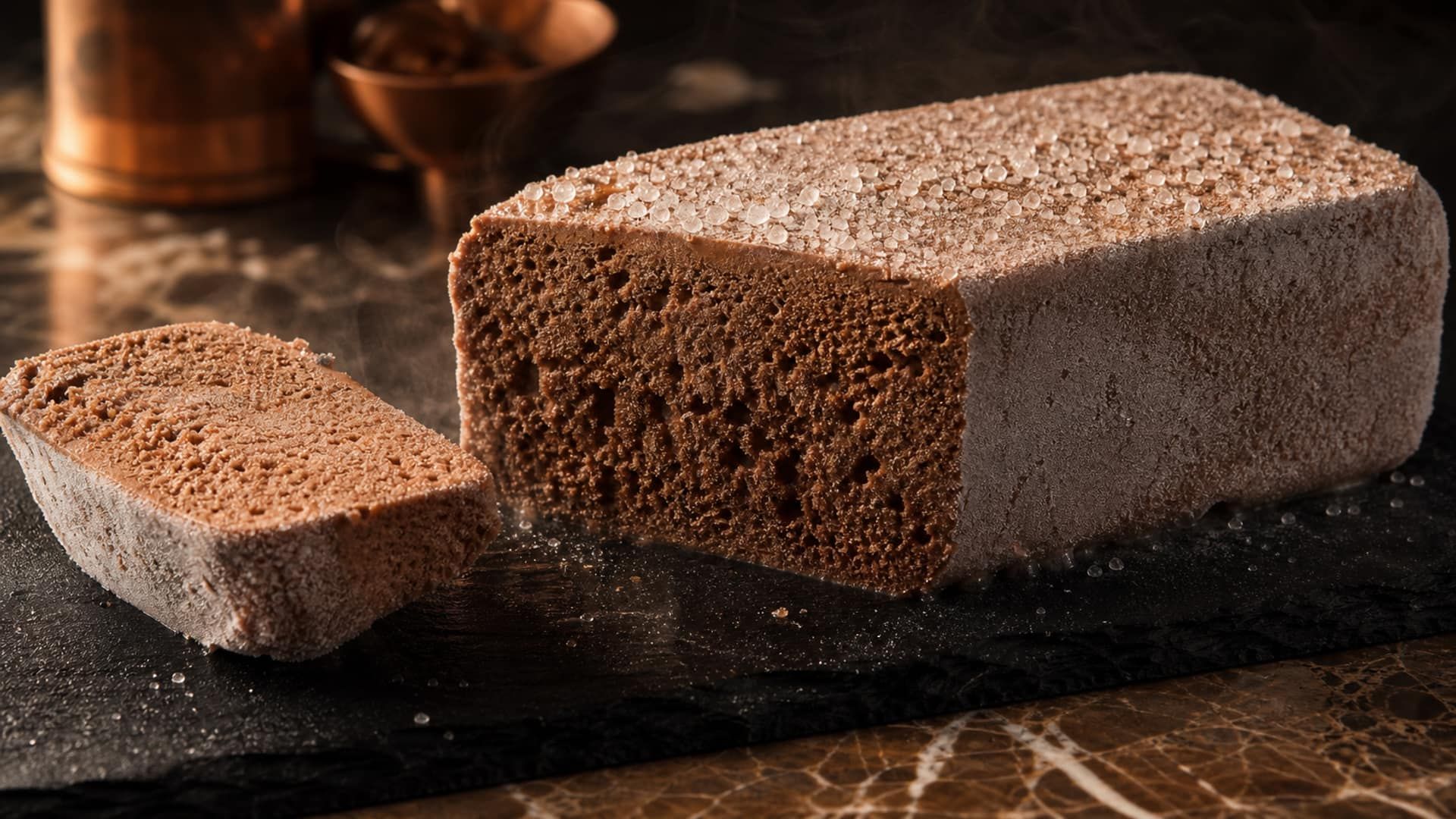
Trehalose has the molecular weight of sucrose yet less than half its sweetness, is non-reducing, and forms a high-Tg amorphous glass when sufficiently dry. Its moisture behaviour depends on physical form: the stable dihydrate is comparatively low-hygroscopic, while anhydrous forms readily take up water and convert toward the dihydrate.
What Trehalose Is
Trehalose (C₁₂H₂₂O₁₁, MW 342 g/mol) is a non-reducing disaccharide built from two glucose units joined by an unusual α,α-1,1-glycosidic bond. The bond connects the anomeric carbons of both glucose units. Sucrose is also non-reducing because its α-1↔β-2 bond connects the anomeric carbons of glucose and fructose; the difference is the identity and geometry of the linked monosaccharides, not a free anomeric carbon in sucrose.
Because neither anomeric carbon is available, intact trehalose cannot open into the reactive aldehyde form required for Maillard browning. It is comparatively stable, but “non-reducing” does not mean chemically inert under every heat, acid, enzyme, or storage condition.
Why the α,α-1,1 bond matters
A reducing sugar carries a free anomeric carbon that can open into an aldehyde and react with amino acids (the Maillard reaction). Trehalose’s α,α-1,1 linkage ties up both anomeric carbons, so it has no reactive end. No reactive end means no Maillard browning, no off-flavour formation from sugar–protein reactions, and exceptional colour stability.
Industrially, trehalose is produced by the enzymatic conversion of tapioca or corn starch — starch is liquefied, then a pair of enzymes rearranges the terminal glucose linkage into the α,α-1,1 bond. It also occurs naturally in mushrooms, yeast, honey, and the tissues of organisms that survive extreme dehydration, which is the biological clue to its preservative power.
Properties That Set It Apart
Trehalose shares a molecular weight and broad colligative behaviour with sucrose, yet differs in sweetness, thermal properties, and solid-state hydration. In gelato-style formulation tables its relative sweetness index (POD) is often set near 45 when sucrose is 100. POD and PAC are practical formulation indices rather than universal thermodynamic constants, so the table source and test conditions matter.
Because its molecular weight (342 g/mol) equals that of sucrose, ideal dilute calculations give the same number of dissolved molecules per gram. This supports an approximate dry-solids PAC near 100 when sucrose is 100. Real freezing-point and water-activity effects also depend on concentration, activity coefficients, physical form, and product water, so verify concentrated formulations rather than treating the index as an exact 1:1 guarantee.
Dry amorphous trehalose has a reported glass-transition temperature of roughly 100–120°C (about 107°C in one DSC study). Water is a powerful plasticizer: at about 10% water by mass, reported Tg values are near room temperature—roughly 10–30°C, depending on sample history and measurement—not 80°C. A Tg near 80°C corresponds to only a few percent water. Trehalose therefore supports a rigid glass only when moisture and storage temperature are controlled. Its stable dihydrate is comparatively low-hygroscopic; anhydrous forms can absorb water and transform toward the dihydrate.
| Property | Trehalose | Sucrose | Glucose (dextrose) |
|---|---|---|---|
| Molecular weight (g/mol) | 342 | 342 | 180 |
| Sweetness (POD, sucrose = 100) | ~45 | 100 | ~70 |
| PAC (freezing-point depression, sucrose = 100) | ~100 | 100 | ~190 |
| Hygroscopicity | Low for stable dihydrate; anhydrous forms rehydrate | Low | Moderate |
| Maillard browning | None (non-reducing) | Slight (inverts on heat) | Yes (reducing) |
Trehalose versus sucrose and glucose on the parameters that drive formulation choices.
The takeaway: dry trehalose and sucrose have similar first-order colligative effects per gram, while trehalose is less sweet and has a higher dry Tg. Moisture uptake depends on crystal form, and concentrated-product aw and freezing behaviour still require measurement or a validated model.
Behaviour in Frozen and Aerated Systems
In ice cream and sorbet, sugars do double duty — they sweeten and they depress the freezing point, controlling how much water stays liquid at serving temperature. With a PAC near 100, trehalose depresses freezing about like sucrose by mass, so it slots into a sugar blend without throwing off the hardness target. Its real contribution is cryoprotection: trehalose immobilises water in a glassy, slow-diffusing matrix at the ice interface, which restrains ice-crystal growth during storage and freeze–thaw cycling and keeps texture smoother for longer.
Because it adds only about 45% of sucrose’s sweetness, trehalose lets you raise total dissolved solids — improving body and lowering water activity — without over-sweetening a sorbet or dairy base. That decoupling of solids from sweetness is hard to achieve with sucrose alone.
To see the trade-off in a mix, replace part of the sucrose with trehalose in the balancer below: PAC stays the same while POD falls.
The same glass-forming, water-immobilising behaviour fights syneresis in gummies and pâte de fruit, where weeping is a slow migration of free water out of the gel. By tying up water in a more rigid amorphous phase, trehalose reduces the free water available to bleed out, helping pectin and gelatine systems hold their set over shelf life.
Foams and creams
In aerated systems—marshmallow, meringue, whipped fillings—trehalose can stiffen the continuous sugar phase as it concentrates. When the supplied grade and final solid state remain low-hygroscopic, partial replacement can reduce tack; performance still depends on environmental RH, package barrier, and the complete sugar system.
Stability, Moisture, and Shelf Life
Trehalose’s preservative reputation comes from two linked mechanisms: glass formation and water replacement. As a product dries or freezes, trehalose vitrifies into a high-Tg glass that physically locks molecules in place, halting the diffusion needed for spoilage and degradation reactions. At the molecular scale it also substitutes for water at the surface of proteins and other sensitive structures — its hydroxyl groups hydrogen-bond where water used to sit, preserving shape and function through drying. This is why it stabilises freeze-dried fruit, flavours, and biological materials so effectively.
For chocolate and confectionery bound for hot, humid markets, the comparatively low hygroscopicity of stable trehalose dihydrate can be useful. Whether a filling or coating absorbs less moisture depends on its final solid state, the full formulation, RH, and package; verify the claimed bloom benefit in storage tests.
Zero Maillard reactivity gives trehalose a second shelf-life role: colour and flavour preservation. In heat-processed and freeze-dried products, reducing sugars darken and generate roasted off-notes over time. Trehalose contributes none of that chemistry, so delicate pastel colours and fresh fruit flavours read truer for longer.
Read its moisture behaviour correctly
Trehalose is sometimes described loosely as both “retaining” and “repelling” water. The precise description depends on state: a dry amorphous matrix can immobilise water and slow molecular mobility; crystalline dihydrate is comparatively low-hygroscopic; anhydrous crystals can rehydrate. It is not correct to assign one moisture behaviour to every physical form and humidity.
Using Trehalose: Dosage, Substitution, and Cost
Trehalose is rarely the whole sugar system. A 10–30% sucrose replacement is a practical trial range, though some dry, low-moisture products can use more. A 1:1 dry-mass swap approximately preserves the first-order colligative contribution but cuts perceived sweetness; measure aw and validate the freezing curve in the finished formulation.
Set the functional goal
Decide what you need: bloom resistance, anti-syneresis, cryoprotection, or colour/flavour stability. That goal sets the replacement level — start near 10–30% of sucrose for most products.
Start on a dry-mass basis
Use a gram-for-gram dry-solids substitution as a first calculation because both sugars are MW 342. Then account for trehalose grade and hydration state and verify aw and freezing behaviour in the actual concentrated mix.
Rebalance sweetness
Expect perceived sweetness to fall. A trial blend such as 70% trehalose + 30% invert sugar can restore sweetness and humectancy, but it also changes aw, hygroscopicity, and Tg; recalculate and measure rather than assuming those properties stay fixed.
Confirm the numbers
Model the revised blend's water activity, PAC, and POD before scaling, so the swap meets the texture and shelf-life target rather than just the cost target.
The constraint is price. Trehalose typically costs 3–6× as much as sucrose, so it earns its place in premium and high-value applications — tropical-market chocolate, freeze-dried inclusions, reduced-sweetness reformulations, and products where colour or flavour fidelity justifies the spend. At mainstream price points, partial replacement at the low end of the 10–30% band usually captures most of the benefit for the least cost.
When the premium is worth it
Reach for trehalose when the failure mode you are designing against is expensive: bloom in hot-climate chocolate, ice-crystal coarsening in stored frozen desserts, browning or fading in heat-processed colours, or collapse in freeze-dried product. For ordinary ambient confectionery with no humidity or browning problem, cheaper sugars do the job.
Frequently Asked Questions
Is trehalose worth the cost?
Can I replace all the sugar with trehalose?
Does trehalose make ice cream less sweet?
Why is trehalose resistant to Maillard browning?
How can trehalose and sucrose share a molecular weight yet behave differently?
Is trehalose natural and vegan?
References
- Simperler, A. et al. (2006). Glass transition temperature of glucose, sucrose, and trehalose: an experimental and in silico study. Journal of Physical Chemistry B, 110, 19678–19684.
- Drake, A. C. et al. (2018). Effect of water content on the glass transition temperature of mixtures of sugars, polymers, and penetrating cryoprotectants in physiological buffer. PLOS ONE, 13, e0190713.
- Weng, L., Ziaei, S. & Elliott, G. D. (2016). Effects of water on structure and dynamics of trehalose glasses at low water contents and its relationship to preservation outcomes. Scientific Reports, 6, 28795.
- Nagase, H. et al. (2005). De- and rehydration behavior of α,α-trehalose dihydrate. Journal of Pharmaceutical Sciences, 94, 487–495.
Related Articles
Sugar Types in Confectionery: Which Sugar Does What
Sucrose, glucose syrup, dextrose, fructose, invert sugar, lactose and trehalose compared: which sugar to use in caramel, ganache, fondant, pâte de fruit, ice cream, panning and nougat, and why.
Caramel Glass Transition: How Moisture Sets Texture
Why a few points of water move a caramel from hard crack to chewy: the glass transition, a Gordon–Taylor table you can recompute, and the water left at each cooking stage.
POD and PAC Values for Ice Cream Sugars, with Calculator
POD and PAC values for sucrose, dextrose, fructose, invert sugar, lactose, glucose syrup and polyols, a free sugar-balance calculator, and how to read the totals.