Dark Chocolate Truffle Ganache: A Step-by-Step Calculator Walkthrough
Learn to formulate a dark chocolate truffle ganache against an Aw 0.75 target using the Formul.io calculator. Covers ingredient entry, metric interpretation, adjustments, and process control toward a 21-day ambient shelf life.
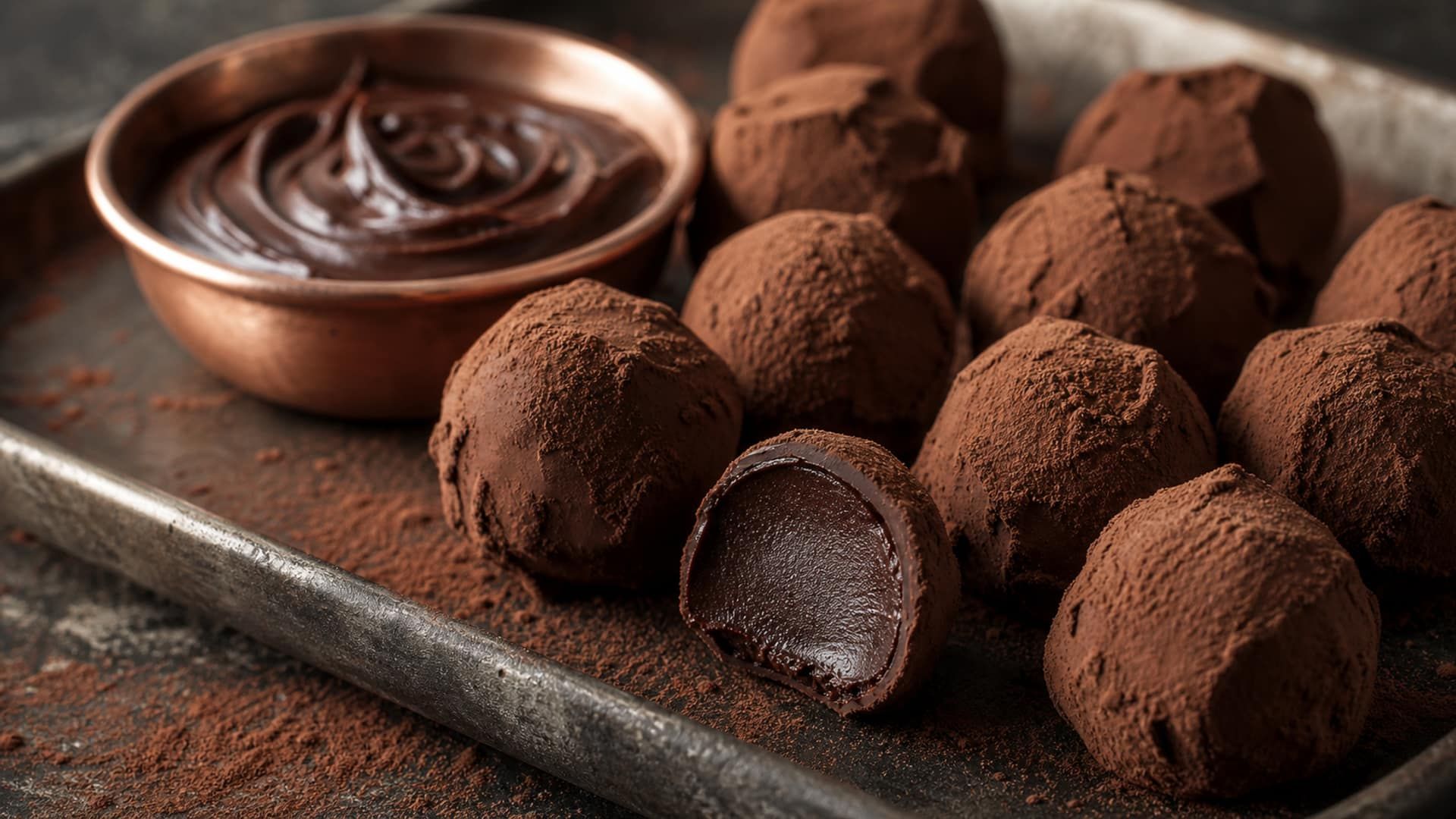
This article walks you through entering a professional dark chocolate truffle ganache into the Formul.io Ganache Calculator — step by step. You will learn what each metric means, how to interpret the results, and what to adjust when the numbers are not within specification. Water activity is worked out two ways — a transparent sugar-ratio approximation by hand, and the Formul.io engine’s estimate for the same formula. For this formula they differ (about 0.75 by hand, about 0.77 in the engine); the walkthrough shows where the gap comes from and what to adjust.
Who This Walkthrough Is For
This guide targets professional confectioners and pastry chefs producing bonbon truffle centres at scale. It assumes familiarity with ganache emulsification technique and a need for predictable, documented shelf life — not a casual home recipe.
Target Metrics for a Professional Truffle Ganache
Before opening the calculator, define your targets. A truffle ganache must balance two competing demands: low enough water activity for microbiological stability, and enough moisture to remain pipeable at 28-30°C. The following targets represent a commercially practical compromise for a dark chocolate truffle piped into bonbon shells.
Why Aw 0.75 Is the Target
At Aw 0.75, bacterial growth is fully suppressed and the common (non-xerophilic) molds — Aspergillus, Penicillium — cannot establish, since they need roughly Aw 0.80+. The organisms that can still grow near this level are xerophilic molds (the Eurotium / Aspergillus glaucus group, from ~0.71–0.75) and osmophilic yeasts (Zygosaccharomyces rouxii, down to ~0.62). So 0.75 is a deliberate, conservative compromise for a pipeable truffle — low enough to make spoilage slow and keep a 21-day ambient limit realistic, not a hard sterility guarantee. That is exactly why the shelf life below is capped conservatively and why challenge testing is required before commercial release. Above about Aw 0.80, weeks at room temperature are no longer realistic: plan to refrigerate unless a meter reading and a storage test support a short ambient life. The food-safety line sits higher: the FDA Food Code (2022) treats a measured aw below 0.88 as not needing time and temperature control, so design to a calculated 0.85 or lower and confirm the finished batch on a meter.
The Formula (1000g Batch)
This formulation uses a 3.43:1 chocolate-to-cream ratio (by weight). The high proportion of dark chocolate delivers cocoa butter for fat content and cocoa fiber for bound water, both of which reduce free water and lower Aw. Glucose syrup and invert sugar serve as crystallization inhibitors and secondary humectants. Cocoa butter replaces part of the cream fat to reduce water input without reducing total fat.
| Ingredient | Amount (g) | % | Function |
|---|---|---|---|
| Dark chocolate 70% | 600 | 60.0% | Cocoa butter, cocoa solids, chocolate flavour |
| Heavy cream 35% fat | 175 | 17.5% | Water phase, fat, emulsification |
| Glucose syrup DE42 | 80 | 8.0% | Crystallization inhibitor, body, moderate humectant |
| Invert sugar (Trimoline) | 60 | 6.0% | Humectant, anti-crystallization, enhanced sweetness |
| Cocoa butter | 50 | 5.0% | Additional fat; adds richness with zero water |
| Unsalted butter 84% | 35 | 3.5% | Emulsion plasticity, gloss, mouthfeel |
Dark Chocolate Truffle Ganache — 1000g Batch
Aw by Hand (Sugar-Ratio Approximation)
Total water: Chocolate 6.0g + Cream 99.75g + Glucose 16.0g + Invert 13.2g + Butter 5.6g = 140.6g (14.06%)
Total sugar: Chocolate 174.0g + Cream (lactose) 5.25g + Glucose 64.0g + Invert 46.8g = 290.1g (29.01%)
Bound water: Protein (chocolate 24g + cream 5.25g) × 1.5 = 43.9g; Cocoa fiber (600g × 0.55 × 0.06) × 0.6 = 11.9g; Total bound = 55.8g (cap at 40% of water = 56.2g — not capped)
Free water: 140.6 − 55.8 = 84.8g (8.48%)
Sugar-ratio approximation: ratio = 29.01 / 8.48 = 3.42; aw = 1 − 0.08 × 3.42 + 0.0022 × 3.42² = 1 − 0.274 + 0.026 = 0.752
This polynomial is a simplified teaching approximation, not the calculation the Formul.io engine runs. For the same formula (on a real 72.4% couverture), the engine estimates Aw ≈ 0.77 (band 0.76–0.79), about 0.02 above the hand result. The two also count the inputs differently. The hand sum treats all 64.0g of glucose-syrup solids and 29% of the couverture as sugar; the engine’s ingredient records give 23.1% sugar for the batch, because most of the solids in a DE40–42 glucose syrup are longer-chain saccharides and the 72.4% couverture is 25.7% sugar. The engine also counts more of the water as free: 10.1% of the batch, against 8.48% by hand.
Step-by-Step Calculator Entry Walkthrough
Open the Formul.io Ganache Calculator and follow these steps. The calculator accepts ingredient inputs by weight and returns water activity, predicted shelf life, fat content, and emulsion stability metrics in real time.
Start a New Formulation
In the Ganache Calculator, click 'New Recipe'. Enter a name such as 'Dark Truffle 70% — v1'. Select the batch size: 1000g. The calculator will scale percentages and absolute gram amounts simultaneously, so you can always switch batch size later without recalculating manually.
Enter Dark Chocolate 70%
Add ingredient: 'Dark Chocolate 70%', amount: 600g. The calculator auto-fills the library composition for your chosen couverture — but these vary by brand (a real 70–72% dark runs roughly 26–30% sugar, 38–41% fat, and 4–9% protein; a Barry Callebaut 72.4%, for instance, is 25.7% sugar, 38.9% fat, 8.9% protein). Always confirm against your supplier's technical datasheet and click 'Customise' if it differs. Protein in particular feeds the bound-water term, so don't skip it — the fat, sugar, and protein percentages all affect the Aw result.
Enter Heavy Cream 35%
Add ingredient: 'Heavy Cream 35%', amount: 175g. Default composition: water 57%, fat 35%, protein 3%, lactose 3%. Watch the Aw estimate in the right panel — it jumps sharply at this point because cream contributes the majority of free water. This is expected; no later entry moves it as far.
Enter Glucose Syrup DE42
Add ingredient: 'Glucose Syrup DE42', amount: 80g. Typical composition: water 20%, solids 80% — mostly longer-chain saccharides, with only about a third of the solids counting as sugar. That is why the Aw estimate barely moves after this entry: the syrup adds water along with relatively little sugar. Its job here is body and crystallization control — note the 'Crystallization Risk' indicator falling as glucose replaces part of the sucrose.
Enter Invert Sugar (Trimoline)
Add ingredient: 'Invert Sugar', amount: 60g. A real invert syrup runs roughly 20–26% water and 73–82% sugar (Trimoline, id 6823, is the reference the formula table uses); pick an entry in that range so your result matches. Invert sugar contributes more aggressively to Aw reduction than sucrose, because monosaccharides bind water more effectively per gram. The calculator applies a monosaccharide correction factor. After this step, the Aw estimate is already close to its final value of about 0.77.
Enter Cocoa Butter
Add ingredient: 'Cocoa Butter', amount: 50g. Composition: fat 100%, water 0%. Since cocoa butter adds fat with zero water, it does not change free water — but it increases total fat content, improving emulsion stability. The 'Fat Content' percentage in the results panel will rise. Aw will not change materially from this entry.
Enter Unsalted Butter
Add ingredient: 'Unsalted Butter 84%', amount: 35g. Default composition: fat 84%, water 16%, protein 0.5%. This contributes a small amount of water (5.6g), but the protein content adds marginally to bound water. The net Aw impact is small. After this entry, the calculator reads about 0.77 Aw and 37.4% fat.
Review and Verify the Results
Check the results dashboard against your targets. This formula reads Aw 0.77 (band 0.76–0.79), fat 37.4% and free water 10.1%: Aw sits above the 0.75 target, free water just above the 8-10% band and fat just under the 38-42% band. Save this version, then work through the adjustments below and re-check each change before production trials.
Understanding the Calculator Results
The Formul.io Ganache Calculator returns several metrics beyond Aw. Here is what each means for your production decisions.
| Metric | This Recipe | What It Means | Action If Out of Range |
|---|---|---|---|
| Water Activity (Aw) | 0.77 | Microbiological stability threshold | If > 0.80: reduce cream or increase chocolate |
| Free Water % | 10.1% | Water available for microbial growth and emulsion | If > 12%: add more chocolate or glucose syrup |
| Fat Content % | 37.4% | Emulsion type and richness | If < 35%: risk of separation; add cocoa butter |
| Sugar:Water Ratio | 2.28 | Sugar % ÷ free water % from the engine totals; higher = lower Aw | Raise it to lower Aw; judge by the calculator's Aw, not a fixed ratio |
| Predicted Shelf Life | 40 days | Model estimate at 20°C (default Balanced model); refrigerated 156 days | Improve packaging if ambient < 21 days |
| Crystallization Risk | Medium (38) | Glucose + invert sugar inhibit sucrose crystals | If Medium/High: increase glucose to 10% |
Interpreting Calculator Output Metrics
Calculator Uncertainty: ±0.02 Aw
The calculator reports Aw with ±0.015 model uncertainty. Combined with typical ingredient composition variability (±0.5% water in chocolate), total practical uncertainty is approximately ±0.02-0.03 Aw units. For this formula’s estimate of 0.77, the actual Aw could reasonably range 0.74-0.80, up to the 0.80 line above which weeks at room temperature stop being realistic. When Aw is this close to that line, always validate with a bench-top Aw meter before commercial release.
How to Adjust If Aw Is Out of Specification
If Aw Is Too High (above 0.78)
The most direct lever is increasing the chocolate:cream ratio. Reducing cream reduces free water directly — the largest single water contributor. As a guideline, reducing cream by 10g (0.1 parts) from 175g to 165g at constant other weights will lower Aw by approximately 0.01 units. Make the adjustment in the calculator, verify the new Aw reading, and check that fat content has not dropped below 38% (the floor of the 38–42% target band).
- Reduce cream: every 10g reduction lowers Aw by approximately 0.01 (most effective lever)
- Increase chocolate from 600g to 620-640g: contributes more bound water via protein and cocoa fiber
- Replace part of cream with additional cocoa butter: same fat, zero water contribution
- Increase invert sugar from 60g to 70-75g: monosaccharides have stronger Aw-reducing effect per gram than sucrose
- Add sorbitol (5-10g): polyol that binds water; use sparingly to avoid laxative effect at high doses
If Aw Is Too Low (below 0.72) or Texture Is Too Firm
An Aw below 0.72 is rarely a safety concern, but it typically indicates a ganache that is too firm to pipe at working temperature. Slightly increasing cream (by 10-20g) raises Aw and improves pipeability. Alternatively, warming the working temperature from 28°C to 32°C will soften the texture without changing formulation.
- Increase cream by 10-20g: directly raises free water and softens texture
- Increase butter from 35g to 45g: adds plasticity without significantly changing Aw
- Work at 30-32°C instead of 28°C: lower the batch viscosity for piping without reformulating
- Reduce cocoa butter by 10-15g if texture is excessively brittle
Process Steps: Making the Ganache
The formulation is only half the work. Emulsification technique directly determines whether the ganache sets with the correct texture or separates. Follow these steps precisely — particularly the temperature control at emulsification, which is the most common failure point.
Prepare Ingredients
Finely chop the 600g dark chocolate to pieces no larger than 5mm. Measure all ingredients by weight using a calibrated scale accurate to ±1g. Pre-warm the cocoa butter to 40°C so it is fully liquid. Remove butter from refrigerator 30 minutes before use — it must be at room temperature (20-22°C) for incorporation.
Heat the Cream Mixture
Combine cream, glucose syrup, and invert sugar in a heavy-bottomed saucepan. Heat over medium heat to 85°C, stirring continuously to ensure the glucose syrup dissolves fully. At 85°C, the glucose syrup viscosity is low enough to integrate completely. Do not boil — holding the cream much above 85°C develops an unpleasant cooked-milk (Maillard) flavour. (Whey proteins actually begin denaturing far lower, around 70–80°C, so the 85°C cap is about flavour, not preventing denaturation.) Remove from heat immediately at 85°C.
First Emulsification Stage
Pour one-third of the hot cream mixture (approximately 105g) over the chopped chocolate. Do not stir immediately. Wait 30 seconds to allow heat to melt the surface chocolate. Then stir vigorously from the centre outward with a silicone spatula, working in tight circles. You are creating the emulsion nucleus — the initial oil-water interface. The mixture should become glossy and elastic, not grainy or separated.
Second and Third Cream Additions
Add another third of the cream mixture. Stir again from the centre outward until fully incorporated. Repeat with the final third. After each addition, the ganache should remain homogeneous — elastic and glossy, not broken or oily. If the mixture shows signs of separation (oily layer on top, grainy texture), proceed to the troubleshooting section before continuing.
Add Liquid Cocoa Butter
Stream in the pre-melted cocoa butter (at 40°C) while stirring. The ganache temperature at this point should be 38-42°C — ideal for incorporating liquid fat without shocking the emulsion. Stir thoroughly for 60 seconds.
Add Butter at Critical Temperature (35-40°C)
This is the critical control point. Check the ganache temperature with an instant-read thermometer. It must be between 35°C and 40°C — not lower, not higher. Above 40°C, the butter melts and oils out and the ganache may separate. Below 35°C, the chocolate has partially crystallised and the butter will not incorporate smoothly. Add room-temperature butter in three small pieces, incorporating each fully. Finish with a 30-second burst from an immersion blender to create a perfectly homogeneous emulsion.
Rest and Crystallise
Pour the ganache into a frame or piping bag depending on your application. If framing: pour to a depth of 12-15mm, cover with plastic wrap in contact with the surface, and allow to crystallise at 18-20°C for 12-18 hours. Do not refrigerate during crystallisation — the cocoa butter requires room-temperature crystallisation for proper form V polymorph development. If piping into bonbon shells: pipe at 28-30°C (ganache must be cooled to this temperature first) and allow to set 2 hours before capping.
To size the batch before you pour, the free bonbon mould yield planner works out the filling and shell chocolate for full mould loads, and the frame and cut-yield planner scales a proven slab to your frame and plans the cut.
Critical Control Point: Butter Addition Temperature
The butter addition window of 35-40°C is the most technically critical step in truffle ganache production. At this temperature, the ganache is fluid enough for fat emulsification but only a few degrees above the point where stable cocoa butter crystals survive (they melt at about 33-34°C). Missing this window — by even 3-4°C in either direction — is the leading cause of truffle ganache that appears smooth immediately after production but separates or becomes greasy within 24 hours. Use a probe thermometer; do not estimate by touch.
Troubleshooting Common Problems
| Problem | Likely Cause | Solution |
|---|---|---|
| Ganache separates (oily layer) | Too hot during emulsification (>45°C), or cream added too quickly | Bring to 32-34°C and re-emulsify with an immersion blender; if still oily, add warm syrup, or milk boiled and cooled to about 35°C, a teaspoon at a time (not cream) |
| Aw reading above 0.80 | Cream too high, or chocolate too low | Reduce cream by 20-30g; increase chocolate by equivalent amount |
| Ganache too firm to pipe at 28°C | Chocolate ratio too high, or Aw too low | Increase cream by 15g; reduce cocoa butter by 10g |
| Grainy texture after setting | Sugar crystallisation (sucrose shock) | Increase glucose syrup to 90g; ensure cream temperature was 85°C to dissolve sugars |
| Dull, matte surface after setting | Incorrect crystallisation temperature (too cold) | Ensure setting room is exactly 18-20°C; avoid drafts; use frame not refrigerator |
| Grey, dull film on the shell days after capping (fat bloom) | Liquid fat from the filling (butter, soft cocoa butter) migrating into the shell; warm or fluctuating storage; a poorly tempered or very thin shell | Temper the shell properly and keep it from being too thin; cap only once the ganache has crystallised; store at a steady 14-18°C. Water activity does not cause fat bloom — an Aw gap drives moisture migration, not bloom |
Truffle Ganache Troubleshooting Guide
Truffle Ganache vs Slab Ganache: Key Differences
The same Aw target of 0.75 can be achieved with different ratios depending on the application. Truffle ganache (for piping into shells or hand-rolling) needs a softer set and slightly more cream relative to chocolate. Slab ganache (for cutting and enrobing) requires a firmer set and can use a higher chocolate ratio. When entering a formulation in the calculator, check the ‘Application’ dropdown — the calculator will flag if the predicted texture is incompatible with your chosen application.
| Parameter | Truffle | Slab / Enrobing |
|---|---|---|
| Chocolate:Cream ratio | 3.4:1 | 4.0:1 or higher |
| Working temperature | 28-30°C | 22-24°C |
| Fat content | 38-42% | 36-40% |
| Texture at 20°C | Soft, plastic | Firm, cuttable |
| Typical Aw | 0.75-0.78 | 0.72-0.76 |
| Piping suitability | Yes (at 28-30°C) | No (too firm) |
Truffle vs Slab Ganache Formulation Comparison
Scaling the Formula
This formulation scales proportionally for batch sizes from 500g to 20kg. Because Aw depends on ratios (not absolute amounts), the calculated Aw remains constant regardless of batch size — provided all percentages are maintained. In the calculator, use the ‘Batch Size’ field to enter your target weight; the calculator recalculates all gram amounts automatically. Check the following when scaling up:
- Aw does not change with scale — confirm the percentage breakdown matches the 1000g reference
- Heat transfer changes with batch size: larger batches require higher starting cream temperature (88-90°C) to account for heat loss during pouring
- Immersion blender effectiveness decreases at >5kg; use a planetary mixer with paddle at 5kg+
- Cooling rate slows with larger frames: allow 18-24 hours for sets above 5kg batch
- Fat bloom risk increases with slower cooling; maintain room temperature at exactly 18-20°C during crystallisation
Aw Does Not Drift with Batch Size
A common misconception is that scaling a recipe changes water activity. Aw is an intensive property — it depends on concentration ratios, not absolute amounts. Doubling a 1000g batch to 2000g at the same percentage breakdown gives the same Aw. The only way to accidentally change Aw during scale-up is by adding water (for example, by not accounting for steam condensation on equipment, or by measuring ingredients by volume instead of weight).
Shelf Life Expectations at Aw 0.75
At the target Aw of 0.75, a truffle ganache falls below the minimum water activity required for growth of the most common non-xerophilic confectionery mould species (Aspergillus niger requires Aw ≥ 0.77-0.80; Penicillium requires Aw ≥ 0.78-0.82). It does not fully exclude xerophilic moulds (Eurotium / A. glaucus group, ~0.71–0.75) or osmophilic yeasts (Zygosaccharomyces rouxii, down to ~0.62) — which is why the estimates below are deliberately conservative and challenge testing is required. The practical shelf life depends on storage temperature, packaging, and initial microbial load of ingredients. This formula’s current estimate of about 0.77, with a band reaching 0.79, sits at the low end of those mould growth ranges, so reach the target first — or treat the ganache as refrigerated until a meter reading on the finished batch says otherwise.
Shelf Life Is Always Conditional
The shelf life estimates above assume: (1) ingredients sourced from reputable suppliers with controlled microbial loads, (2) GMP production environment with clean equipment, (3) moisture-barrier primary packaging, (4) no temperature abuse above 22°C. Any deviation from these conditions reduces actual shelf life. The calculator provides a model-based estimate — it does not replace shelf-life challenge testing for commercial production.
Frequently Asked Questions
Why does the calculator show a different Aw than I calculated by hand?
Can I substitute corn syrup for glucose syrup DE42?
The ganache sets too quickly and I cannot pipe it — what is wrong?
How do I enter this recipe if my cream has a different fat percentage?
What Aw should I target for truffles sold at ambient temperature for more than 30 days?
Related Resources
Open This Formulation in the Engine
The exact 1000g formula above, built on Barry Callebaut 72.4% — live metrics (Aw ~0.77, 37% fat), yours to clone.
Related Topics
Related Articles
Water Activity in Ganache: The Science Behind Shelf Life Prediction
How the Formul.io Ganache Calculator estimates water activity from a formulation's sugar, polyol, and alcohol composition to predict microbial shelf life — and how to use those numbers responsibly.
Shelf-Stable Dark Chocolate Ganache
A 1 kg dark ganache with a calculated aw around 0.75. Use the complete formulation and its model-based storage predictions to develop a filling for your product.
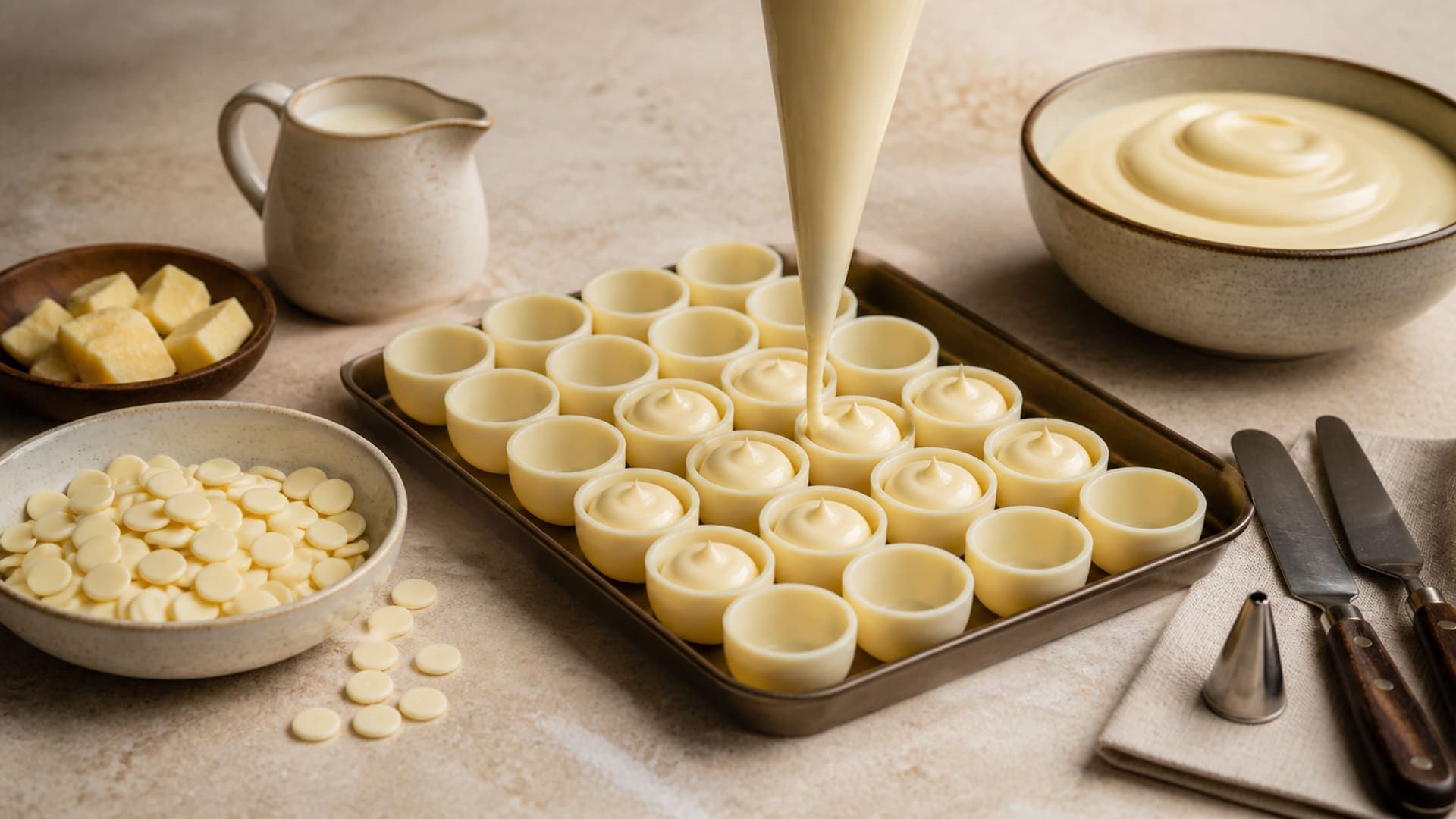
White Chocolate Bonbon Ganache: A 1 kg Trial Formula
A 1 kg white chocolate bonbon filling engineered for low predicted aw, a plastic set, and controlled piping—ready for measurement and shelf-life validation.