My Caramel Crystallized During Storage
Grainy, sandy, or white caramel that crystallized after production? Learn the five root causes of sucrose graining and how to prevent each one.
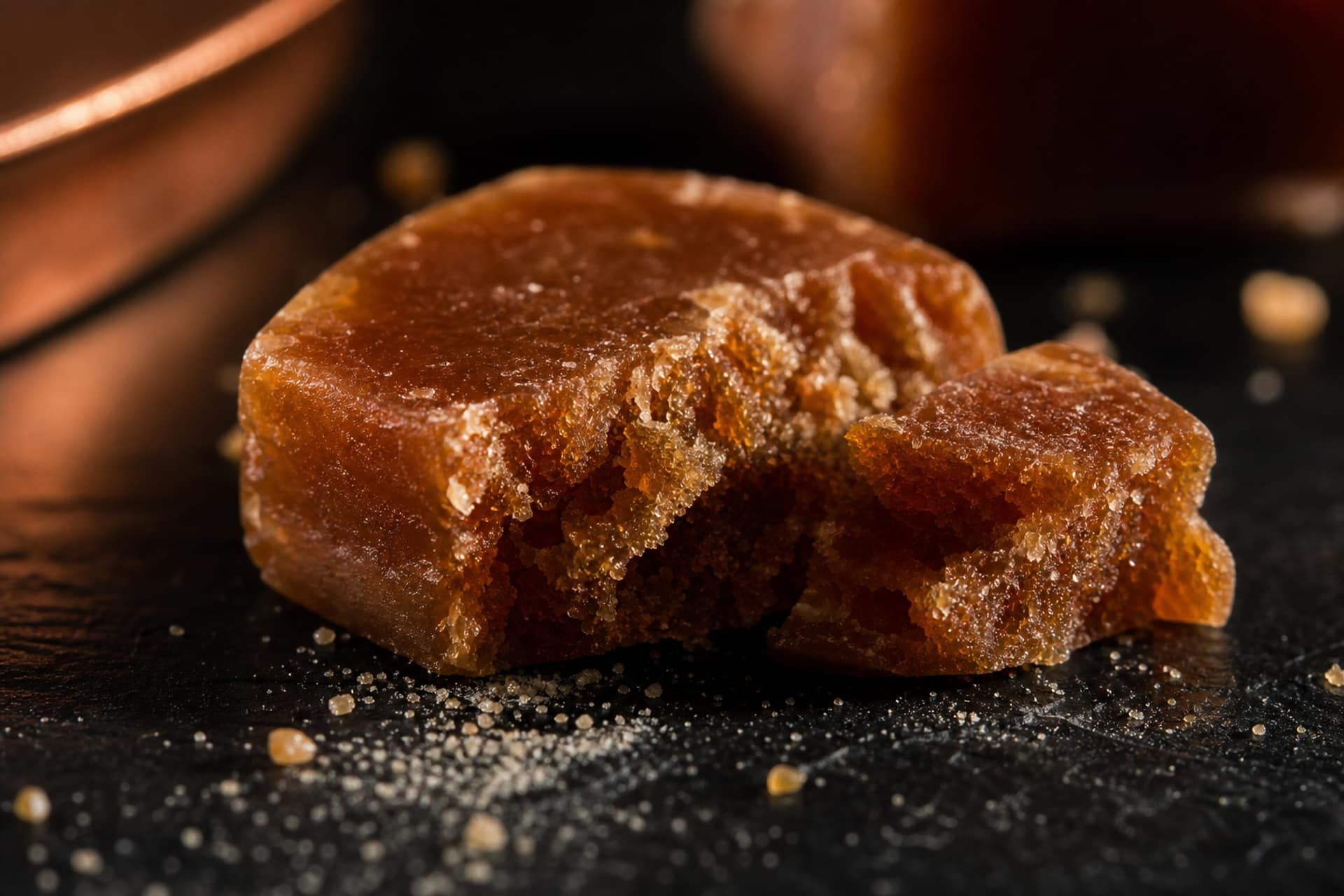
You produced a batch of caramels that looked flawless out of the frame. Smooth, glossy, and perfectly textured. A week later you open the box and find white, chalky, grainy confections that crumble when you bite into them. The caramel has crystallized — a process confectioners call graining — and the batch is likely unsalvageable for retail.
Graining is one of the most frustrating failures in caramel production because it can happen days or weeks after a seemingly perfect cook. Understanding the five root causes gives you the tools to prevent it entirely and, in some cases, to rescue a batch in its early stages.
What Crystallized Caramel Looks and Feels Like
- Texture: Sandy, gritty, or crumbly instead of smooth and yielding
- Appearance: White or opaque patches spreading from the center or from the surface inward
- Surface: Dull, chalky finish instead of the characteristic gloss
- On the tongue: Individual sugar crystals are detectible — the melt is rough rather than clean
- Progression: Often starts in one corner or near the cut edges and spreads to the whole piece over days
Graining vs. Fat Bloom
Graining and fat bloom can both cause a white appearance on caramel, but they feel different. Graining feels sandy and rough — you are feeling sugar crystals. Fat bloom feels smooth and waxy — it is cocoa butter recrystallization. In plain caramel (no chocolate coating), a white surface is almost always graining.
The Science: Why Sucrose Crystallizes
Caramel is a supersaturated sucrose solution. When you cook sugar syrup above 100°C, you evaporate water and force far more sucrose into solution than could dissolve at room temperature. A cooked caramel at 118°C contains roughly 87% dissolved solids — a concentration that would be impossible to achieve without heat.
When this supersaturated system cools, the sucrose molecules are energetically unstable. Given any opportunity — a microscopic undissolved crystal, a scratch on the pan, vibration, or simply enough time — they will begin to organize into an ordered crystal lattice. This is nucleation. Once a nucleus forms, the surrounding dissolved sucrose has a ready-made template to attach to, and crystal growth follows rapidly. A single nucleus can grain an entire batch within hours.
Why One Crystal Can Ruin a Batch
Sucrose crystallization is autocatalytic: each crystal that forms provides more surface area for further crystallization. A batch that begins graining at one edge will typically grain completely within 24-72 hours. Early intervention (remelting) is the only option once nucleation begins.
Doctoring agents — glucose syrup and invert sugar — work by disrupting this process. Their larger or differently shaped molecules insert themselves between sucrose molecules, physically blocking the formation of a regular crystal lattice. This is why a well-formulated caramel with adequate glucose remains stable at room temperature for months, while a pure sucrose caramel will grain within days.
The Five Root Causes
| Cause | How It Triggers Graining | Primary Fix |
|---|---|---|
| Insufficient doctoring agent | Sucrose can form crystal lattices without interference | Minimum 1:1 sucrose:glucose ratio; add invert sugar for extra protection |
| Crystal seeding during cooking | Undissolved sucrose on pan sides falls back into the batch and nucleates | Wash pan sides with a wet brush; cover pot in early cooking stage |
| Stirring after the critical temperature | Agitation provides energy for nucleation; crystals form under mechanical stress | Stir only until sugar dissolves, then stop; no stirring above 105°C |
| Humidity exposure during storage | Moisture absorption dilutes the surface layer, reducing supersaturation differential and triggering recrystallization | Airtight packaging; storage below 65% RH; desiccant packets |
| Temperature shock during storage | Temperature cycling causes repeated supersaturation changes, accelerating nucleation | Store at constant 15-20°C; avoid refrigerator cycling |
The five causes of caramel graining and their primary fixes
Cause 1: Insufficient Doctoring Agent
This is the single most common cause of graining in stored caramel. Doctoring agents — glucose syrup and invert sugar — are not just sweeteners. They are crystal inhibitors that work at the molecular level.
How Glucose Syrup Prevents Crystallization
Glucose syrup is a mixture of glucose, maltose, and longer dextrin chains (oligosaccharides). Dissolved alongside sucrose, these other saccharides dilute it and get in the way of sucrose molecules joining a growing crystal lattice. Dextrose Equivalent (DE) runs opposite to chain length: a lower DE means more long chains, which make the syrup thicker and give the caramel more body, so they resist graining mainly through viscosity. A higher DE means more glucose and maltose, which work by raising the overall solubility of the sugar mix and make the syrup sweeter and thinner. DE 38-42 syrups are the common choice in caramel because they add body and crystal control with little extra sweetness.
Invert Sugar Works Alongside Glucose
Invert sugar (a roughly 50:50 mixture of glucose and fructose) is also an effective doctoring agent, used alongside glucose syrup. It is sweeter, more hygroscopic and browns faster, so it can make caramel sticky in humid storage. If your caramel is still graining despite adequate glucose, replace 10-20% of the sucrose with invert sugar or add trimoline (inverted sugar paste) at 5-10% of total formula weight.
Minimum Ratio Requirements
| Caramel Type | Minimum Sucrose:Glucose Ratio | Recommended Ratio | Expected Shelf Life at 18°C |
|---|---|---|---|
| Soft eating caramel (enrobed) | 1:0.8 | 1:1 to 1:1.2 | 4-6 weeks |
| Soft eating caramel (wrapped) | 1:1 | 1:1.2 to 1:1.5 | 6-10 weeks |
| Chewy caramel (slabs) | 1:1 | 1:1 to 1:1.3 | 4-8 weeks |
| Hard caramel / toffee | 1:0.5 | 1:0.8 to 1:1 | 3-6 months |
| Caramel sauce (refrigerated) | 1:0.5 | 1:0.8 | About 2 weeks refrigerated (homemade cream sauce) |
Recommended sucrose:glucose ratios by caramel type
Below-Minimum Ratio Means a High Graining Risk
Below 1:0.8 sucrose:glucose, a clear or non-dairy soft caramel is at high risk of graining in storage, and careful cooking will not compensate. Dairy caramels get some extra protection because milk proteins and fat thicken the mass and get in the way of sucrose crystals, although lactose can itself crystallize, so a low ratio still raises the risk. Fix the formulation, not the process.
Cause 2: Crystal Seeding During Cooking
Even a perfectly formulated caramel can grain if seed crystals are introduced during cooking. Seeding can happen in several ways:
- Pan side sugar: As the syrup boils, droplets splash onto the sides of the pan. If these droplets are not washed back into the mass, they lose moisture rapidly, become supersaturated, and crystallize. When these crystals fall back into the batch, they seed it.
- Sugar on the thermometer: Undissolved or recrystallized sugar on a probe or spoon dipped into the cooling mass
- Dust in the environment: Airborne powdered sugar or fine sucrose dust from another production area
- Equipment residue: Crystallized sugar left from a previous batch in the same pan, frame, or depositor
Prevention: Controlling the Cooking Environment
Wash down pan sides
During the early cooking stage (80-100°C), use a clean pastry brush dipped in hot water to wash any sugar crystals from the sides of the pan back into the mass. Do this every 2-3 minutes until the syrup is clear.
Cover the pot during early cooking
Placing a lid on the pan for the first 3-4 minutes after the sugar dissolves causes steam to condense on the lid and wash back down the sides, preventing crystal buildup without requiring manual brushing. Remove the lid before the final cooking stage.
Clean all equipment before use
Rinse all pans, frames, thermometer probes, and scrapers with hot water before each batch. Dried sugar residue from the previous batch is a seed crystal reservoir. Never use equipment that has visible dried sugar deposits.
Control the production environment
Do not produce caramel in the same room or time window as operations that generate sugar dust (e.g., powdered sugar applications, icing). Airborne sucrose dust landing in an open batch is a seeding event.
Cause 3: Stirring at the Wrong Stage
Mechanical agitation provides energy to supersaturated sucrose molecules, dramatically increasing the probability of nucleation. Many confectioners stir caramel out of habit throughout the entire cook, not realizing that stirring above approximately 105°C in a plain sugar-glucose syrup actively promotes the graining they are trying to prevent.
The Stirring Rule
Stir until the sugar is fully dissolved, then stop. Once the syrup is clear and all granules are dissolved (typically 95-100°C), do not stir again until after cream or dairy is added and the batch is back below 80°C. Stirring a supersaturated sugar-glucose solution above 105°C is a direct cause of graining.
Note that this rule applies to the dry sugar cooking stage. Once cream, milk, or butter is added to the caramel, the system changes significantly: the fat and protein from the dairy suppress crystallization, and stirring to prevent burning is appropriate. The danger zone is during the pure sugar cooking phase before dairy addition.
Cause 4: Humidity Exposure During Storage
Sucrose is hygroscopic — it absorbs moisture from the surrounding air. When a caramel piece is stored in a high-humidity environment, the surface layer absorbs water vapor and its sucrose concentration drops slightly as the surface becomes more dilute. This reduction in surface supersaturation creates the thermodynamic conditions for recrystallization, as the sucrose molecules rearrange into a more stable crystal state.
There is also a subtler mechanism: in very high humidity, the absorbed moisture can partially dissolve the surface layer of sugar, and as ambient humidity drops again (e.g., overnight), the surface reconcentrates and crystallizes in an uncontrolled way. This cycle of absorption and reconcentration, repeated over days, is called grain inversion and produces a coarse, granular surface texture.
Critical Humidity Thresholds
Store caramel at below 65% relative humidity at all times. Above 70% RH, surface moisture absorption is rapid and graining risk is high. At 80%+ RH, even well-formulated caramels will show surface graining within a week. Use a calibrated hygrometer in your storage area.
Storage and Packaging Fixes
- Airtight individual wrapping: Twist-wrap or flow-pack each piece immediately after cutting and cooling. Exposure time between cutting and packaging should be less than 30 minutes in a production environment
- Barrier packaging: Use multi-layer packaging with a moisture barrier layer (e.g., polyester/polyethylene laminate) for products with extended shelf life targets
- Desiccant packets: Include a silica gel packet inside retail boxes for products stored outside individual wrappers
- Controlled storage environment: Target 15-20°C and 50-60% RH in storage. Invest in climate control if producing caramel at scale
- Avoid refrigeration for uncoated product: Refrigerators are humid environments. Moving product in and out of a refrigerator causes condensation on the surface, dramatically accelerating graining
Cause 5: Temperature Shock and Storage Cycling
Supersaturation is temperature-dependent: the higher the temperature, the more sucrose can remain dissolved. When a caramel is cycled between temperatures — for example, refrigeration overnight and room temperature during the day — each cooling cycle makes the caramel more supersaturated. Each warming cycle gives sucrose molecules more mobility. The combination of high supersaturation and high molecular mobility is exactly the condition that promotes nucleation.
- Store at a constant temperature between 15-20°C. Avoid locations near heating vents, refrigeration units, or exterior walls with large temperature swings
- If product must be refrigerated (e.g., dairy-enrobed caramel), keep it consistently cold rather than cycling in and out
- When moving caramel from a cold storage area to a warm display, allow it to equilibrate gradually in an intermediate-temperature zone rather than moving directly from cold to warm
- Avoid placing caramel near display lighting that generates significant heat — repeated warming and re-cooling of product in display cases is a common production-environment failure mode
Intentional Crystallization: Fondant Seeding
It is worth noting that confectioners also use intentional crystallization as a deliberate technique. Fondant-seeded caramel uses fine-grained fondant (which contains millions of microscopic sucrose crystals) added during cooling to produce a short, sandy texture that melts cleanly on the palate. This is common in traditional British-style caramel fudge. The difference between intentional and accidental graining is control: fondant-seeded products are formulated for specific crystal size and distribution. The problem article above describes uncontrolled, spontaneous crystallization that produces large, uneven crystals and a coarse, unpleasant texture.
Fudge vs. Caramel: Intentional vs. Accidental Graining
Traditional fudge is deliberately grained caramel. It is seeded with fondant while still warm and beaten to control crystal size. If you are making fudge and it grains — that is correct. If you are making smooth caramel bonbons and they grain — that is a production failure requiring one of the five fixes above.
Can You Fix Crystallized Caramel?
Whether you can rescue a grained batch depends on how far crystallization has progressed and what type of caramel you are making.
| Stage | Description | Salvage Option |
|---|---|---|
| Early (surface only) | White patches on surface, interior still smooth | Repack immediately in airtight, low-humidity packaging. Surface grain may not progress if humidity is controlled. |
| Partial (throughout piece) | Sandy texture throughout but piece holds shape | Remelt at 70-80°C, add 10-15% additional glucose syrup by weight of the batch, re-cook to temperature, re-frame. |
| Full (complete graining) | Crumbly, fully white, no smooth interior | Remelt completely, add glucose and invert sugar, re-cook. Usable as caramel sauce, caramel filling component, or flavoring base if texture is not critical. |
| Sealed / enrobed product | Graining detected after chocolate coating | Cannot rescue individual pieces. Batch must be discarded or repurposed as inclusion pieces where caramel texture is hidden. |
Salvage options for grained caramel by crystallization stage
Weigh the grained batch
Record the exact weight before remelting so you can calculate the correct amount of glucose to add.
Add water and remelt slowly
Place the grained caramel in a clean pan. Add 10-15% water by weight of the batch. Heat gently to 70-80°C, stirring constantly, until all crystals have dissolved. The caramel will be very fluid at this stage.
Add glucose syrup
Add glucose syrup at 15-20% of the batch weight. This corrects the doctoring deficiency that likely contributed to graining. If invert sugar (trimoline) is available, add an additional 5-8% for enhanced protection.
Re-cook to target temperature
Cook the remelted, glucose-corrected caramel back to your target cooking temperature (typically 116-120°C for soft caramel). Monitor temperature carefully.
Cool without agitation
Pour onto a clean, lightly oiled frame or slab. Do not stir or agitate during cooling. Allow to set completely at 18-20°C in a dry environment before cutting.
Prevention Checklist
Pre-Production Checklist: Crystallization Prevention
Formulation checks:
- Sucrose:glucose ratio minimum 1:1 for soft caramel (by weight)
- Consider adding invert sugar / trimoline at 5-10% of formula weight
- Verify glucose syrup is DE 38-42 for maximum crystal disruption
During cooking:
- Stir only until sugar is fully dissolved, then stop
- Wash pan sides with a wet brush every 2-3 minutes during 80-100°C stage
- Cover pot for first 3-4 minutes after sugar dissolves
- Use clean equipment — no dried sugar residue from previous batches
After cooking:
- Do not stir or agitate during cooling below 80°C
- Cool at 18-20°C in a low-humidity environment
- Frame or deposit into clean, moisture-free molds
Storage:
- Package airtight within 30 minutes of cutting
- Store at 15-20°C, below 65% RH
- Avoid temperature cycling
- Use desiccant in retail boxes if not individually wrapped
Optimize Your Caramel Formula With the Calculator
The Formul.io Caramel Calculator lets you model your formulation before production. Enter your ingredient weights and the calculator reports the sucrose:glucose ratio, predicted water activity, cooking temperature, and glass transition temperature — giving you the data to identify crystallization risk before you light the burner.
Frequently Asked Questions
Why did my caramel grain after only a few days when it tasted fine at first?
Is it safe to eat crystallized caramel?
My recipe uses equal parts sucrose and glucose — why is it still graining?
At what temperature is spontaneous crystallization most likely to occur?
Can I use corn syrup instead of glucose syrup to prevent graining?
Why does my caramel grain in some batches but not others when I use the same recipe?
Related Topics
Related Articles
Chewy Salted Caramel Recipe: 119°C, Brix and Aw
A 663 g chewy salted caramel cooked to 119°C, with the Brix, water and water-activity targets that define the chew, butter and salt timing, and what each degree of the cook does to the texture.
Caramel Glass Transition: How Moisture Sets Texture
Why a few points of water move a caramel from hard crack to chewy: the glass transition, a Gordon–Taylor table you can recompute, and the water left at each cooking stage.
Why is my Pâte de Fruit Grainy?
A sandy or grainy texture in Pâte de Fruit is a common failure. Learn how to prevent sugar crystallization and ensure a smooth, melting texture.