Chewy Salted Caramel Recipe: 119°C, Brix and Aw
A 663 g chewy salted caramel cooked to 119°C, with the Brix, water and water-activity targets that define the chew, butter and salt timing, and what each degree of the cook does to the texture.
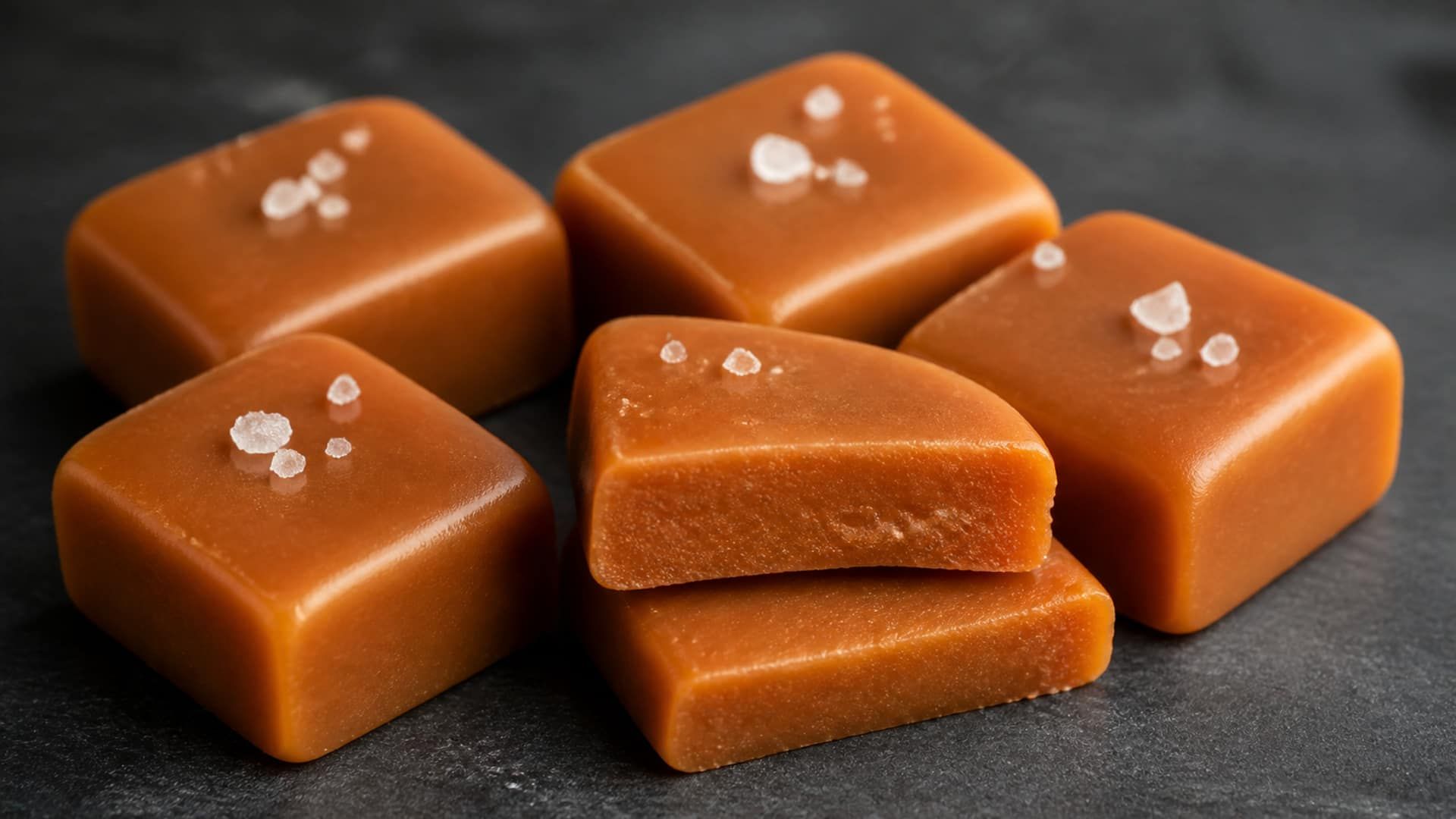
A Chewy Caramel Defined by Numbers
Most caramel recipes give a process and leave the texture to memory. This one starts from the texture: a chewy caramel that holds a clean cut at room temperature, described by a cooking temperature, a final Brix and a water activity you can check.
The formula is a 663 g pre-cook batch built on equal parts sucrose and DE40 glucose syrup. Below you will find the formula, how to read it in the Formul.io Caramel Calculator, what each degree of the cook changes, and the full two-stage cooking method.
Target Metrics at a Glance
Cooking temperature: 119°C, the firm-ball stage (118–120°C). The butter joins after the cook and brings its own water, so the caramel still reads chewy. Final Brix: about 86.9 (the sugar solution’s concentration; about 10% water in the finished caramel) Water activity (Aw): about 0.58 (calculator range ±0.03) Texture prediction: Chewy Storage: room temperature. The Aw sits inside the calculator’s 0.45–0.60 optimal band for chewy caramel; storage would only switch to refrigerated above aw 0.88
The Formula: 663 g Pre-Cook Batch
A 1:1 sucrose-to-glucose ratio is standard for chewy caramels. Sucrose gives sweetness and structure; DE40 glucose syrup keeps the sucrose from crystallizing and adds body. The cream brings fat, milk protein and lactose, which feed the Maillard flavour of the second cook. The butter goes in after the cook, and the fleur de sel goes in last.
| Ingredient | Mass (g) | % of Batch | Role |
|---|---|---|---|
| Sucrose | 200 | 30.2% | Sweetness, structure |
| Glucose syrup DE40 | 200 | 30.2% | Crystallization inhibitor, body |
| Heavy cream 35% fat | 180 | 27.1% | Fat, water, milk protein, Maillard flavour |
| Butter 82% fat | 80 | 12.1% | Fat phase, mouthfeel (added after the cook) |
| Fleur de sel | 3 | 0.45% | Seasoning (added last) |
Chewy Salted Caramel — Pre-Cook Batch (663 g total)
Why DE40 Instead of DE60?
Dextrose Equivalent (DE) measures how far the starch in a glucose syrup was broken down. A DE40 syrup carries more maltose and longer chains and less free glucose than a DE60 syrup. Those larger sugars thicken the caramel and glass at higher temperatures: maltose’s dry glass transition is about 87°C, glucose’s about 31°C. A DE60 syrup therefore gives a softer, stickier caramel that flows more on the shelf. For a caramel that holds its cut shape at room temperature, DE40 is the safer choice.
Calculator Walkthrough: From Ingredients to Texture Prediction
Open the Formul.io Caramel Calculator, set the caramel type to Salted and choose the Chewy style, the texture the calculator judges the recipe against. Enter each ingredient from the formula table. The calculator reads each ingredient’s composition from its database and recomputes the prediction as you type.
Enter Ingredients and Choose the Chewy Style
Add sucrose (200 g), glucose syrup DE40 (200 g), heavy cream 35% (180 g) and butter 82% (80 g). Leave the salt out: it is added off-heat and takes no part in the cook. Set the caramel type to 'Salted' and choose the 'Chewy' style. With a soft or chewy target the calculator adds the butter after the cook, as this recipe does.
Enter 119°C and Read the Texture Prediction
Enter 119 in the cooking temperature field, the firm-ball temperature many chewy caramel recipes use. For this formula the calculator predicts 'Chewy': about 86.9 Brix and 9.9% water in the finished caramel, after the butter's water has joined it and diluted the sugar solution. The prediction matches the style, so the texture guidance panel suggests no change.
Read the Brix and Water Output
Brix here is the concentration of the caramel's sugar solution: dissolved solids as a share of dissolved solids plus water. The fat and milk solids sit outside that solution, so Brix is not 100 minus the water content. Compare the predicted 86.9 with a calibrated refractometer reading on a small cooled sample.
Interpret the Water Activity Result
The calculator outputs Aw ≈ 0.58 (±0.03). That is inside its 0.45–0.60 optimal band for chewy caramel, near the top, and storage reads room temperature: it switches to refrigerated only above aw 0.88. Cooking to 120°C lowers the prediction to about 0.57 and still reads chewy; at 121°C the texture reads firm. Confirm the final Aw on a meter before setting a shelf life.
Review the Texture Guidance Panel
The texture guidance panel compares the predicted texture with the style you chose and, when they differ, recommends a cooking temperature. For this formula the prediction reads 'Soft' up to 115°C, 'Chewy' from 116°C to 120°C, and 'Firm' from 121°C; from either side the panel steers back to 118–119°C. The hardness and chewiness scores beside it, about 25 and 76 at 119°C, are the calculator's relative 0–100 scales for comparing formulas.
Scale the Batch
Open Scale Recipe and enter a target weight. The current weight is the ingredient total, 660 g here (the salt is left out), and every ingredient scales by the same factor. Brix and Aw predictions do not change with batch size. The pan does: a larger batch holds more heat, takes longer to reach temperature and keeps climbing after you lift it off the burner.
What Each Degree Does to Brix and Texture
Brix is a practical in-production check: a refractometer reads it on a small cooled sample, and it follows the cooking temperature through boiling-point elevation. The table shows the calculator’s predictions for this formula, Chewy style with the butter added after the cook, across a range of cooking temperatures.
| Cooking Temp (°C) | Final Brix | Water in Finished Caramel | Predicted Texture | Aw (±0.03) |
|---|---|---|---|---|
| 115 | 84.9 | 11.5% | Soft | 0.64 |
| 116 | 85.5 | 11.0% | Chewy | 0.62 |
| 117 | 86.0 | 10.6% | Chewy | 0.61 |
| 118 | 86.4 | 10.3% | Chewy | 0.60 |
| 119 | 86.9 | 9.9% | Chewy (target) | 0.58 |
| 120 | 87.2 | 9.6% | Chewy | 0.57 |
| 121 | 87.6 | 9.4% | Firm | 0.56 |
| 123 | 88.2 | 8.9% | Firm | 0.53 |
| 125 | 88.8 | 8.4% | Firm | 0.51 |
| 127 | 89.3 | 8.0% | Firm | 0.49 |
| 130 | 89.9 | 7.6% | Firm | 0.46 |
This Formula by Cooking Temperature — Formul.io Caramel Calculator Predictions, Butter Added After the Cook (syrup 80% solids, cream 58% water, butter 16% water)
Three degrees below 119°C still read chewy; two degrees above already read firm. That narrow window is why a calibrated thermometer matters more than any other tool in this recipe.
Aw Calculation Method
The calculator estimates Aw by treating the dissolved sugars as one solution (the Ferro Fontán–Chirife–Boquet rule over Norrish’s constants), on the water the milk protein and fibre do not hold on their sorption isotherms. More dissolved sugar in less water means a lower Aw.
At 119°C this formula keeps about 9.9% water, which puts Aw near 0.58. Humectants such as sorbitol lower Aw further at the same texture; enter them in the calculator to see their effect, then confirm the final Aw on a meter before setting a shelf life.
Cooking Process: Step by Step
The two-stage method cooks the sugar and glucose syrup on their own first, then deglazes with warm cream and cooks the mixture to the final temperature. The first stage gives caramelization flavour, since there is no protein in the pan yet. The second gives Maillard flavour, from the cream’s milk proteins reacting with the reducing sugars, and it is where you control the endpoint.
Safety: Steam Burns from Deglazing
When hot sugar (155°C) meets cream or any water-containing liquid, the water flashes to steam instantly. Warm the cream to at least 70°C before adding it, pour it in a slow stream from the edge of the pot, wear heat-resistant gloves and keep your face away from the pot. Never add cold cream to sugar above 150°C.
Warm the Cream
Heat the heavy cream (180 g) in a separate saucepan to 70–80°C. This reduces the temperature shock when it meets the hot sugar and limits splattering. Hold it warm off the heat while you cook the sugar.
Cook Sugar and Glucose to 155°C
Combine the sucrose (200 g) and glucose syrup DE40 (200 g) in a heavy copper or stainless saucepan. Stir gently until the sucrose dissolves, then stop stirring. Cook over medium-high heat to 155°C on a calibrated digital thermometer, a light amber. The colour comes from caramelization; the darker you take it, the more bitter the caramel tastes.
Deglaze with Warm Cream
Take the pan off the heat or turn the flame to its lowest setting. Pour the warm cream in a slow, steady stream while stirring with a high-heat silicone spatula. The mixture will bubble hard. Once the boiling subsides, return to medium heat. The temperature drops sharply; you now cook the combined mixture to the final target.
Final Cook to 119°C
Cook the sugar-cream mixture, stirring constantly from the bottom, until the thermometer reads 119°C. The milk proteins and lactose scorch easily on the pan surface, so do not stop stirring from this point. The butter added next brings its own water, which is why a firm-ball cook still lands chewy.
Cool to 80°C, Then Add the Butter
Take the pan off the heat and let the caramel cool to about 80°C, checking with the thermometer. At that temperature it is still fluid but no longer hot enough to split the butter. Add the cold butter (80 g, in cubes) and blend with an immersion blender for 60 seconds. A stable emulsion looks glossy and even, with no pools of fat.
Fold In the Salt
Once the caramel is smooth, fold in the fleur de sel (3 g) with a spatula. Salt takes no part in the cook, so adding it last lets you taste and adjust before pouring. For a visible salt crunch, hold back a pinch and sprinkle it over the slab once the surface has set.
Frame and Set
Pour straight into a caramel frame on a silicone mat or into silicone moulds. The 663 g batch yields about 560 g after the cook; a 20 × 20 cm frame gives a slab about 1 cm thick. Let it set at 18–20°C for at least 12 hours, 24 preferred, without refrigerating. Cut with a lightly oiled guitar or knife.
Adjusting the Formula Using Calculator Feedback
The texture guidance panel tells you which way to move the cook when the prediction misses the style. These are the common deviations and the first and second adjustments to try.
| Symptom | Calculator Diagnosis | Primary Adjustment | Secondary Adjustment |
|---|---|---|---|
| Caramel too soft, won't hold shape | Predicted: Soft — below the chewy range | Raise the cook to the temperature the texture guidance suggests (about 118°C for this formula) | Reduce the cream slightly |
| Caramel too firm, lacks chew | Predicted: Firm — above the chewy range | Lower the cook by 2–3°C | Increase the cream or the post-cook butter slightly |
| Caramel sticky, pulls to fingers | Aw above the chewy band (0.60) | Cook 1–2°C higher, staying inside the chewy range | Wrap the cut pieces straight away so they cannot take up moisture |
| Caramel crystallizes (sandy texture) | High crystallization risk score | Keep the glucose syrup at least equal to the sucrose | Add a little invert sugar to further inhibit crystallization |
| Aw too high for target shelf life | Aw above the 0.45–0.60 chewy band; the value shows out of band | Cook higher within the chewy range (up to about 120°C) | Replace some cream with a humectant such as sorbitol and check the new Aw in the calculator |
Common Texture Deviations and Calculator-Guided Adjustments
Scaling Up Without Losing the Texture
For a 10× batch (6.63 kg pre-cook), multiply every ingredient by 10. The cooking temperature, Brix and Aw stay the same: they are properties of the formula, not of the batch size. The cooking dynamics do change. A large mass takes longer to reach temperature and keeps rising after you lift it off the heat, so take it off slightly before the target and let the carry-over finish the cook. Find that offset on your own pan, then confirm each batch with a refractometer reading on a cooled sample.
In-Line Brix Verification
To check Brix without waiting for the batch to cool, take a small drop on a clean spoon, set it on ice for 10 seconds and read it on a calibrated Brix refractometer. The calculator’s Brix range for the Chewy style, 85.8–87.9, is a sucrose reference: the concentration a plain sugar syrup reaches between 116°C and 121°C. The texture verdict itself comes from the glass transition of this recipe’s own sugars, so use this formula’s readings instead: about 85.5–87.2 for its chewy cooks (116–120°C), 86.9 at 119°C. A reading outside that means the cook drifted; re-check the thermometer before the next batch.
Try This Formula in the Calculator
Enter the ingredients into the Formul.io Caramel Calculator to see the full prediction: Brix, water activity, texture, glass transition temperature and crystallization risk. Move the cooking temperature a degree at a time to watch the texture and Aw shift.
Frequently Asked Questions
Where does this caramel's Aw sit in the 0.45–0.60 band for chewy caramel?
What does the Brix reading represent and how do I measure it?
Can I substitute corn syrup for glucose syrup DE40?
My caramel oiled out (fat separated). What happened and how do I fix it?
Why is 119°C called firm ball, not soft ball?
How long should I rest the caramel before cutting?
Related Articles
Related Topics
Related Articles
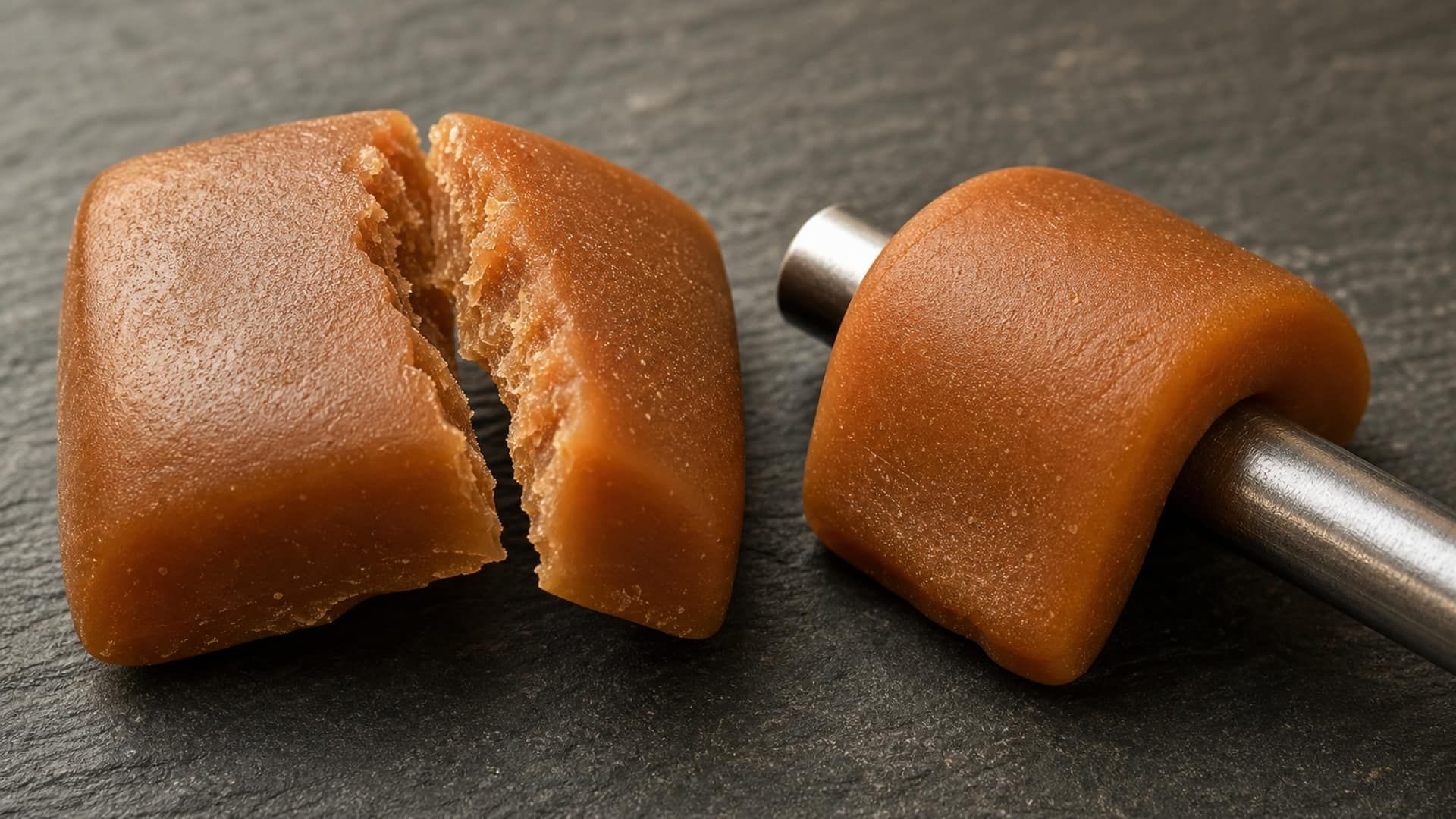
Caramel Glass Transition: How Moisture Sets Texture
Why a few points of water move a caramel from hard crack to chewy: the glass transition, a Gordon–Taylor table you can recompute, and the water left at each cooking stage.
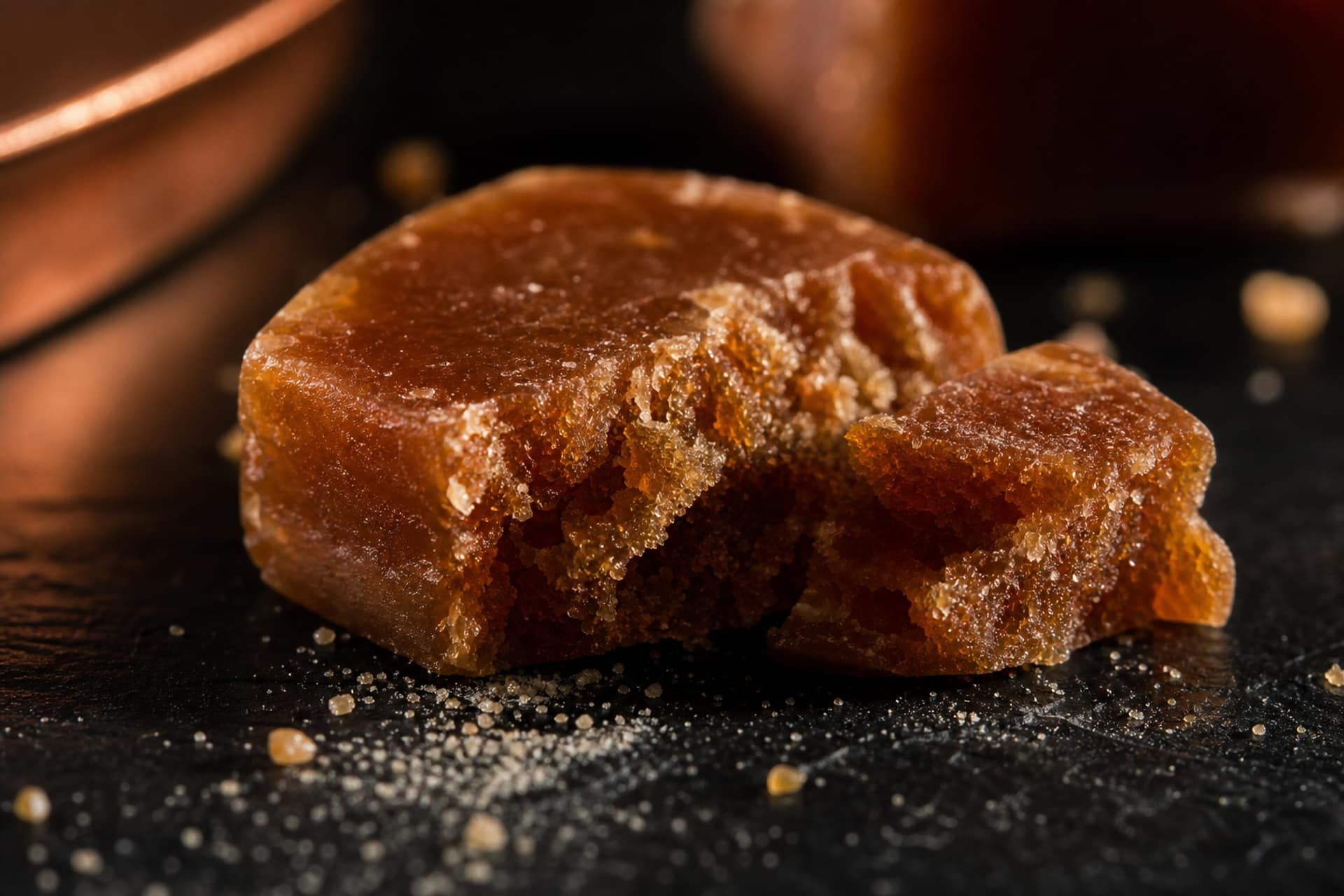
My Caramel Crystallized During Storage
Grainy, sandy, or white caramel that crystallized after production? Learn the five root causes of sucrose graining and how to prevent each one.
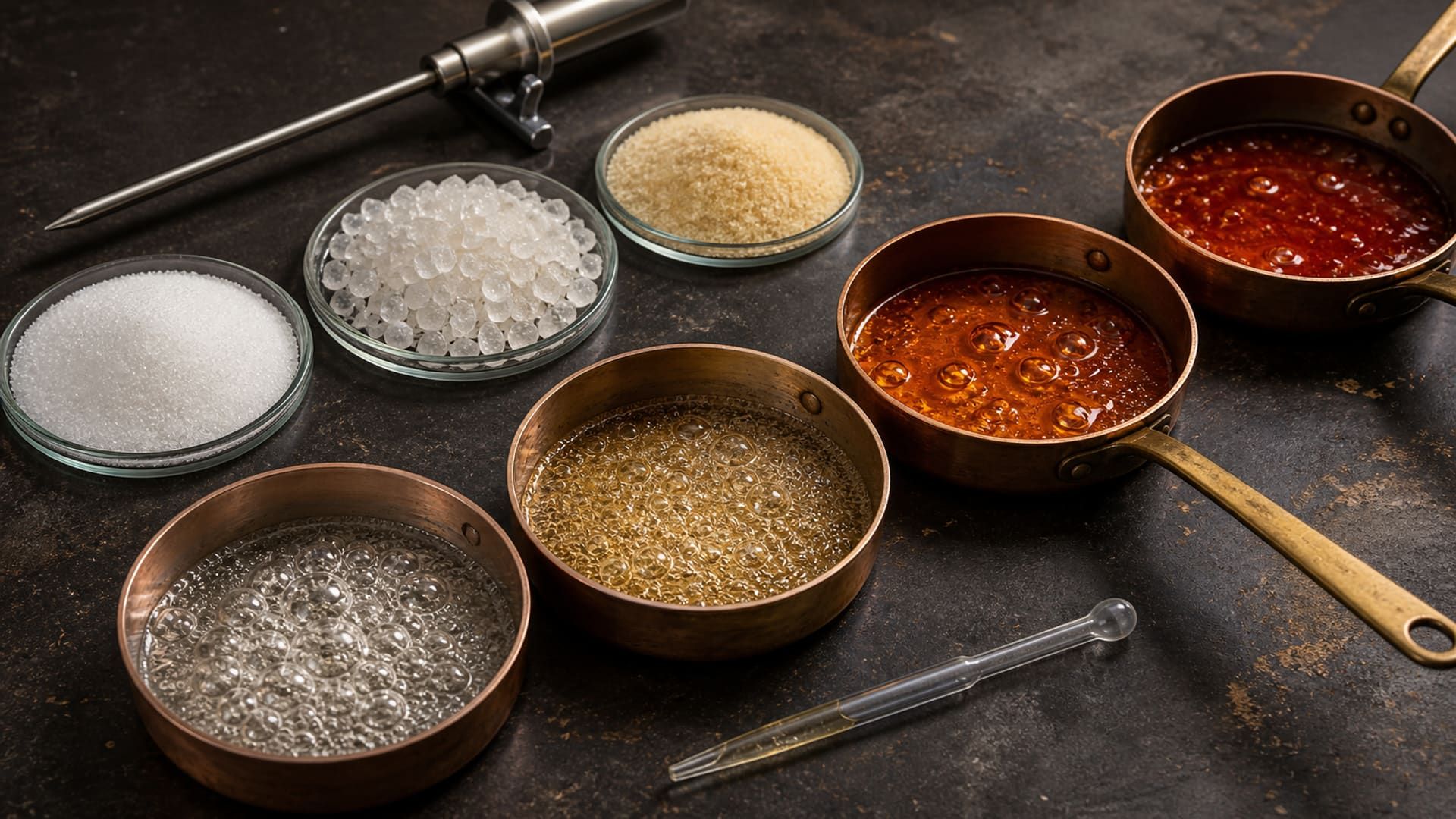
Caramelization Temperature by Sugar Type
A condition-aware reference for fructose, glucose, sucrose, maltose, and lactose that separates melting, decomposition, visible browning, and finished caramel colour.