How Long Does Ganache Last? Shelf Life by Type and Storage
How long ganache keeps in the fridge, out of it and in the freezer — from a classic 1:1 cream ganache to shelf-stable bonbon fillings — and why water activity sets the limit.
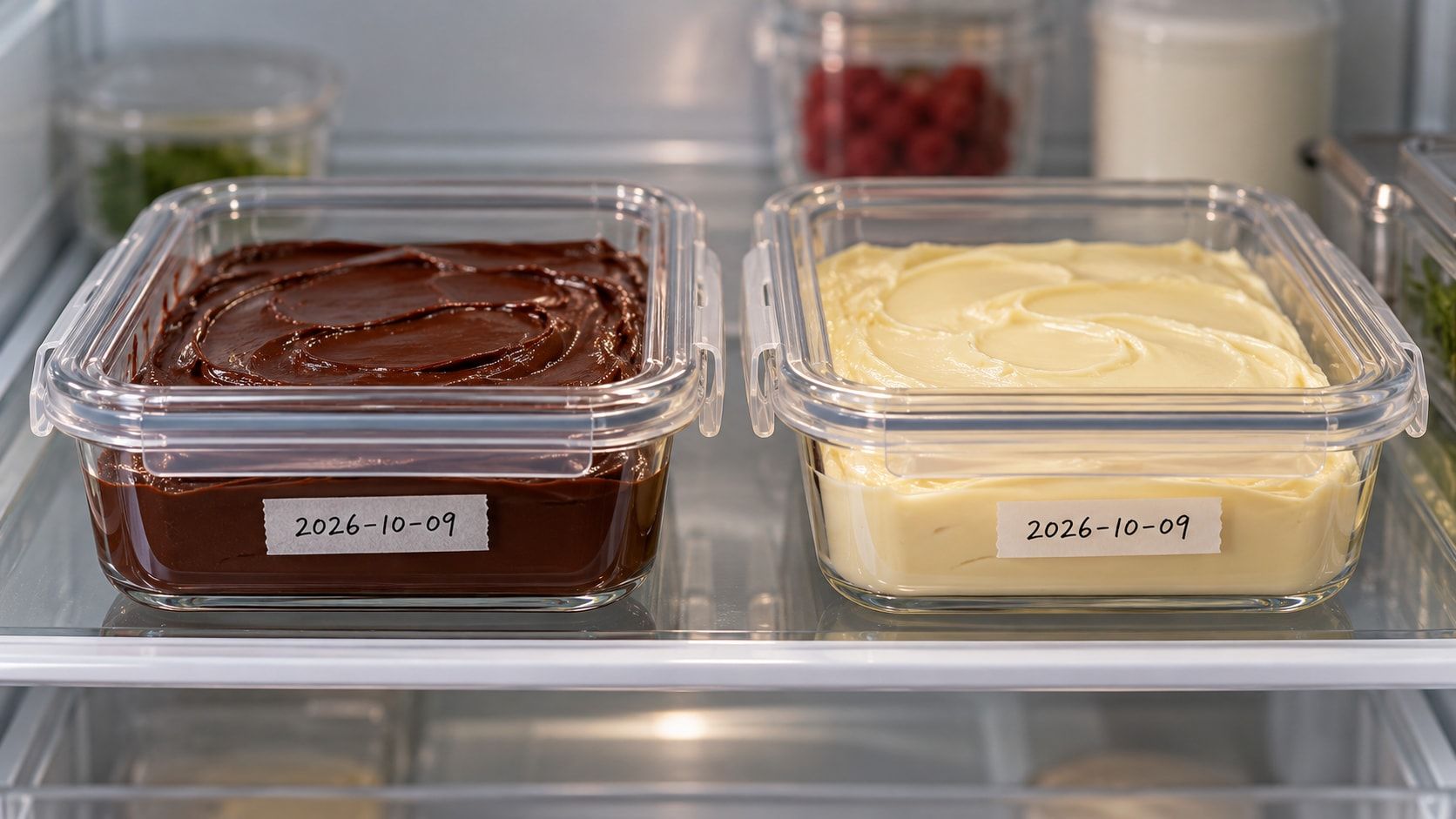
A 1:1 cream ganache is a fridge product: about 12 days refrigerated. Keep it out only while you work with it (no more than 2 hours); frozen, it keeps its quality for 2–3 months. A ganache formulated with invert sugar, glucose syrup and sorbitol to a measured water activity below about 0.80 can keep for weeks at room temperature. The difference is not the fat. It is how much of the ganache’s water is still available to microbes.
Where the day counts come from
The day counts in this guide come from the Formul.io ganache calculator’s Conservative shelf-life model, which derives them from water activity at 20 °C and 4 °C. They are spoilage estimates, not safe holding times, measurements or label dates. If you sell ganache, confirm the date with a storage test of the finished product in its packaging.
Ganache Shelf Life by Type
Every row below was calculated in Formul.io, and five of them are saved recipes you can open. Days lead; the water activity (aw) and the microbes that can still grow at that aw explain the number.
| Ganache | Room temperature (20 °C) | Fridge (4 °C) | Water activity | What can grow |
|---|---|---|---|---|
| Classic 1:1: 66 % dark chocolate and 35 %-fat cream, equal weights | Refrigerate; ≤2 h out | ~12 days | 0.929 | Bacteria and pathogens, many yeasts |
| The same 1:1 with 80 g of the cream swapped for invert sugar† | Refrigerate; ≤2 h out | ~21 days | 0.888 | Bacteria and pathogens, many yeasts |
| 2:1 truffle ganache: chocolate and cream only† | Fridge unless measured below 0.88 | ~30 days | 0.864 | Molds, some yeasts |
| Water ganache with invert sugar, glucose syrup and sorbitol | ~19 days | ~79 days | 0.790 | Molds and yeasts |
| Truffle ganache with glucose syrup, invert sugar, cocoa butter and butter | ~25 days | ~98 days | 0.773 | Molds and yeasts |
| White chocolate bonbon ganache with sugars and sorbitol | ~35 days | ~133 days | 0.748 | Molds and yeasts |
| Dark bonbon ganache with invert sugar, sorbitol, glucose syrup, cocoa butter and butter | ~34 days | ~131 days | 0.749 | Molds and yeasts |
Conservative-model figures. † Calculator simulations, not saved recipes. For the first three rows the model's room-temperature figures (about 2, 5 and 7 days) are spoilage estimates, not safe holding times.
Days come from the calculator’s Conservative model, its base curve. The default Balanced setting multiplies it by up to 1.6 below aw 0.85, fading to ×1 by aw 0.90; it is fitted to shelf lives chefs declare for finished bonbons sealed in a chocolate shell, so it does not apply to ganache kept in a bowl or tub. The linked truffle and shelf-stable dark recipes are saved on Balanced, so their pages show higher figures.
Whipped ganache is usually made with more cream than chocolate, often 1 part chocolate to 2 parts cream. It carries more water than the 1:1 above, so treat it as a fridge product too.
These figures assume clean equipment, fresh ingredients and the formulation as written. Cream close to its date, fruit purée, a warm kitchen or an uncovered container all shorten them, so treat each figure as a ceiling, not a target.
Classic 1:1 dark chocolate cream ganache
500 g dark chocolate and 500 g cream: open the live calculation behind the 12-day fridge figure and copy it into your account.
Is Ganache Shelf Stable? Why Water Activity Decides
Water activity measures how available a food’s water is to microbes, on a scale from 0 to 1, where pure water is 1.0. It is not the same as water content. Sugars and polyols dissolved in the water hold it back and lower aw; fat does not, because it does not dissolve in water.
The classic 1:1 ganache is 29.3 % water with little dissolved in it beyond the chocolate’s sugar and the cream’s lactose, so its aw sits at 0.929. Swapping 80 g of cream for invert sugar removes water and adds dissolved sugar at the same time: aw drops to 0.888 and the fridge figure grows from 12 to 21 days, but the ganache is still above 0.88 and still a fridge product.
| Water activity | What can still grow | Storage consequence |
|---|---|---|
| 0.88 and above | Normal bacteria and pathogens, many yeasts | Refrigerate |
| 0.80 to just below 0.88 | Normal molds, some yeasts | Fridge unless measured below 0.88; short room-temperature life |
| 0.70–0.80 | Molds and yeasts | Weeks at room temperature, once measured |
| 0.60–0.70 | Osmophilic yeasts and a few molds | Longer still; rare in a cream ganache |
| Below 0.60 | No microbial growth | Limited by flavor and texture, not microbes |
Microbial classes used by the Formul.io ganache calculator, after Ergun, Lietha and Hartel (2010).
The 0.88 line is a safety line, and it applies to a measured value. For foods like ganache that are not sealed straight after heating, the FDA Food Code (2022) treats aw below 0.88 as not needing time and temperature control for safety, whatever the pH. Safety is not quality: weeks at room temperature become realistic only below about 0.80.
Below 0.88 is not “never spoils”
Under 0.88 the main risk shifts from bacteria to molds and yeasts, which grow more slowly but still grow. Staphylococcus aureus can still grow slowly just below 0.88, which is why a calculated value near the line is not enough: design to a calculated 0.85 or lower, then measure the finished ganache. Cold slows growth; it does not stop it.
To make a ganache last longer, take water out and dissolve more into what is left: more chocolate per gram of cream, part of the cream replaced with invert sugar or glucose syrup, and sorbitol. These formulations show how far that goes:
Shelf-stable dark chocolate ganache
Invert sugar, sorbitol, glucose syrup, cocoa butter and butter: aw 0.749.
Dark chocolate truffle ganache
Glucose syrup, invert sugar, cocoa butter and butter: aw 0.773.
Dark chocolate water ganache
Water instead of cream, with invert sugar, glucose syrup and sorbitol: aw 0.790.
White chocolate bonbon ganache
Invert sugar, glucose syrup and sorbitol: aw 0.748.
How to Store, Freeze and Thaw Ganache
Cool it promptly
The FDA Food Code expects cooked food that needs refrigeration to fall from 57 °C to 21 °C within 2 hours and to 5 °C within 6 hours. Spread a 1:1 cream ganache thin in a shallow container to manage that.
Cover the surface and label it
Press film onto the surface or use an airtight container, and write the date it was made on the lid.
Freeze on the day you make it
Pack it airtight and freeze it fresh. Freezing pauses microbes but does not reliably kill them, so days already spent in the fridge still count.
Use it within 2–3 months
At −18 °C microbes do not grow, so the limit in the freezer is quality: drying, absorbed odors and a coarser texture.
Thaw in the fridge, still closed
Thaw the sealed container in the fridge overnight. Take out only what you are about to use and open it at working temperature, so condensation forms on the container, not the ganache.
Re-emulsify if it looks grainy or oily
Thawed ganache can look grainy or split. Warm it gently, blend it smooth and use it promptly.
Freezing suits ganache you have made ahead for a cake or a production run. It does not rescue a ganache that is already near the end of its fridge life, and it does not make a 1:1 cream ganache safe to keep at room temperature after thawing.
The same rule applies to finished bonbons and truffles
Keep them in their closed box while they warm up after the fridge or freezer. Water that condenses on cold chocolate dissolves surface sugar and dries into a dull white sugar bloom.
How to Tell Ganache Has Gone Bad
| What you see, smell or taste | Likely cause | What to do |
|---|---|---|
| Fuzzy spots: white, green, blue or black | Mold | Discard all of it; threads reach below the surface |
| Sour, fermented or alcoholic smell; fizzing or small gas bubbles | Yeast or bacterial growth | Discard |
| Stale, cardboard-like, rancid or soapy taste | Fat oxidation or lipolysis | A quality fault; replace it |
| Oily surface, grainy or curdled texture | Broken emulsion or sugar crystals | Not spoilage by itself; warm and re-blend within its date |
| Dry, hard crust | Water loss to the air | Cover it tighter next time |
Spoilage signs versus quality changes in ganache.
Pathogenic bacteria usually do not change how ganache looks, smells or tastes. A 1:1 cream ganache past its fridge window goes in the bin even when it seems fine. For product-level diagnosis, see the spoilage diagnosis guide.
Ganache Shelf Life Questions
Does ganache need to be refrigerated?
How long can ganache sit out at room temperature?
Is water ganache more shelf stable than cream ganache?
Does more chocolate make ganache last longer?
Can I keep ganache longer by adding butter?
Can I refreeze ganache after thawing it?
Related Topics
Related Articles
Water Activity in Ganache: The Science Behind Shelf Life Prediction
How the Formul.io Ganache Calculator estimates water activity from a formulation's sugar, polyol, and alcohol composition to predict microbial shelf life — and how to use those numbers responsibly.
Shelf-Stable Dark Chocolate Ganache
A 1 kg dark ganache with a calculated aw around 0.75. Use the complete formulation and its model-based storage predictions to develop a filling for your product.
Water Ganache Shelf Life: aw, Storage, and Formulation
Water ganache can deliver a clean chocolate flavour without cream, but its shelf life still depends on dissolved solids, measured aw, process hygiene, and the final package.