Water Ganache Shelf Life: aw, Storage, and Formulation
Water ganache can deliver a clean chocolate flavour without cream, but its shelf life still depends on dissolved solids, measured aw, process hygiene, and the final package.
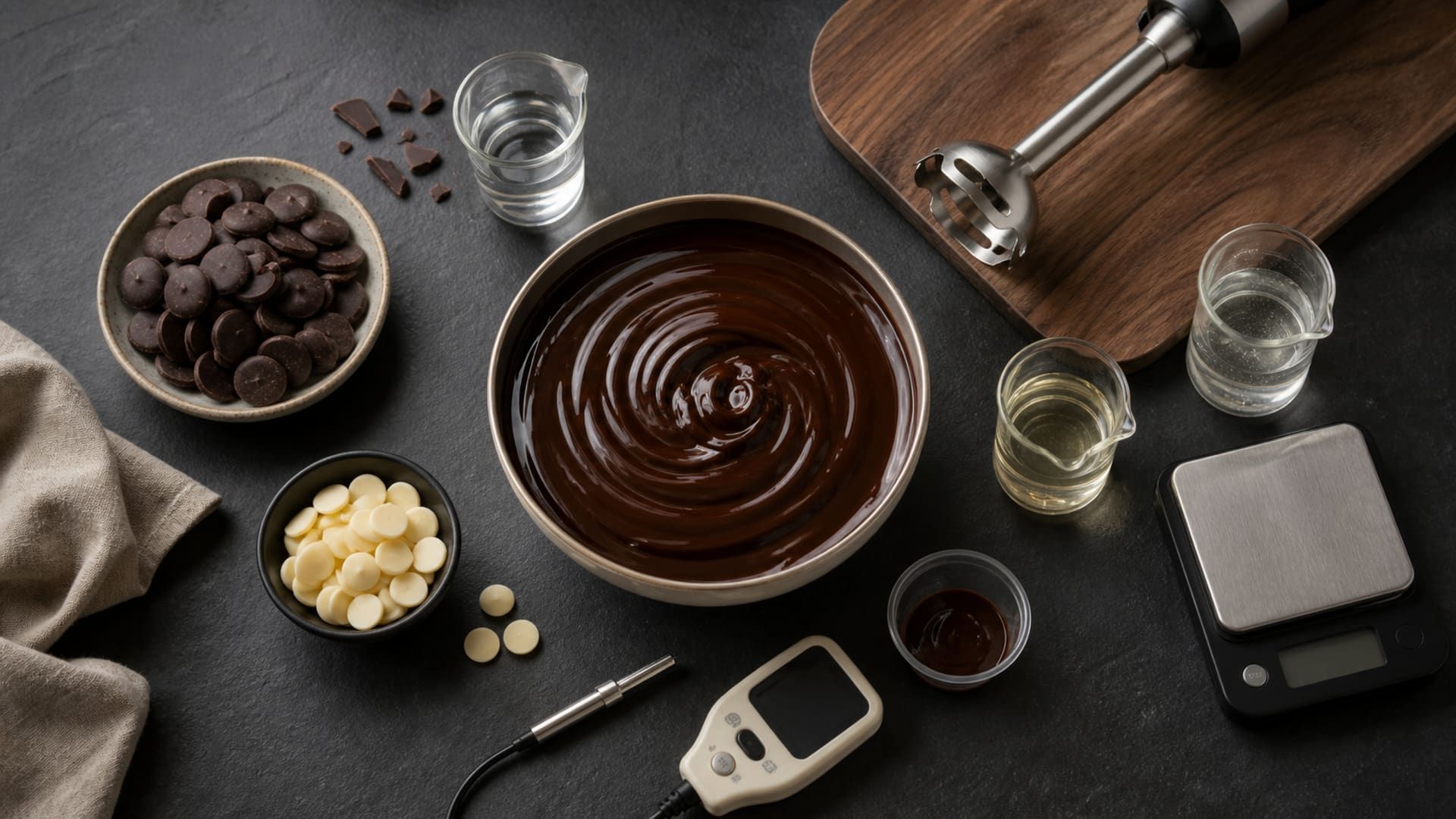
A water ganache replaces cream with a deliberately built aqueous phase. That removes the cream’s milk fat and proteins, but it does not remove water or make the filling shelf-stable by definition. You still have to balance water, sugars, fat, emulsion structure, hygiene, and packaging as one system.
A shelf-life estimate is not a release decision
The figures in this guide are formulation-screening estimates. Measure aw on the equilibrated finished product, assess the microbiological hazards for your process, and validate the product in its final package before assigning a commercial shelf life.
What Changes When Cream Becomes Water
Cream contributes water, milk fat, proteins, lactose and minerals at the same time. Plain water contributes only the aqueous carrier. Recheck the fat and solids balance instead of assuming a direct swap; the worked example below uses chocolate and cocoa butter for structure and dissolved sugars and polyols to influence water availability.
| Liquid system | What enters the ganache | Formulation consequence |
|---|---|---|
| 35% cream | Water, milk fat, protein, lactose, minerals | Cream helps texture and emulsification, but its composition varies and its water still affects aw. |
| Water | A known mass of water | The water input is easy to quantify, but every gram must be balanced by fat, solids, and a sound emulsion. |
| Juice or purée | Water, native sugars, acids, fibre, minerals | Brix and pH vary by fruit and batch; replacing water gram for gram requires a full recalculation. |
Water ganache is a formulation choice, not simply a dairy swap.
Water activity, written as aw, describes how available the water is for microbial growth and other changes. It is different from total moisture: two fillings can contain similar water percentages yet show different aw because their sugars, polyols, proteins, and other dissolved solids interact with that water differently.
The FDA Food Code 2022 treats a food with a measured aw below 0.88 as not needing time/temperature control for safety, at any pH. That is a boundary for pathogens, not a universal safety certificate. Osmophilic yeasts and xerophilic moulds can tolerate lower aw, and contamination, pH, process, temperature, oxygen, and packaging still influence the result.
Fat helps create texture and slows some moisture movement, but it does not exert the same water-binding effect as dissolved sugars or polyols. Raising cocoa butter while leaving the aqueous phase unchanged may firm the ganache without delivering the aw reduction you expected.
A Worked 1 kg Water Ganache
This worked formula uses dark couverture and cocoa butter to build the fat phase. Invert sugar, glucose syrup, and sorbitol contribute dissolved solids and plasticity to the water phase. Enter your supplier specifications rather than treating catalogue compositions as interchangeable.
| Ingredient | Weight | Batch % | Function |
|---|---|---|---|
| Callebaut 70-30-38 dark chocolate | 600 g | 60% | Chocolate flavour, cocoa butter, dispersed cocoa solids |
| Cocoa butter | 70 g | 7% | Fat structure without added water |
| Water | 150 g | 15% | Aqueous phase and flavour release |
| Invert syrup, 82% solids | 80 g | 8% | Humectancy, softness, crystallisation control |
| Glucose syrup DE40, 80% solids | 50 g | 5% | Body and crystallisation control |
| Sorbitol powder, 99.8% solids | 50 g | 5% | Humectancy and texture control |
Worked 1,000 g dark water ganache formula calculated in Formul.io.
The figures were recalculated in Formul.io on 9 October 2026 using the listed ingredient records. The calculator’s Conservative shelf-life model puts this aw at about 19 days at 20 °C and 79 days refrigerated, a screening figure rather than a validated date. They describe the input composition, not a measured batch. Record the finished yield if water evaporates during preparation.
Open the 1 kg water ganache formula
Inspect the exact ingredients and process, then copy the recipe into your account to adapt it.
This formula carries 150 g added water, but its total water is about 180.6 g: couverture and syrups also contribute water. That distinction matters when replacing a syrup or adding an infusion. Count the new ingredient’s full composition before judging the change.
The 50 g sorbitol entry means powder with 99.8% dry solids in the selected record. A 70% solution at the same weight would carry roughly 15 g water; using it without recalculation changes both the water and polyol contributions.
Make a small process trial before choosing moulded shells or a frame. Assess how the mass flows at the intended working temperature and sets afterward. Do not infer a piping window or a successful emulsion solely from a quality score.
Changing dark chocolate, using a different sorbitol specification, or adding coffee, alcohol, juice, or purée changes more than flavour. It changes water, soluble solids, fat, or pH; update the ingredient specification and recalculate before making the batch.
Process the Emulsion Reproducibly
Prepare the production setup
Sanitise food-contact tools and containers, let them dry, and weigh every ingredient separately. Record the actual couverture, syrup, and sorbitol specifications used.
Melt the fat phase
Melt the dark chocolate and cocoa butter together to 45°C. Stir gently until uniform and avoid prolonged heating.
Build the aqueous phase
Combine water, invert sugar syrup, glucose syrup DE40, and sorbitol. Heat to 80°C while stirring until the solids are fully dispersed.
Create the emulsion
Add the hot aqueous phase to the melted chocolate in three additions. Mix from the centre after each addition until the mass becomes elastic and glossy.
Homogenise without aerating
Use an immersion blender with the head fully submerged. Blend just until the ganache is smooth; trapped air creates voids and complicates filling and storage checks.
Cool and deposit
Cool the ganache to 30°C, then deposit under the conditions established for the shell or frame. Record deposit temperature and batch time as process controls.
Temperature is part of the formulation in practice. A colder mass may look acceptably thick while hiding an incomplete emulsion; excessive heat can delay crystallisation and alter the working window. Keep the same phase temperatures, addition sequence, shear, and deposit temperature between pilot and production batches.
Do not replace water with juice or purée one for one
Fruit ingredients bring variable Brix, acidity, minerals, and suspended solids. Measure or obtain their specification, enter them as new ingredients, and reassess both emulsion behaviour and shelf-life controls.
Plan Storage From the Finished Product
There is no validated number of room-temperature days for this example. Define the intended storage temperature, distribution route and package before selecting a proposed date to investigate.
Record the shell and filling masses, closure, package, actual yield and phase temperatures. Water can move between a filling, shell and surrounding air; an open cup of ganache does not reproduce the finished confection.
Choose measurable criteria for the aspects likely to limit the product: aw, the relevant microbiology, filling texture, flavour, bloom, leakage or cracking. Agree the safety-related tests with a qualified laboratory using the actual recipe and process description.
The shelf-life planning guide provides a sample allocation and blank record. Use it to plan unopened units and checkpoints, and keep model outputs separate from measurements. Do not extend a date on the basis of an attractive day-zero sample.
For refrigerated distribution, include the package’s warming procedure. A different temperature regime needs its own evidence, and moisture condensing on a cold surface is a separate issue from the initial bulk aw.
Water Ganache Shelf-Life Questions
Does aw 0.79 make this water ganache safe at room temperature?
Why use water instead of cream in ganache?
Can I replace the water with fruit juice or purée?
Can I remove sorbitol from the formula?
Does refrigeration automatically extend the validated shelf life?
Is this formula dairy-free?
References: Hartel, von Elbe and Hofberger, Confectionery Science and Technology (2018), for confectionery structure and water-related stability. Food Safety Authority of Ireland, Guidance Note No. 18: Validation of Product Shelf-life, Revision 5 (2022), for study design. Quoted recipe composition is calculated in Formul.io and has not been validated by a storage trial.
Related Topics
Related Articles
Water Activity in Ganache: The Science Behind Shelf Life Prediction
How the Formul.io Ganache Calculator estimates water activity from a formulation's sugar, polyol, and alcohol composition to predict microbial shelf life — and how to use those numbers responsibly.
Water Activity Calculator for Ganache and Filled Chocolates
Calculate water activity from your formulation, compare ingredient changes, and use recipe-level predictions to plan shelf-life testing for filled chocolates.
Fruit Purée in Ganache: Substitution, Not Addition
Adding fruit purée to ganache without reformulating around it splits the emulsion and cuts shelf life. Here's the science and the fix.