Shelf-Stable Buttercream: Which Frostings Pass 0.85, and a Recipe That Does
American buttercream sits just under 0.85 water activity (aw), the line cottage-food rules use; cream cheese frosting and meringue buttercream belong in the fridge. Here is a calculated buttercream with room to spare, and what moves the number.
Weights, method and calculated water activity below; a free account lets you save and adapt the recipe.
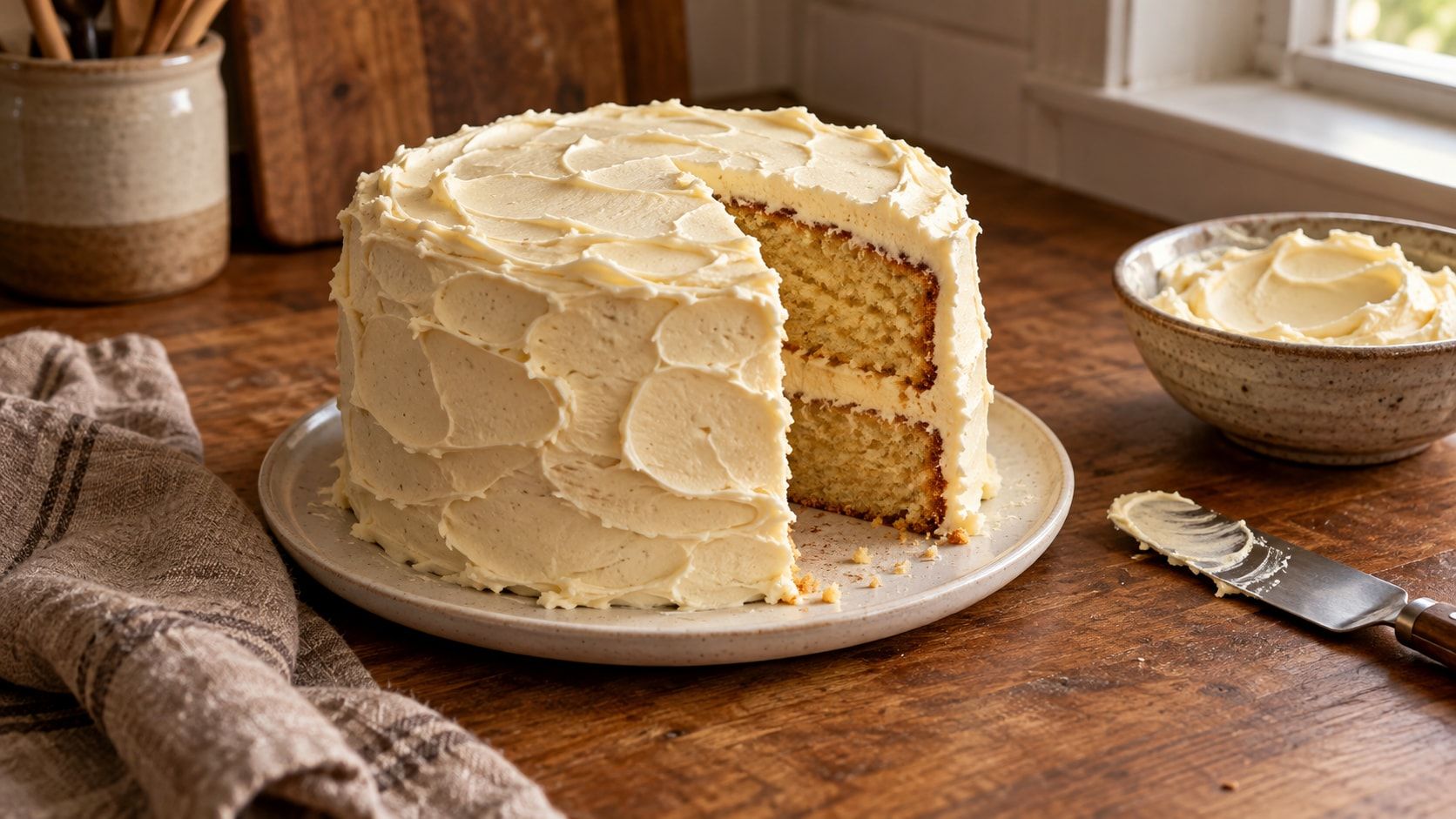
American buttercream can be shelf stable, but only just. A classic recipe of butter, powdered sugar and a little cream or milk sits just under 0.85 water activity (aw), the line cottage-food states such as Maryland use: labs at Kansas State and Iowa State measured it at 0.79 to 0.83. Cream cheese frosting and meringue buttercream belong in the fridge.
Three frostings, three answers
Fridge only: 2 hours out at most
Swiss meringue buttercream†
150 g egg whites and 300 g sugar whipped with 450 g butter, vanilla and ¼ teaspoon (1.5 g) of salt.
- Out of fridge safety limit
- 2 hours
- Fridge 4 °C / 39 °F
- 22 days
- Water activity aw
- 0.892
Just under 0.85 in two labs: test your own batch before you sell
Classic American buttercream
Open the recipe: Classic American buttercream227 g butter, 480 g powdered sugar, 30 g heavy cream, vanilla and ¼ teaspoon (1.5 g) of salt.
- In a jar 20 °C / 68 °F once a test shows 0.85 or lower
- 13 days
- Fridge 4 °C / 39 °F
- 54 days
- Water activity aw
- 0.820
Likely passes 0.85: test it, then it can stay out
Shelf-stable buttercream
Open the recipe: Shelf-stable buttercreamThe classic with 4 g of salt and 20 g more powdered sugar.
- In a jar 20 °C / 68 °F
- 19 days
- Fridge 4 °C / 39 °F
- 76 days
- Water activity aw
- 0.793
Days: calculator estimates of when spoilage begins at 68 °F and 39 °F, not label dates; flavor usually fades sooner. † Calculator simulation, not a saved recipe.
Calculate your own frosting before you pay a lab to test it: the calculator is free. It often shows water activity as two numbers, such as 0.44–0.82; compare the higher one with 0.80 and 0.85.
Is Buttercream Shelf Stable?
Water activity measures how freely microbes can use the water in a food, on a scale from 0 to 1. Maryland’s cottage-food rules and the extension services that have tested frostings put the line for keeping a frosting out of the fridge at 0.85, and so does this page.
The classic American buttercream lands just under it. The Kansas Value Added Foods Lab at Kansas State University measured a simple buttercream of butter, powdered sugar, heavy cream, vanilla and salt at 0.83. Iowa State University Extension had the same recipe made with milk instead of cream and lab-tested three versions, with skim, 2 % and whole milk: 0.788 to 0.812. Calculated in Formul.io, the recipe comes to 0.819.
| Frosting and lab | Measured | Calculated |
|---|---|---|
| Simple buttercream with heavy cream (Kansas State) | 0.83 | 0.819 |
| The same with skim, 2 % or whole milk (Iowa State) | 0.788–0.812 | 0.822 with 2 % or whole milk† |
| Glaze of powdered sugar, milk and vanilla (Kansas State) | 0.85 | 0.814† |
Lab results as published by K-State Research and Extension and Iowa State University Extension and Outreach; calculated in Formul.io from the same recipes in grams. † Calculator simulation, not a saved recipe.
Made exactly as tested, the classic recipe stayed under 0.85 in both labs, and both extension services treat it as safe at room temperature. Your batch differs in butter, cream and measuring, and in these three comparisons the calculation came within 0.04 of each lab result, above or below it. So this page treats a calculated 0.80 or lower as likely to pass 0.85, and anything above 0.80 as too close to call until a lab tests your finished frosting.
Why Buttercream Sits Just Under 0.85
Water at room temperature dissolves about twice its weight of sugar, and a syrup holding all the sugar it can has a water activity of about 0.85. The classic recipe has only about 60 g of water, two-thirds of it from the butter, against 480 g of powdered sugar. About a quarter of the sugar dissolves and the rest stays as fine crystals, so the water is a saturated syrup: Iowa State’s lab read 67 to 69 % dissolved solids (°Brix).
That is why more sugar does not take a buttercream any lower. What does is anything else that dissolves in that little water: salt most of all, then the milk sugar in the cream and the alcohol in the vanilla.
Shelf-Stable Buttercream Recipe
This is the classic recipe with two changes. Salt does the work: 4 g instead of ¼ teaspoon (1.5 g) takes the calculated water activity from 0.819 to 0.793. The extra 20 g of powdered sugar changes nothing in the water activity; it takes sugar over 65 % of the frosting’s weight, the no-test rule of thumb Kansas State gives for frostings at Kansas fairs.
| Ingredient | Weight (g) | US measure | What it does |
|---|---|---|---|
| Unsalted butter, softened | 227 | 1 cup (2 sticks) | Body; two-thirds of the water |
| Powdered sugar | 500 | About 4¼ cups; weigh it | Saturates the water |
| Heavy cream, 35–36 % fat | 30 | 2 tablespoons | Softens it to spreading |
| Pure vanilla extract | 4 | 1 teaspoon | Flavor |
| Fine salt | 4 | About ⅔ teaspoon; weigh it | Lowers water activity |
| Total | 765 |
Makes 765 g of frosting.
Beat the butter with the salt and vanilla
Beat the softened butter with the salt and vanilla on medium speed for about 1 minute, until smooth. Butter that is soft but still cool, around 65–68 °F (18–20 °C), whips best.
Add the powdered sugar
Sift the powdered sugar if it is lumpy. Add it in three or four parts on low speed, scraping the bowl between additions until no dry sugar is left.
Add the cream, and stop at 30 g
Beat in the cream a teaspoon at a time until the frosting spreads easily. Use no more than the 30 g: a lab result holds only for the recipe you sent.
Whip until light
Beat on medium-high speed for 2 to 3 minutes, until light and fluffy.
Store it covered
Keep the frosting in a closed container. Until a lab result for your batch shows 0.85 or lower, keep it in the fridge, then let it soften and rewhip it before use.
Open the shelf-stable buttercream
See its calculated water activity, save a copy to your library and enter your own butter, cream and salt.
At 0.5 % of the frosting, 4 g of salt is about what a buttercream made with salted butter carries. Use unsalted butter and weigh the salt, so every batch gets the same 4 g: fine table salt measures about ⅔ teaspoon, and kosher salt varies by brand.
The recipe makes 765 g. To see how much a layer cake takes to fill and cover, use the cake frosting and filling calculator.
What Lowers a Buttercream’s Water Activity
Every row starts from the classic batch. More sugar or a little more liquid barely moves it, because the water stays saturated either way. What takes it down is more of what dissolves on top of the sugar, or less water for it to dissolve in.
| Change to the classic recipe | Water activity | Verdict |
|---|---|---|
| None: the classic as written | 0.819 | Too close to call |
| Twice the cream, 60 g† | 0.823 | Too close to call |
| 120 g more powdered sugar† | 0.819 | Too close to call |
| 40 g cocoa powder and 15 g more cream† | 0.819 | Too close to call |
| 30 g light corn syrup added† | 0.813 | Too close to call |
| Half the butter replaced by shortening† | 0.807 | Too close to call |
| 4 g salt and 20 g more powdered sugar: the shelf-stable recipe | 0.793 | Likely passes 0.85 |
| 10 g glycerin added† | 0.783 | Likely passes 0.85 |
| All shortening, water instead of cream, 4 g salt† | 0.760 | Likely passes 0.85 |
Calculated in Formul.io. † Calculator simulation of the classic formula with that change, not a saved recipe.
Salt works hardest: about 0.01 lower for each extra gram in this batch, because all of it dissolves in about 60 g of water. Glycerin, sold for cake decorating, works the same way.
Recalculate after any change, then have the new recipe tested.
Cream Cheese Frosting and Meringue Buttercream Need the Fridge
Even with plenty of sugar, a cream cheese frosting calculates only just under the line, too close to rely on. With less sugar, the water dissolves all of it and the number climbs past the line; Kansas State’s lab measured a low-fat cream cheese frosting at 0.91.
| Cream cheese frosting | Calculated water activity |
|---|---|
| 226 g cream cheese, 113 g butter, 360 g powdered sugar, vanilla† | 0.827 |
| The same with 240 g powdered sugar† | 0.862 |
Calculated in Formul.io. † Calculator simulation, not a saved recipe.
Kansas State found that some cream cheese frostings need refrigeration and some do not, so it keeps every cream cheese frosting and filling out of Kansas fairs. Connecticut prohibits cream cheese frosting for cottage food, and Iowa State Extension says frostings made with cream cheese, whipped cream or eggs need refrigeration.
Meringue buttercreams go over the line for another reason. Their sugar is dissolved in egg whites, and the butter’s water dilutes that syrup below saturation: the Swiss meringue buttercream on the card above calculates at 0.892. Keep both in the fridge, and out of it for no more than 2 hours, or 1 hour above 90 °F (32 °C).
Can You Sell Buttercream Under Cottage Food Rules?
Cottage-food rules usually let you sell from your home kitchen only foods that keep safely without refrigeration. Two states show how differently they treat buttercream:
- Maryland lists icings and frostings made with butter, milk or cream cheese among the products an independent laboratory must test before you sell them. The result must show a water activity of 0.85 or lower, or a pH of 4.6 or lower. You follow the tested recipe exactly, test again after any change, and keep a copy of the result with you when you sell in person (Maryland Department of Health, Product Testing FAQ, revised October 2025).
- Connecticut lists buttercream, cream cheese and whipped cream frostings among prohibited cottage foods. It allows store-bought frosting, fondant, and frostings made without butter, eggs, cream, milk or cream cheese, such as ones made only from shortening, sugar and commercially made meringue powder. You can have a frosting tested, but a passing result does not guarantee approval (Connecticut Department of Consumer Protection, cottage food FAQ, March 2026).
Check your own state’s cottage-food rules before you sell or pay for a test. A lab result tells you whether your frosting meets the number; your state decides whether you may sell it.
Calculate before you pay for a test
Every recipe you send to a lab is a separate test, and in Maryland every change needs a new one. Recipes that calculate at 0.80 or lower (the higher of the calculator’s two numbers) are the ones worth sending. Between 0.80 and 0.85, try the salt or glycerin first and calculate again; above 0.85, change the recipe before any test.
Shelf-Stable Frosting Questions
Is buttercream shelf stable?
How long can buttercream sit out at room temperature?
Does buttercream need to be refrigerated?
Is cream cheese frosting shelf stable?
Does more powdered sugar make buttercream shelf stable?
Can I sell buttercream under cottage food rules?
Can a cake frosted with shelf-stable buttercream stay out?
Related Topics
Related Articles
Is Ganache Shelf Stable? No, Unless You Change the Recipe
A classic chocolate-and-cream ganache belongs in the fridge. A ganache can stay out only when its water activity (aw), how freely microbes can use its water, is 0.85 or lower.
Confectionery Shelf-Life Testing: Plan Your First Study
Build a retention-sample plan for a filled chocolate: choose checkpoints, calculate the packs needed, and record results without confusing a trial target with a validated date.
Moisture Migration: Water Activity, Fick's Law, and Packaging
Predict moisture movement by separating its water-activity driving force from diffusion rate, and compare packaging only with WVTR units and test conditions attached.