Cake Frosting and Filling Calculator
How much buttercream, ganache or cream cheese frosting a layer cake needs for filling, crumb coat and final coat, and how much sponge to bake.
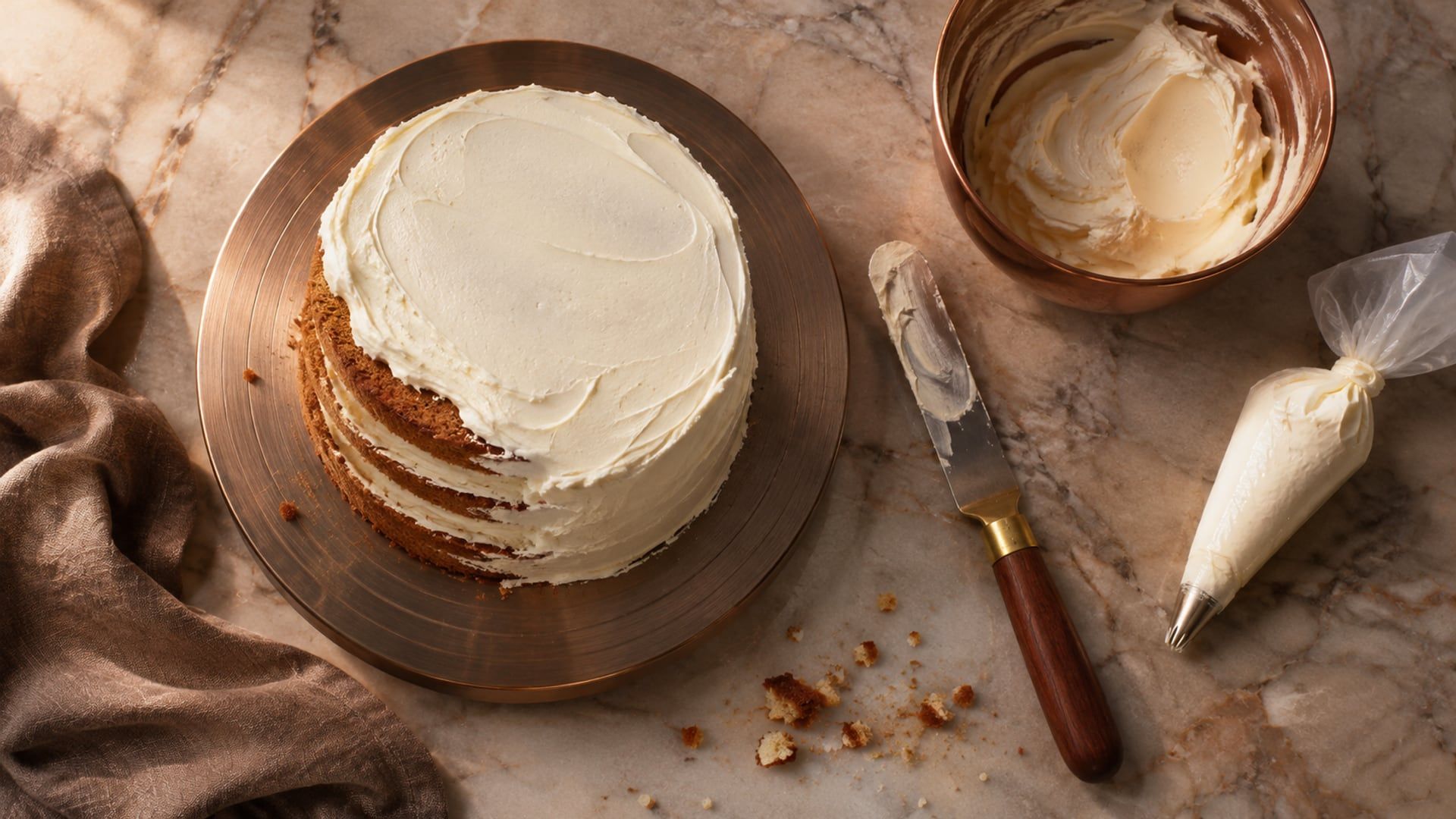
A 20 cm (8 in) round cake of three 2 cm sponge layers, with 1 cm of filling and a 5 mm coat, needs about 910 g of American buttercream, about 4½ US cups: 480 g to fill, 350 g to cover, and 10 % for the bowl and bag. In inches, an 8 in cake with ¾ in layers and ½ in fillings takes about 1,090 g of American buttercream, about 5½ US cups. Enter your own cake, in centimetres or inches, and the calculator gives the grams of filling, coat, drip and sponge. It weighs the cream by its density, because a cup of whipped ganache weighs much less than a cup of firm ganache.
What to enter
- Choose the shape, centimetres or inches, the number of sponge layers and the diameter.
- Enter the height of one baked layer and the thickness of the filling between two layers.
- Pick the cream you fill and cover with, how thick the coat is, and whether you add a drip.
- If you know the density of your cream, enter it under Your cream’s density.
How Much Frosting a Layer Cake Needs
For a round cake of three 2 cm sponge layers with 1 cm of filling between them and a 5 mm crumb and final coat, American buttercream comes to these amounts. The amount to make includes 10 % for what stays in the bowl, the piping bag and on the spatula.
| Cake | Filling | Coat | To make | Drip ganache |
|---|---|---|---|---|
| Round 15 cm (6 in) | 260 g | 240 g | 550 g | 90 g |
| Round 20 cm (8 in) | 480 g | 350 g | 910 g | 130 g |
| Round 25 cm (10 in) | 770 g | 480 g | 1,370 g | 160 g |
American buttercream at 0.85 g/cm³, three 2 cm layers, 1 cm fillings, 5 mm coat; rounded to 10 g.
The filling grows with the area of the cake, the coat with its top plus its sides. That is why a 25 cm cake needs half as much again as a 20 cm one, not twice as much: its area is 56 % larger, but the coat on the sides grows only with the diameter.
The cream changes the grams as much as the size does. The same 20 cm cake takes these amounts of each cream the calculator offers:
| Cream | Density used | To make for a 20 cm cake | Where the density comes from |
|---|---|---|---|
| American buttercream | 0.85 g/cm³ | 910 g | Published figures for whipped buttercream icings |
| Swiss meringue buttercream | 0.80 g/cm³ | 860 g | Typical value; weigh yours |
| Cream cheese frosting | 1.05 g/cm³ | 1,130 g | Typical value; weigh yours |
| Whipped white ganache | 0.75 g/cm³ | 800 g | Typical value, between whipped cream and set ganache; weigh yours |
| Dark ganache for sharp edges | 1.15 g/cm³ | 1,230 g | Worked out from the measured density of chocolate and cream |
Three 2 cm layers, 1 cm fillings, 5 mm coat; rounded to 10 g.
How the Amounts Are Worked Out
The calculator works out a volume for each part of the cake and multiplies it by the density of the cream.
The inner area stops 5 mm short of the edge on every side, the way a filling is piped inside a dam so the crumb coat can close the gap.
Cake height is the layers plus the fillings between them. Semi-naked is a 2 mm coat, a crumb and final coat 5 mm, a thick coat for sharp edges 8 mm.
Density turns volume into grams. Whipping adds air, so the same 500 ml of cream can weigh anything from about 230 g as whipped cream to nearly 600 g as set ganache. If you whip longer or shorter than usual, or your recipe is richer in butter or chocolate, your cream will not match the typical value. Fill a 250 ml cup level with it, weigh it and divide the grams by 250: that is its density in g/cm³, and you can enter it in the calculator.
Soft Fillings Inside a Dam
Many cakes are filled with something the coating cream cannot replace: curd, compote, caramel or a mousse. Pipe a ring of the coating cream around the edge of each layer and spoon the soft filling inside it, so it cannot squeeze out under the weight of the layers above.
The calculator counts the filling in the cream you chose. For a different filling, divide the filling line by the density of that cream and multiply by the density of your filling: a curd or compote is heavier than buttercream for the same space, a whipped mousse lighter. Make the coating cream for the coat line plus a little extra for the rings, and bring the filling down to 5 or 6 mm if it is soft, so the cake stays stable when you cut it.
Why Some Densities Are Typical Values
For American buttercream there are published figures: industry measurements put whipped buttercream icings at about 0.75 to 0.95 g/cm³, and 0.85 sits in the middle. Chocolate has a measured density of about 1.3 g/cm³, and cream is close to that of water, so a ganache of 60 % chocolate and 40 % cream comes to about 1.15. For Swiss meringue buttercream, cream cheese frosting and whipped ganache there are no published measurements, so the calculator uses typical working values and marks them as such. Weigh a cup of yours the first time and you will have your own number from then on.
Sponge and Batter
The calculator also weighs the sponge. Food-science measurements of baked sponge cakes give a specific volume of about 3 to 4 cm³ per gram, which is a density of about 0.25 to 0.35 g/cm³; the calculator uses 0.30 for a light sponge such as a génoise. Butter and pound cakes are denser, about 2.1 to 2.2 cm³ per gram, and the calculator uses 0.45.
The batter to make is the baked weight plus what bakes off as steam. Measured losses run from about 5 to 13 % for sponge cakes and about 9 % for pound cakes, so the calculator adds 10 %. Weigh one layer of your own sponge to check: if it is heavier or lighter than the calculator says, your recipe is denser or airier than the typical one.
Drips
A ganache drip runs along the top edge, so its amount depends on the edge, not the area. The calculator allows about 2 g of ganache for each centimetre of edge, which is about 130 g for a 20 cm cake. It is a working figure from practice rather than a measurement: a thin drip that stops halfway down needs less, a heavy drip with a flooded top needs more. The calculator splits the drip into a 1:1 dark ganache, equal weights of chocolate and cream, and opens it in the ganache calculator. Let it cool until it just flows before you pour.
Amounts to plan with, not to the gram
The calculator is accurate about the geometry and approximate about everything that depends on your hands and your recipe: how much air you whip in, how even your layers are, how much you scrape back. Make the amount it gives the first time, weigh what is left, and adjust the overage for the next cake.
How much buttercream do I need for an 8 inch cake?
How much frosting is needed for a crumb coat?
How much ganache do I need for a drip?
Why does whipped ganache need fewer grams than firm ganache?
How do I find the density of my frosting?
How much batter do I need for a 20 cm cake?
Related Topics
Related Articles
Cake Servings and Pan Size Calculator
How many servings a round, square, or sheet cake gives, a serving chart for every common size, and how to convert a recipe to a bigger or smaller pan.
Cake Pricing Calculator
Work out what to charge for a cake: ingredients, your time, kitchen costs and profit, with the price per cake, per serving and per kg.
Shelf-Stable Buttercream: Which Frostings Pass 0.85, and a Recipe That Does
American buttercream sits just under 0.85 water activity (aw), the line cottage-food rules use; cream cheese frosting and meringue buttercream belong in the fridge. Here is a calculated buttercream with room to spare, and what moves the number.