Cake Servings and Pan Size Calculator
How many servings a round, square, or sheet cake gives, a serving chart for every common size, and how to convert a recipe to a bigger or smaller pan.
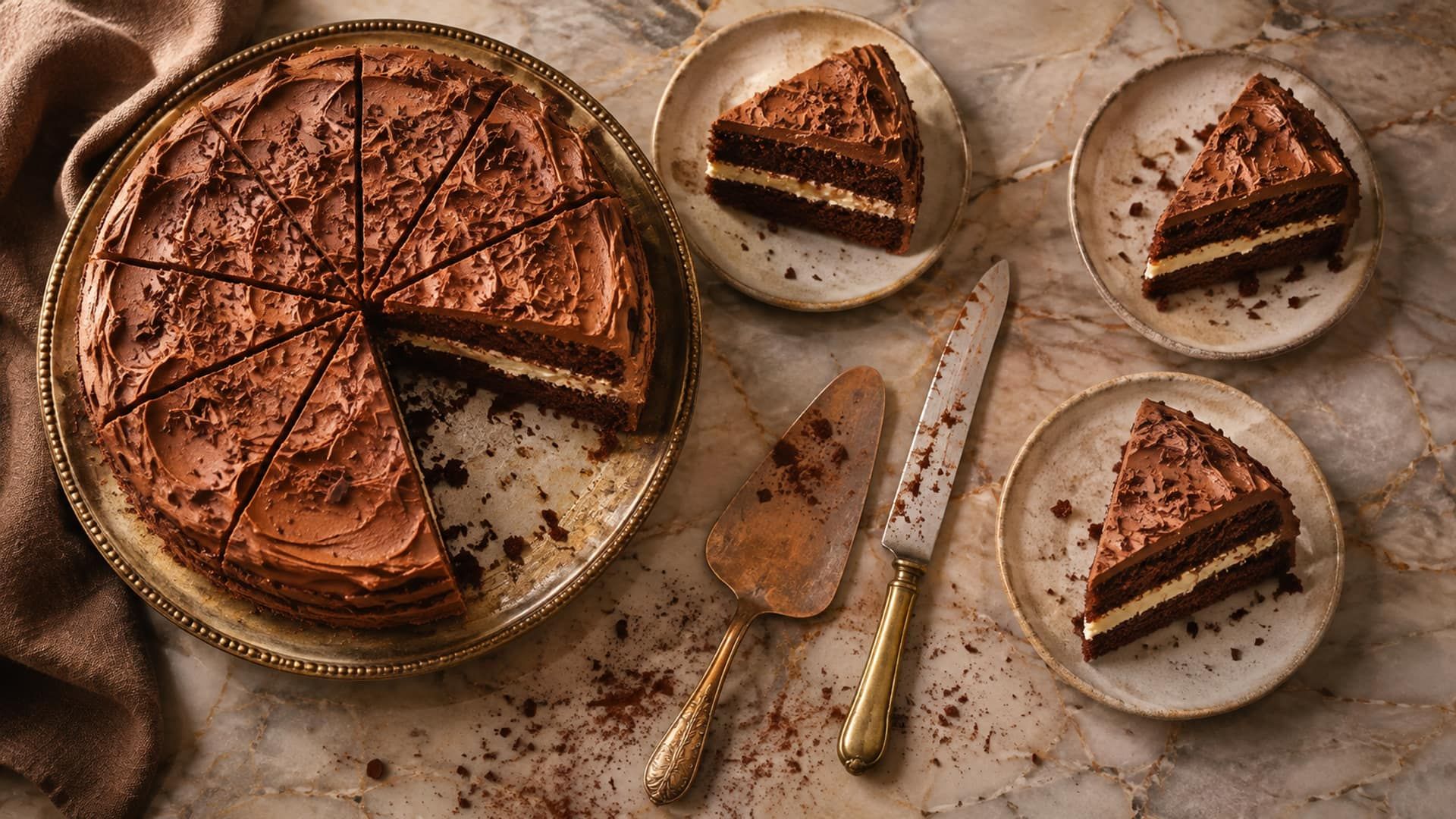
An 8 in round cake about 4 in tall gives 16 party slices of 1½ × 2 in or 25 wedding slices of 1 × 2 in; a 20 cm round about 10 cm tall gives 16 and 24. A cake gives as many servings as the slices you cut from its top, so choose your pan and height below. Converting a recipe? Add the pan it was written for, and multiply every ingredient by the factor the calculator shows.
Servings and Pan Size Calculator
What to enter
- Pick the shape and units, then tap a pan size or type your own.
- Choose the height of the finished, filled cake, not of one sponge layer.
- Pick the slice you cut: party for birthdays, wedding for tiered cakes served on small plates.
- Converting a recipe? Choose Yes and enter the pan the recipe was written for: round, square or a rectangle such as 9 × 13 in.
Cake Size and Serving Chart
The chart counts whole slices from a single cake about 4 in (10 cm) tall, the height these slice sizes are meant for. For a tiered cake, add the servings of each tier.
| Pan | Party slices (1½ × 2 in) | Wedding slices (1 × 2 in) |
|---|---|---|
| Round 6 in (15 cm) | 9 | 14 |
| Round 7 in (18 cm) | 12 | 19 |
| Round 8 in (20 cm) | 16 | 25 |
| Round 9 in (23 cm) | 21 | 31 |
| Round 10 in (25 cm) | 26 | 39 |
| Round 12 in (30 cm) | 37 | 56 |
| Round 14 in (36 cm) | 51 | 76 |
| Square 6 in (15 cm) | 12 | 18 |
| Square 7 in (18 cm) | 16 | 24 |
| Square 8 in (20 cm) | 21 | 32 |
| Square 9 in (23 cm) | 27 | 40 |
| Square 10 in (25 cm) | 33 | 50 |
| Square 12 in (30 cm) | 48 | 72 |
| Square 14 in (36 cm) | 65 | 98 |
Whole slices from one cake about 4 in (10 cm) tall. Centimetres in brackets are rounded.
If you bake in centimetre pans, the round sizes common in Europe give these counts:
| Pan | Party slices (4 × 5 cm) | Wedding slices (2.5 × 5 cm) |
|---|---|---|
| Round 15 cm | 9 | 13 |
| Round 18 cm | 13 | 19 |
| Round 20 cm | 16 | 24 |
| Round 23 cm | 21 | 32 |
| Round 24 cm | 23 | 35 |
| Round 25 cm | 25 | 38 |
| Round 28 cm | 31 | 47 |
| Round 30 cm | 36 | 54 |
Whole slices from one cake about 10 cm tall. A 20 cm pan is slightly smaller than an 8 in one, so it gives one wedding slice fewer.
Many printed serving charts list more party servings than these. A 1½ × 2 in slice covers 3 square inches of the top, and an 8 in round has 50 square inches, so 16 slices of that size is what it holds. A chart that promises more is cutting smaller slices than it names. The calculator counts only whole slices of the size you choose, so the number you quote a customer is one you can actually cut.
How Servings Are Counted
Servings are the top area of the cake divided by the footprint of one slice, rounded down to whole slices.
Top area: π × diameter² ÷ 4 for a round cake, side × side for a square, width × length for a sheet. Party slice: 1½ × 2 in = 3 in². Wedding slice: 1 × 2 in = 2 in².
Take a 9 in round. Its top is π × 9² ÷ 4 = 63.6 square inches. That holds 21 party slices of 3 square inches, or 31 wedding slices of 2. The same method works for a sheet: a quarter sheet of 9 × 13 in has 117 square inches, which is 39 party slices or 58 wedding slices. A half sheet of 13 × 18 in gives 78 and 117.
To get those numbers out of a round cake, do not cut it in wedges from the middle: the pieces get very wide at the edge. A common way is to cut a circle 2 in (5 cm) in from the edge, slice that ring into pieces 1 or 1½ in wide, then cut the next ring 2 in further in, and finish the small centre like a small cake.
Taller and Shorter Cakes
The slice sizes assume a cake about 4 in (10 cm) tall, which is two or three sponge layers with filling. A taller cake does not give more servings from the same top, but each slice is bigger. For a cake 6 in (15 cm) tall or more, many bakers cut each slice in half across its height and count twice the servings, which suits small wedding portions. A single 2 in (5 cm) layer gives a thin slice; count it as half a serving or cut the slices wider.
Converting a Recipe Between Pans
A recipe scales with the volume of the cake, so compare the area times the height of the new cake with the area times the height of the cake the recipe was written for. Multiply every ingredient by that factor.
For two round pans of the same height, this is the ratio of the diameters squared.
Going from a 20 cm to a 24 cm round pan of the same height multiplies the area, and every ingredient, by (24 ÷ 20)² = 1.44. Going down from a 9 in to an 8 in round, the factor is (8 ÷ 9)² = 0.79. An 8 in square holds 27 % more than an 8 in round, because a square of the same side has the corners a circle leaves out. A recipe for a 9 × 13 in rectangle (117 square inches) baked in an 8 × 8 in square of the same depth (64 square inches) needs 0.55 of every ingredient, a little over half.
Rounding matters for a few ingredients. Weigh eggs rather than counting them, or round to whole eggs and accept a small change. Leavening, salt and spices scale with the rest at the sizes in the chart; check the taste of a much larger batch before you sell it.
The oven does not scale. A wider pan of the same depth bakes in about the same time, and a deeper one needs longer. Bake a deeper or much wider cake a little cooler and for longer so the edge does not dry out before the centre sets, and test the middle with a skewer. Fill each pan to the same depth as the recipe’s pan, rather than pouring in what is left.
Splitting batter between several pans
Use the same factor to split one batch between tiers. Work out the volume of each tier, add them, and give each pan its share of the batter by weight. A scale is faster and more even than filling by eye.
Planning a Tiered Cake
Tiers add up. A three-tier round cake of 6, 8 and 10 in, each about 4 in tall, gives 9 + 16 + 26 = 51 party slices or 14 + 25 + 39 = 78 wedding slices. Wedding cakes are usually counted in wedding slices, because they are served after a meal. For a birthday or a party where the cake is the dessert, count in party slices.
When the guest list sits between two sizes, choose the larger tier, or plan a plain sheet cake of the same flavour in the kitchen for the extra servings. It is cheaper to make, and nobody sees it being cut.
Once you know the size, work out the cream and sponge with the frosting and filling calculator and the price with the cake pricing calculator.
How many servings are in an 8 inch round cake?
How many people does a 9 × 13 sheet cake feed?
Why does my pan's chart say more servings than the calculator?
How do I convert a 9 inch cake recipe to an 8 inch pan?
Does a taller cake give more servings?
What size cake do I need for 30 people?
Related Topics
Related Articles
Cake Frosting and Filling Calculator
How much buttercream, ganache or cream cheese frosting a layer cake needs for filling, crumb coat and final coat, and how much sponge to bake.
Cake Pricing Calculator
Work out what to charge for a cake: ingredients, your time, kitchen costs and profit, with the price per cake, per serving and per kg.
Shelf-Stable Buttercream: Which Frostings Pass 0.85, and a Recipe That Does
American buttercream sits just under 0.85 water activity (aw), the line cottage-food rules use; cream cheese frosting and meringue buttercream belong in the fridge. Here is a calculated buttercream with room to spare, and what moves the number.