Glucose Syrup Substitutes: What to Use Instead and What Changes
Corn syrup is a drop-in. Invert sugar, honey, golden syrup, glucose powder, dextrose and trehalose can each stand in for glucose syrup, but each changes sweetness, softness or colour. Here is what to use, how much, and when nothing works.
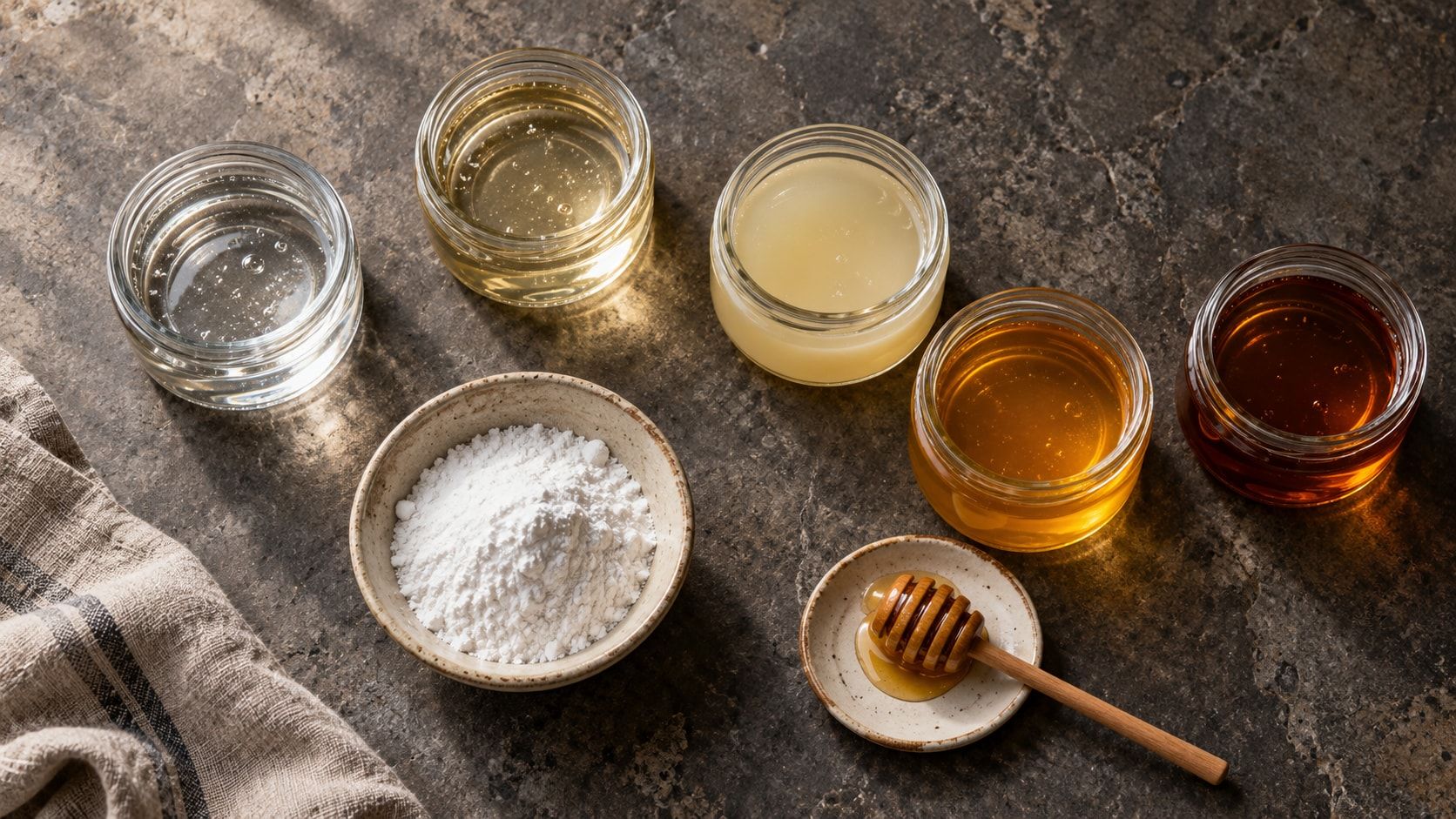
Glucose syrup is rarely in a recipe for sweetness. It stops sucrose from crystallizing, adds body and keeps a confection soft, so a substitute has to do the same job. The closest is US light corn syrup, which is itself a glucose syrup.
Quick answer
Best swap: light corn syrup, 1:1 by weight. Good in most fillings: invert sugar syrup or honey, 1:1, if you accept more sweetness and a softer set. Powders: convert glucose powder or dextrose by dry solids and add back the missing water. No good swap: clear hard candy and sugar work.
What Glucose Syrup Does in a Recipe
Glucose syrup is made by breaking starch down into glucose, maltose and longer chains. It carries water: EU rules set at least 70 % dry matter, and confectioners’ grades commonly sit around 78–85 %. Its functions are what you need to replace:
- Doctoring. Glucose, maltose and longer saccharides get in the way of sucrose crystals, which keeps caramel smooth and fudge and fondant fine-grained.
- Body. The longer chains raise viscosity, which gives caramel its chew and slows how far a hot syrup spreads.
- Moisture retention. Dissolved sugars hold water, so fillings stay soft and dry out more slowly.
- Low sweetness. A DE 42 syrup tastes roughly 40–50 % as sweet as sugar, so it adds solids without much extra sweetness.
- Moderate browning. Its reducing sugars take part in Maillard browning, more slowly than fructose-rich sugars do.
What dextrose equivalent (DE) means
DE is the share of reducing sugars in the syrup’s dry solids, counted as if they were dextrose. Starch is close to 0 and pure dextrose is 100. A higher DE generally means a sweeter, thinner syrup with less body that browns faster. Low-DE syrups resist graining mainly through viscosity and long chains; glucose and fructose do it by raising overall sugar solubility. DE does not give the water content; that is a separate figure on the spec sheet.
Glucose Syrup Substitutes Compared
The ratios below replace 100 g of a typical glucose syrup with about 80 % solids. Sweetness figures are relative to sucrose = 100 and vary with concentration and test method.
| Substitute | Swap for 100 g glucose syrup | What changes | Best / worst uses |
|---|---|---|---|
| Light corn syrup | 100 g | Essentially nothing: in the US, corn syrup is glucose syrup made from corn starch. Some grades carry slightly more water. | Best: anything. Worst: dark corn syrup, which adds colour and molasses flavour, in pale candy. |
| Higher-DE glucose syrup (DE 60+) | 100 g | Sweeter (about 70 at DE 63), thinner, softer at the same cook, browns sooner. | Best: ganache, soft caramel. Worst: chewy caramel (less body); hard candy (more hygroscopic, lower Tg). |
| Invert sugar syrup | 100 g, or replace part | Much sweeter (invert sugar ~120–130 on a dry basis), more hygroscopic, browns faster, softer at the same cook. | Best: ganache, fondant fillings, soft caramel. Worst: hard candy, sugar work. |
| Honey | 100 g | About as sweet as sugar by weight; roughly 38 % fructose, 30 % glucose and 17 % water. Strong flavour, fast browning. | Best: honey caramels, nougat, flavoured ganache. Worst: neutral or pale products. |
| Golden syrup | 100 g | Partially inverted cane syrup, about 80 % sugars, roughly 40 % of them still sucrose, which adds to the sucrose load. Sweeter, golden colour, toasty flavour. | Best: toffee, honeycomb, butterscotch. Worst: clear candy, white fillings. |
| Dried glucose syrup (glucose powder) | About 83 g powder + 17 g water | Same saccharides if the DE matches; only the water has to be restored. | Best: ice cream, ganache, dry mixes. Worst: none, once dissolved. |
| Dextrose | About 80 g anhydrous + 20 g water, or 88 g monohydrate + 12 g water | Sweeter (about 70), no body, browns faster, softer; can crystallize on its own in high-solids masses. | Best: ice cream, sorbet, part of a ganache. Worst: hard candy, fondant, chewy caramel. |
| Trehalose | Part of the solids only, on a dry basis | Replaces solids and lowers sweetness (about 45) only. Does not prevent graining and may crystallize itself at high concentration; non-reducing, so it does not brown. | Best: less-sweet ganache and frozen desserts. Worst: as the doctor in any boiled sugar. |
| Acid (cream of tartar) | Omit the syrup; add about 0.1–0.2 % of the sugar weight to the sugar–water syrup, before any dairy | Inverts part of the sucrose during the boil; the amount depends on time, heat and pH, so results vary. Acid also slows Maillard browning. | Best: emergency fondant or caramel sauce. Worst: candies that must keep for weeks. |
Swap ratios assume glucose syrup at about 80 % solids, glucose powder at 96 % and anhydrous dextrose near 100 %. Use your supplier's figures when they differ.
Convert glucose syrup, powder and dextrose
Enter your products' solids and get the replacement mass and water correction, without an account.
What Changes in a Caramel: Engine Test
We ran one recipe through the Formul.io caramel calculator: a lean-doctored, dairy-rich chewy caramel (its lactose, protein and fat also help against graining) of 400 g sugar, 200 g glucose syrup DE 40, 400 g cream (35 % fat) and 60 g butter, cooked to 118 °C. We then replaced only the 200 g of glucose syrup. The values below are engine estimates, not measurements.
| Doctor in the caramel | Sweetness index (sucrose = 1) | Sugar-phase Tg | Graining risk score |
|---|---|---|---|
| 200 g glucose syrup DE 40 (baseline) | 0.78 | −26.9 °C | 41 |
| 200 g light corn syrup | 0.79 | −27.4 °C | 43 |
| 200 g glucose syrup DE 60 | 0.83 | −31.0 °C | 41 |
| 200 g invert sugar syrup | 0.99 | −40.6 °C | 40 |
| 200 g honey | 0.99 | −39.7 °C | 48 |
| 160 g dextrose | 0.93 | −39.5 °C | 43 |
| No doctor (sugar raised to 560 g) | 0.98 | not compared | 88 |
Swaps in the same caramel at the same 118 °C cook; dextrose and the no-doctor row are matched on dry solids. Tg is the engine's glass-transition estimate for the sugar phase: the further below room temperature, the softer the caramel.
Corn syrup is a true drop-in: every value stays within a couple of points. Invert sugar and dextrose keep the graining score close to the baseline and honey raises it to 48; all three push sweetness from 0.78 to 0.93–0.99 and lower Tg by about 13 °C. Removing the doctor more than doubles the graining score.
Two effects soften it: glucose and fructose lower Tg on their own, and they leave more water in the batch at the same thermometer reading, because small molecules raise the boiling point more per gram than the longer chains in glucose syrup. Water activity barely moves (0.547 vs 0.538): any solution boiling at 118 °C ends near aw ≈ 101.3/186 ≈ 0.54, whatever the solute.
If you swap in invert sugar, honey or dextrose, cook a few degrees higher, or replace only part of the glucose, then check the texture on a cooled test piece.
Dairy caramel with glucose syrup
The baseline 118 °C chewy caramel. Open the live calculation or copy it into your account.
Dairy caramel with invert sugar instead of glucose
The same caramel with 200 g invert sugar syrup. Compare moisture, Tg and the predicted texture.
When There Is No Good Substitute
Clear hard candy, poured sugar and pulled sugar are where substitutes fail. These masses are cooked almost dry, and their surfaces take up water from the air once they cool. Fructose-rich sugars and extra dextrose make them more hygroscopic, so they turn tacky and cloudy, and invert sugar, honey and golden syrup also add colour.
Hard candy is usually made with roughly 70:30 to 50:50 sucrose to glucose syrup, on a dry-solids basis, and the syrup portion has no equivalent among the swaps above. Use corn syrup or another glucose syrup. Acid inversion is a traditional fallback, but the amount of invert it forms is hard to control.
Do not use invert sugar or honey in shelf-stable hard candy
Hard candy needs a doctor that draws in as little moisture as possible. A regular or low-DE glucose syrup does this far better than invert sugar, honey or golden syrup, which make the surface sticky in storage.
How to Choose and Test a Substitute
Name the job glucose does here
Doctoring in caramel and fudge, body in chewy candy, softness and moisture in ganache, low sweetness in ice cream. Pick the substitute that covers the main job in the table.
Match the water
Syrups swap roughly 1:1 by weight. For glucose powder or dextrose, keep the dry solids equal and add back the water the syrup carried.
Correct the cook and the sweetness
With invert sugar, honey or dextrose in a boiled sugar mass, cook a few degrees higher or replace only part of the glucose. In ganache, reduce another sweetener if the result tastes too sweet.
Run a small batch and store it
Check the texture when cool, the colour, and any graining after a few days of storage. Recalculate the full recipe before you scale up.
Glucose Syrup Substitute Questions
Is corn syrup the same as glucose syrup?
Can I use honey instead of glucose syrup?
How do I replace glucose syrup with glucose powder?
Is glucose powder the same as dextrose?
How do I replace glucose syrup with dextrose?
Can I just leave glucose syrup out?
Related Articles
Glucose Syrup Substitution Calculator
Convert liquid glucose syrup, dried glucose syrup, dextrose, invert sugar, or trehalose by dry solids, then correct the water and review any sourced POD and PAC change.
Glucose Syrups and Dextrose Equivalent Explained
Comprehensive analysis of glucose syrups, Dextrose Equivalent (DE) impact on confectionery formulations, and the functional differences between syrup and powder forms.
Sugar Types in Confectionery: Which Sugar Does What
Sucrose, glucose syrup, dextrose, fructose, invert sugar, lactose and trehalose compared: which sugar to use in caramel, ganache, fondant, pâte de fruit, ice cream, panning and nougat, and why.