Glucose Syrups and Dextrose Equivalent Explained
Comprehensive analysis of glucose syrups, Dextrose Equivalent (DE) impact on confectionery formulations, and the functional differences between syrup and powder forms.
Introduction to Glucose Syrups
To replace liquid syrup with powder or another sugar, use the glucose syrup substitution calculator. It converts the mass on a dry-solids basis and shows the water adjustment; the guide below explains the product properties to consider when choosing a replacement.
Glucose syrup is an aqueous solution of nutritive saccharides obtained from starch (corn, wheat, potato) via hydrolysis. It is a fundamental ingredient in modern confectionery, primarily used to control sugar crystallization, adjust viscosity, and manage water activity (Aw). Commercial glucose syrups are manufactured through a two-stage enzymatic process: liquefaction with α-amylase reduces native starch to shorter oligosaccharide chains at high temperature, followed by saccharification with glucoamylase to reach the target DE value. The resulting syrup is then refined with activated carbon, ion-exchanged, and concentrated by evaporation to approximately 75–80% dry matter content. The three commercially dominant starch sources—corn in North America, wheat in Europe, and potato in northern Europe—yield syrups with functionally equivalent properties at the same DE value, though subtle differences in the oligosaccharide chain-length distribution can produce minor variations in viscosity and Maillard reactivity at comparable DE values. Tapioca and cassava starch are the primary sources in Southeast Asia. Because glucose syrup’s functional properties derive from the distribution of saccharide molecules by molecular weight rather than from any specific chemical interaction with the starch source, formulators can reliably switch between raw material origins at the same DE without reformulation. The key functional contributions glucose syrup makes in a confectionery formulation are: disrupting sucrose crystallization by competing for space in the crystal lattice and interfering with nucleation; increasing viscosity during processing, which controls spreading and working characteristics; reducing water activity through osmotic pressure in the aqueous phase; and participating in Maillard browning reactions with free amino groups, with the rate and intensity of browning increasing with DE. Modern professional confectionery formulation treats glucose syrup as a two-component ingredient—dry matter and water. Standard glucose syrup at DE 42 contains approximately 80% solids and 20% water; always account for this water contribution when calculating the water activity and total moisture of a formulation, since failing to do so is one of the most common sources of discrepancy between calculated and measured water activity in finished ganache and caramel products.
Understanding Dextrose Equivalent (DE)
The most critical parameter for characterizing glucose syrups is the Dextrose Equivalent (DE). It represents the percentage of reducing sugars calculated as dextrose on a dry weight basis. It indicates the degree of hydrolysis the starch has undergone. The DE scale runs from 0 (native, unhydrolyzed starch, which has no free reducing ends) to 100 (pure dextrose, fully hydrolyzed to the monomer). In practice, commercial syrups range from DE 20 (lightly hydrolyzed, predominantly long-chain oligosaccharides, sometimes sold as ‘maltodextrin’ at the low end) to DE 95 (nearly complete conversion to glucose monomers). The average molecular weight of a syrup is inversely proportional to its DE: a DE 20 syrup averages approximately 900 g/mol, a DE 42 syrup approximately 430 g/mol, and a DE 65 syrup approximately 280 g/mol. This molecular weight difference drives all downstream functional property differences between high-DE and low-DE syrups. In professional practice, DE is measured by the Lane–Eynon copper-reduction titration or, more precisely, by HPLC analysis of the saccharide profile, which quantifies the percentages of glucose, maltose, maltotriose, and higher oligosaccharides individually. Two syrups with identical DE values can have different saccharide profiles—one DE 42 might be 18% glucose + 14% maltose + 68% higher oligosaccharides while another has 20% glucose + 12% maltose + 68% higher oligosaccharides—producing subtle but measurable differences in hygroscopicity, freezing-point depression, and Maillard browning rate. When sourcing glucose syrup for precision formulation, requesting a full saccharide profile or certificate of analysis from the supplier is the surest way to achieve consistent product quality across batches.
DE Calculation Formula
DE = (Reducing Sugars / Total Solids) × 100
A DE of 0 represents raw starch. A DE of 100 represents pure dextrose (glucose).
Key concept: DE influences average molecular size, viscosity, hygroscopicity, freezing-point depression, browning, and—generally—sweetness. It does not uniquely determine any of them because the complete glucose/maltose/oligosaccharide profile matters. Low-DE syrups usually provide more body and steric interference with sucrose crystallization; higher-DE syrups generally contain more small reducing sugars and develop color faster. Regular confectioners’ syrup near DE 42 is common because it offers a useful balance, not because one DE is universally correct for every caramel or ganache.
The ranges below are practical, overlapping market categories rather than a regulatory classification. In particular, DE alone does not uniquely determine sweetness: two syrups with the same DE can have different glucose, maltose, and higher-saccharide profiles.
| Property | Low-conversion (~20-38 DE) | Regular/confectioners (~40-44 DE) | High-conversion or high-maltose (~45-58 DE) | High-DE (~60+) |
|---|---|---|---|---|
| Sweetness | Generally low | Generally moderate | Profile-dependent | Generally higher |
| Viscosity | Very high | High | Moderate | Low |
| Anti-crystallization | Strong steric interference | Balanced | Profile-dependent | Weaker steric interference |
| Hygroscopicity | Lower | Moderate | Moderate-high | Higher |
| Freezing Point Depression | Lower | Moderate | Moderate-high | Higher |
| Maillard Reaction | Slower | Moderate | Faster when reducing-sugar content is higher | Generally faster |
Glucose Syrup vs. Atomized Glucose (Powder)
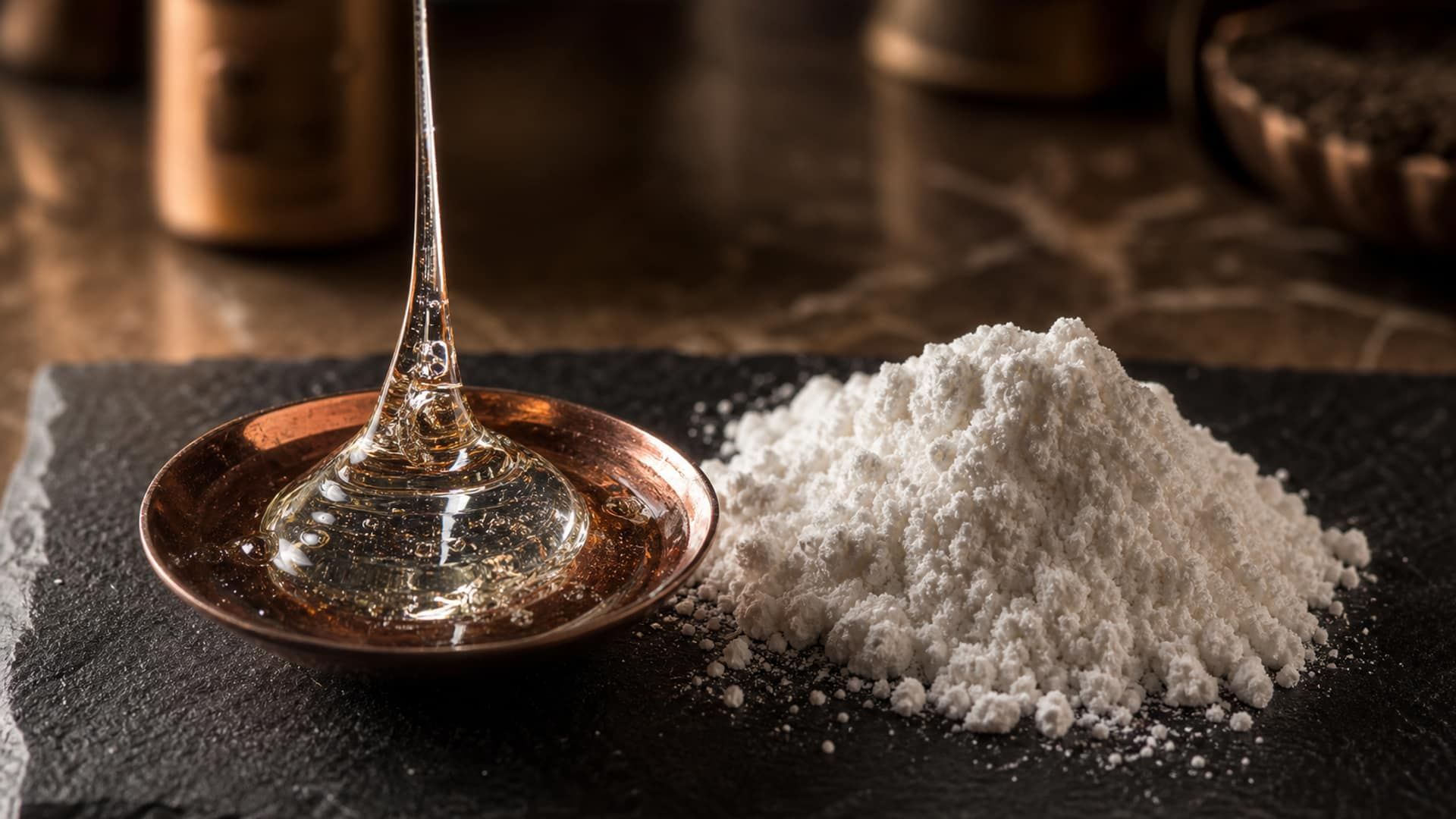
Glucose is available in both liquid syrup and dehydrated powder forms (atomized glucose). While chemically similar if the DE is the same, their physical application differs significantly. Atomized glucose is produced by spray-drying liquid glucose syrup: each droplet of liquid is exposed to a stream of hot, dry air in a drying chamber, causing water to evaporate so rapidly that individual droplets solidify into hollow amorphous microspheres before crystallization can occur. This rapid solidification gives atomized glucose its amorphous, non-crystalline structure—the same structure that makes it highly hygroscopic. Once opened, atomized glucose absorbs moisture rapidly from the surrounding air, which is why it must be stored in sealed, moisture-proof containers. The spray-drying process makes atomized glucose substantially more expensive than the equivalent liquid syrup—typically 2–3× the cost per kilogram of dry matter—because of the energy-intensive drying step and the cost of the spray-drying equipment. Its primary advantages are: precise weighing without sticky equipment fouling, full compatibility with dry premix formulations, long ambient shelf life when properly sealed, and exact dry matter control for recipes calculated on a 100% dry-weight basis. In pastry and chocolate applications, atomized glucose powder is particularly valued for ice cream formulation (where adding liquid syrup would displace water needed for precise Aw and PAC balance), in dry ganache premixes, and wherever the recipe is controlled entirely by dry matter percentages rather than by total mass. When budget constraints preclude atomized glucose, standard liquid syrup is always the more cost-effective choice; the substitution calculation in the formulation note below makes the conversion straightforward and exact.
| Feature | Glucose Syrup (Liquid) | Atomized Glucose (Powder) |
|---|---|---|
| Pros | Ready to use, Cost-effective, No dissolving | Easy to weigh, typically ~95-97% dry matter, Long shelf life |
| Cons | Sticky handling, Contains ~20% water | Expensive, Hygroscopic, Needs hydration |
Approximate formulation example: If a supplier’s syrup certificate states 80% dry solids and its atomized powder states 96% dry solids, 100 g syrup contains 80 g solids and 20 g water. The solids-equivalent replacement is 80 / 0.96 ≈ 83.3 g powder; add about 16.7 g water to preserve the original 100 g mass. Recalculate from the actual certificates of analysis—commercial syrups are commonly ~78-85% solids and powders are not literally 100% dry.
Applications in Confectionery
Ganache & Truffles
Caramels & Toffees
Ice Cream & Sorbets
Pâte de Fruit
References
- Hull, P. (2010). Glucose Syrups: Technology and Applications. Wiley-Blackwell.
- Edwards, W. P. (2000). The Science of Sugar Confectionery. Royal Society of Chemistry.
- European Parliament and Council. Directive 2001/111/EC: definitions and composition requirements for glucose syrup.
- Starch Europe. Glucose syrups factsheet.
Related Topics
Related Articles
Sugar Types in Confectionery: Which Sugar Does What
Sucrose, glucose syrup, dextrose, fructose, invert sugar, lactose and trehalose compared: which sugar to use in caramel, ganache, fondant, pâte de fruit, ice cream, panning and nougat, and why.
Caramelization Temperature by Sugar Type
A condition-aware reference for fructose, glucose, sucrose, maltose, and lactose that separates melting, decomposition, visible browning, and finished caramel colour.
Cocoa Butter Polymorphism: Temper Chocolate Reliably
Understand cocoa butter’s six traditional crystal forms, target Form V through controlled pre-crystallization, and reduce bloom through measured process and storage controls.