Reducing Sugar in Ganache: A Worked Syrup Replacement
Follow a dry-solids balance for replacing part of an invert syrup with sorbitol, then separate the calculated sugar reduction from the texture and shelf-life tests.
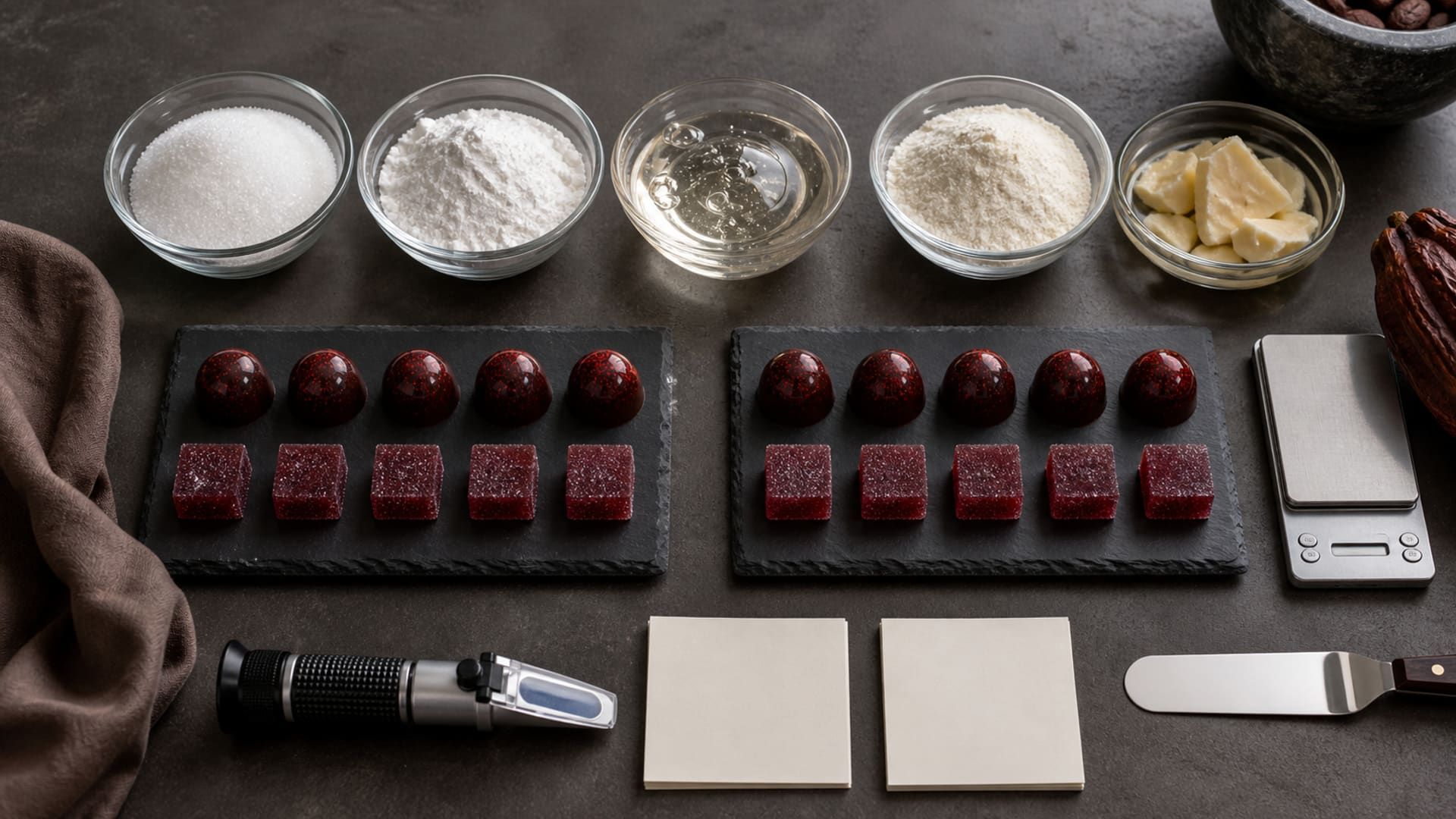
If a ganache is too sweet, removing syrup changes more than flavour. It also removes water and dissolved solids. Adding that weight back as cream introduces fat and protein as well, so an apparently small edit can become several changes at once.
This guide isolates one decision: how to replace part of an invert-syrup contribution while keeping its mass and dry solids approximately constant. The arithmetic gives you a starting trial. It does not promise the same sweetness, emulsion or storage performance.
Choose What You Are Trying to Reduce
Write down whether the target is less perceived sweetness, fewer grams of sugars on the nutrition declaration, or both. These goals are related but different: swapping one sugar for a less-sweet sugar can change flavour without meaningfully reducing total sugars.
Sorbitol is a polyol rather than a sugar. Replacing sugar with it can reduce the sugars contribution while retaining some sweetness and bulk, but the ingredient still affects nutrition, flavour, water activity and digestive tolerance. Check the intended product and market before adopting a dose.
Start with a recipe that already works. Keep the chocolate, dairy ingredients, processing method and finished yield fixed for the first comparison. Otherwise a texture change cannot be attributed to the sweetener change with much confidence.
| Your goal | What to calculate | What still needs a trial |
|---|---|---|
| Less sweetness | Composition and relative-sweetness direction | Taste in the finished chocolate system |
| Fewer sugars | Sugars from every ingredient, on the same final-product basis | Whether the product still meets its sensory target |
| Similar texture | Water and dry solids as separate balances | Firmness, flow, crystallization and emulsion quality |
| Same storage conditions | A new formulation estimate | Finished-product measurements and storage evidence |
Do not treat a powder as automatically water-free. Dextrose hydrate, dried glucose syrup, fibres and polyol powders can all carry moisture or ingredients other than the named sweetener. Use the supplier’s composition, and distinguish dry solids from sugars: the two quantities are not interchangeable.
For the example below, assume an invert syrup declared at 82% dry solids, all counted as sugars, and a sorbitol powder declared at 99.8% dry solids with no sugars. These are explicit teaching inputs, not specifications for every product sold under those names.
Calculate the Replacement Before Making a Batch
Take a 100 g portion of the syrup contribution in a recipe. It contains 82 g dry solids and 18 g water under the stated assumptions.
Keeping 70 g of that syrup leaves 57.4 g dry solids and 12.6 g water. The removed 30 g carried 24.6 g dry solids and 5.4 g water. Replace those two contributions separately instead of pouring in 30 g of a different ingredient.
The required powder mass is 24.6 ÷ 0.998 = 24.649 g. The remaining 30 − 24.649 = 5.351 g is added water. Rounded to 0.01 g for the calculation, use 24.65 g powder and 5.35 g water; choose practical weighing precision appropriate to the actual batch.
| Contribution | Control | Trial | Meaning |
|---|---|---|---|
| Invert syrup | 100.00 g | 70.00 g | The same syrup specification in both |
| Sorbitol powder | 0 g | 24.65 g | 99.8% dry solids in this example |
| Added water | 0 g | 5.35 g | Restores the water removed with the syrup |
| Total mass | 100.00 g | 100.00 g | The replacement fits the same ingredient allocation |
| Dry solids | 82.00 g | About 82.00 g | Small difference only from rounding |
| Water | 18.00 g | About 18.00 g | Includes moisture in the powder |
| Sugars | 82.00 g | 57.40 g | 24.60 g less in this 100 g contribution |
Illustrative ingredient balance, not a complete ganache recipe or a measured production result.
The sugars in this contribution fall by 30%. That is not a 30% reduction in the finished ganache: chocolate, cream, milk powder and other syrups may still contribute sugars.
If the unchanged finished batch weighs 1,000 g, removing 24.6 g sugars from one contribution lowers the whole-product amount by 2.46 g per 100 g. The percentage reduction for the full product requires its original total sugars. A marketing claim needs the applicable comparison and labelling rules, not the percentage from one ingredient line.
Cooking loss matters too. If the trial loses a different amount of water, use the actual final yield for the nutrition calculation. The same ingredient weights can produce different per-100-g declarations when finished weights differ.
Equal solids do not mean equal behaviour
This balance preserves mass and approximate water. It does not preserve the number or type of dissolved molecules. Recalculate the complete recipe and measure its behaviour; do not copy the control’s aw or shelf life onto the trial.
Make a Comparison You Can Interpret
Use the same ingredient lots and equipment for the control and trial. Write the exact replacement on the batch sheet before weighing, and label the finished samples so the two cannot be confused after setting.
Add the replacement to the appropriate aqueous phase using the established process for the recipe. Check that the powder dissolves fully. Undissolved particles can be mistaken for a texture problem caused by the overall composition.
Keep emulsification, deposit conditions and set time comparable. Record actual temperatures and finished mass rather than assuming they matched because the operator followed the same instruction.
Confirm the two supplier specifications
Record syrup solids and sugars, powder solids and sugars, and whether the proposed ingredient is suitable for the product.
Write the mass balance
Separate dry solids and water. Check that all replacement quantities return the intended total mass.
Recalculate the whole recipe
Include sugars from chocolate and dairy, and compare composition and predicted aw. Keep calculated and measured values in separate columns.
Prepare labelled control and trial batches
Use the same process where appropriate. Record deviations, yield, deposit behaviour and any visible emulsion defect.
Compare after setting
At the same product temperature, assess sweetness, flavour, firmness and the actual use: piping, framing or spreading.
A simple blind comparison helps prevent the expected result from driving the description. Ask the assessor to describe sweetness and texture separately. “Less sweet” does not establish that the sample is equally pleasant or that it pipes cleanly.
Record observations in concrete terms: the deposit held a ridge, a cut edge crumbled, an oily ring appeared, or the centre stuck to the knife. Those descriptions help choose the next edit much more than an overall “better” score.
Decide Whether to Keep, Adjust or Reject the Trial
If the flavour improves but the filling is too firm, do not immediately add cream to the tested sample and retain its original identity. Design a second documented recipe change so you can calculate the new water and fat contributions.
If a gritty texture appears, first distinguish undissolved powder from crystals that developed during setting or storage. Inspect when the defect appeared and which ingredient specification was used. More blending will not resolve every crystallization problem.
If the surface becomes sticky later, compare the packages and storage conditions as well as the sweetener blend. A satisfactory fresh sample does not show how the replacement handles humidity or moisture transfer into a shell.
Adopt a trial only after it performs in its intended use and passes the relevant safety and storage assessment. Keep the old and new recipe versions available so the team can identify which results belong to each.
Can I replace 30 g invert syrup with 30 g sorbitol powder?
Does the example reduce the whole ganache's sugars by 30%?
Can a less-sweet sugar achieve the same nutrition change?
Will the new ganache have the same aw?
References: Hartel, von Elbe and Hofberger, Confectionery Science and Technology (2018), for the roles of sweeteners and physical structure. The worked numbers above are a mass balance using the stated example specifications; they are not laboratory observations or a supplier’s universal substitution instruction.
Related Topics
Related Articles
Sugar Types in Confectionery: Which Sugar Does What
Sucrose, glucose syrup, dextrose, fructose, invert sugar, lactose and trehalose compared: which sugar to use in caramel, ganache, fondant, pâte de fruit, ice cream, panning and nougat, and why.
Trehalose: Properties, Uses, and Science in Confectionery
How a non-reducing disaccharide with the molecular weight of sucrose but under half its sweetness protects frozen, aerated, and freeze-dried confectionery.
Glucose Syrup Substitution Calculator
Convert liquid glucose syrup, dried glucose syrup, dextrose, invert sugar, or trehalose by dry solids, then correct the water and review any sourced POD and PAC change.