Maillard Reaction vs Caramelization: What Changes in the Pan?
Maillard browning combines reducing sugars with amino compounds; caramelization transforms sugars without requiring protein. Compare the reactions and use the temperature explorer.
Use the free temperature reference, then calculate your complete caramel formula.
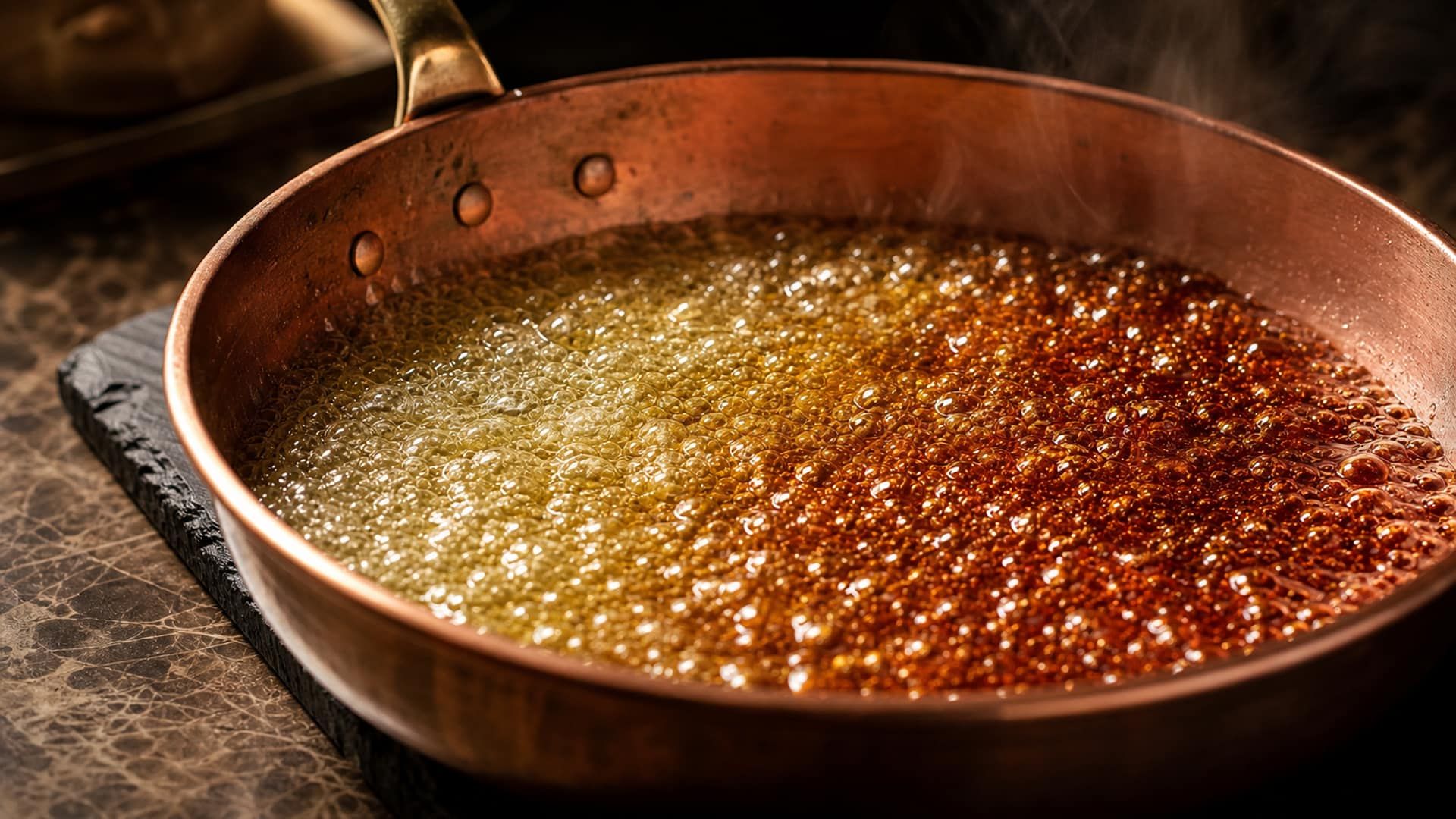
Maillard vs caramelization: the key difference
The Maillard reaction needs reducing sugars and amino groups, supplied by amino acids, peptides or proteins. Caramelization transforms sugars without requiring protein. Milk caramel can develop both; a plain sugar-and-water caramel develops sugar-browning reactions. Plant proteins can also support Maillard browning, so dairy-free does not mean Maillard-free.
What is the Maillard reaction?
Maillard browning is a sequence of reactions that builds colour and aromas from reducing sugars and amino compounds. Heating accelerates it; the result also depends on time, pH and water availability. In dairy caramel, lactose and milk proteins provide reactants alongside other reducing sugars in the recipe.
What is caramelization?
Caramelization is sugar chemistry involving dehydration, fragmentation and formation of new compounds responsible for colour and flavour. Sugar identity and the cooking conditions determine how it develops. Use the temperature reference as a cooking guide, and compare the reaction ingredients rather than identifying every brown colour as Maillard.
What Are the Two Reactions That Make Caramel Brown?
When you cook caramel, you are not witnessing a single chemical event. Two distinct reactions unfold simultaneously in the pan, each producing its own family of aroma and color compounds, each triggered by different conditions, and each responding differently to temperature, pH, and ingredient composition. Understanding the Maillard reaction and caramelization as separate phenomena — and learning to control the balance between them — is the foundation of precision caramel flavor development.
Professional confectioners who rely solely on temperature and color observation are working with incomplete information. Two caramels cooked to identical temperature and color can taste entirely different depending on which reaction dominated during cooking. A dairy-rich caramel cooked quickly at high heat develops a very different flavor profile than an identical formula cooked slowly at lower temperature — even at the same final Brix and moisture content.
Key Distinction
Maillard reaction requires both amino acids (from cream, butter, or milk proteins) and reducing sugars. The reaction proceeds at any temperature; what changes is the rate — it becomes rapid enough to drive visible caramel browning on a cooking time-scale above ~110°C and runs hardest through 140-165°C. Caramelization is the thermal decomposition of sugars alone — no protein required. It has a real chemistry-driven onset that depends on sugar type: fructose at ~110°C, glucose at ~150°C, and sucrose at ~160–170°C.
How Does the Maillard Reaction Work in Caramel?
The Maillard reaction, first described by French chemist Louis-Camille Maillard in 1912, is a condensation reaction between the free amino group of an amino acid and the carbonyl group of a reducing sugar. The initial product — a glycosylamine — is unstable and undergoes rapid rearrangement through the Amadori product into an extraordinarily complex cascade of secondary reactions. The final output is not a single compound but a mixture of hundreds of volatile and non-volatile molecules collectively responsible for roasted, nutty, toffee, and meaty aromas.
In confectionery, the amino acid sources are the dairy ingredients: cream contributes caseins and whey proteins, butter provides milk fat globule membrane proteins, and milk powder delivers a concentrated protein payload. The reducing sugar side is provided by glucose (from corn syrup, glucose syrup, or sucrose hydrolysis), fructose (from invert sugar, honey, or fructose syrup), and lactose (from dairy). Sucrose itself is not a reducing sugar — it must first be hydrolyzed by acid or invertase before it can participate in the Maillard reaction.
Maillard Reaction Mechanism (Simplified)
Step 1 — Condensation: Amino acid (R-NH₂) + Reducing sugar (aldehyde/ketone) → Glycosylamine + H₂O
Step 2 — Amadori Rearrangement: Glycosylamine → Amadori product (1-amino-1-deoxy-2-ketose)
Step 3 — Degradation: Amadori products → Hundreds of volatile compounds via dehydration, fragmentation, and cyclization
The entire cascade is endothermic and accelerates steeply with temperature — reaction rate rises roughly 2–3× for every 10°C increase between 120°C and 160°C.
Which Flavor Compounds Does the Maillard Reaction Produce?
The Maillard reaction produces three dominant flavor compound families that confectioners should understand. Each family is associated with specific temperature ranges and amino acid / sugar pairings, giving you levers to shift the flavor profile of your caramel.
| Compound Family | Flavor Character | Primary Precursors | Formation Temperature |
|---|---|---|---|
| Pyrazines | Nutty, roasted, chocolate-like | Amino acids + glucose/fructose; Strecker degradation pathway | Form across a wide range (documented from ~80°C in model systems and ~140°C in coffee roasting); rapid accumulation on caramel time-scales at 155-180°C |
| Furans (e.g., furfural) | Caramel, sweet, almond-like | Pentose sugars or Amadori products | 130-160°C |
| Diacetyl (2,3-butanedione) | Buttery, creamy, milky | Primarily inherited from dairy (cultured cream/butter); trace formation via methylglyoxal + acetaldehyde aldol condensation | Dairy-borne; trace Maillard yield 110-140°C |
| Strecker aldehydes | Green, fatty, malty (complex) | Amino acid + diketone degradation | 140-170°C |
| Melanoidins (non-volatile) | Brown color, bitter-roasted taste | Late-stage Maillard polymerization | 160°C+ |
Major Maillard reaction flavor compound families in caramel
The buttery character of lightly cooked, cream-heavy caramels comes primarily from intact butterfat aromatics and dairy-derived diacetyl (a fermentation product of cultured cream and butter), reinforced by early Maillard lactones — not from heat-driven diacetyl synthesis, which contributes only trace amounts at 110-140°C. Pyrazines, like the rest of the Maillard product slate, have no hard temperature threshold — they form across a wide range and are documented as low as ~80°C in model systems and ~140°C in coffee roasting. On caramel cooking time-scales, however, pyrazine accumulation only becomes flavor-relevant above ~130°C and runs rapidly through 155-180°C, adding depth and roasted complexity. Above 165°C, melanoidin formation dominates — these large brown polymers contribute color and bitter roasted notes, and once formed they cannot be removed from the product.
How Does Caramelization Differ from the Maillard Reaction?
Caramelization is the thermal decomposition of sugars in the absence of nitrogen compounds. No amino acids are required — this reaction occurs even in pure sugar solutions. The mechanism involves dehydration, isomerization, fragmentation, and polymerization of sugar molecules under heat, producing a complex mixture of compounds collectively known as caramelans, caramelens, and caramelins — the brown polymers that give caramel its characteristic color.
Critically, different sugars caramelize at different temperatures. This is not simply a curiosity — it has direct formulation implications. A caramel made with significant fructose (from invert sugar or honey) will begin developing color and caramel notes at much lower temperatures than a sucrose-only recipe, requiring careful temperature monitoring to avoid over-cooking.
| Sugar | Caramelization Onset | Flavor Notes Produced | Common Sources in Caramel |
|---|---|---|---|
| Fructose | ~110°C | Fruity, sweet, sharp caramel | Invert sugar, honey, fructose syrup |
| Galactose | ~160°C | Mild, sweet caramel | Lactose hydrolysis (dairy) |
| Glucose (Dextrose) | ~150°C | Clean, neutral caramel | Glucose syrup, corn syrup, dextrose |
| Sucrose | ~160°C | Complex caramel, slight bitterness | White sugar, the base of most caramels |
| Maltose | ~180°C | Malt-like, mild | High-maltose corn syrup, malt extract |
Caramelization onset temperatures by sugar type
Key Caramelization Flavor Compounds
Diacetyl — also forms during caramelization, adding buttery notes even in vegan (no-dairy) recipes.
Hydroxymethylfurfural (HMF) — sweet, caramel-like aroma, forms early in caramelization of fructose-containing sugars.
Furanones (e.g., DMHF, maltol) — intense sweet caramel and cotton candy aroma, very low flavor threshold.
Caramelans — bitter brown polymers, form at high temperatures (170°C+) and contribute color without sweetness.
What Are the Practical Differences Between Maillard and Caramelization?
| Property | Maillard Reaction | Caramelization |
|---|---|---|
| Reactants required | Amino acids + reducing sugars | Sugars only (no protein needed) |
| Onset temperature | No true threshold — runs at all temperatures; becomes rapid above ~110°C, accelerates further at 140°C+ | Sugar-specific chemistry threshold: ~110°C (fructose), ~150°C (glucose), ~160°C (sucrose) |
| Optimal temperature range | 140-165°C | 160-180°C |
| pH dependency | Strong — alkaline pH (8-10) accelerates reaction severalfold | U-shaped — slowest near pH 7; accelerated by both pH<3 and pH>9 |
| Flavor contribution | Complex: nutty, roasted, buttery, meaty | Caramel, sweet, slightly bitter, fruity |
| Color contribution | Brown (melanoidins) | Amber to deep brown (caramelans) |
| Dominant in dairy caramels? | Yes (protein-rich systems) | Secondary to Maillard |
| Dominant in pure sugar recipes? | No (absent without protein) | Yes — the only browning reaction |
| Water activity dependence | Accelerates at lower aw (higher Brix) | Less sensitive to aw |
| Controllable via pH? | Yes — baking soda raises pH and shifts balance dramatically | Yes — both acid (cream of tartar, citric) and strong alkali accelerate; near-neutral pH minimizes it |
Maillard reaction vs caramelization: key differences for confectioners
What Happens at Each Caramel Cooking Temperature?
Understanding which reactions are active at each temperature stage allows you to make deliberate decisions about cooking endpoint, rather than simply stopping when color looks ‘right’. The following guide assumes a dairy-based caramel (cream + sugar), where both reactions are active simultaneously.
| Temperature | Active Reactions | Flavor Development | Color | Practical Notes |
|---|---|---|---|---|
| Below 110°C | Neither (water still present) | None — syrup stage | Colorless | Water activity too high; reactions essentially inactive |
| 110-130°C | Maillard becomes rapid on a cooking time-scale; fructose caramelization starts | Buttery/milky notes from dairy (butterfat, cultured-cream diacetyl, early lactones) | Pale yellow | Soft/firm ball stage (112-120°C) — most dairy caramels stay here |
| 130-145°C | Maillard accelerating; furan formation increasing | Caramel, light toffee, buttery | Golden | Hard ball / soft crack — toffee and butterscotch territory |
| 145-160°C | Strong Maillard; fructose/lactose caramelization continuing; sucrose caramelization starts at the top of the range (~160°C) | Rich toffee, nutty, complex caramel | Amber | Critical zone — pyrazines forming, flavor deepening rapidly |
| 160-170°C | Both reactions at peak intensity | Deep caramel, roasted nuts, slight bitterness | Deep amber | For dark caramel flavor; watch closely — seconds matter here |
| 170-180°C | Melanoidin and caramelan polymerization dominant | Bitter, roasted, dark chocolate notes | Dark brown | Sauce caramel territory — intentional bitterness |
| Above 185°C | Decomposition exceeding useful reaction | Acrid, burnt, astringent | Very dark / black | Overcooked — off-flavors from thermal decomposition of compounds |
Browning reactions and flavor development at each caramel cooking stage
The 160-170°C Window Is Critical
Between 160°C and 170°C, both the Maillard reaction and caramelization are operating at near-peak intensity simultaneously. Flavor compounds accumulate at their fastest rate here — a 30-second difference can shift the profile from rich caramel to over-bitter. Use a calibrated digital probe thermometer, not a candy thermometer with wide tolerance.
Set a cook temperature in the explorer below to see its stage, the reactions at work and which sugars have reached their caramelization onset.
How Do Brix and Water Activity Shape Caramel Browning?
Brix (°Bx) measures dissolved solids concentration — in confectionery, predominantly sugars. As caramel cooks and water evaporates, Brix rises and water activity falls. The effect on Maillard kinetics is strong but non-monotonic: browning is fastest at intermediate water activity — roughly aw 0.6–0.7, corresponding to about 75–85°Brix in a sugar syrup — where the reactants are concentrated but still mobile enough to react. Push the solids much higher (above ~90°Brix, aw well below 0.5) and the rate falls again, because the medium becomes too viscous and water-starved for the reactants to move.
A practical consequence is that two caramels cooked to the same temperature but different starting Brix can develop very different color and flavor intensities. A caramel starting from a lower Brix spends longer in the high-water early phase before it reaches the fast intermediate-aw window; one starting higher moves through that window sooner. This also explains why adding cream late in the cook (a common technique) — which raises water activity again — produces a different flavor than adding it at the start.
Brix and Maillard Rate
Rule of thumb: Maillard reaction rate rises steeply with temperature (roughly 2–3× per 10°C). Its dependence on water is non-monotonic — browning peaks around intermediate water activity (aw ≈ 0.6–0.7, roughly 75–85°Brix) and slows again as solids climb well above ~90°Brix and reactant mobility drops. High-Brix caramels therefore reach a given color by a different path — and with a different flavor — than lower-Brix caramels cooked more slowly.
Formul.io’s Caramel Calculator tracks Brix throughout the cook and models its effect on reaction intensity, helping you predict color development rate from your specific formula.
How Does pH Affect Caramel Color and Flavor?
pH is one of the most powerful and underutilized levers for controlling Maillard reaction rate in confectionery. The reaction proceeds fastest in mildly alkaline conditions (pH 8-10) because the amine groups of amino acids are deprotonated at higher pH — making them more reactive with sugar carbonyls. At neutral pH (7.0), Maillard proceeds at a moderate rate. In acidic conditions (pH < 6.0), the reaction slows significantly.
In practice, dairy-based caramels have a natural pH of approximately 6.2-6.8, depending on cream and butter quality. Adding small amounts of sodium bicarbonate (baking soda) can raise pH to 7.5-8.5, dramatically accelerating browning. This technique is used in some commercial caramel recipes to achieve deep color quickly and at lower cooking temperatures — reducing the extent of caramelization (and associated bitterness) relative to Maillard-driven flavor.
Practical pH Adjustment for Color Control
Effect of baking soda on Maillard rate (illustrative — the exact shift depends on the base’s buffering):
- 0 g/kg sodium bicarbonate → natural pH ~6.5 → baseline browning rate
- ~0.5 g/kg sodium bicarbonate → pH ~7.5 → noticeably faster browning
- ~1.0 g/kg sodium bicarbonate → pH ~8.0 → markedly faster browning
- ~2.0 g/kg sodium bicarbonate → pH ~8.5 → strong acceleration; risk of soapy off-flavors
These dosages are a starting point, not fixed values: dairy solids and added acids buffer the mix, so the pH a given dose reaches — and the resulting rate change — vary with the formula. Measure pH with a calibrated meter.
Caution: Higher pH also increases the rate of sucrose inversion and can help prevent crystallization (usually beneficial), but excessive alkalinity produces soapy or chemical off-flavors. Stay below ~1.5 g/kg unless testing carefully.
Acidic caramels — those made with cream of tartar, citric acid, or high-acid honey — have two distinct effects that pull in opposite directions. First, the lower pH directly slows Maillard amino-sugar condensation. Second, acid catalyzes sucrose inversion, splitting non-reducing sucrose into glucose and fructose, both of which are reducing sugars and Maillard-active. Fructose in particular is the most Maillard-reactive sugar (per the table above) and the first sugar to caramelize (~110°C). The net result: cream of tartar does not produce a meaningfully lighter caramel at a given cooking endpoint — it shifts the flavor signature (sweeter, fruitier, more HMF and caramelan, less roasted pyrazine character) while typically yielding equivalent or darker color from the enlarged reducing-sugar pool. If lighter final color is the actual goal, the correct levers are temperature endpoint, time at temperature, and reducing-sugar load, not acidification.
Why Do Reducing Sugars React Faster Than Sucrose?
Not all sugars are equal in the Maillard reaction. A reducing sugar is one with a free anomeric carbon — a reactive aldehyde or ketone group that can condense with amino acids. Glucose (an aldose) and fructose (a ketose) are both reducing sugars. Sucrose is not a reducing sugar: its anomeric carbons are linked to each other in the glycosidic bond, blocking Maillard reactivity entirely.
For sucrose to participate in the Maillard reaction, it must first be hydrolyzed into glucose and fructose — a process called inversion. Sucrose hydrolysis occurs slowly under acidic conditions and heat, and can be catalyzed by the enzyme invertase. This explains why caramels containing invert sugar, honey, or glucose syrup develop deeper color and more complex Maillard-derived flavor than those made exclusively with sucrose at the same temperature.
- Fructose — most reactive reducing sugar; very high Maillard reactivity due to its ketose structure; also the first to caramelize (110°C)
- Glucose — moderately reactive; forms preferentially with lysine and glycine from dairy proteins; dominant in glucose-syrup-based caramels
- Lactose — reducing disaccharide from dairy; reacts more slowly than monosaccharides due to its larger molecular size
- Sucrose — not a reducing sugar; must be hydrolyzed first; effectively inactive in Maillard unless invertase or acid is present
- Maltose — reducing disaccharide from high-maltose syrups; reacts more slowly than glucose, contributing malt-like notes
Formulation Implication
Replacing 20-30% of sucrose with glucose syrup (DE 40) or invert sugar in a dairy caramel will increase Maillard reaction intensity significantly — producing deeper color and richer flavor at the same cooking temperature. This allows you to achieve dark caramel character while cooking to a lower final temperature, reducing bitter melanoidin formation and improving shelf stability.
When Does Maillard Dominate vs Caramelization in a Caramel?
The single most important factor determining which browning reaction dominates in your caramel is protein content. In dairy-rich systems — those containing significant cream, milk, or butter — the Maillard reaction is the primary driver of color and flavor. Caramelization is present but plays a secondary role. Remove the dairy, and caramelization becomes the sole source of browning, producing a fundamentally different flavor profile.
This distinction matters practically for vegan caramel development. Many producers attempt to replicate dairy caramel flavor using coconut cream as a substitute. Canned coconut cream contains approximately 2% protein, comparable to heavy cream (2.1–2.8% protein per USDA), but the amino acid composition of coconut proteins differs sharply from casein and whey. The result is a different subset of Maillard compounds and a noticeably different flavor. Understanding this helps set realistic expectations and guides flavor compensations using ingredients like vanilla, coffee extract, or caramel flavoring.
| System Type | Dominant Reaction | Flavor Profile | Color Development | Key Variables |
|---|---|---|---|---|
| Dairy cream + sucrose + glucose | Maillard (primary) + Caramelization | Complex: buttery, nutty, roasted caramel | Fast, driven by dairy proteins | Protein content, reducing sugar ratio, pH |
| Dairy cream + sucrose only | Maillard (primary) + Caramelization | Buttery, lighter caramel | Moderate — sucrose must invert first | Temperature, cooking time, cream fat % |
| Pure sucrose (no dairy) | Caramelization only | Clean caramel, slight bitterness | Moderate, begins at 160°C | Temperature precision (narrow window) |
| Sugar + glucose syrup (no dairy) | Caramelization only | Mild caramel, cleaner, sweeter | Earlier than sucrose alone (150°C+) | Glucose DE, sugar ratio |
| Coconut cream + sugar | Maillard (weak) + Caramelization | Coconut-caramel, less complex | Slower than dairy | Coconut protein content, reducing sugars |
| Condensed milk + sugar | Strong Maillard (lactose-rich) | Very deep, toffee, dulce-de-leche | Very fast — high lactose + protein | Lactose, protein concentration, pH |
Dominant browning reaction by caramel system type
How Do I Deliberately Control Caramel Flavor During Cooking?
Armed with the science above, here is a systematic approach to controlling and directing browning chemistry in your caramel formulation. These steps apply to dairy-based caramel; adaptations for vegan systems are noted where relevant.
Define Your Flavor Target
Before formulating, articulate precisely what flavor profile you want: light and buttery (diacetyl-dominant), rich and complex (Maillard-forward with moderate pyrazines), deep and roasted (high-pyrazine, some melanoidin bitterness), or clean and pure caramel (caramelization-forward with minimal Maillard). Each target maps to a different temperature endpoint and ingredient profile.
Select Sugars for Maillard Reactivity
For deeper color and richer Maillard flavor: include 20-40% glucose syrup (DE 38-42) or 10-15% invert sugar in your formula. These provide reducing sugars that react immediately, without waiting for sucrose hydrolysis. For lighter, cleaner caramel character with color from caramelization: use predominantly sucrose with minimal glucose syrup, and cook to 160°C or above.
Adjust Protein Content for Maillard Intensity
Heavy cream (36% fat) provides approximately 2.1–2.8% protein (USDA); whole milk provides 3.3%; skim milk powder provides 34–37%. Adding 5% skim milk powder to a cream-based caramel dramatically increases Maillard intensity — use this technique to deepen color and add complexity without extending cook time. For vegan systems, soy-based ingredients provide more Maillard activity than coconut due to higher protein content and amino acid diversity.
Set pH to Target
For standard dairy caramel: no pH adjustment needed (natural pH 6.5-7.0 is appropriate). For faster browning and deeper color: add 0.5-1.0 g sodium bicarbonate per kg final weight, raising pH to 7.5-8.0. To shift flavor character away from roasted/pyrazine and toward sweeter, fruitier, HMF-driven caramel: add cream of tartar (0.5-1.0 g/kg) or citric acid. Note that acidification does NOT reliably yield lighter color — the same acid catalyzes sucrose inversion, generating fructose and glucose that re-feed both Maillard and low-temperature caramelization. Treat cream of tartar as a flavor-profile lever, not a color-restraint lever. For lighter color, use a lower temperature endpoint or less reducing-sugar load. Always measure pH with a calibrated meter — ingredient batches vary.
Cook to Target Temperature with Precision
Use a calibrated digital thermometer with ±0.5°C accuracy. For buttery, lightly colored caramel: stop at 118-128°C (soft-to-hard ball stage). For traditional amber caramel: 135-155°C (soft crack). For deep caramel with roasted notes: 160-168°C (early caramel stage). Do not exceed 175°C unless intentionally targeting bitterness as a design element.
Monitor Brix at Each Stage
Track Brix with a refractometer throughout the cook. Maillard browning is fastest at intermediate water activity — roughly 75-85°Brix (aw ≈ 0.6-0.7) — and slows again as solids climb well above ~90°Brix and the mixture becomes too viscous and water-starved for the reactants to move. Note too that at high Brix the temperature rises rapidly, so reduce heat input before reaching target to compensate for residual heating in the pan.
What Are the Key Numbers for Caramel Flavor Control?
How Does Flavor Intensity Change With Cooking Temperature?
The chart shows combined reaction intensity for a dairy caramel (cream + glucose syrup + sucrose). At 160-170°C, both reactions operate near peak simultaneously, producing the most complex flavor. Above 175°C, decomposition reactions start to dominate — net flavor quality declines despite continued color formation.
How Can the Formul.io Caramel Calculator Predict Flavor Development?
The temperature explorer above is a cooking reference. The full Caramel Calculator predicts formulation properties such as water activity, cooking stage and glass transition from your ingredients and process. Use those outputs to compare recipes while following colour and aroma during the cook.
When dairy ingredients and baking soda are present, the calculator can explain the expected increase in Maillard browning. It does not calculate concentrations of aroma compounds or replace tasting the finished caramel.
References and Further Reading
- Maillard, L.-C. (1912). “Action des acides aminés sur les sucres: formation des mélanoïdines par voie méthodique.” Comptes Rendus de l’Académie des Sciences, 154, 66–68. — original description of the reaction, full PDF scan via HathiTrust.
- Hodge, J. E. (1953). “Dehydrated foods: chemistry of browning reactions in model systems.” Journal of Agricultural and Food Chemistry, 1(15), 928–943. — the canonical mechanism diagram for Amadori/Heyns rearrangements still in use today.
- Wikipedia: Maillard reaction — overview with full citation tree (mechanism, kinetics, health effects).
- Wikipedia: Caramelization — sugar-pyrolysis chemistry, onset temperatures by sugar type, caramelans/caramelens/caramelins.
Related Science Articles
Frequently Asked Questions
What is the difference between the Maillard reaction and caramelization?
Why does adding glucose syrup to caramel deepen the flavor and color?
How does pH affect caramel color development?
Can I achieve Maillard flavor in vegan caramel?
What temperature should I cook caramel to for the best flavor?
Why does condensed milk caramel (dulce de leche) develop such deep color at low temperatures?
Is caramelization a chemical change?
What is the maillard reaction equation?
What is the difference between maillard reaction temperature and caramelization temperature?
What is the process of browning sugar under heat called?
Which component of milk causes caramelization when heated?
At what temperature does lactose caramelize?
Related Topics
Related Articles
Chewy Salted Caramel Recipe: 119°C, Brix and Aw
A 663 g chewy salted caramel cooked to 119°C, with the Brix, water and water-activity targets that define the chew, butter and salt timing, and what each degree of the cook does to the texture.
Caramel Glass Transition: How Moisture Sets Texture
Why a few points of water move a caramel from hard crack to chewy: the glass transition, a Gordon–Taylor table you can recompute, and the water left at each cooking stage.
Sugar Types in Confectionery: Which Sugar Does What
Sucrose, glucose syrup, dextrose, fructose, invert sugar, lactose and trehalose compared: which sugar to use in caramel, ganache, fondant, pâte de fruit, ice cream, panning and nougat, and why.