What Gelatin Bloom Strength Really Measures
The science behind the bloom number — how the gelometer test works, why firmness tracks concentration times bloom, and what heat, acid, and fresh fruit do to a gel.
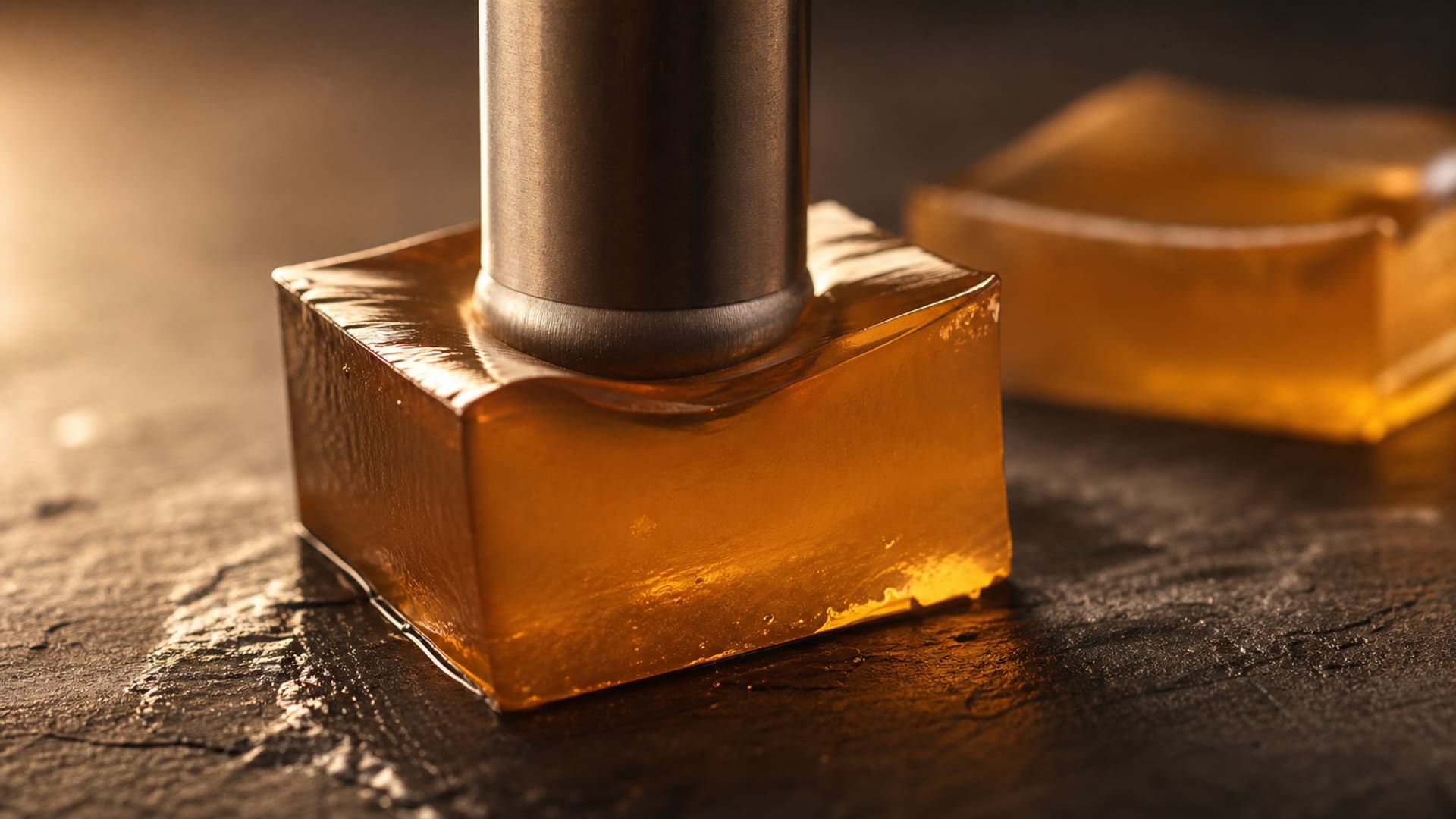
Every conversation about substituting or dosing gelatin comes back to a single number — the bloom value. It is printed on professional sheet packaging, quoted in pastry references, and used by the gelatin calculator to convert between grades. But bloom is not a marketing figure; it is the output of a standardized physical test, and understanding what that test measures explains both why the substitution math works and where it stops working.
How the Bloom Test Works
The test is named after Oscar T. Bloom, a chemist at Swift & Company who patented the gelometer in 1925. The method he devised is still, in essence, the industry standard, formalized today as AOAC Official Method 948.21 — the Gelatin Manufacturers Institute of America (GMIA) reference procedure, with ISO 9665 as its international analogue.
The procedure fixes everything except the gelatin itself. A gel is prepared at a standardized concentration — 6⅔% by weight, which is 7.5 g of gelatin dissolved in 105 g of water — melted gently, poured into a standard jar, and matured at 10°C for around 17 hours so the network sets fully and reproducibly. A texture analyzer then presses a flat, sharp-edged plunger 12.7 mm (half an inch) in diameter exactly 4 mm into the surface of the gel. The peak force required, expressed in grams, is the bloom value.
Because concentration, temperature, maturation time, plunger size, and penetration depth are all held constant, the only thing the number reflects is the intrinsic gelling power of that particular gelatin. That is what makes bloom a fair basis for comparison: a 250 bloom platinum sheet and a 120 bloom titanium sheet were measured under identical conditions, so their ratio genuinely reflects how much more firmly one gels than the other.
One detail worth correcting, because it circulates widely online: the plunger is 12.7 mm across, not 5 mm. The larger contact area matters — a mismeasured probe would report a completely different force — so any bloom-derived calculation rests on the standardized 12.7 mm geometry.
From Bloom to Firmness: Why the Ratio Rule Holds
The useful consequence of a fixed-concentration test is that bloom behaves, to a first approximation, like a firmness-per-gram rating. Across the concentrations used in confectionery, the firmness of a set tracks the product of gelatin concentration and bloom. Hold that product constant and the set feels the same. This is exactly why the substitution rule works: to swap grades without changing texture, multiply the original weight by the ratio of the two bloom values.
To preserve gel firmness when changing grades, keep concentration × bloom constant. A stronger replacement (higher bloom) means you need less of it; a weaker one means more.
It is a first-order rule, and honest food science names its limits. The elasticity of a set gel — its shear modulus — rises faster than concentration alone; for cross-linked networks it climbs closer to the square of concentration. Over the modest range between two adjacent grades the linear ratio is an excellent approximation, but a large jump — replacing titanium with platinum, say — can land slightly firmer or softer than predicted. The rule gets you close; a small bench test confirms the last few percent.
The calculator below applies this ratio: enter the amount your recipe calls for, the grade it assumes and the gelatin you have.
Convert leaf grades by sheet count, not by grams
Sheet gelatin hides a convenience: manufacturers cut each grade to a compensating weight, so a weaker grade’s leaf is physically heavier. A gold leaf weighs about 2.0 g, a titanium leaf about 5.0 g — and a fixed number of leaves gels roughly the same volume regardless of grade. That is why a recipe written in “sheets” travels between brands. The dangerous move is swapping grades gram-for-gram: 10 g of titanium is two heavy leaves, while 10 g of platinum is nearly six — wildly different gelling power. Convert by sheet count, or let the calculator convert by bloom.
Grades, Sheets, and Powder
The named grades are a shorthand for bloom bands, and they run in a fixed order of strength.
| Grade | Typical bloom (g) | Typical leaf weight | Character of the set |
|---|---|---|---|
| Platinum | 230–250 | ~1.7 g | Firmest, clearest — mirror glazes, clean entremets |
| Gold | 190–220 | ~2.0 g | The pastry default — mousse, bavarois, glazes |
| Silver | 150–170 | ~2.5 g | Moderate set, softer bite |
| Bronze | 125–140 | ~3.3 g | Soft, melting set |
| Titanium | 100–120 | ~5.0 g | Weakest, most delicate |
Standardized leaf grades: bloom bands, representative leaf weights, and typical use
Powdered gelatin is usually sold without a grade. Common retail and professional powders sit around 200–250 bloom; Modernist Cuisine standardizes its recipes on 225 bloom, which is a reasonable working assumption. When a powder is genuinely unlabeled, assuming the lower end — around 200, the same as gold — is the safe choice: it errs toward a slightly firmer set rather than one that fails to hold.
What Weakens a Gel: Heat, Acid, and Enzymes
Bloom describes an undamaged gelatin. Three things degrade it in the kitchen, and each is widely misdescribed.
Heat. Gelatin dissolves cleanly at about 50–60°C, and that is where it should be worked. Degradation is not an all-or-nothing event, though — it is gradual and time-and-temperature dependent. The GMIA handbook notes that gelatin solutions weaken progressively on prolonged heating above roughly 40°C, with thermal fragmentation of the protein chains accelerating as the temperature climbs through 60–70°C. A brief pass to a boil causes partial, not total, loss of setting power; sustained boiling is what genuinely ruins a batch. The practical rule — add gelatin off the strongest heat — follows from this, but a single accidental boil rarely means the dessert will never set.
Acid. Low pH slowly hydrolyzes the peptide bonds that hold the network together, softening the gel, and the effect compounds with heat. But the common claim that gelatin is strongest at pH 4.8–5.5 is only half true: gel strength peaks near the gelatin’s isoelectric point, and that point depends on how the gelatin was manufactured. Lime-cured Type B gelatin has an isoelectric point around pH 5, so it does peak in that acidic window. Acid-cured Type A gelatin — common in gummy manufacture — peaks much higher, around pH 7–9. A modest amount of acid (on the order of 1–1.5% citric acid) can even slightly strengthen a set; it is acid combined with sustained heat above 100°C that destroys it.
Enzymes. Several fresh fruits carry proteases that digest gelatin outright, so a gel made with them never sets: bromelain in pineapple, actinidin in kiwi (identified by Arcus in 1959 while investigating kiwifruit jellies that refused to set), papain in papaya, ficin in figs, and zingibain in ginger.
Cook proteolytic fruit thoroughly — 60°C is not enough
The fix for enzyme trouble is heat, but not gentle heat. Bromelain and papain are unusually heat-stable, staying active up to roughly 68–70°C, so warming a purée to a gelatin-friendly 60°C will not deactivate them and the dessert will still fail. Bring these fruits to a proper boil, cook them thoroughly, or use the canned form — commercial canning has already denatured the enzyme. Only then is the fruit safe to set.
Dosing by Bloom, Not by Habit
Because firmness tracks concentration times bloom, a dose quoted for one grade has to be scaled for another. A texture target is really a reference percentage at a reference bloom; for a different gelatin, multiply by the ratio of reference bloom to your bloom. At gold-grade 200 bloom, a convenient conversion is that 10 g per litre equals 1% of the liquid.
| Texture | Dose at ~200 bloom | Examples |
|---|---|---|
| Soft, spoonable | 1.0–1.5% | Panna cotta, cream sets |
| Standard, molded | 1.5–2.5% | Mousse, bavarois, charlotte |
| Firm, sliceable | 2.5–4% | Cut jelly, terrine, aspic |
| Chewy | 6–10% | Gummies, pâte-style confections |
Typical gelatin dosing by finished texture, at gold-grade 200 bloom
Two cautions keep these numbers honest. First, the chewy band is different in kind: gummy formulas express gelatin as a percentage of the total finished candy mass, not of a liquid being set, so do not read 8% the same way you read 2% for a panna cotta. Second, 1.5% is the safe default for anything that must unmold cleanly; drop toward 1% only for a deliberately soft, spoonable, or aerated result, and treat the sub-1% panna cotta floor as a lower limit that an acidic or high-fat cream may push you back above.
What exactly does a bloom value of 200 mean?
Why is the substitution rule only 'first order'?
Can I substitute sheet gelatin for powder by weight?
Does adding acid ruin a gelatin gel?
Why won't my jelly set with fresh pineapple or kiwi?
Related Articles
Gelatin Bloom Strength, Types and Dosing
Convert between gelatin grades by bloom strength and dose gelatin for the exact texture you want — with an interactive calculator and a clear guide to sheet, powder, and blooming.
Gelling Agents for Jelly Textures: Selection, Dosage, and Set Temperatures
Pick the gelling agent that delivers the texture you want — melt-in-mouth, firm and sliceable, brittle clean-cut, or warm-serve heat-stable — with dosages, set temperatures, and vegan options for agar, gelatin, pectin, carrageenan, and gellan.
Mousse Science: Foam Stability, Cream, and Gelatin
Build stable mousse by controlling bubble size, cream-fat crystallization, overrun, and gelatin concentration—with practical Bloom conversion and realistic heating guidance.