Raspberry Hibiscus Pâte de Fruit and Ganache Bonbons for Valentine's Day
A two-layer Valentine's bonbon: a raspberry pâte de fruit cooked with hibiscus infusion under a dark chocolate ganache, with the calculated pH, Brix and water activity of each layer and why the hibiscus belongs in the jelly.
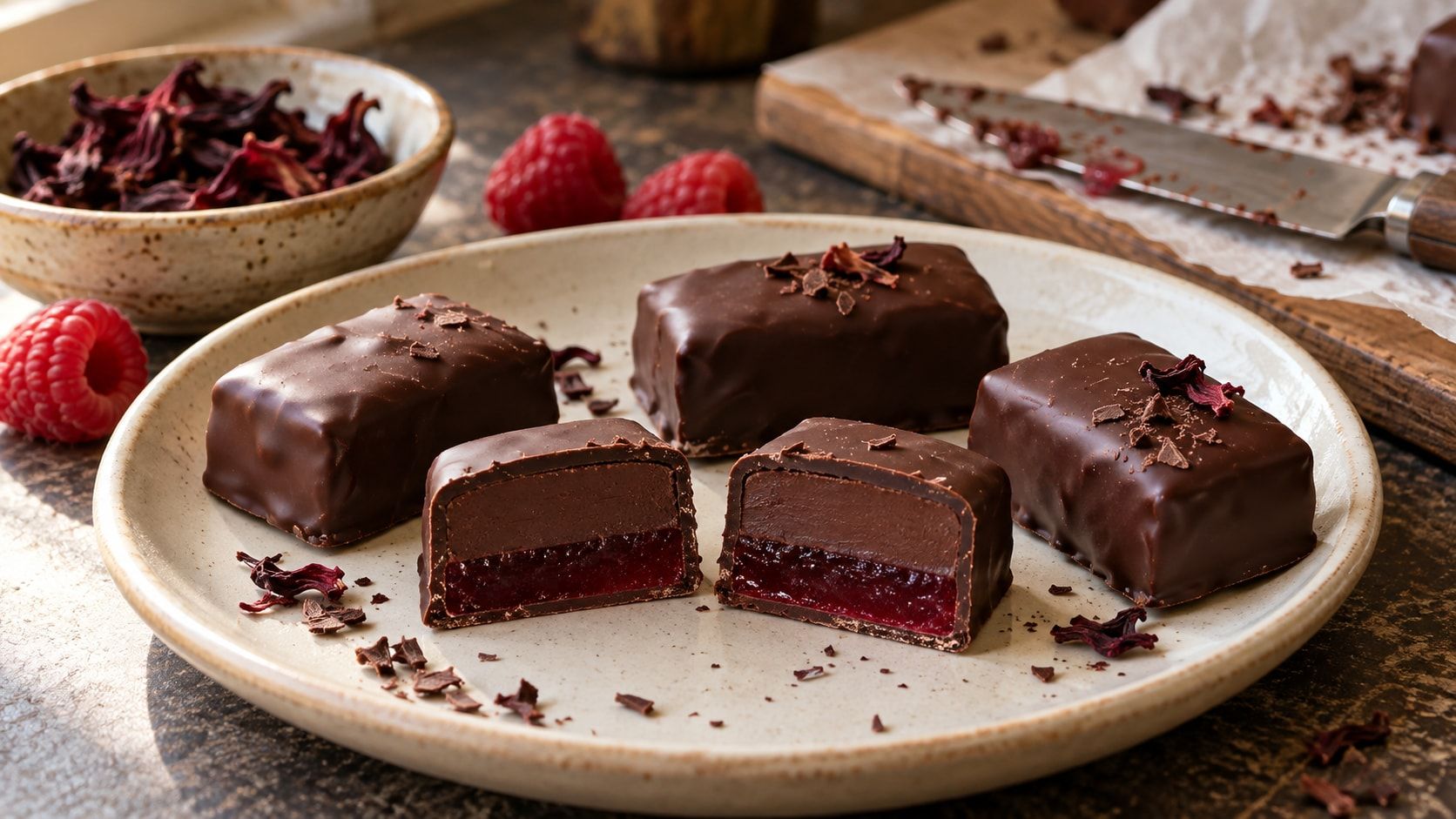
Hibiscus gives a raspberry pâte de fruit a deeper red and a tart, floral edge, but only in the right layer. Its red comes from anthocyanins, which stay red in acid and fade toward purple-grey as the pH rises. Infuse it into the pâte de fruit, which sets at about pH 3.2, not into the cream of the ganache. This bonbon pairs a raspberry and hibiscus jelly with a dark chocolate ganache whose water activity nearly matches it, so the two layers keep each other in balance.
Why the Hibiscus Goes in the Pâte de Fruit
The red of dried hibiscus calyces comes mostly from one anthocyanin, delphinidin-3-sambubioside, with cyanidin-3-sambubioside behind it. Anthocyanins change colour with pH: bright red in acid, duller and bluer toward neutral, green in alkali. They are also more stable in acid, so the colour lasts longer there.
A pâte de fruit is built at the acidic end. Its yellow pectin only sets once the acid brings the pH to about 3.2, which is exactly where the hibiscus stays red. Cream sits near neutral, at about pH 6.5 to 6.8, so an infusion in the ganache’s cream loses its red and its tartness disappears into the fat. Keep the hibiscus in the jelly and let the dark chocolate carry the ganache.
Hibiscus also brings its own sourness from the organic acids in the calyces, and a floral, slightly astringent taste that reads close to cranberry next to raspberry. In the jelly that tartness sits on top of the fruit; folded into a cream ganache, the fat would blunt it.
Raspberry Hibiscus Pâte de Fruit
Brew the infusion first: steep about 15 g of dried hibiscus flowers in 165 g of just-boiled water for 10 minutes, strain and press the flowers, and weigh out 150 g of liquid. Weigh it after straining: the flowers hold back part of the water, and the formula is built on 150 g of infusion, not on the water you poured.
| Ingredient | Amount | Note |
|---|---|---|
| Raspberry purée, 100 % fruit | 400 g | Thawed |
| Hibiscus infusion | 150 g | Strained, from about 15 g dried flowers |
| Sugar | 520 g | 50 g of it mixed with the pectin |
| Glucose syrup DE 40 | 130 g | Against surface crystallization |
| Yellow pectin (buffered, slow set) | 14 g | 0.6 % of the batch |
| Citric acid | 6 g | Dissolved in 6 g of water |
Makes about 905 g: a layer about 8 mm deep in a 28 × 28 cm frame.
Disperse the pectin
Whisk the pectin into 50 g of the sugar. Warm the purée and the hibiscus infusion to about 40 °C and rain in the pectin and sugar while whisking, so no lumps form.
Boil, then add the sugars
Bring it to the boil and boil for about a minute so the pectin dissolves. Add the remaining 470 g of sugar in two or three additions, letting it return to the boil each time, then the glucose syrup.
Cook to 76 °Brix
Cook, stirring, to 76 °Brix on a refractometer, about 107 °C on a thermometer at sea level. The calculator's endpoint for this batch is 107.2 °C, with about 320 g of water evaporated.
Add the acid and cast
Off the heat, stir in the citric acid solution and cast immediately into a frame on a silicone mat or oiled paper. The acid starts the set, so do not wait.
Let it set
Leave the jelly uncovered at room temperature until firm, about a day, before you spread the ganache over it.
The calculator’s pH of 3.18 counts the raspberry’s own acids and the citric acid. It treats the infusion as hibiscus tea, so a much stronger infusion brings extra acid it does not see. The window is forgiving: with 4 g of citric acid instead of 6 the calculated pH is 3.34, still a firm set, but with no acid at all it is 4.04 and the yellow pectin will not set. If you brew the infusion stronger, start with 4 g of acid and check a cooled sample with a pH meter.
Raspberry and hibiscus pâte de fruit
400 g raspberry purée and 150 g hibiscus infusion cooked to 76 °Brix with yellow pectin and 6 g citric acid: open the live calculation behind pH 3.18 and aw 0.757.
Dark Chocolate Ganache Layer
The ganache is drier than a truffle ganache on purpose. Invert sugar and sorbitol bind its water, bringing its water activity down to 0.762, almost exactly the jelly’s 0.757.
| Ingredient | Amount | Note |
|---|---|---|
| Dark chocolate, 70 % | 350 g | Melted to about 40 °C |
| Cream, 35 % fat | 140 g | |
| Invert sugar | 60 g | Lowers water activity |
| Glucose syrup DE 40 | 30 g | |
| Sorbitol powder | 40 g | Lowers water activity; 6 % of the ganache |
| Butter, 82 % fat | 40 g | Soft, added at about 35 °C |
Makes about 660 g: a layer about 7 mm deep in the same frame.
Heat the liquids
Bring the cream, invert sugar, glucose syrup and sorbitol to the boil, then let them cool to about 80 °C.
Emulsify
Pour them over the melted chocolate in three additions, stirring from the centre, or blend with an immersion blender kept below the surface, until glossy and elastic.
Add the butter
At about 35 °C, blend in the soft butter.
Spread over the jelly
At 28–30 °C, spread the ganache over the set pâte de fruit in its frame and level it.
Crystallize, cut and dip
Leave it 24 hours at 16–18 °C, then cut it into squares with a guitar or a hot knife and dip or enrobe the pieces in tempered dark chocolate.
Dark chocolate ganache for layered bonbons
350 g 70 % chocolate, 140 g cream, invert sugar, glucose syrup, sorbitol and butter: open the live calculation behind aw 0.762 and adjust the ganache for your own jelly.
Why the Two Layers Are Matched
In a layered bonbon the two fillings touch for the whole of its life, and water moves from the layer with the higher water activity to the one with the lower until the two meet. How fast depends on temperature and on how far apart the layers start, so a mismatch shows up slowly, over weeks, after the bonbons have left the kitchen.
Picture a softer ganache at aw 0.85 on this jelly. The jelly would draw water from it and turn soft and sticky at the boundary, while the ganache lost water there, firmed up and risked graining. Matching the layers avoids both. Build the ganache in the calculator next to the jelly and adjust its invert sugar and sorbitol until the two water activities are as close as you can get them, here 0.757 and 0.762.
The chocolate around them matters too. Cocoa butter holds almost no water, which is why a complete coating protects both fillings from the air, but a coating is only as good as its thinnest point. Enrobe or dip the pieces after cutting so that the cut edges are sealed as well.
Storing Raspberry Hibiscus Bonbons
| Layer | Water activity (band) | Microbial class | Model day count at 20 °C, for comparison only |
|---|---|---|---|
| Raspberry hibiscus pâte de fruit | 0.757 (0.727–0.787) | Molds and yeasts | ~111 |
| Dark chocolate ganache | 0.762 (0.747–0.777) | Molds and yeasts | ~44 |
Calculated in Formul.io. The day counts are house-calibrated references from water activity, not label dates, and the ganache and pâte de fruit curves are calibrated separately.
Plan the bonbon’s life around the ganache, the shorter of the two. Keep the bonbons in a closed box at 15–18 °C and below 55 % relative humidity, away from light, which also fades anthocyanins. If you sell them, confirm the date with a storage test of the finished bonbons in their packaging.
If you also cut some of the jelly on its own, as plain pâte de fruit squares, roll those in a sugar and citric acid coating, about 9 parts sugar to 1 part acid. The coating keeps the jelly’s surface from turning sticky in humid air; in the bonbons the chocolate does that job.
Raspberry Hibiscus Bonbon Questions
Can I infuse hibiscus in the ganache cream instead?
Why did my hibiscus jelly turn dull or brownish?
How strong should the hibiscus infusion be?
Will the pâte de fruit set without the citric acid?
How long do these bonbons keep?
Related Topics
Related Articles
Strawberry Pâte de Fruit: A 1 kg Batch Cooked to 77°Brix
A 1 kg strawberry pâte de fruit with slow-set HM pectin, cooked to 77°Brix at pH 3.2: the formula, the calculator readings, the cook, cutting, coating and storage.
Pectin Selector and Compatibility Checker
Choose the broad HM or LM gelation mechanism, then check whether an exact supplier product supports your fruit gel, glaze, or dairy process.
Moisture Migration: Water Activity, Fick's Law, and Packaging
Predict moisture movement by separating its water-activity driving force from diffusion rate, and compare packaging only with WVTR units and test conditions attached.