Plant-Based Dairy Substitution: Milk, Cream, and Butter in Pastry
Replace dairy in pastry by function, not by name — match the fat, water, protein, and aeration each ingredient delivered, then compensate the gaps with the right plant alternative and emulsifier.
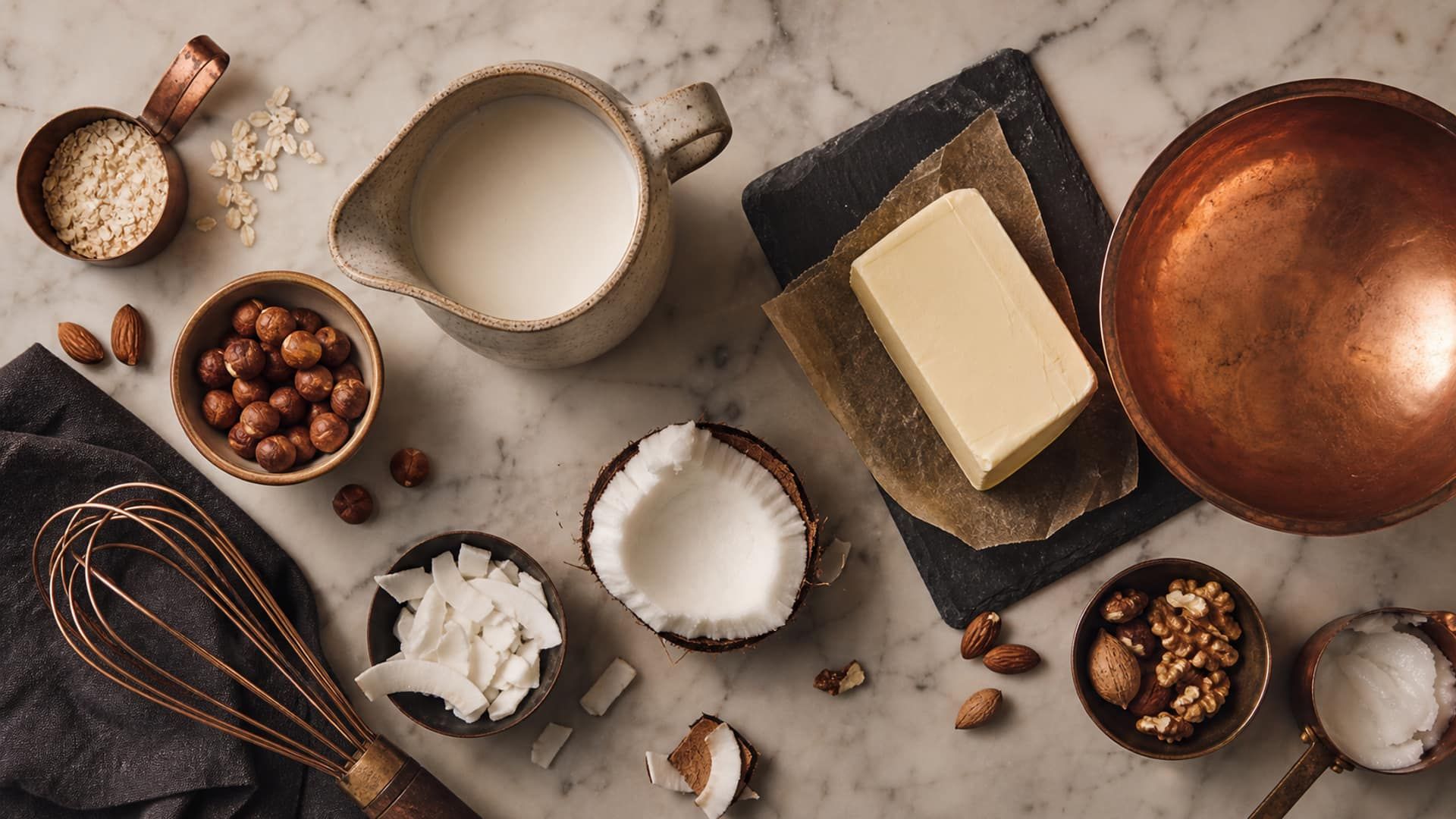
What Dairy Actually Provides
Dairy fails as a one-to-one swap because every dairy ingredient does several jobs at once. Replace the ingredient and you replace all of those jobs blindly; replace the function and you keep control. Four functions carry almost everything dairy contributes to pastry.
Fat builds richness, mouthfeel, and structure — the solid-fat content (SFC) at each temperature decides snap when cold and clean melt on the palate. Water is the continuous phase that hydrates flour, dissolves sugar, and gives batters and ganache their plasticity. Protein is the hidden one: casein and whey in dairy adsorb at fat-droplet interfaces and hold the emulsion together, which is why dairy ganache rarely splits. Aeration is cream’s special talent — partially crystallised fat traps air into a stable foam when whipped cold.
Substitute the function, not the ingredient
Before swapping any dairy ingredient, list what it was doing — fat, water, protein/emulsification, aeration — then choose a plant alternative plus a compensation for each gap. A plant milk replaces dairy water and a little protein but almost no fat; a plant fat replaces fat but adds zero water and zero emulsifier. Account for every job or the formula breaks where you least expect it.
The rest of this guide works through the three dairy ingredients you replace most — milk, cream, and butter — and for each one names the plant alternative that fits and the compensation that closes the gap. The companion ingredient substitution guide handles dairy-free ganache in full; here the focus is the breadth dairy covers elsewhere: milk in batters, sponges, and custards; cream in mousse, fillings, and whipped toppings; butter in lamination and cookie doughs.
Replacing Milk in Batters, Sponges, and Custards
Whole dairy milk is mostly water (~87%) carrying about 3.3% protein, 3.5% fat, and 4.8% lactose. In a sponge or batter its main job is hydration with a little protein for structure and browning; the fat contribution is minor. That makes milk the easiest dairy ingredient to replace — plant milks are about 88-96% water — but two properties still decide the outcome: protein content (which drives emulsification and browning) and water activity, since a plant milk can shift the finished product’s Aw relative to dairy.
Protein is the differentiator. Soy milk carries the most (around 3% protein) and behaves closest to dairy in custards and pastry creams, where protein helps the system set and emulsify. Oat milk is neutral and slightly sweet from its own enzymatic sugars, making it the default for sponges and pancakes. Almond, coconut, hazelnut, and rice milks carry little protein and read as flavour-forward or thin — fine for flavoured batters, weaker in anything that relies on protein to bind.
| Plant milk | Protein | Aw shift vs dairy | Best fit | Watch for |
|---|---|---|---|---|
| Soy | Highest (~3%) | None (0.000) | Custards, pastry cream, choux | Distinct flavour in delicate sponges |
| Oat | Low (~0.7%) | Small rise (+0.004) | Sponges, pancakes, batters | Sweetness; thin body needs less added sugar |
| Almond | Low (~0.5%) | Largest rise (+0.007; most water) | Flavoured batters, frangipane-style bakes | Thin; little emulsification or browning |
| Coconut (drink) | Very low | Rise (+0.006; high water) | Rich batters, coconut-forward bakes | Coconut flavour carries through |
| Hazelnut | Low | Not computed (no reference composition) | Nutty sponges, praline-adjacent bakes | Assertive flavour; allergen |
| Rice | Very low | Negligible (+0.001; its sugar offsets the water) | Allergen-restricted bakes | Almost no protein; weakest structure |
Plant milks for batters and custards, compared on the two properties that matter: protein and water-activity impact. Aw column: Formul.io ganache calculator, a milk ganache (500 g 70% couverture, 400 g milk, 100 g glucose syrup DE40) with whole milk swapped gram for gram, using USDA reference compositions for each drink and counting plant sugars as sucrose.
Plant milks can raise water activity — plan for it
Most plant milks carry more water and less sugar than dairy milk at equal mass, so swapping them in can nudge the finished product’s Aw upward. In the calculator’s milk ganache the rise stays within about 0.01, largest for the watery almond and coconut drinks, while soy and rice drinks leave Aw essentially unchanged. The effect is small in a baked sponge that loses water in the oven, but real in an unbaked cream or filling. For shelf-stable applications, treat a plant-milk swap as a reason to recheck Aw, not a neutral exchange.
Replacing Cream in Mousse, Fillings, and Whipped Toppings
Cream is the hardest dairy ingredient to replace because it is doing the most: about 36% fat, 58% water, 2.8% protein and 2.8% carbohydrate, all in a naturally stabilised oil-in-water emulsion that also whips. Plant creams match the water and some of the fat, but two functions break — emulsification and aeration.
The aeration problem is physical. Cream whips because some of its fat is crystalline at cold temperatures: partially solid fat globules pierce and reinforce the air-bubble walls, locking in the foam. This is why dairy cream is whipped at 4-8°C — warm cream has too little solid fat content to build stable bubble walls. Most plant creams either carry too little fat or the wrong SFC curve to do this unaided, which is why dedicated whipping versions blend a hardening fat (often deodorised coconut fat) with a protein-based aerator — typically a soy-protein whipping agent or a potato-protein aerator — to rebuild the foam structure dairy fat and casein gave for free.
For an unwhipped mousse or filling, the priority shifts from aeration to emulsification. Coconut cream at about 21% fat is the closest plant match to dairy cream compositionally, but its roughly 2% protein contains none of the milk caseins that hold a dairy emulsion together — so plant ganache and plant mousse split far more readily than dairy versions. The fix is to restore the missing fat with a little cocoa butter or coconut fat and the missing emulsifier with lecithin, covered in the emulsification section below.
| Cream | Fat (%) | Water (%) | Protein (%) | Carbs (%) | Emulsification | Aw impact vs dairy |
|---|---|---|---|---|---|---|
| Dairy heavy cream | 36 | 58 | 2.8 | 2.8 | Excellent (caseins) | Reference |
| Coconut cream | 21 | 73 | 2.0 | 2.8 | Poor (no caseins) | +0.04 |
| Soy cream | 7 | 84 | 2.1 | 6.8 | Moderate (soy proteins) | +0.06 |
| Almond cream | 10 | 84 | 1.0 | 5.0 | Poor | +0.06 |
| Oat cream | 3 | 87 | 1.1 | 8.9 | Poor | +0.06 |
Plant creams vs dairy cream per 100g. Coconut cream is the closest match on fat; the others demand heavier fat and emulsifier compensation. Aw column: Formul.io ganache calculator, a dark bonbon filling (480 g 70% couverture, 230 g cream, 120 g glucose syrup DE40, 110 g sorbitol, 60 g cocoa butter) with the cream swapped gram for gram, using this table's compositions and counting the carbohydrate as sucrose.
Read down the Aw column and the cost of high water becomes clear. In that filling the calculator’s room-temperature estimate (Conservative model) falls from 23 days with dairy cream to 14 with coconut cream and about 10 with soy, almond or oat cream. In a fresh 1:1 ganache, already at about aw 0.93, the same swaps add only about 0.01. Coconut cream is the gentlest, and the only one whose own solid fat lends some body at fridge temperature. For dairy-free mousse, pair coconut cream’s fat with a protein aerator and a gelling agent for foam stability, since plant fat alone will not hold the air the way crystallising dairy fat does.
Replacing Butter in Lamination and Cookie Doughs
Butter is roughly 80-82% fat, ~16% water, and ~1% protein. That 16% water is the trap. Most people replace butter with a pure plant fat — coconut fat, shea, cocoa butter, or a liquid oil — and quietly delete a sixth of the recipe’s water, drying out the dough and starving any emulsion of its continuous phase.
The hidden water deficit when you drop butter
Butter is about 16% water. Swapping 100g butter for 100g of a pure plant fat removes ~16g of water and ~1g of protein from the formula. Add back roughly 16g of water per 100g of fat to keep dough hydration right, and add a neutral emulsifier (sunflower lecithin or mono-/diglycerides) to rebuild the water-in-fat emulsion the butter’s own milk solids used to stabilise.
Match the SFC curve to the job. Lamination needs a plastic fat that stays workable across a wide temperature band so it sheets without shattering or oozing — a firm coconut-fat or shea-based blend behaves closest to a dry butter here. Cookie doughs are more forgiving: a softer blend of deodorised coconut fat plus a liquid oil gives spread and tenderness, and the water you add controls gluten development and final crispness.
One hard constraint sits underneath all of this. Coconut oil is incompatible with tempered chocolate: above roughly 5-10% of the cocoa-butter fat phase it disrupts cocoa butter’s Form V crystallisation, leaving chocolate that never sets cleanly and blooms. Keep coconut-based plant butters out of anything tempered — use cocoa butter or shea (a compatible cocoa-butter equivalent) when a solid fat must live alongside couverture.
The formula below is a generic, brand-agnostic plant butter you can make in-house. The soft version suits cookie doughs and creaming; swapping part of the coconut fat for shea gives a firmer, more plastic block for lamination.
Weigh the water phase
Water 150g. This restores the ~16% water that pure plant fat lacks, so the finished butter hydrates dough like dairy butter rather than drying it out.
Weigh the fat phase
Deodorised coconut fat 580g plus sunflower (or other neutral) oil 250g for the soft version. For a firm, laminating-grade block, swap about 300g of the coconut fat for shea butter — its higher solid-fat content makes the block more plastic across a wider temperature band.
Add the emulsifier
A neutral emulsifier (sunflower lecithin or mono-/diglycerides) binds the water into the fat so the block does not weep. Start from the dose on the supplier's data sheet and adjust it in small trial blocks. Some makers also add a little plant protein to stand in for butter's milk solids; dose it the same way.
Emulsify warm but not hot
Bring the fat phase to 18-20°C — just soft enough to blend — and emulsify the water phase in gradually. Overheating breaks the emulsion: the water separates and the butter weeps once it sets, so keep it cool and work it only until uniform.
Set in the fridge
Mould or sheet the emulsion and chill. The coconut and shea fats crystallise as they cool, setting the block firm. Rest it cold before lamination so the fat is plastic, not brittle, when you start sheeting.
Compensating for Lost Emulsification
Across milk, cream, and butter the same gap keeps opening: plant alternatives carry far less emulsifying protein than dairy. Casein is an extraordinary natural emulsifier, and nothing in a plant cream or plant fat replaces it for free. Lecithin helps close that gap, but there is no fixed dose: the useful amount depends on the fat, the total droplet surface, mixing energy and temperature.
How much lecithin to add
Run a dose series rather than a formula. Couverture already contains lecithin: chocolate makers add about 0.3–0.4% of the chocolate’s weight, and above about 0.5% the chocolate starts to thicken again, so more is not automatically better. Record any added lecithin as a percentage of the whole batch, step it up from a low dose, and check both separation and excess thickness. Add the lecithin before you emulsify — it cannot rescue an emulsion that has already split.
Emulsification and water activity move together, so fix them together. Because plant creams and milks carry more free water than dairy, every swap that loses protein also tends to raise Aw — in the bonbon filling above, by about 0.04 for coconut cream and 0.06 for soy, almond or oat cream versus the dairy formula. After restoring the emulsion with lecithin, recheck Aw and pull it back down where shelf life matters: reduce total added water, raise sugar, or shift some sucrose to invert sugar or a polyol to depress Aw without adding bulk.
Quick Selection Guide
When you only need the decision, start here. Pick by the dairy ingredient and its dominant function, then apply the listed compensation.
| Replacing | In | Use | Compensation |
|---|---|---|---|
| Milk | Sponge / batter | Oat milk | Expect a small Aw rise; trim added sugar for oat's own sweetness |
| Milk | Custard / pastry cream | Soy milk | Highest plant protein helps it set and emulsify |
| Cream | Mousse / whipped topping | Whipping plant cream (coconut fat + soy- or potato-protein aerator) | Whip cold (4-8°C); add a gelling agent for foam hold |
| Cream | Ganache / filling | Coconut cream | Add cocoa butter for fat and test a lecithin dose series; recheck Aw |
| Butter | Cookie dough | Soft plant butter (coconut fat + oil) | Add ~16g water per 100g fat + neutral emulsifier |
| Butter | Lamination | Firm plant butter (coconut fat + shea) | Add water + emulsifier; keep block plastic, not brittle |
| Butter | Tempered chocolate | Cocoa butter or shea (NOT coconut) | Coconut oil disrupts Form V above ~5-10% — avoid |
Decision shortcut: the plant alternative and the compensation for the most common dairy-replacement jobs in pastry.
Frequently Asked Questions
Which plant milk works best in custards and pastry cream?
Why does my dairy-free ganache split when I use coconut cream?
How much water do I add when replacing butter with a plant fat?
Can I whip plant cream like dairy cream?
Can I use coconut oil to replace butter in chocolate work?
Why does switching to plant milk or cream raise my product's water activity?
Related Articles
Ingredient Substitution in Confectionery: Match Function, Preview the Recipe
Match water, fat, sugar and emulsion function before you swap an ingredient, then preview what the change does to water activity and shelf life before you commit.
Mousse Science: Foam Stability, Cream, and Gelatin
Build stable mousse by controlling bubble size, cream-fat crystallization, overrun, and gelatin concentration—with practical Bloom conversion and realistic heating guidance.
Gelling Agents for Jelly Textures: Selection, Dosage, and Set Temperatures
Pick the gelling agent that delivers the texture you want — melt-in-mouth, firm and sliceable, brittle clean-cut, or warm-serve heat-stable — with dosages, set temperatures, and vegan options for agar, gelatin, pectin, carrageenan, and gellan.