Ingredient Substitution in Confectionery: Match Function, Preview the Recipe
Match water, fat, sugar and emulsion function before you swap an ingredient, then preview what the change does to water activity and shelf life before you commit.
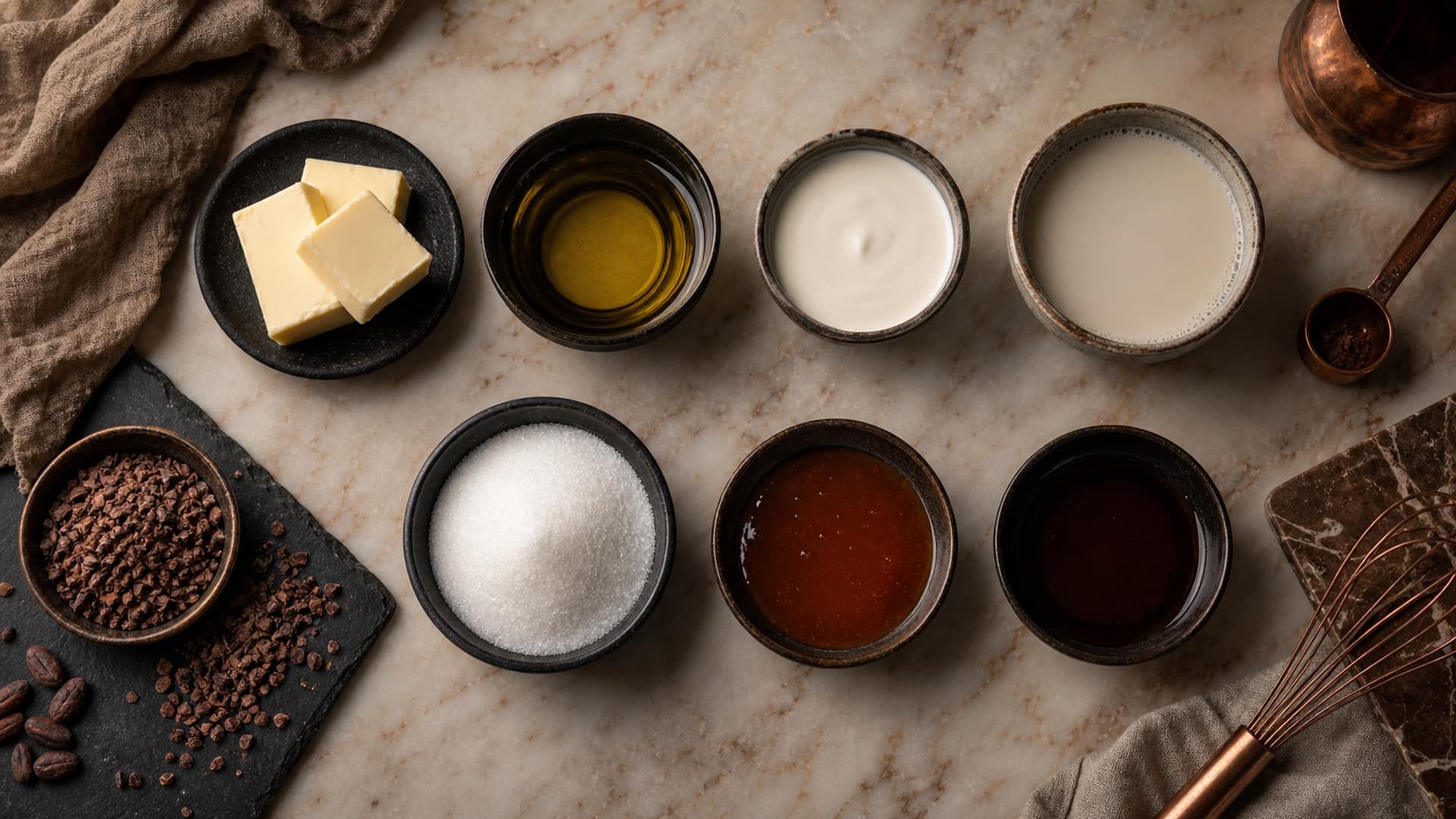
Why Equal-Weight Swaps Break Recipes
A recipe usually has to change for one of three reasons: a customer discloses an allergy, a supplier runs out, or a core ingredient doubles in price. In each case the question is the same: which ingredient can take this one’s place without breaking the product?
Equal weight is rarely the answer. Cream is not simply “35% fat”, butter is not simply “solid fat”, and sucrose is not simply sweetness. Each ingredient brings water, dissolved solids, a crystallisation behaviour, flavour and emulsifying activity, so a swap that matches one of them can move the others. Match the functions that matter in this product, calculate the result, then confirm it on the finished piece.
What the substitution preview does
For any ingredient in the formula on screen, Formul.io lists replacement candidates and previews the swap against the whole recipe before anything changes. The preview shows the new quantity and a before-and-after of total weight, water, sugar, fat and alcohol content, water activity and estimated shelf life. Nothing is written until you apply it, and applying it changes only the draft on screen.
| Scenario | Typical trigger | What to check first | Secondary concern |
|---|---|---|---|
| Allergen compliance | A customer discloses a dairy, peanut, tree-nut or gluten allergy | The candidate's own allergen information, then the fat, water and protein match | Water activity: avoid a shelf-life regression |
| Ingredient unavailability | Supplier out of stock, seasonal gap, import delay | Water activity and the composition percentages | Total batch weight: a swap can change the yield you planned |
| Cost reduction | Margin pressure, a commodity price spike, scaling up | Water activity and shelf life: the swap must not cost keeping quality | The saving itself, read on the saved recipe's Economics tab (a Pro module) |
Why recipes change, and the number that matters most in each case
Match Function Before Weight
“Equivalent” depends on the product. A softer fat may be acceptable in a piped ganache but fail in a snapped shell. Extra water may ease processing yet raise microbial and migration risk. Define what the product must do, then record these five properties for the original ingredient and each candidate.
| Property | Why it matters | How to verify |
|---|---|---|
| Water and dissolved solids | Changes phase ratio, concentration, water activity and process yield | Supplier specification, mass balance, refractometry where applicable |
| Fat content and solid-fat profile | Controls firmness, melt, coating set and oil migration | Supplier SFC curve, DSC or controlled texture tests |
| Sweetness and freezing-point effect | Changes flavour and frozen-product softness independently | One declared coefficient system plus sensory and freezing tests |
| Emulsion function | Affects droplet formation and resistance to coalescence | Process trial, microscopy or separation test |
| Crystallisation and compatibility | Controls snap, graining, temper and bloom | Temper test, storage trial, DSC or X-ray analysis |
A substitute is functionally equivalent only for the properties the product relies on
Do not collapse these into one score. Two formulas can share total fat yet differ sharply in solid fat at 20°C, or share total water yet differ in water activity because their solutes differ. Use supplier specifications for the actual materials: “coconut cream”, “oat cream”, glucose syrup and plant butter are categories, not fixed compositions.
Replacing Fats and Cream
Butter shows why label shorthand is risky. USDA reference data for unsalted butter give about 81% fat, 16% water and 0.85% protein per 100 g. Replacing 100 g butter with 100 g anhydrous fat removes roughly 16 g water and almost all milk protein. Adding 16 g water back restores the water but gives 116 g of mixture, not 100 g, so a weight-preserving swap has to solve the fat and water balances together.
Cream to Coconut Cream for a Dairy-Free Ganache
Heavy cream is the usual dairy ingredient in ganache. It supplies water, milk fat for mouthfeel, and milk proteins that help stabilise the emulsion. Coconut cream is the most common dairy-free replacement, and the Codex standard sets its composition: at least 20% fat and 25.4–37.3% total solids, which leaves roughly 63–75% water.
| Parameter | Heavy cream (36% fat) | Coconut cream (Codex) | Impact |
|---|---|---|---|
| Fat content | 36% | At least 20%; many products sit at 20–25% | Less fat: add cocoa butter if the texture needs it |
| Water content | About 58% | Roughly 63–75%; near 70% at 22–24% fat | More water: water activity can rise |
| Emulsifying proteins | Milk proteins, about 2.8% | No milk proteins | Less help holding the emulsion |
| Fat type | Milk fat, broad melting range | Mostly lauric fat | Different melt and set |
| Allergen | Milk | No milk | Check the label for coconut and cross-contact statements |
Heavy cream compared with coconut cream; use your supplier's specification for the real numbers
The fat gap can be closed by arithmetic. The added cocoa butter also enlarges the batch, so solve against the new total rather than adding fat up to 35 g.
Worked composition example
For coconut cream at 23% fat, solve (23 + x)/(100 + x) = 0.35. The result is x = 18.46 g. The new mixture contains 41.46 g fat in 118.46 g total, or 35.0%. If the coconut cream supplied 72 g water, the reconstructed mixture contains about 60.8% water: close to, but not automatically identical with, a particular dairy cream.
Watch for emulsion stability
Matching fat and water still does not recreate the milk proteins that help hold a dairy ganache together. Lecithin can help, but its useful dose depends on the chocolate, the total fat surface, mixing energy and temperature. Couverture already contains some: chocolate makers add about 0.3–0.4% of the chocolate’s weight, and above about 0.5% the chocolate starts to thicken again. Express any lecithin you add as a percentage of the whole ganache, step it up in small increments from a low dose, and check for both separation and excess thickness rather than adding a fixed percentage.
Cocoa Butter Is a Special Case
Cocoa butter gets its gloss and snap from a controlled crystal network. Lauric fats such as coconut and palm-kernel oil have very different triglyceride compositions, and mixed into real chocolate they can soften it and cause bloom instead of behaving as a lower-melting cocoa butter. Cocoa-butter equivalents are designed around closer triglyceride compatibility; ordinary coconut oil is not one.
Coconut oil can still work in an untempered ganache or in a deliberately formulated compound coating. The product must then no longer be treated as unchanged tempered chocolate, and local standards may stop you from calling the coating “chocolate”.
Do not judge compatibility by melting point alone
Matching one melting point does not reproduce cocoa butter’s crystal forms. For a tempered shell, use chocolate, cocoa butter or a documented compatible fat system, and check temper and bloom resistance under the intended storage cycle.
Replacing Sugars
Sucrose, glucose, fructose, invert sugar, trehalose and glucose syrups cannot be exchanged through one sweetness percentage. Each swap answers three separate questions: how sweet the result is, how many dissolved particles it adds (which drives water activity and freezing point), and how it changes crystallisation, hygroscopicity and browning. Balance syrups on dry solids, not syrup weight: 50 g of an 80%-solids syrup brings 40 g solids and 10 g water.
| Change | Expected direction | Required check |
|---|---|---|
| Sucrose → dextrose on equal dry mass | Lower sweetness; greater molar freezing-point effect; more reducing sugar | Sensory balance, frozen fraction, browning, hygroscopicity |
| Sucrose → invert syrup | Usually greater sweetness and hygroscopicity; syrup adds water | Declared solids and inversion, aw measurement, stickiness |
| Sucrose → trehalose | Lower sweetness with similar disaccharide molar mass; no reducing end | Glass transition, hydration state, crystallisation, cost |
| One glucose syrup → another DE/profile | Viscosity, sweetness and crystallisation control may all move | Supplier saccharide profile and pilot cook |
Directional effects travel better than one universal sweetness or POD/PAC table
Sucrose to Trehalose for Lower Hygroscopicity
Trehalose is a non-reducing disaccharide about 40–45% as sweet as sucrose. It is used in dragées and dry-coated confections where surface moisture pickup causes stickiness or clumping. Because its molar mass matches sucrose, replacing part of the sucrose changes water activity little; the bigger shifts are sweetness and price.
| Parameter | Sucrose | Trehalose | Impact on recipe |
|---|---|---|---|
| Relative sweetness | 100% | About 40–45% | Accept lower sweetness or rebalance with another sugar |
| Hygroscopicity | Moderate | Very low | Less stickiness in humid conditions |
| Water activity effect | Reference | Similar per gram | Small aw change at equal dry mass |
| Reducing sugar | No | No | No added browning |
| Cost | Low | Several times sucrose | Use only where its function is needed |
Sucrose compared with trehalose for dragées and dry-coated confections
Peanuts to Sunflower Seeds for a Peanut-Free Product
Peanuts are a legume, and EU and US allergen law list them separately from tree nuts. They appear in pralines, nougat, brittle and dragée centres. Sunflower kernels are a common replacement: USDA data put them at about 51% fat against 49% for raw peanuts, and neither contributes much free water, so the water-activity change is usually small. Flavour, colour and roast behaviour change more than the composition does.
The swap alone does not make the product peanut-free
If peanuts or tree nuts share your equipment, replacing them in the recipe does not make the product peanut-free. Manage cross-contact in production, decide with a food-safety adviser whether a precautionary “may contain” statement is needed, and do not claim “peanut-free” unless cross-contact is controlled.
Preview a Swap in Formul.io
The preview runs the real calculator on the formula on screen, so it shows the same numbers the results panel would after the swap.
Open the formula you want to change
A saved recipe or an unsaved calculation both work. The preview uses the ingredient list on screen, including its process stages, in any calculator.
Press "Find substitutes" on the ingredient
The control sits on each ingredient row; on a phone, open the ingredient's actions. The "Replace ingredient" dialog opens for that row.
Choose a candidate
"Recommended" lists candidates from curated substitution rules, badged "Validated" or "Rule", and composition-similar ingredients, badged "Similarity-based". Below it you can search the whole catalogue by name, brand or composition, within the same category or across all ingredients.
Read the preview
The right-hand pane shows the current quantity beside the replacement quantity and says whether it was "calculated using a substitution rule" or is a "1:1 replacement by weight". If a rule caps the share, it also says how much of the original remains. "Impact on the recipe" then lists each metric Before and After.
Check the warnings and details
Large swings in water activity, sugar or fat are flagged as warnings. A candidate without a validated rule carries "Not scientifically validated. Test in small batches first." "Adjustments and substitution details" holds the rule's rationale, its maximum share and every line the swap adds, removes or changes.
Apply, then save as a version
"Apply Substitution" writes the change into the draft on screen and the results recalculate. The saved recipe changes only when you save; see the last section for keeping the original.
Reading the Substitution Preview
The comparison translates ingredient chemistry into consequences you can judge against your specification. Read it from the top: batch size first, then composition, then the two keeping-quality rows.
Total Weight
A rule applied at its maximum share, or one that adds a water or fat adjustment, need not keep the batch the same size. If total weight moves, every per-unit figure moves with it: piece count, mould fill and the yield you promised.
Composition Percentages
Water, sugar, fat and alcohol are shown as percentages of the batch, with the change in percentage points. Alcohol appears only when the formula contains some, and a swap that dilutes it can remove a preservative you relied on. Judge each row against the bands your calculator shows for the style, not by the size of the shift alone.
Water Activity
The calculator predicts water activity from the composition: a solution model for dissolved sugars and polyols and, in ganache and caramel, the water held by solids such as cocoa, protein and fibre. A swap changes the water and solutes, so it moves aw.
Where a few hundredths of aw matter
Most spoilage bacteria need aw of about 0.91 or more, most yeasts about 0.88 and most molds about 0.80, while xerophilic molds and osmophilic yeasts grow down to roughly 0.60–0.65. A ganache in the 0.80s is therefore still a yeast and mold question. Read the change against your current aw, not only the new absolute value, and see the water activity calculator guide for the full picture.
Shelf Life
Shelf life is estimated from the substituted composition, so it moves with water activity, and a small aw shift often shows up here as a clearer number of days. It is an estimate for comparing candidates: confirm the winner with your own storage trial before you print a date.
When a Straight Swap Is Not Enough
Some replacements cannot be made at equal weight because they differ too much in water, fat or emulsifying behaviour. They need rebalancing: adjusting several ingredients together.
- Whole milk → water: loses about 3.25% fat and 3.2% protein. Add a fat source and an emulsifier, and expect water activity to move.
- Butter → coconut oil: coconut oil melts at about 24°C, while milk fat melts over a broad range; it also removes butter’s roughly 16% water. Expect a different set, melt and room-temperature texture.
- Sucrose or invert sugar → sorbitol: sorbitol is less sweet, and in the EU a food with more than 10% added polyols must carry the statement “excessive consumption may produce laxative effects”. Check sweetness and labelling, not only aw.
- Glucose syrup → honey: honey can contain up to 20% water and is rich in fructose, so it is sweeter, more hygroscopic and browns faster. Account for its water and flavour.
- Liquid cream → cream powder: removes most of the water. At the same weight the recipe dries out; rebuild the water contribution separately.
What the dialog tells you, and what it leaves to you
There is no single “needs rebalancing” flag. A curated rule states its ceiling as a “Max 30%“-style note when it may not be applied in full, carries its rationale, and can add accompanying adjustments to the preview’s change list. A candidate without a rule carries none of that and is marked as not scientifically validated. Compare the total weight and composition rows against what the formula needs, and treat the cases above as a start for manual adjustment.
Combining Several Substitutions
A customer who needs a dairy-free and peanut-free product may need several swaps. Apply them one at a time: each preview runs on the formula as it stands, including the swaps already applied. Start with the largest ingredient, usually cream or sugar, because it moves the metrics most; then adjust emulsifiers, inclusions and decorations against the new baseline.
Track the cumulative aw change
Three swaps that each add 0.01 aw add 0.03 together, enough to take a filling from 0.81 to 0.84. After the last swap, compare the final aw with the original recipe’s value, not only with each step.
Saving the Substituted Recipe as a Version
Keep the original formula for production runs where its ingredients are available, and keep the substituted formula alongside it.
Review every metric after the swap
Confirm that water activity, the composition percentages, the estimated shelf life and the total batch weight are within your product specification. Note anything outside your normal tolerance.
Press "Save version"
It sits next to "Save Recipe" in the editor and saves the changes as a snapshot in the recipe's history, which you can later compare or restore.
Describe the substitution
In Version History, use "Edit Notes & Rating" to record what was replaced and why, for example "Dairy-free: coconut cream plus cocoa butter, lecithin dose series". The note becomes the audit trail for that version.
Frequently Asked Questions
Does the substitution list guarantee the replacement is safe for my customer's allergen?
A candidate shows "78% match". Is that good enough?
Can I substitute an ingredient that is not in the recommended list?
The preview shows water activity up by 0.04. What should I do?
Why does glycerol lower water activity more than sorbitol at the same weight?
Can I use substitution in ice cream or mousse recipes?
Related Topics
Related Articles
Plant-Based Dairy Substitution: Milk, Cream, and Butter in Pastry
Replace dairy in pastry by function, not by name — match the fat, water, protein, and aeration each ingredient delivered, then compensate the gaps with the right plant alternative and emulsifier.
Water Activity Calculator for Ganache and Filled Chocolates
Calculate water activity from your formulation, compare ingredient changes, and use recipe-level predictions to plan shelf-life testing for filled chocolates.
Sugar Types in Confectionery: Which Sugar Does What
Sucrose, glucose syrup, dextrose, fructose, invert sugar, lactose and trehalose compared: which sugar to use in caramel, ganache, fondant, pâte de fruit, ice cream, panning and nougat, and why.