Fruit Purée Brix Calculator
Standardize a measured fruit purée to a target apparent Brix by adding a declared-Brix ingredient, diluting with water, or removing water by evaporation.
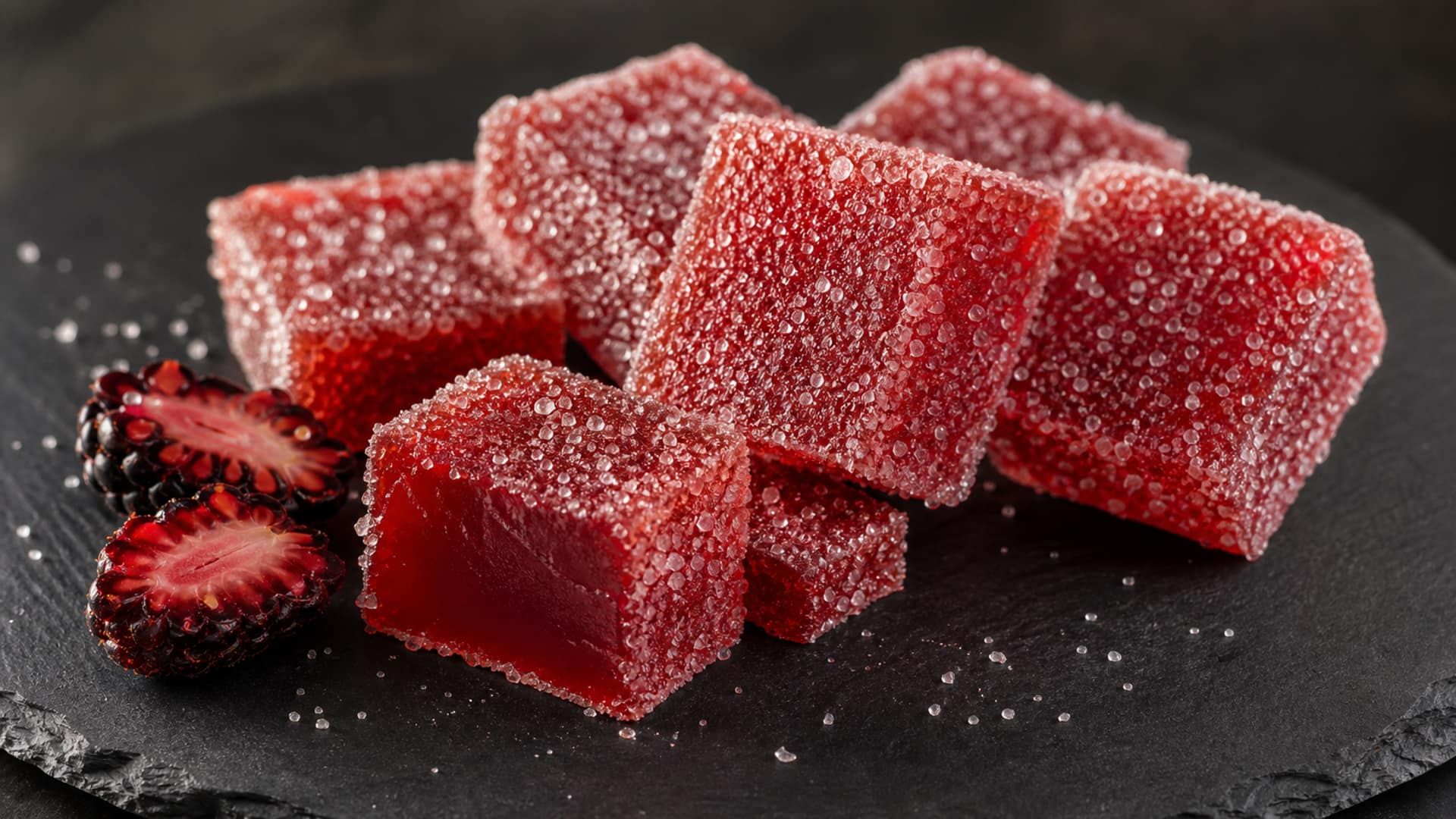
Fruit purées vary by cultivar, ripeness, harvest, processing, and storage. If a formula was developed with one lot and the next lot reads differently, using the same mass changes the apparent-Brix-equivalent contribution even though the reading does not reveal the purée’s exact water or solids composition.
This calculator standardizes a measured apparent Brix by mass balance. Enter the purée mass, current reading, target, and a safe adjustment method: add an ingredient with a declared Brix, dilute with water, or concentrate by removing water. It reports the required mass and proves the resulting Brix-equivalent balance. The application selector is context only; it never supplies a target or turns one number into a universal recommendation for pâte de fruit, sorbet, ganache, or jam.
What to enter
- Enter your purée’s weight and its measured Brix, then the Brix you want.
- Choose how you’ll adjust — add sugar, add water, blend, or reduce.
- The result updates as you type: read the grams to add or evaporate, then remeasure with your refractometer.
How to Standardize Fruit Purée Brix
Start with a representative, well-mixed sample. Separate juice at the top and dense pulp at the bottom can give different readings even though both came from the same container. Follow the refractometer instructions for zeroing, sample preparation, cleaning, and reference temperature.
Weigh and homogenize the purée
Record the usable purée mass. Stir or homogenize enough to make the sampled liquid representative, without introducing a processing change that the production batch will not receive.
Measure current apparent Brix
Use a clean, calibrated refractometer and a representative sample at the instrument's stated reference temperature. Repeat the reading when pulp, bubbles, or temperature make the result unstable.
Choose a documented target and method
Take the target from your validated formula or process specification. Enter the measured Brix of an added purée or concentrate; use 100 only for dry sucrose. Choose water for dilution or evaporation when only water is being removed.
Apply, mix, and remeasure
Add or remove the calculated mass, mix completely, return the sample to measurement temperature, and verify the new reading before committing the adjusted purée to the recipe.
The calculator rejects an unreachable target. A 65 °Bx concentrate cannot raise a purée to 70 °Bx by blending, water cannot increase Brix, and evaporation cannot lower it. This is safer than returning a negative addition that looks mathematical but has no physical meaning.
Brix is an optical reading, not a complete fruit analysis
A refractometer is calibrated against sucrose solutions. In fruit purée, acids, minerals, other dissolved compounds, temperature, and sample condition also affect refractive index. Treat the reading as apparent Brix, keep the method consistent, and remeasure the adjusted batch.
The Brix-Equivalent Mass Balance
For the calculation, degrees Brix are used as a mass percentage of Brix-equivalent solids. A 1,000 g batch at 10 °Bx therefore carries a calculated 100 g Brix-equivalent portion. This is an arithmetic representation of the optical reading, not a claim that laboratory analysis found exactly 100 g of soluble solids. The engine keeps full precision and rounds only the displayed result.
When adding sugar, another purée, or concentrate, let M be source mass, Bi the initial Brix, Bt the target Brix, and Ba the measured Brix of the adjuster. The required adjuster mass x is:
The target must lie strictly between the source and adjuster readings. Final Brix-equivalent solids equal the source equivalent plus the equivalent carried by the adjuster.
The same balance covers both directions. An adjuster above the target raises Brix; one below the target lowers it. The dedicated water mode fixes Ba = 0 and reports the result as water to add. For a lower nonzero target, that simplifies to water = M × (Bi − Bt) ÷ Bt.
Evaporation adds no material. Under the explicit assumption that only water leaves, the source Brix-equivalent portion stays constant. Expected final mass is M × Bi ÷ Bt, and water to remove is source mass minus that final mass. This gives a weighing endpoint, not a heating program.
The output separates the source, added, and final Brix-equivalent portions from the final non-Brix-equivalent remainder and total mass. That remainder is not a water calculation: it can include water, suspended pulp, insoluble material, and other mass not represented by the apparent-Brix equivalent. The separation is an arithmetic proof that makes a data-entry error easier to spot.
Worked Brix Adjustment Examples
The initial calculator fixture uses 1,000 g of purée at 10 °Bx, a 15 °Bx target, and dry sucrose at 100 °Bx. The source Brix-equivalent portion is 1,000 × 0.10 = 100 g.
Applying the blend equation gives 1,000 × (15 − 10) ÷ (100 − 15) = 58.8235… g sucrose. Final mass is 1,058.8235 g and the final Brix-equivalent portion is 158.8235 g. The proof is 158.8235 ÷ 1,058.8235 × 100 = 15 °Bx. In production, weigh 58.82 g as the starting addition, dissolve and mix it completely, then remeasure rather than assuming the optical reading must match the arithmetic.
| Task | Calculated action | Mass-balance result |
|---|---|---|
| 1,000 g at 10 °Bx to 15 °Bx with dry sucrose | Add 58.82 g sucrose | 1,058.82 g final; 158.82 g Brix-equivalent solids |
| 1,000 g at 10 °Bx to 15 °Bx with 65 °Bx concentrate | Add 100 g concentrate | 1,100 g final; 165 g Brix-equivalent solids |
| 1,000 g at 15 °Bx to 10 °Bx with water | Add 500 g water | 1,500 g final; original 150 g Brix-equivalent solids retained |
| 1,000 g at 10 °Bx to 20 °Bx by evaporation | Remove 500 g water | 500 g final; original 100 g Brix-equivalent solids retained |
Checked fixtures used by the fruit-purée Brix engine tests
The concentrate example shows why its own reading matters. Replacing 65 °Bx with a fruit-name average changes the calculated addition. Measure the exact drum, aseptic bag, or batch being blended whenever its variability matters to the formula.
Evaporation is a mass endpoint only
Removing 500 g of water does not specify a safe pan temperature, vacuum, heating time, aroma retention, color change, microbial treatment, or final texture. Weigh during concentration and remeasure Brix; use the validated process for the product.
What Apparent Brix Can and Cannot Tell You
Apparent Brix is useful for incoming-lot standardization because it is fast and repeatable when the sampling method is controlled. It is not identical to total dry matter, total sugars, sweetness, water activity, pH, acidity, pectin content, or flavor concentration.
Several practical details influence the number:
- Temperature compensation has limits. Let hot or chilled samples reach the measurement condition specified for the instrument.
- Suspended pulp, seeds, bubbles, or poorly mixed solids can make the optical boundary hard to read or reduce repeatability.
- Fruit acids and non-sugar dissolved solids contribute to refractive index, so 15 °Bx fruit purée is not necessarily 15% sucrose.
- A processed concentrate and a fresh purée can share a reading while differing in aroma, color, fibers, acids, and thermal history.
- Adding dry sucrose changes soluble solids and sweetness at the same time; blending concentrate also introduces its own acid and flavor profile.
For consistent production, write down the instrument, calibration check, sample temperature, sampling method, reading, and lot identity. After adjustment, mix enough to eliminate local gradients and repeat the measurement. If duplicate readings disagree beyond your normal method tolerance, investigate the sample instead of averaging blindly.
No shelf-life or process guarantee
This tool does not calculate water activity, microbial stability, pectin set, freezing behavior, cooking endpoint, sensory sweetness, or shelf life. A matched apparent Brix is one controlled input to the complete formulation and process validation.
Using the Result in Pâte de Fruit, Sorbet, Ganache, or Jam
The same arithmetic can prepare a consistent purée input for different applications, but the appropriate target is formula-specific.
For pâte de fruit, incoming purée Brix changes the measured Brix-equivalent contribution from a fixed purée mass. Standardizing that input can reduce one source of variation, but it does not determine the purée’s physical water content. The finished gel still depends on the complete sugar system, pectin type and dose, pH, acid timing, cooking loss, and measured endpoint. Do not treat the purée target as the finished-product Brix.
For sorbet, standardizing fruit helps compare lots before the full mix is balanced. Scoopability and freezing behavior depend on every sugar, fruit solids, added water, alcohol if present, stabilizer, serving temperature, and process. The application selector does not recommend a sorbet target or calculate PAC.
For fruit ganache or fillings, the correction changes fruit mass and the apparent-Brix balance, but it does not calculate physical water or total solids entering the emulsion. Recalculate the complete formula from supplier composition data and validate emulsion behavior and water activity where required. Equal apparent Brix does not create equal shelf life.
For jam or preserves, use the specification and legal/process requirements that apply to the exact product and market. This calculator supplies only the pre-adjustment mass balance; it does not replace a validated thermal process or finished-product endpoint.
In every case, record both the unadjusted and adjusted lot. That preserves traceability and makes it possible to separate fruit variability from later cooking, mixing, freezing, or storage effects.
Verification Checklist Before Production
Use the displayed quantity as a controlled starting point:
- Confirm the mass units and that the sample represents the full purée batch.
- Confirm current, target, and adjuster readings were entered as degrees Brix rather than fractions.
- Check that the chosen method moves in the right direction and that the action is practical for the product.
- Apply the change uniformly, avoiding unrecorded rinse water or evaporative loss during blending.
- Return the adjusted sample to the instrument’s measurement condition and remeasure.
- Recalculate the complete recipe and verify its relevant endpoint in a bench trial before production scale.
The calculator deliberately stops at that boundary. It makes the Brix-equivalent arithmetic transparent while leaving product-specific targets and safety decisions with the validated formulation and process.
How much sugar should I add to raise fruit purée Brix?
Can I use fruit concentrate instead of dry sugar?
How do I lower the Brix of a fruit purée?
Can evaporation raise Brix without adding sugar?
Is refractometer Brix the same as percent sugar in fruit?
What Brix should I use for pâte de fruit, sorbet, ganache, or jam?
Related Topics
Related Articles
Fruit Purée in Ganache: Substitution, Not Addition
Adding fruit purée to ganache without reformulating around it splits the emulsion and cuts shelf life. Here's the science and the fix.
Stabilizing Ice Cream and Sorbet: A Complete Guide
Stabilizing a frozen dessert means controlling water, ice crystals, air, and the unfrozen phase across the whole cold chain. This guide walks the system end to end — building blocks, process, stabilizer choice, and target ranges for both dairy ice cream and dairy-free sorbet.
Fruit Jelly Recipe Formulation: Brix, Acid Balance, and Yield
How to formulate any fruit jelly from first principles — choosing the right Brix target, balancing acid for pectin gelation, controlling sugar ratios, and predicting yield before you cook.