Why Confectionery Spoils: 4 Aging Mechanisms and How to Manage Them
Every confectionery product starts degrading the moment it's made. The four aging mechanisms behind shelf life, and which formulation levers actually control them.
What Aging Actually Means
When you finish a ganache, caramel, or pâte de fruit, you’ve created a thermodynamically unstable system that immediately begins drifting toward equilibrium with its environment. That drift is what we call aging, and every confectionery product is subject to it — no matter how skilfully it’s made. Four physical and chemical mechanisms drive aging, and understanding them lets you design recipes with predictable shelf life instead of relying on intuition. The rest of this article walks through each mechanism, what controls it, and which formulation choices give you real leverage.
Safety and Quality Are Two Different Things
Before any discussion of shelf life, separate two ideas that often get blended together. Food safety is binary — a product is either safe to eat or it is not, and “slightly unsafe” isn’t a category. Safety is governed almost entirely by microbial limits: water activity, pH, preservatives, and time-temperature history. Quality is a continuous gradient — flavour, texture, aroma, and appearance all drift gradually from the product you made on day one. A truffle can be perfectly safe while tasting stale; it can also be microbiologically dangerous while still looking fresh. Most of what follows is about quality, because that’s where formulation choices matter most. Where safety is concerned, the rule is simpler: stay below the relevant microbial aw threshold, or rely on a preservation hurdle (refrigeration, low pH, low aw, packaging) until the product is consumed.
The Four Aging Mechanisms
Every confection ages through some combination of four mechanisms. Their relative weight depends on the formula — a hard caramel ages very differently than a fresh cream ganache — but all four are always present in some form.
1. Microbial Growth
Microorganisms — bacteria, yeasts, and moulds — need available water to grow. The relevant measurement isn’t total moisture content but water activity (aw), a 0-to-1 scale describing how much of the water in a product is free for microbial use versus bound to sugars, proteins, or fats. Two confections with identical moisture content can have very different aw and therefore very different microbial risk. Each microbial group has a minimum aw below which it cannot grow; below the toughest threshold (osmophilic yeasts around 0.60) microbial growth essentially stops. This is why a dry caramel keeps for months at room temperature while a fresh cream ganache spoils within days — they sit on opposite sides of the microbial line.
| Organism Type | Minimum aw | Risk in Confectionery |
|---|---|---|
| Most bacteria | 0.91 | Rare except in very wet products |
| Most yeasts | 0.88 | Fresh cream ganaches at risk |
| Most molds | 0.80 | Primary concern for confections |
| Xerophilic molds | 0.65 | Threat to even 'dry' products |
| Osmophilic yeasts | 0.60 | Extreme conditions only |
Minimum Water Activity for Microbial Growth
aw matters more than moisture %
Water activity is the single most important safety parameter in confectionery. Total moisture content tells you almost nothing on its own — two formulas with the same water percentage can have wildly different aw depending on sugar composition, polyols, and bound-water-holding ingredients.
2. Sugar Crystallisation
Finished confections that contain dissolved sugar — ganache, caramel, fondant — are usually supersaturated, meaning more sugar is dissolved than the system can hold at equilibrium. Over time, sugar slowly leaves solution and forms visible crystals: the grainy texture of an aged ganache, the cloudy haze on an old caramel. The further the system sits from equilibrium, the faster crystallisation proceeds. Two ingredients reliably slow it down: glucose syrup and invert sugar. Both are mixtures of different sugars, and that diversity makes it physically harder for sucrose molecules to find each other and arrange into crystals. A meaningful share of either is one of the most effective crystallisation inhibitors available — which is why you’ll find one or both in nearly every shelf-stable confection.
3. Fat Oxidation
Fats — cocoa butter, dairy fat, nut oils — undergo oxidation, a chain reaction in which oxygen attacks unsaturated fatty acids and produces off-flavours described as stale, painty, or cardboard-like. The reaction is autocatalytic: once it starts, it accelerates itself. Three conditions speed it up significantly: heat, light, and oxygen exposure. Saturated fats (cocoa butter, coconut oil) resist oxidation far better than polyunsaturated fats (most nut oils, sunflower oil), which is why dark chocolate keeps significantly longer than nut-heavy confections or white chocolate. Premium chocolates ship in opaque, oxygen-barrier packaging and are stored cool for exactly this reason.
4. Physical Changes: Fat Bloom and Moisture Migration
The fourth mechanism is the slowest but the most visible. Fat bloom is the dull, whitish coating that appears on aged chocolate — cocoa butter migrating to the surface and recrystallising in unstable forms. It’s tied to polymorphism: cocoa butter can solidify in several crystal forms, and only one (Form V) gives the snap and gloss of well-tempered chocolate. Temperature cycling pushes the fat toward less stable forms, releasing surface bloom. Alongside bloom, moisture migration quietly redistributes water inside any multi-component confection: a high-aw filling will slowly hydrate a lower-aw shell until the system equilibrates, softening textures and dissolving sugar at the interface. Both effects accelerate with temperature swings, which is why temperature stability during storage matters as much as the absolute temperature.
Describing Aging Mathematically
Food science describes most aging processes with first-order kinetics — quality decays exponentially over time, faster under harsh conditions and slower under stable ones. The general form is:
Q(t) is product quality at time t, Q₀ is initial quality, and k is a rate constant capturing the combined effect of temperature, humidity, packaging, and formulation. The lower k is, the longer the shelf life.
The exact value of k for any given formula isn’t something you can read off a textbook — it has to be calibrated against measured data. But the shape of the curve is universal: aging is not linear. A product that’s still acceptable on day 30 may decay much faster between day 30 and day 60 than it did in the first month.
Temperature is the factor that moves k most predictably. Q10 and Arrhenius show how to estimate k at one storage temperature from a measurement at another.
What Drives Shelf Life in Your Formula
A handful of formulation and storage factors directly control how quickly the four mechanisms above act. Each one is a lever you can pull at the recipe-design stage:
- Water activity — lower aw means slower microbial growth and slower chemical reactions. The single most powerful variable. Reducing aw from 0.80 to 0.65 can shift ambient shelf life from days to months.
- Invert sugar and glucose syrup share — a higher share of these mixed sugars suppresses sucrose crystallisation.
- Unsaturated fat content — more polyunsaturated fat (nut oils, sunflower) means faster oxidation. Saturated fats (cocoa butter, coconut) keep much longer.
- pH — a lower pH suppresses microbial growth, which is why fruit-based confections (pâte de fruit) tolerate higher aw than dairy-based ones.
- Storage temperature stability — temperature variance is often worse than absolute temperature; cycling drives bloom, crystallisation, and fat migration.
- Packaging — a barrier against moisture and oxygen (WVTR — water vapour transmission rate — and oxygen permeability) can extend shelf life dramatically with no recipe change.
Each of these variables is computed inside the Formul.io calculators for the specific product type — adjusting any of them in the calculator lets you see the predicted shelf-life impact before you produce a batch.
Frequently Asked Questions
Why does my chocolate, ganache, or caramel spoil faster than its claimed shelf life?
Does refrigeration always help?
What matters more: the recipe or the storage conditions?
How do professional manufacturers actually determine shelf life?
Can shelf life be extended without preservatives?
Related Topics
Related Articles
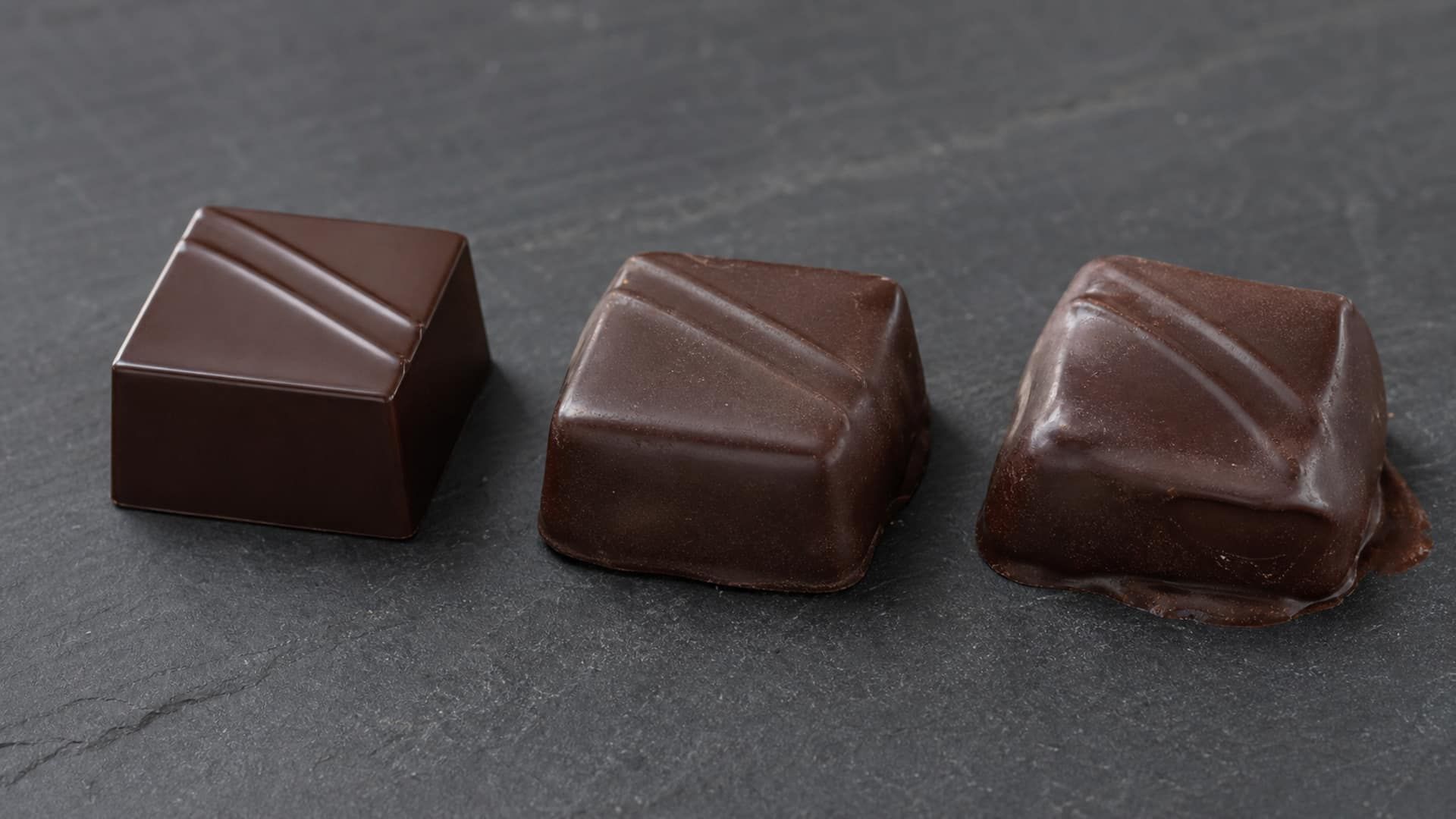
Q10 and Arrhenius: How Storage Temperature Shortens Shelf Life
Estimate how a change in storage temperature changes confectionery shelf life with the Q10 rule and the Arrhenius equation, work through an accelerated shelf-life test, and learn where both models stop being reliable.
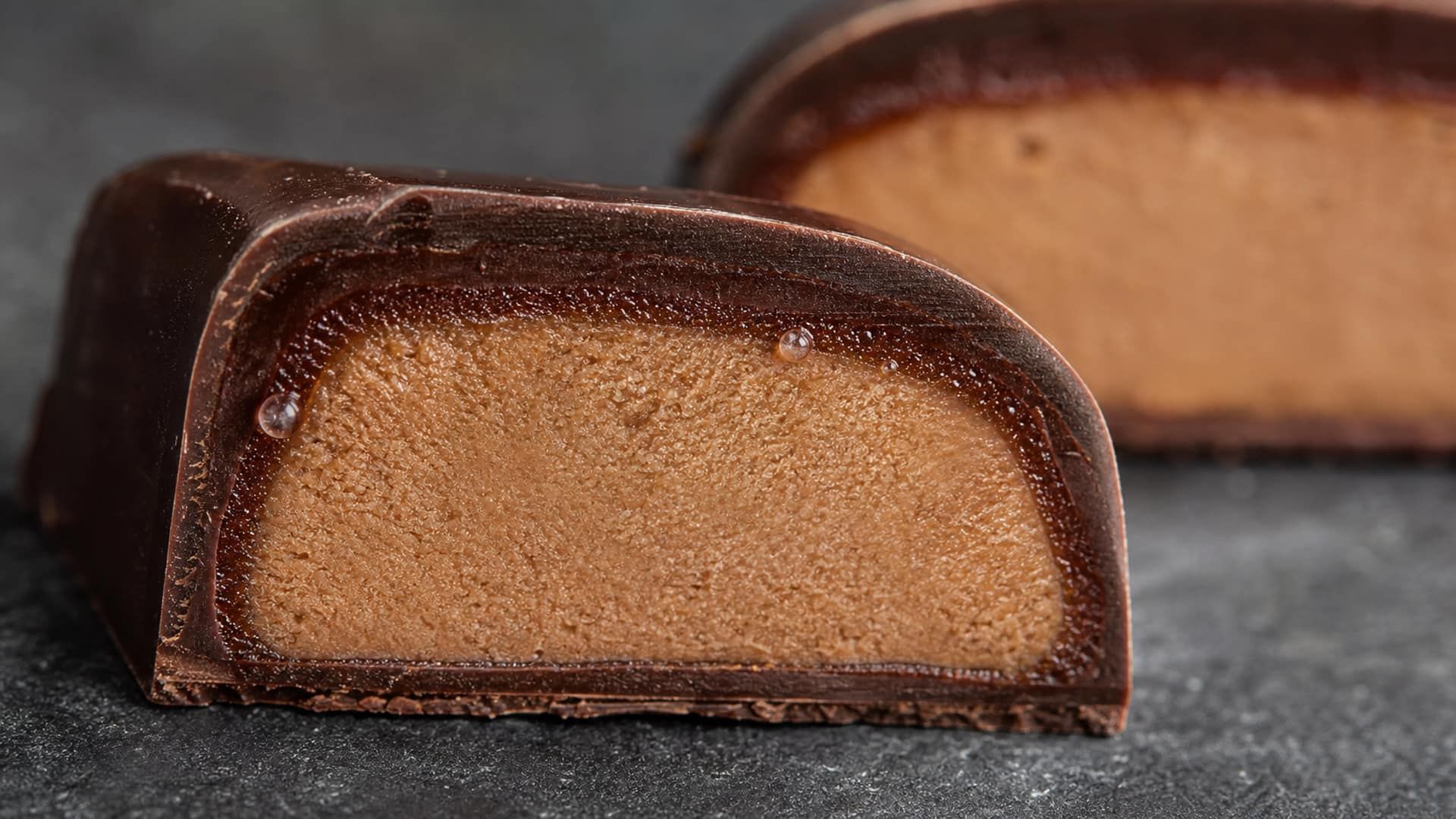
Moisture Migration: Water Activity, Fick's Law, and Packaging
Predict moisture movement by separating its water-activity driving force from diffusion rate, and compare packaging only with WVTR units and test conditions attached.
Water Activity in Ganache: The Science Behind Shelf Life Prediction
How the Formul.io Ganache Calculator estimates water activity from a formulation's sugar, polyol, and alcohol composition to predict microbial shelf life — and how to use those numbers responsibly.