Sheet vs Powder Gelatin: Grades, Weights, and Conversion
How to move between sheet and powder gelatin without changing your set — matching by bloom, converting leaf grades by sheet count, and handling the water each form carries.
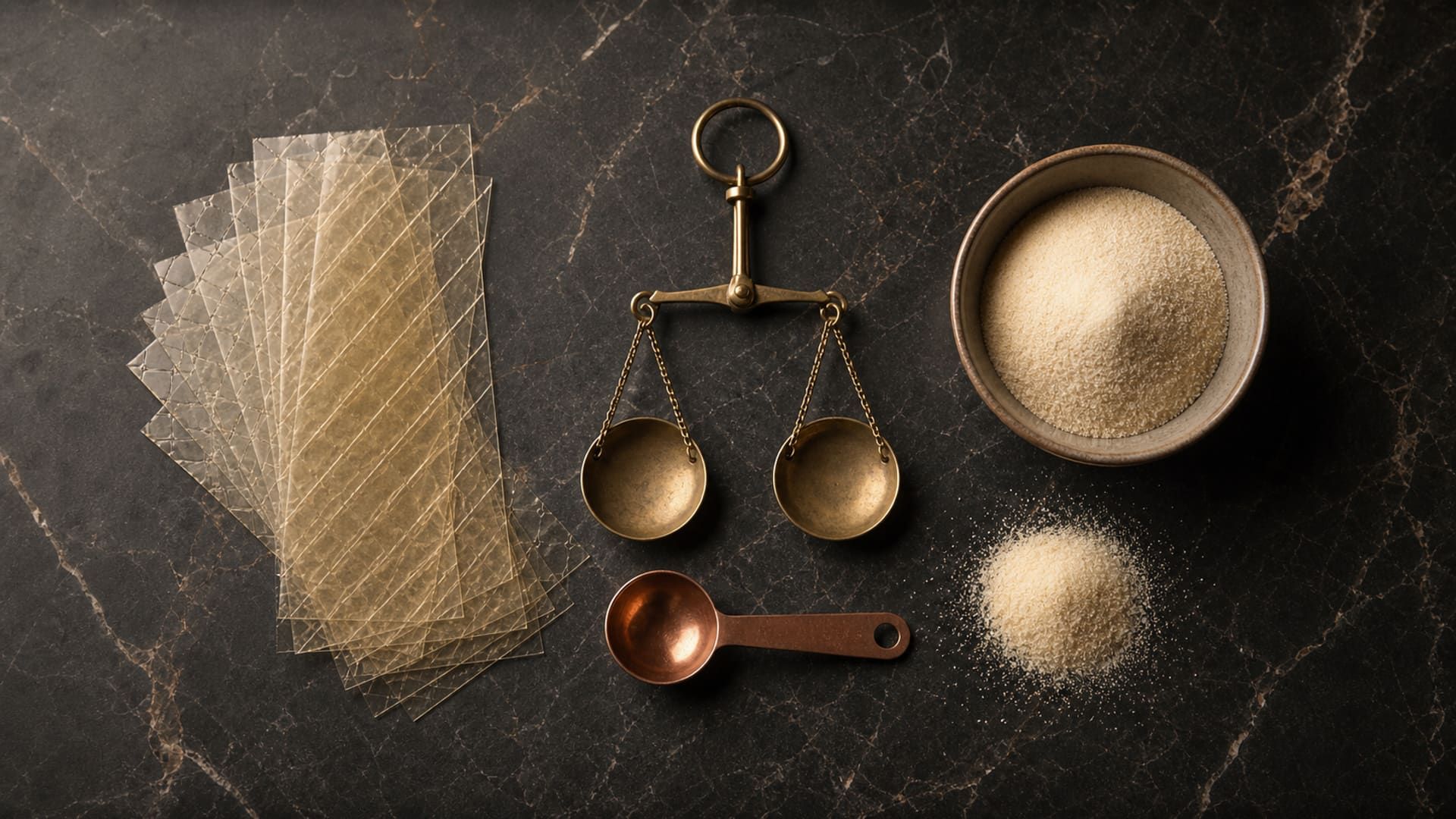
Sheet and powder gelatin are the same protein doing the same job, but recipes are rarely written for the one you happen to have. Converting between them cleanly comes down to three ideas: match the bloom strength, convert leaf grades by sheet count rather than grams, and account for the water each form carries into the recipe. Get those right and the set stays identical. The gelatin calculator does the arithmetic; this guide explains it.
The Two Forms
Sheet (leaf) gelatin is sold in professional grades — platinum, gold, silver, bronze, and titanium — each mapping to a band of bloom strength, from platinum (firmest, ~230–250) down to titanium (softest, ~100–120). Gold, around 200 bloom, is the pastry default. Sheets dissolve cleanly, leave no grain, and are the professional’s choice for clear glazes and clean-unmolding entremets.
Powdered gelatin is usually sold without a grade name. Common retail and professional powders sit around 200–250 bloom; a working assumption of 225 is reasonable, and Modernist Cuisine standardizes its recipes on that figure. Powder is easy to buy, easy to weigh precisely on a scale, and blooms directly in the recipe liquid.
| Sheet (leaf) | Powder | |
|---|---|---|
| Graded by bloom | Yes — platinum to titanium | Rarely; assume ~225 |
| Typical bloom | 100–250 by grade | 200–250 |
| Measured by | Sheet count or weight | Weight |
| Blooming water | Soaked then wrung out (discarded) | Counted in the recipe liquid |
Sheet and powder gelatin at a glance
Converting by Bloom, Not by Habit
Gelatin is gelatin: the same mass of the same bloom sets the same, whether it arrived as a sheet or a powder. So sheet-to-powder conversion is a matter of matching the effective gelling power, which means accounting for bloom. To swap while holding firmness constant, multiply the original weight by the ratio of the two bloom values.
For example, a recipe calling for 10 g of gold sheet (200 bloom) becomes about 8.9 g of a 225-bloom powder — a little less, because the powder is slightly stronger. Reverse the direction and the weight goes up.
The calculator below opens on this example; change the amount or the grades to convert your own recipe.
A subtlety worth naming: this ratio assumes the two gelatins are otherwise comparable — both cleanly bloomed, both fully dissolved, neither degraded by heat. It preserves gel firmness, not necessarily every textural nuance. At the same firmness a very high-bloom gelatin can set a touch more brittle and a low-bloom one a touch more elastic, because they build the network from slightly different chain lengths. For everyday work that difference is invisible, but for a signature texture it is worth a small test batch when you change grades.
Never swap leaf grades gram-for-gram
Leaf gelatin hides a trap: manufacturers cut each grade to a compensating weight, so a weaker grade’s sheet is heavier. A gold leaf is about 2.0 g; a titanium leaf about 5.0 g. That is deliberate — a fixed number of leaves gels roughly the same volume regardless of grade, which is why a recipe written in “sheets” works across brands. Swapping grades by weight breaks this: 10 g of titanium is two heavy leaves, while 10 g of platinum is nearly six. Convert leaf-to-leaf by sheet count, and let bloom handle sheet-to-powder.
| Grade | Typical bloom (g) | Typical leaf weight |
|---|---|---|
| Platinum | 230–250 | ~1.7 g |
| Gold | 190–220 | ~2.0 g |
| Silver | 150–170 | ~2.5 g |
| Bronze | 125–140 | ~3.3 g |
| Titanium | 100–120 | ~5.0 g |
Leaf grades: bloom bands and representative sheet weights
The Water Difference
The one thing that does not transfer directly between forms is the water each carries into the recipe. Powdered gelatin is bloomed by sprinkling it over roughly five times its weight in cold liquid and letting it swell; that water is part of the recipe and must be counted toward your total liquid. Sheet gelatin is bloomed differently — soaked in a generous bowl of cold water, then lifted out and gently wrung. Discard the soaking bath; the sheets themselves retain absorbed water. For precise work, weigh the hydrated sheets and subtract their dry weight to include retained water in the balance.
This matters most when you are near the edge of a formula. Swap a powder for sheets without adjusting, and you have quietly removed the bloom water from your liquid balance; swap sheets for powder and you have added it. For a firm set at low water margins, keep track of which form you are using and where its water goes.
When to Reach for Which
Choose sheets when clarity and precision matter: mirror glazes, clean-unmolding entremets, and any set where a faint grain would show. Their standardized grades make texture repeatable, and counting leaves is fast at the bench.
Choose powder when availability and exact weighing matter: it is stocked everywhere, easy to scale on a gram scale, and blooms straight into the recipe. For most home kitchens, a good powder at a known bloom does everything sheets do.
There is a practical dimension beyond texture, too. Sheets are quick to count but awkward to split — half a leaf is a guess — so very small or very precise doses are easier to hit with powder and a gram scale. Powder, in turn, has to be sprinkled and bloomed carefully to avoid clumping, where a sheet simply softens in its bath with no technique required. Neither form is harder to use overall; each just rewards a slightly different habit, and most kitchens settle on whichever they can buy reliably at a known strength.
Whichever you keep on hand, the conversion is the same: match the bloom, respect the water, and confirm a texture-critical set with a small bench test.
How many sheets of gelatin equal one packet of powder?
Can I substitute powder for sheets 1:1 by weight?
Do I still bloom sheet gelatin?
Which is stronger, sheet or powder?
Related Articles
Gelatin Bloom Strength, Types and Dosing
Convert between gelatin grades by bloom strength and dose gelatin for the exact texture you want — with an interactive calculator and a clear guide to sheet, powder, and blooming.
What Gelatin Bloom Strength Really Measures
The science behind the bloom number — how the gelometer test works, why firmness tracks concentration times bloom, and what heat, acid, and fresh fruit do to a gel.
How to Bloom and Dissolve Gelatin Correctly
Bloom powdered gelatin in measured cold water; soak sheets separately and squeeze them. Follow the method for each form, account for the water and convert gelatin mass.