Pistachio Paste, Praline and Cream: Choose and Substitute
Three green products can bring very different amounts of pistachio, sugar and fat into a filling. Read the specification, choose the right starting material and test the replacement.
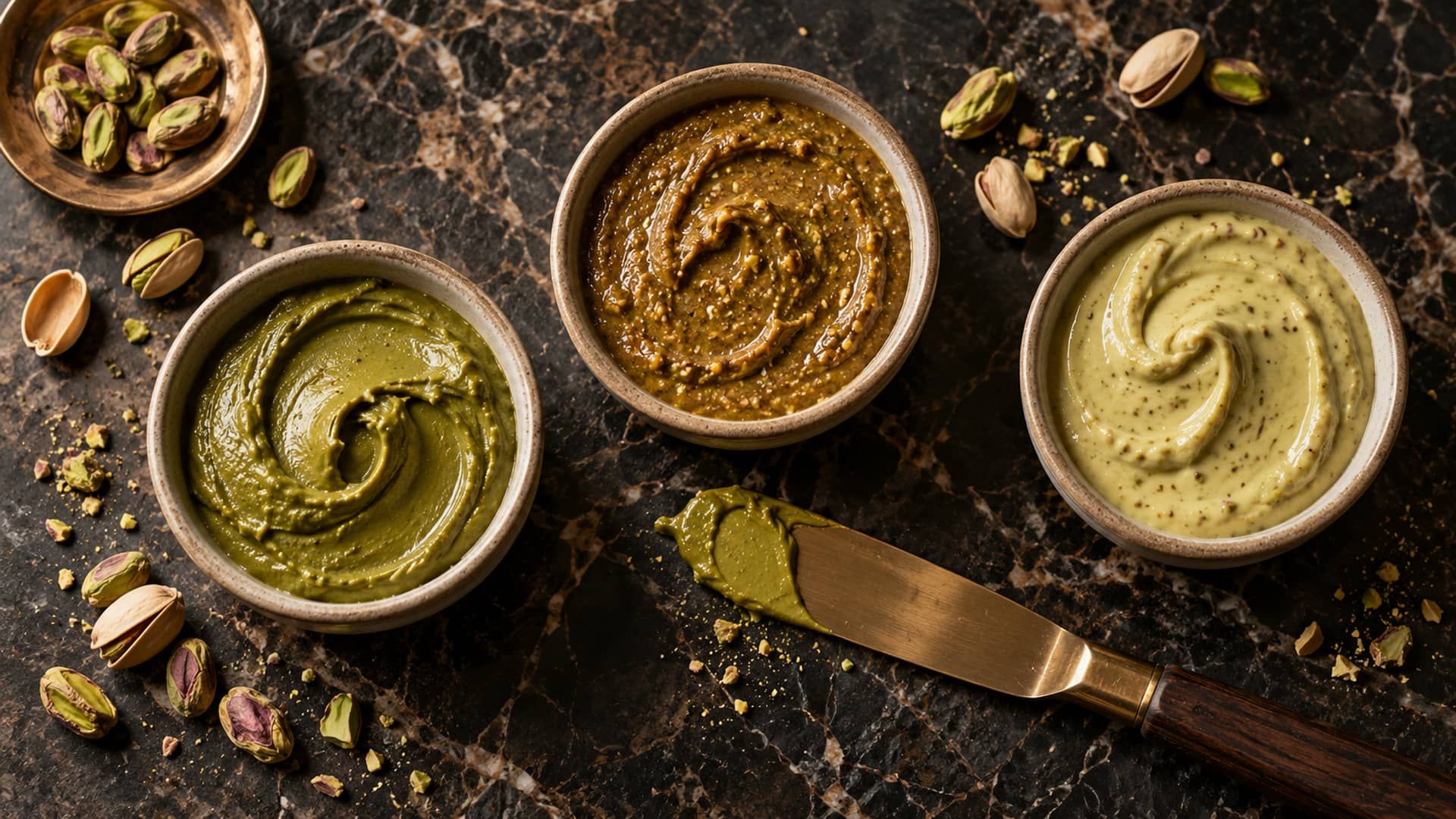
A recipe asks for pistachio paste, but the product you can buy says pistachio cream. Before substituting it, turn the container around: the ingredient list and nut percentage are more useful than the green colour or the product name.
Start with the outcome you need. A ganache developed around unsweetened nuts, a sweet praline centre and a ready-to-use pastry filling do not need the same ingredient, even when all three should taste of pistachio.
Read the composition behind the name
Pure pistachio paste is finely ground pistachio, with the nut’s own oil and solids. A specification that says “100% pistachio” describes the nut content; it does not mean that the paste is entirely fat, nor does “unsweetened” mean the nuts contain no naturally occurring sugars.
Praline combines nuts and sugar, with processing that affects the flavour. Do not assume every pistachio praline contains only pistachios and sugar: commercial products can contain other nuts, and the pistachio percentage may differ substantially between suppliers.
Pistachio cream or spread is a less precise description. A jar may contain sugar, added vegetable oil, cocoa butter, milk powder and emulsifier, while a fresh pastry cream may contain milk or cream and considerably more water.
| Product description | What to confirm | Useful starting point |
|---|---|---|
| Pure pistachio paste | That the ingredient list really is pistachio only | A formula where you want to choose the sugar and fat separately |
| Pistachio praline | Pistachio percentage, other nuts, sugars and added fats | A sweet nut centre with a flavour profile suited to the product |
| Pistachio cream or spread | Nut content, fat sources, milk ingredients and whether water is present | A ready-made sweet filling, or a formula developed specifically around that spread |
| Fresh pistachio pastry cream | The full dairy or water phase and storage instructions | Fresh pastry applications with an appropriate cold chain |
The categories help you ask questions; they are not a substitute for the supplier’s specification. A product marketed as a “paste” may still be sweetened, while a “cream” is not necessarily made with dairy cream.
Keep the specification with the recipe
Record the exact product, declared nut percentage, ingredients and nutrition values per 100 g. Keep the storage instructions too: a supplier’s shelf life for an unopened jar is not the shelf life of the confection you make from it.
Compare the ingredients that matter to your filling
Read four things before testing a swap: pistachio content, sugars, fat sources, and water-containing ingredients. Then check the full allergen declaration, including milk, soy and other nuts, plus the supplier’s cross-contact warnings; a replacement can introduce ingredients your original product excluded.
The nutrition panel’s “of which sugars” value includes sugars from all ingredients. It is not necessarily the mass of added sucrose, and total carbohydrate is not interchangeable with sugar when you plan the adjustment.
Fat quantity is only part of the comparison. Pistachio oil, cocoa butter and added vegetable fats have different behaviour at the temperature where you serve the filling; matching total fat alone does not reproduce the same set or mouthfeel.
A spread that feels thick in the jar is not automatically a stronger setting ingredient in a ganache. Its sugar particles, fat blend and temperature contribute to that appearance, so judge it inside the actual finished product.
Taste the candidates in the intended application, not only from the spoon. Roasting, particle size and the other ingredients affect how the pistachio comes through, while sweetness can change the balance of the whole filling.
For a purchasing comparison, calculate the cost at the amount you actually need in the recipe. A cheaper jar can require a larger addition to provide a similar quantity of nuts, bringing extra sugar and fat with it and changing the finished yield.
Write down the ingredient’s main job first. Buying a concentrated nut flavour for further formulation is a different decision from buying a finished filling that you intend to pipe directly without additional processing.
Plan the replacement without copying grams blindly
First decide what you are trying to preserve: pistachio quantity, flavour, sweetness, firmness or final batch weight. You may need to adjust several ingredients to preserve all of them, and sometimes the available replacement cannot fit the original recipe.
Use a simple nut-content check as the first screen: multiply the product mass by its declared pistachio fraction. This checks the mass of pistachio supplied, not flavour intensity or finished texture.
| Illustrative label | Pistachio supplied by 100 g | Other material supplied by 100 g |
|---|---|---|
| 100% pistachio | 100 g | No added ingredients; the nuts themselves still contain fat, protein and carbohydrate |
| 50% pistachio | 50 g | 50 g of other ingredients; identify them from the specification |
| 25% pistachio | 25 g | 75 g of other ingredients; do not assume all of this is sugar |
Hypothetical label arithmetic, not a recipe or a specification for any particular brand.
Under those assumptions, matching the nuts in 100 g of pure paste would require 200 g of the 50% product or 400 g of the 25% product. That adds substantial other material and changes the batch weight; it is a warning that a direct swap may be impractical, not an instruction to multiply the filling blindly.
When you know the sugars supplied by each candidate, compare them at the proposed use level. Do the same for total fat, and examine the individual fat sources before deciding what to remove elsewhere.
Do not subtract everything labelled “carbohydrate” from the recipe’s sucrose. Do not remove cream solely to compensate for the mass of a spread, either: cream also supplies water and milk components that the spread may not replace.
If the supplier cannot provide a needed value, record that uncertainty in the trial notes. Missing data is not zero: a calculation from an incomplete specification remains a weaker basis for a decision, even when its totals look tidy.
Keep the original formula
Record the exact starting ingredient and the texture, sweetness and flavour you want to preserve. Keep a reference sample when practical.
Compare the two specifications
Check pistachio content, sugars, fat sources and the complete allergen information, including cross-contact warnings. Ask the supplier for missing composition data rather than guessing from the colour or name.
Choose a feasible small trial
Write down the proposed ingredient changes and the resulting batch weight. If matching nut content crowds out essential ingredients, choose a more concentrated product instead.
Process and evaluate consistently
Use the same mixing, setting and storage conditions as the original. Compare flavour and texture at the intended service temperature, then check the retained sample during storage.
Choose the product you can use consistently
Choose pure paste when independent control of nuts, sugars and fats matters most. Choose praline when its sweetness and nut flavour belong in the intended centre; choose a spread when its complete composition and convenience suit the application.
Once a trial works, keep its exact product specification and quantities. A future purchase with a similar name is another ingredient change, not automatically the same recipe.
Formul.io can help you record the actual ingredients and compare a proposed change in the relevant recipe calculator. Use measured product data where available, and keep the bench comparison alongside the calculation before adopting the replacement.
Can I replace pistachio paste with pistachio cream at equal weight?
Is the greenest pistachio product the best choice?
Does pistachio cream always contain milk?
Can I remove all the sugar after switching to praline?
Related Topics
Related Articles
Ingredient Substitution in Confectionery: Match Function, Preview the Recipe
Match water, fat, sugar and emulsion function before you swap an ingredient, then preview what the change does to water activity and shelf life before you commit.
Sugar Types in Confectionery: Which Sugar Does What
Sucrose, glucose syrup, dextrose, fructose, invert sugar, lactose and trehalose compared: which sugar to use in caramel, ganache, fondant, pâte de fruit, ice cream, panning and nougat, and why.
Ganache Ratio Guide: Matching Chocolate-to-Cream Ratios to Every Use Case
The chocolate-to-cream ratio determines everything: texture, setting time, shelf stability, and workability. This guide maps each ratio to its application — from pourable glazes to firm praline centres.