My Confectionery Spoils Too Quickly: Diagnosis & Solutions
Product failing before expected shelf life? This troubleshooting guide helps you identify the cause—whether mold, crystallization, texture loss, or rancidity—and provides targeted solutions for each spoilage type.
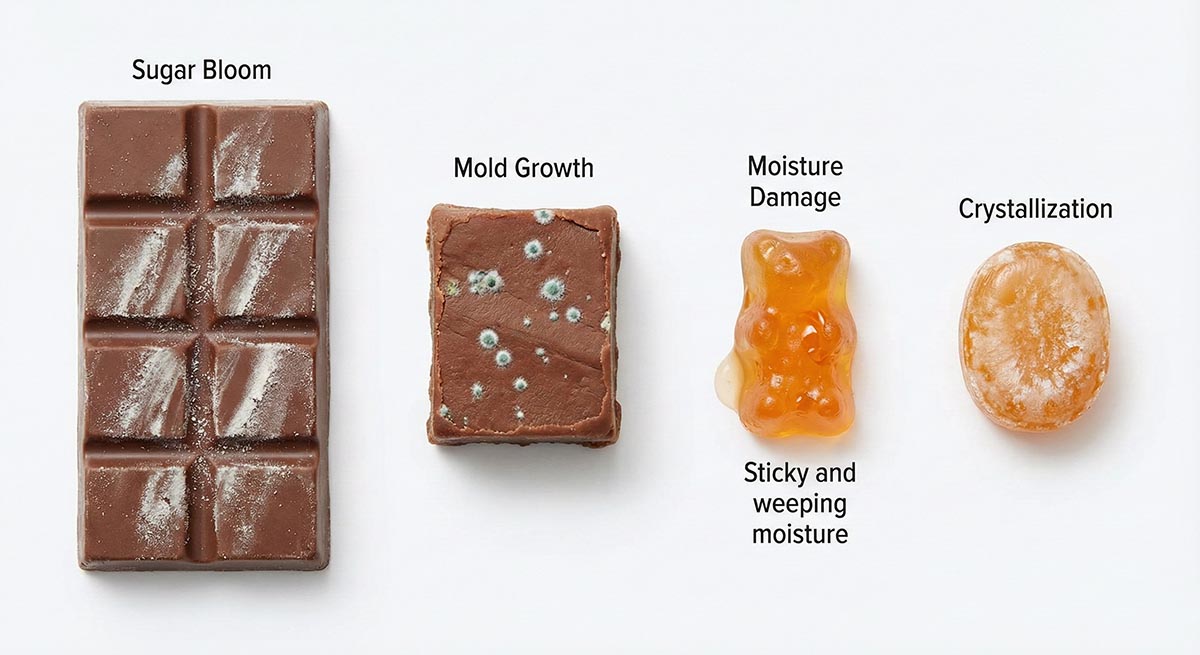
Step 1: Identify the Type of Spoilage
Not all spoilage is the same. Different failures have different causes and different solutions. Start by examining your product and matching symptoms to one of these categories:
| Symptom | Likely Cause | Time to Appear |
|---|---|---|
| Fuzzy growth (white, green, black) | Mold | 5-21 days |
| Fermented/sour smell | Yeast | 7-14 days |
| Gritty texture | Sugar crystallization | 14-60 days |
| Stale, cardboard taste | Fat oxidation (rancidity) | 30-180 days |
| White coating on chocolate | Fat bloom | 14-90 days |
| White spots on chocolate | Sugar bloom | 7-30 days |
| Hard, dry texture | Moisture loss | 14-60 days |
| Soft, sticky texture | Moisture gain | 7-30 days |
Spoilage Type Identification
Mold and yeast growth indicate potential food safety issues. Never sell products showing visible microbial growth. Other spoilage types (crystallization, bloom, texture changes) affect quality but not safety—products may be edible but won't meet quality standards.
Problem: Mold Growth
Symptoms: Fuzzy patches (white, green, blue, or black), musty smell, visible spots on surface or inside product.
Root Cause: Water activity (aw) is too high. Most molds require aw > 0.80 to grow; xerophilic molds can grow at aw > 0.65. High-moisture ganaches and fruit-based products are most vulnerable.
Solutions
- Reduce water activity: Increase sugar-to-water ratio, add polyols (sorbitol, glycerol), or incorporate 2-4% alcohol. Target aw < 0.80 for room-temperature stability.
- Refrigerate: Products with aw > 0.85 should be stored at 4°C. Cold slows mold growth 5-10×.
- Improve packaging: Use low-WVTR packaging to prevent moisture gain from humid environments.
- Check ingredient quality: Fresh cream, fruit purees, and high-moisture ingredients can introduce mold spores. Use pasteurized ingredients from reputable suppliers.
- Sanitize equipment: Mold spores persist on surfaces. Clean and sanitize all equipment between batches.
Use the Ganache Calculator to predict water activity before production. If predicted aw > 0.85, reformulate or plan for refrigerated distribution.
Problem: Sugar Crystallization
Symptoms: Gritty texture, visible white crystals in ganache or caramel, sandy mouthfeel.
Root Cause: Sucrose exceeds its solubility limit (supersaturation) and forms crystals. Common triggers: moisture loss, temperature cycling, insufficient crystallization inhibitors.
Solutions
- Add crystallization inhibitors: Include 15-25% glucose syrup or invert sugar (relative to total sugar). These interfere with sucrose crystal lattice formation.
- Stabilize storage temperature: Temperature cycling promotes crystallization. Store at stable 16-20°C without daily fluctuations.
- Improve moisture control: Moisture loss increases supersaturation. Use barrier packaging to maintain stable moisture content.
- Adjust cooking procedure: For caramels, ensure complete sugar dissolution before reaching temperature. Wash down pot sides to prevent seed crystal formation.
- Increase fat content: Fat (>30%) physically obstructs crystal growth. Consider adjusting chocolate-to-cream ratio in ganache.
Problem: Rancidity (Fat Oxidation)
Symptoms: Stale, cardboard, or painty taste; off-odors; loss of fresh flavor.
Root Cause: Lipid oxidation degrades fats in chocolate, cream, and nuts. Accelerated by heat, light, oxygen exposure, and presence of metals (copper, iron).
Solutions
- Reduce light exposure: Store in darkness or opaque containers. Never display under direct lights for extended periods.
- Lower storage temperature: Oxidation rate halves for every 10°C reduction. Store at 15-18°C instead of room temperature.
- Use oxygen-barrier packaging: Metallized films or vacuum packaging remove oxygen that drives oxidation.
- Choose stable ingredients: Dark chocolate resists oxidation better than milk/white. Fresh cream and nuts oxidize faster than cocoa butter.
- Consider antioxidants: Natural tocopherols (vitamin E) can extend oxidative shelf life in nut-based products.
Problem: Chocolate Bloom
Symptoms: White or grayish coating on chocolate surface. Fat bloom: dull, waxy appearance, soft texture. Sugar bloom: rough, grainy surface, hard texture.
Fat bloom cause: Storage above 22°C melts cocoa butter, which recrystallizes in unstable forms. Sugar bloom cause: Moisture condenses on cold chocolate, dissolves surface sugar, then evaporates leaving crystals.
Solutions
- Maintain storage below 22°C: This is the threshold above which fat migration accelerates significantly.
- Avoid temperature cycling: Stable temperature prevents repeated melt-recrystallization cycles that cause bloom.
- Prevent condensation: When moving chocolate from cold to warm environments, keep packaging sealed until product reaches room temperature.
- Ensure proper tempering: Well-tempered chocolate with stable cocoa butter crystals (Form V) resists bloom longer.
- For filled products: Moisture migrating from filling causes internal bloom. Use barriers between filling and shell.
Problem: Texture Changes
Too hard/dry: Product losing moisture to environment. Common in ganache stored at low humidity. Fix: improve barrier packaging, store at higher humidity (60-70%), or reformulate with humectants (glycerol, sorbitol).
Too soft/sticky: Product gaining moisture from environment. Common in caramels in humid climates. Fix: improve barrier packaging, store at lower humidity (40-50%), include desiccant in packaging, or reformulate for lower initial aw.
Quick Diagnostic Flowchart
Is there visible growth or fermented smell?
YES → Microbial spoilage (mold/yeast). Cause: Water activity too high. Solution: Reduce aw or refrigerate.
Is texture gritty or sandy?
YES → Sugar crystallization. Cause: Supersaturation + time. Solution: Add inhibitors (glucose, invert), stabilize temperature.
Is there white coating on chocolate?
YES → Bloom. Dull/soft—fat bloom (heat exposure). Rough/hard—sugar bloom (condensation). Solution: Temperature and humidity control.
Does it taste stale or off?
YES → Fat oxidation. Cause: Heat, light, oxygen exposure. Solution: Cool, dark storage; barrier packaging.
Is texture wrong but taste OK?
YES → Moisture migration. Too hard—moisture loss; too soft—moisture gain. Solution: Match storage humidity to product aw; use barrier packaging.
Prevention is easier than cure. Use the Formul.io Aging Simulator to predict spoilage risks before production. The simulator shows when each risk (mold, crystallization, bloom) becomes likely under your storage conditions.
Related Topics
Related Articles
My Caramel Crystallized During Storage
Grainy, sandy, or white caramel that crystallized after production? Learn the five root causes of sucrose graining and how to prevent each one.
Why is my Pâte de Fruit Grainy?
A sandy or grainy texture in Pâte de Fruit is a common failure. Learn how to prevent sugar crystallization and ensure a smooth, melting texture.
Why Ganache Splits After Cooling
Your ganache looked perfect, but after refrigeration it's oily and broken. Here's why it happens and how to prevent it.