Fat Bloom and Water Bloom in Chocolate: Science, Risks, and Prevention
Learn the physics behind fat bloom and water bloom in chocolate. Understand risk factors, calculate dew point for water bloom, and implement proven strategies to prevent these defects.
Understanding Chocolate Blooming
Chocolate blooming is one of the most common quality defects in confectionery. While bloomed chocolate is safe to eat, it is visually unappealing and indicates process or storage issues. Understanding the physics behind both types of bloom allows you to predict, prevent, and control these defects.
Two Distinct Phenomena
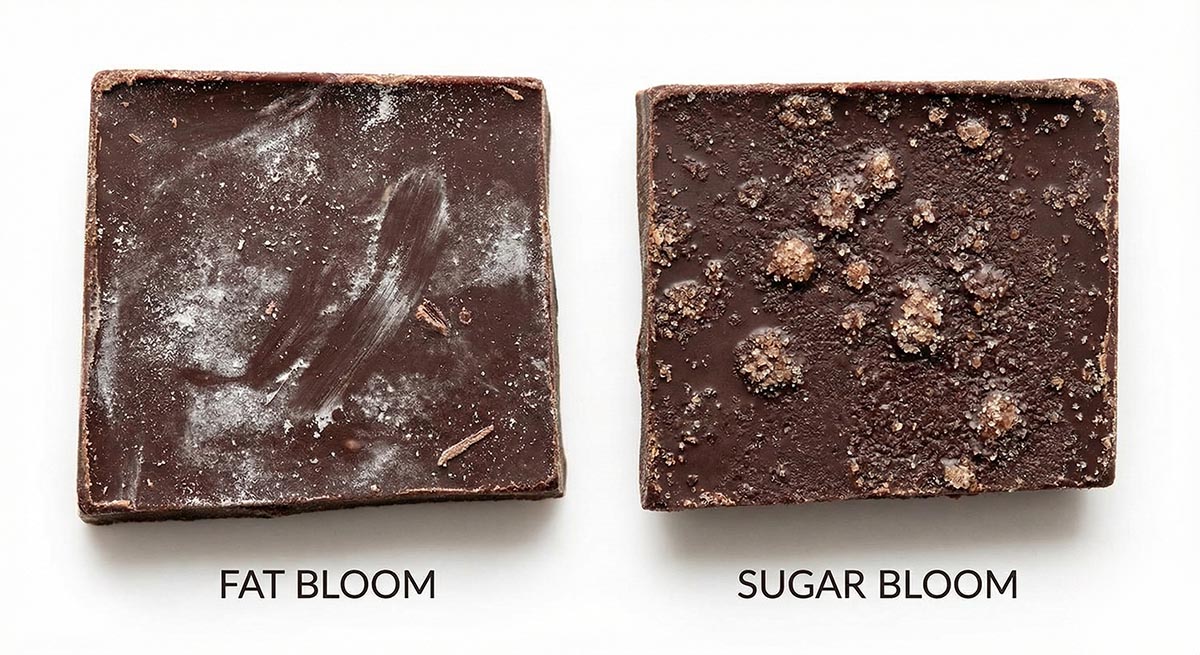
Fat bloom and water bloom (sugar bloom) are caused by completely different mechanisms. Fat bloom is about crystal structure and fat migration. Water bloom is pure physics of condensation and dew point. Each requires different prevention strategies.
Fat Bloom: Crystal Structure and Migration
Fat bloom appears as a whitish-gray film or streaks on chocolate surfaces. It occurs when cocoa butter transitions from the stable βV (beta-5) crystal form into other polymorphic forms, or when fat from fillings migrates to the surface and recrystallizes.
The Physics of Fat Bloom
Cocoa butter exhibits polymorphism - it can crystallize in six different forms (I through VI), each with different melting points and stability. Proper tempering creates Form V (β-V), which gives chocolate its snap, gloss, and stability. When this structure is disrupted, the cocoa butter recrystallizes into less stable forms that appear as bloom.
Target for professional chocolate: ≥80-90% of cocoa butter should be in β-V crystal form after tempering. Below this threshold, fat bloom risk increases significantly.
Risk Factors for Fat Bloom
- Poor Tempering: Incomplete tempering leaves insufficient β-V crystals. Signs include poor snap, matte surface, and soft texture.
- Temperature Fluctuations: Storage temperatures above 18°C or cycles of heating/cooling (>2-3°C variation) accelerate crystal transformation and fat migration.
- Incompatible Fats in Fillings: Nut pastes (hazelnut, almond), praline, and milk fats have different melting profiles than cocoa butter. This incompatibility drives fat migration through the chocolate shell.
- Thin Chocolate Shell: Shells thinner than 1.5 mm allow rapid fat diffusion from fillings to the surface.
- Storage Time: Even perfectly tempered chocolate will eventually develop fat bloom due to slow polymorphic transition. This process accelerates at higher temperatures.
Fat Compatibility Index (CI)
The Compatibility Index quantifies how well filling fats mix with cocoa butter. Lower compatibility means higher migration risk. While exact CI calculation requires specialized equipment, you can assess compatibility through composition:
| Filling Type | Compatibility with Cocoa Butter | Fat Bloom Risk |
|---|---|---|
| Pure chocolate ganache | Excellent | Low |
| Butter-based ganache | Good | Low to Moderate |
| Hazelnut praline | Poor | High |
| Almond paste | Poor | High |
| Milk fat (cream) | Moderate | Moderate |
| Coconut oil fillings | Very Poor | Very High |
Predicting Fat Bloom Risk
While there is no single equation for fat bloom, you can assess risk through controlled testing:
Standard Stability Test
After perfect tempering, store samples at 20-22°C for 24-72 hours. Any graying or streaking indicates formulation or process instability.
Temperature Cycling Test
Subject chocolates to 3 cycles of 12°C ↔ 22°C (12 hours each). This accelerated test reveals migration tendencies that would appear over months of normal storage.
Shell Thickness Verification
Measure shell thickness at multiple points. Maintain minimum 1.5-2.0 mm for filled chocolates with fat-based centers.
Snap and Surface Quality Check
Proper tempering produces a clean snap and glossy surface. Soft chocolate or matte finish indicates inadequate β-V crystal formation.
Water Bloom (Sugar Bloom): Condensation Physics
Water bloom occurs when condensation forms on chocolate surfaces, dissolving surface sugar. When the water evaporates, the sugar recrystallizes into larger, visible crystals that appear as white spots or streaks. Unlike fat bloom, water bloom is entirely preventable through proper humidity and temperature management.
The Dew Point Equation
Water bloom is predictable through dew point calculation. The dew point (Td) is the temperature at which air becomes saturated and water vapor condenses. If chocolate temperature falls below the dew point, condensation is guaranteed.
Dew Point Calculation (Magnus-Tetens Formula)
Td = (b × α) / (a - α) Where: α = ln(RH/100) + (a × T)/(b + T) a = 17.27 (constant) b = 237.7°C (constant) T = air temperature (°C) RH = relative humidity (%) Critical Rule: If T_chocolate < T_dew → Condensation WILL occur
Real-World Example
Scenario: You remove boxed chocolates from refrigerated storage (8-10°C) into a room at 22°C with 60% relative humidity.
Calculate Dew Point
At 22°C and 60% RH, the dew point is approximately 14°C.
Compare Chocolate Temperature
Your chocolate is at 8-10°C (below the 14°C dew point).
Result
Condensation WILL form on the chocolate surface. This dissolved sugar will recrystallize as water bloom when the moisture evaporates.
| Air Temperature (°C) | Relative Humidity (%) | Dew Point (°C) | Safe Chocolate Temp (°C) |
|---|---|---|---|
| 20 | 50 | 9.3 | > 10 |
| 20 | 60 | 12.0 | > 13 |
| 20 | 70 | 14.4 | > 15 |
| 22 | 50 | 11.1 | > 12 |
| 22 | 60 | 13.9 | > 14 |
| 22 | 70 | 16.3 | > 17 |
| 24 | 50 | 12.9 | > 13 |
| 24 | 60 | 15.7 | > 16 |
| 24 | 70 | 18.1 | > 18 |
Dew Point Reference Table
Critical Warning
Any "sweating" or "fogging" on chocolate surfaces—100% water bloom risk. This is most common when unpacking cold boxes in warm, humid environments.
Fat Bloom vs Water Bloom: Direct Comparison
| Characteristic | Fat Bloom | Water Bloom |
|---|---|---|
| Cause | Cocoa butter polymorphic transition or fat migration | Condensation dissolving surface sugar |
| Appearance | Gray-white film, streaks, or dull surface | White spots, crystals, or patches |
| Touch | Slightly greasy, can be wiped off temporarily | Grainy, crystalline texture |
| Predictability | Complex - multiple interacting factors | Highly predictable via dew point calculation |
| Time to Develop | Days to months | Minutes to hours (if condensation occurs) |
| Primary Prevention | Proper tempering, storage temperature control, fat barriers | Temperature equilibration before unpacking, humidity control |
| Reversibility | Can be re-tempered (melting required) | Cannot be reversed without reprocessing |
Practical Prevention Strategies
Preventing Fat Bloom
- Perfect Tempering: Maintain working temperature within ±0.5°C. For dark chocolate: 31-32°C, milk chocolate: 29-30°C, white chocolate: 27-28°C.
- Stable Storage: Store at 14-18°C with <2°C daily variation. Avoid temperature cycling.
- Fat Barrier Layer: For incompatible fillings, create a barrier of tempered chocolate or cocoa butter between filling and shell.
- Adequate Shell Thickness: Maintain minimum 1.5-2.0 mm for filled products.
- Formulation Optimization: When using nut pastes or high-fat fillings, increase shell thickness or use cocoa butter-based barrier coatings.
- Regular Quality Checks: Implement snap test and visual inspection at production and throughout shelf life.
Preventing Water Bloom
- Temperature Equilibration: Allow packaged chocolate to warm to room temperature BEFORE opening. Typical time: 2-4 hours for boxes, longer for pallets.
- Humidity Control: Maintain production and storage areas at ≤50% RH when possible.
- Calculate Before Unpacking: Use the dew point formula before removing chocolate from cold storage.
- Sealed Packaging: Keep chocolate sealed during temperature equilibration to prevent air contact.
- Climate Control: Install dehumidifiers in packaging and storage areas in humid climates.
- Staff Training: Educate all handlers about the risk of condensation when handling cold chocolate.
Key Insight
Water bloom is nearly 100% preventable through discipline and dew point awareness. Fat bloom requires both good process control AND appropriate formulation.
Frequently Asked Questions
Scientific References
- Beckett, S. T. (2009). Industrial Chocolate Manufacture and Use (4th ed.). Wiley-Blackwell.
- Talbot, G. (2009). "Chocolate Temper." In Industrial Chocolate Manufacture and Use (pp. 261-285).
- Lonchampt, P., & Hartel, R. W. (2004). "Fat bloom in chocolate and compound coatings." European Journal of Lipid Science and Technology, 106(4), 241-274.
- Altimiras, P., et al. (2007). "Fat bloom in chocolate: Relationship with fat migration." Journal of Food Engineering, 78(4), 1410-1418.
- Afoakwa, E. O., et al. (2008). "Factors influencing rheological and textural qualities in chocolate." Food Research International, 41(3), 280-288.
- Hartel, R. W. (2001). Crystallization in Foods. Aspen Publishers.
- Magnus-Tetens formula for dew point approximation (widely used in meteorology and industrial applications).
Related Articles
Related Topics
Related Articles
Cocoa Butter Polymorphism: Why Chocolate Coating Needs Proper Tempering
Explore the six crystal forms of cocoa butter, understand why Form V is the professional target, and master the tempering process for perfect gloss, snap, and bloom-resistant coatings.
Confectionery Aging: Understanding How Your Products Change Over Time
A comprehensive guide to the science of confectionery aging. Learn how quality degrades through microbial, chemical, and physical mechanisms, and how to predict product shelf life using validated mathematical models.
Moisture Migration in Confectionery: Fick's Law and Shelf Life
How water moves through confectionery products and packaging over time, following Fick's Law of diffusion. Learn to predict moisture changes, water activity shifts, and optimize packaging to maximize shelf life.