Confectionery Aging: Understanding How Your Products Change Over Time
A comprehensive guide to the science of confectionery aging. Learn how quality degrades through microbial, chemical, and physical mechanisms, and how to predict product shelf life using validated mathematical models.
What Is Confectionery Aging?
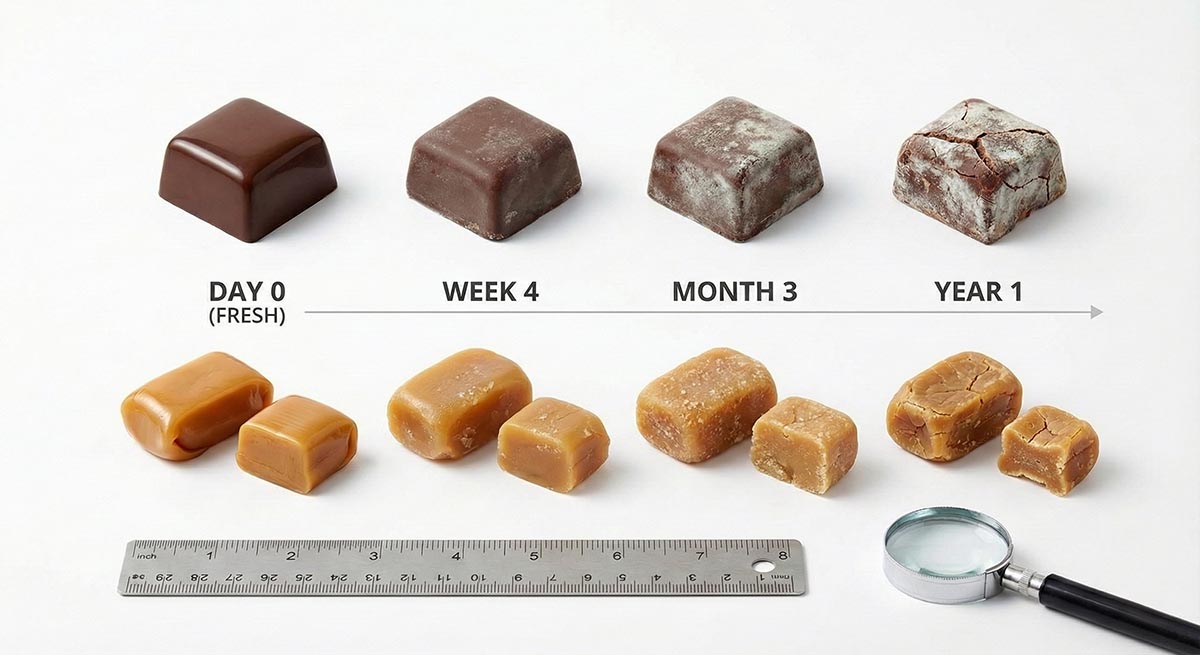
Confectionery aging is the cumulative effect of time-dependent physical, chemical, and microbiological changes that transform a freshly made product into one that no longer meets quality or safety standards. Understanding these mechanisms is essential for predicting shelf life and designing stable formulations.
When you create a ganache, caramel, or pâte de fruit, you're creating a thermodynamically unstable system. The moment production ends, multiple degradation pathways begin competing to reduce your product's quality. Some work quickly (microbial growth in high-moisture products), others slowly (fat oxidation in chocolate), but all follow predictable kinetics that we can model mathematically.
The Formul.io Aging Simulator uses peer-reviewed scientific models to predict how your specific formulation will age under different storage conditions. This isn't guesswork—it's applied food science based on decades of research from institutions like the Institute of Food Technologists, Cornell University, and the Cocoa Research Centre.
The Four Mechanisms of Confectionery Aging
All confectionery products age through four primary mechanisms. The relative importance of each depends on your product's composition, water activity, and storage conditions.
1. Microbial Growth
Microorganisms—bacteria, yeasts, and molds—require available water to grow. This is measured by water activity (aw), not moisture percentage. A ganache with 25% water but high sugar content might have aw = 0.82, which is safe from most bacteria but vulnerable to molds after 2-3 weeks at room temperature.
| Organism Type | Minimum aw | Risk in Confectionery |
|---|---|---|
| Most bacteria | 0.91 | Rare except in very wet products |
| Most yeasts | 0.88 | Fresh cream ganaches at risk |
| Most molds | 0.80 | Primary concern for confections |
| Xerophilic molds | 0.65 | Threat to even 'dry' products |
| Osmophilic yeasts | 0.60 | Extreme conditions only |
Minimum Water Activity for Microbial Growth (Beuchat, 1981)
Critical Threshold: Products with aw > 0.85 are at significant risk of mold growth within 7-14 days at room temperature. Our simulator flags this as a critical risk and recommends refrigeration or reformulation.
2. Sugar Crystallization
Sugar crystallization is the gradual formation of gritty sucrose crystals in ganache, caramels, and fondants. It occurs when sucrose exceeds its solubility limit—a state called supersaturation. As water slowly evaporates or migrates, supersaturation increases, eventually triggering nucleation and crystal growth.
The risk depends on several factors: sugar-to-water ratio, presence of crystallization inhibitors (glucose, fructose, invert sugar), temperature cycling, and time. According to Hartel's Crystallization in Foods (2001), maintaining at least 15-20% of total sugar as invert or glucose effectively suppresses crystallization for months.
Crystallization rate increases with the square of supersaturation level, making formulation optimization crucial for long shelf life.
3. Fat Oxidation & Rancidity
Fats in chocolate, cream, and nuts undergo oxidation—a chain reaction that produces off-flavors described as 'stale,' 'cardboard,' or 'painty.' This is catalyzed by heat, light, and oxygen exposure. Dark chocolate is naturally more resistant (contains antioxidant polyphenols), while white chocolate and nut-based products are vulnerable.
Frankel's Lipid Oxidation (2005) documents that oxidation rate roughly doubles with each 10°C temperature increase (Q10 ≈ 2.0) and triples with direct light exposure compared to dark storage. This is why premium chocolates are sold in opaque packaging and stored cool.
4. Fat Bloom & Texture Changes
Fat bloom—the whitish coating that appears on aged chocolate—results from cocoa butter migration and recrystallization on the surface. It's accelerated by temperature cycling: when chocolate warms, some fat melts and migrates; when it cools, the fat recrystallizes in unstable forms on the surface.
The optimal storage temperature for chocolate is 15-18°C with minimal fluctuation. Above 22°C, fat migration accelerates dramatically. Our simulator models this through a temperature-dependent bloom risk function based on Talbot's Science and Technology of Enrobed and Filled Chocolate (2009).
The Quality Degradation Model
Our aging simulator combines all four mechanisms into a unified quality score that decreases over time. This isn't arbitrary—it's based on first-order kinetics, the same mathematical framework used throughout food science (Labuza, 1984).
Where Q(t) is quality at time t, Q₀ is initial quality (100%), and k is the degradation rate constant. Higher k means faster aging.
The degradation rate constant k is not fixed—it varies with storage conditions. Higher temperatures increase k (Arrhenius relationship). Higher humidity increases k for moisture-sensitive products. Poor packaging increases k by allowing oxygen and moisture exchange. The simulator calculates k for each day based on your specified conditions.
Industry convention defines 'end of shelf life' as 70% of initial quality—the point where trained sensory panels consistently detect degradation. Our simulator predicts when your product will cross this threshold under specified storage conditions.
How Different Products Age
Ganache
Ganache is particularly complex because it combines all four degradation mechanisms. The high water content (typically 15-25%) means microbial risk is significant. The fat from chocolate and cream is susceptible to oxidation. Sugar can crystallize as moisture migrates. And the cocoa butter can bloom if temperature cycles.
| Ganache Type | Room Temperature (18-20°C) | Refrigerated (4°C) |
|---|---|---|
| Dark 2:1 (choc:cream) | 14-21 days | 42+ days |
| Dark 3:1 (firm) | 28-35 days | 60+ days |
| Milk chocolate 2:1 | 7-14 days | 28-42 days |
| White chocolate 2:1 | 5-7 days | 21-28 days |
Typical Ganache Shelf Life (BCCCA, 2004)
Caramel
Caramels are relatively stable due to their high sugar content and low water activity (typically aw 0.55-0.70). The primary aging concern is crystallization—sucrose becoming gritty over time. This is prevented by including glucose syrup or invert sugar to disrupt crystal lattice formation. Moisture pickup from humid air can also accelerate softening.
Pâte de Fruit
Pâte de fruit jellies age primarily through moisture loss, which causes surface hardening and eventually cracking. The pectin gel structure is stable, but the surface-to-volume ratio means small pieces lose moisture faster. Proper packaging (low WVTR) and controlled humidity storage extend shelf life significantly.
Ice Cream & Gelato
Frozen products age through ice crystal growth (coarsening), lactose crystallization (sandy texture), and fat destabilization. Temperature fluctuations are the enemy—each freeze-thaw cycle grows larger ice crystals. Stabilizers (guar, locust bean gum) slow but don't prevent this process.
Using the Formul.io Aging Simulator
Our aging simulator is integrated into each calculator. After calculating your formulation's metrics (water activity, composition, etc.), you can open the aging simulation to see how quality evolves over time under different storage conditions.
Calculate your formulation
Enter your ingredients and calculate. The calculator determines initial water activity, sugar percentage, fat percentage, and other parameters needed for aging prediction.
Open the Aging Simulator
Click 'Simulate Aging' in the results panel. The simulator loads your formulation's calculated metrics.
Configure storage conditions
Set temperature (0-35°C), relative humidity (30-95%), packaging quality (excellent/standard/basic), and light exposure (none/low/high). Use presets for common scenarios: Room Temperature, Refrigerated, or Warm Climate.
Analyze the results
The chart shows quality and water activity over time. Risk markers flag when specific issues (mold, crystallization, bloom) become likely. The predicted shelf life shows when quality drops below 70%.
Pro Tip: Compare different storage scenarios. A ganache that lasts 14 days at room temperature might last 45 days refrigerated—the chart makes this tradeoff quantitatively clear.
Strategies for Optimizing Shelf Life
- Lower water activity: Increase sugar-to-water ratio, use polyols, add alcohol. Target aw < 0.80 for room-temperature stability.
- Include crystallization inhibitors: Replace 15-25% of sucrose with glucose syrup or invert sugar to prevent graininess.
- Optimize storage temperature: 16-18°C is ideal for chocolate products—cold enough to slow reactions, warm enough to avoid condensation.
- Use appropriate packaging: Low-WVTR films (metallized, vacuum-sealed) prevent moisture exchange with environment.
- Minimize light exposure: Store in opaque containers or dark storage to reduce oxidation rate 60-70%.
- Control temperature fluctuations: Stable temperature prevents fat bloom and moisture condensation cycles.
Frequently Asked Questions
Related Topics
Related Articles
Temperature & Shelf Life: The Arrhenius Equation in Confectionery
How temperature accelerates confectionery aging through the Arrhenius equation and Q10 model. Learn why storing chocolate at 25°C instead of 18°C can halve your product's shelf life, with the mathematics to prove it.
Moisture Migration in Confectionery: Fick's Law and Shelf Life
How water moves through confectionery products and packaging over time, following Fick's Law of diffusion. Learn to predict moisture changes, water activity shifts, and optimize packaging to maximize shelf life.
Water Activity in Ganache: The Science Behind Shelf Life Prediction
How Formul.io's Ganache Calculator uses the Day & Govaerts model and advanced corrections to predict water activity with ±0.015 precision, ensuring optimal shelf life and product stability.