Chewy Caramel: The Texture Formula
A scientifically balanced caramel recipe designed for the perfect chew. Learn how glucose DE and cooking temperature control the final texture.
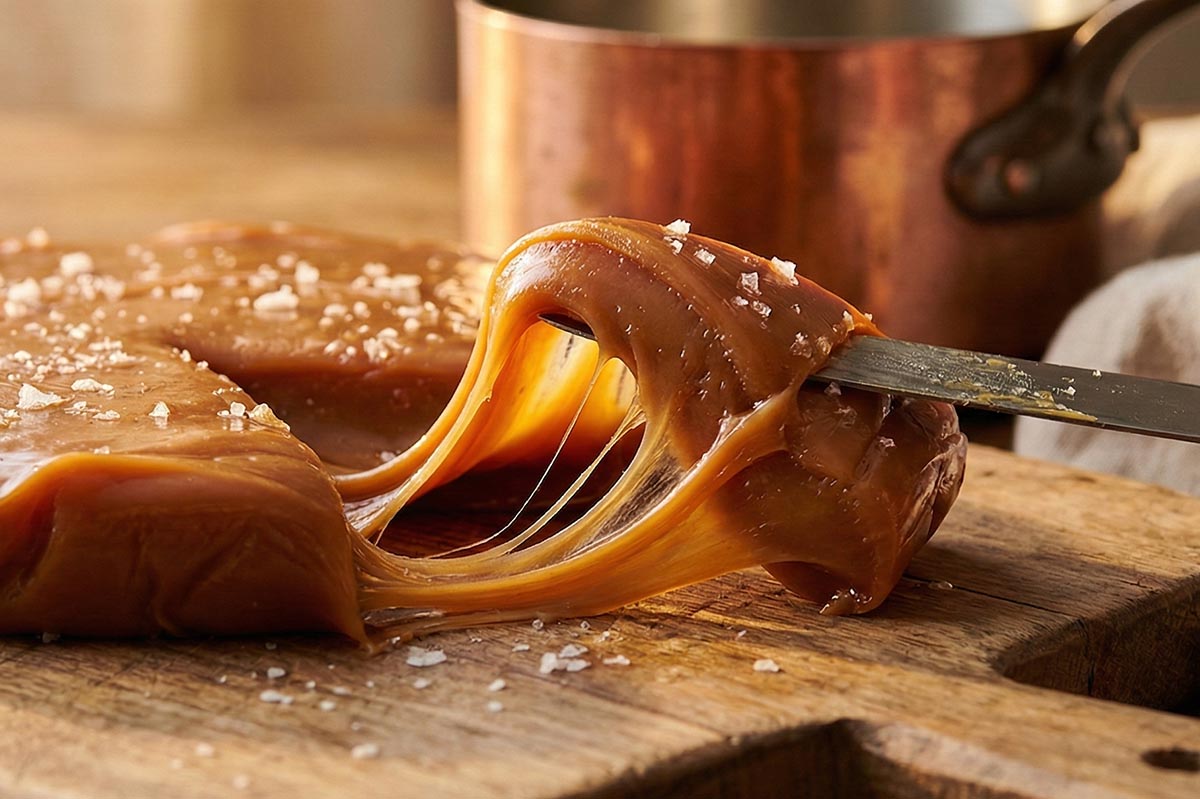
The Physics of Chewiness
Chewiness in caramel is a mechanical property defined by the resistance to deformation and the elasticity of the sugar-protein matrix. It is controlled by three main factors: Residual Moisture (cooking temperature), Doctoring Agents (Glucose DE), and Fat Phase (emulsion).
Target Metrics: - Water Activity (Aw): 0.60 – 0.75 (typical for chewy caramel cooked to soft ball stage; exact value depends on actual residual moisture — verify with Aw meter for shelf-life decisions) - Cooking Temp: 118°C (Soft ball stage) - Glucose DE: 40 (Provides body and elasticity)
The Formula
| Ingredient | Quantity (g) | % | Function |
|---|---|---|---|
| Sugar (Sucrose) | 200 | 33% | Sweetness, Structure |
| Glucose Syrup DE 40 | 200 | 33% | Prevents crystallization, adds body |
| Heavy Cream (35%) | 180 | 30% | Fat, Moisture, Flavor |
| Butter (82%) | 20 | 3% | Mouthfeel, Flavor |
| Salt (Fleur de Sel) | 2 | 0.3% | Flavor enhancer |
| Vanilla Bean | 1 | - | Aroma |
Process
Infusion
Heat cream with vanilla bean. Let infuse for 15 mins.
Sugar Cooking
In a copper pot, combine sugar and glucose syrup. Cook to 155°C (light amber) for flavor development (Maillard reaction).
Deglazing
Warm the infused cream. Slowly pour into the caramel to stop cooking. Caution: Mixture will bubble violently.
Final Cooking
Cook the mixture again, stirring constantly, until it reaches exactly 118°C.
Emulsification
Remove from heat. Cool to 80°C. Add butter and salt. Emulsify with an immersion blender.
Setting
Pour into a frame (16x16cm). Let set for 24 hours at 18°C before cutting.
Why This Works
Related Articles
Chewy Salted Caramel: Formulating for Target Texture Using the Caramel Calculator
Step-by-step walkthrough of the Formul.io Caramel Calculator for a 663g chewy salted caramel batch. Covers Brix targets, Aw prediction, texture control, and the full cooking process from 155°C to 119°C.
Almond Dragée: Building a Multi-Layer Coating from Core to Finish
A complete production guide to multi-layer sugar panning for almond dragée: gum arabic sealing, 20–30 engrossing layers, smoothing, coloring, and final polish — with calculator walkthrough.
Dark Chocolate Truffle Ganache: A Step-by-Step Calculator Walkthrough
Learn to formulate a shelf-stable dark chocolate truffle ganache (Aw 0.75) using the Formul.io calculator. Covers ingredient entry, metric interpretation, and process control for a 21-day ambient shelf life.